
Dozens of books were published about Leiji Matsumoto in his lifetime. Many of them attempted to catalog and analyze his enormous output of manga and anime projects, but a few were devoted to the man himself to explore the biographical origins of his unique talents. Presented here are excerpts from two of them and a collection of photos from others.
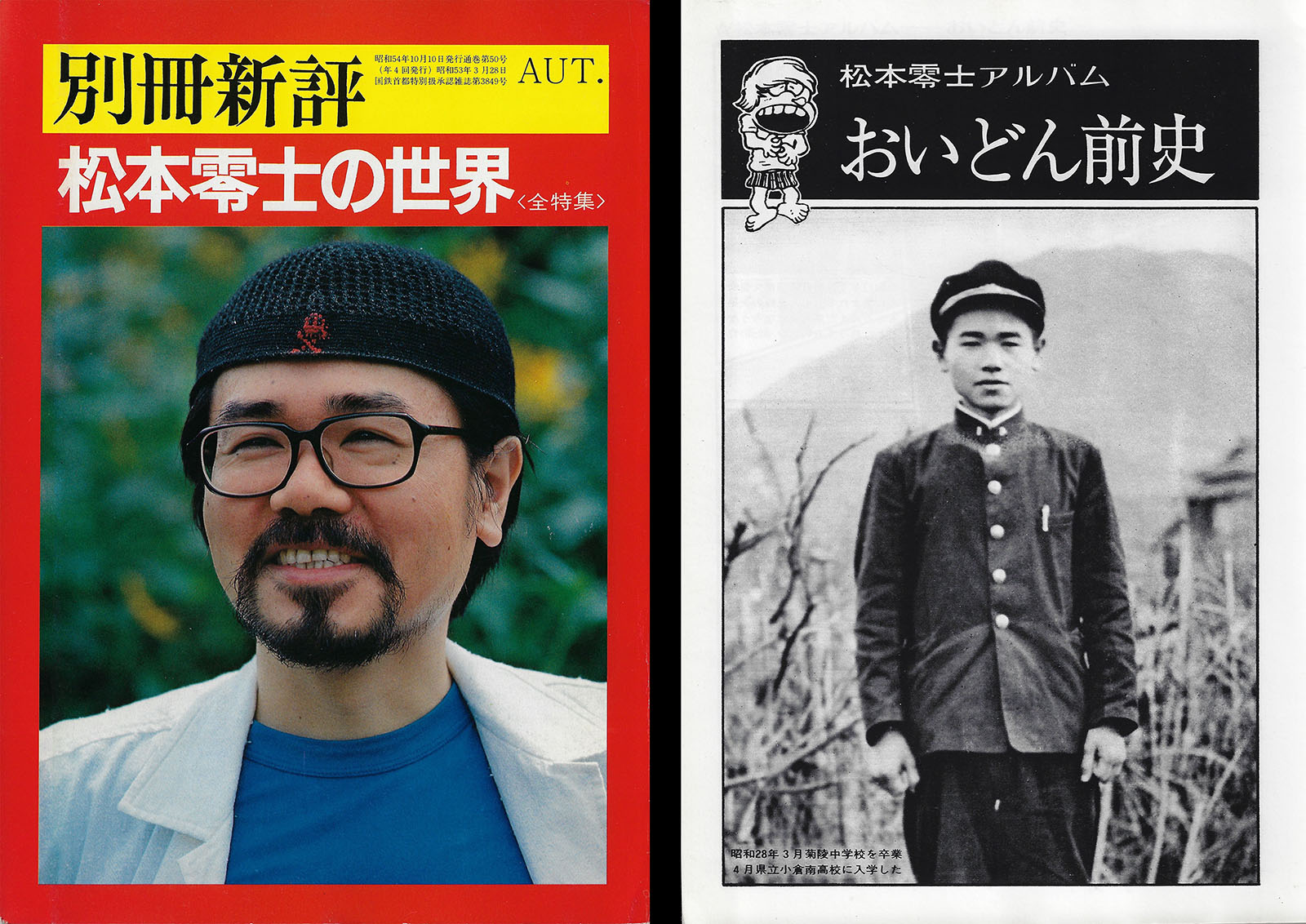
New Review Spinoff Special
The World of Leiji Matsumoto
別冊新評 松本零士の世界
226 pages, b&w
New Review Co., 1979
An extensive look at Matsumoto’s manga career from the beginning up to the time of publication with an interview and analysis of key titles. Mostly text with selected illustrations. Includes a mini-encyclopedia and index list of titles.
The book opened with five pages of photographs, all of which are seen here. The section was titled Leiji Matsumoto Album, Oidon Prehistory. The first caption reads: “Graduated from Kikuryo Junior High School in March 1953 and entered Kokuraminami Prefectural High School in April.”
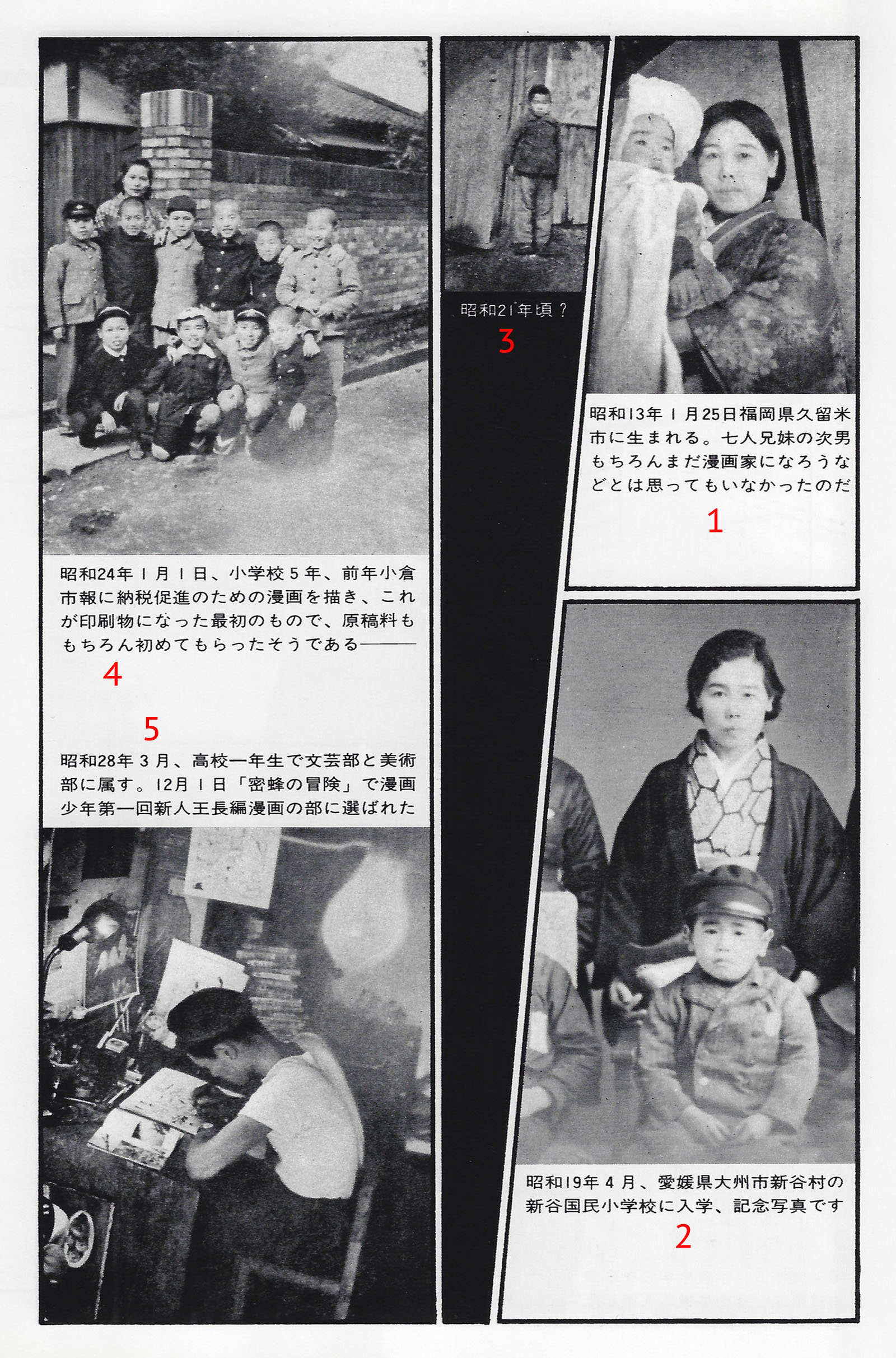
1. Born on January 25, 1938 in Kurume City, Fukuoka Prefecture. The second son of seven siblings, he never thought about becoming a manga artist
2. A commemorative photo of entering Shintani Elementary School in Shintani Village, Ozu City, Ehime Prefecture in April 1944.
3. Around 1946?
4. On January 1, 1949, when he was in the fifth grade of elementary school, he drew a cartoon for the Kokura City Newsletter to encourage tax payment. This was his first work to be published in print, and of course it was the first time he was paid.
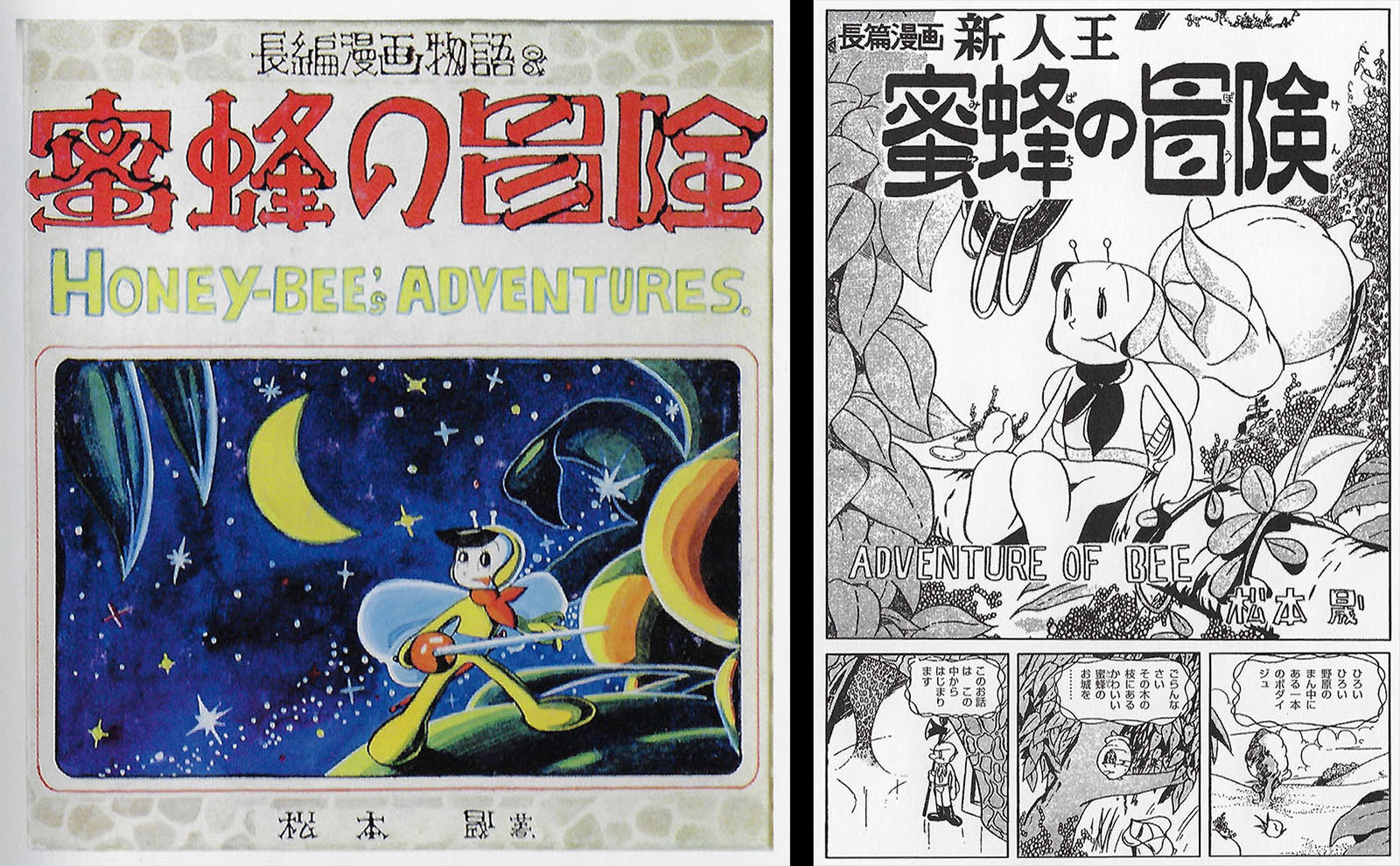
5. In March 1953, as a first-year high school student, he joined the literature club and the art club. On December 1, he was selected as the first newcomer of the year by Manga Shonen magazine in the long-form manga category for The Adventures of a Honeybee.
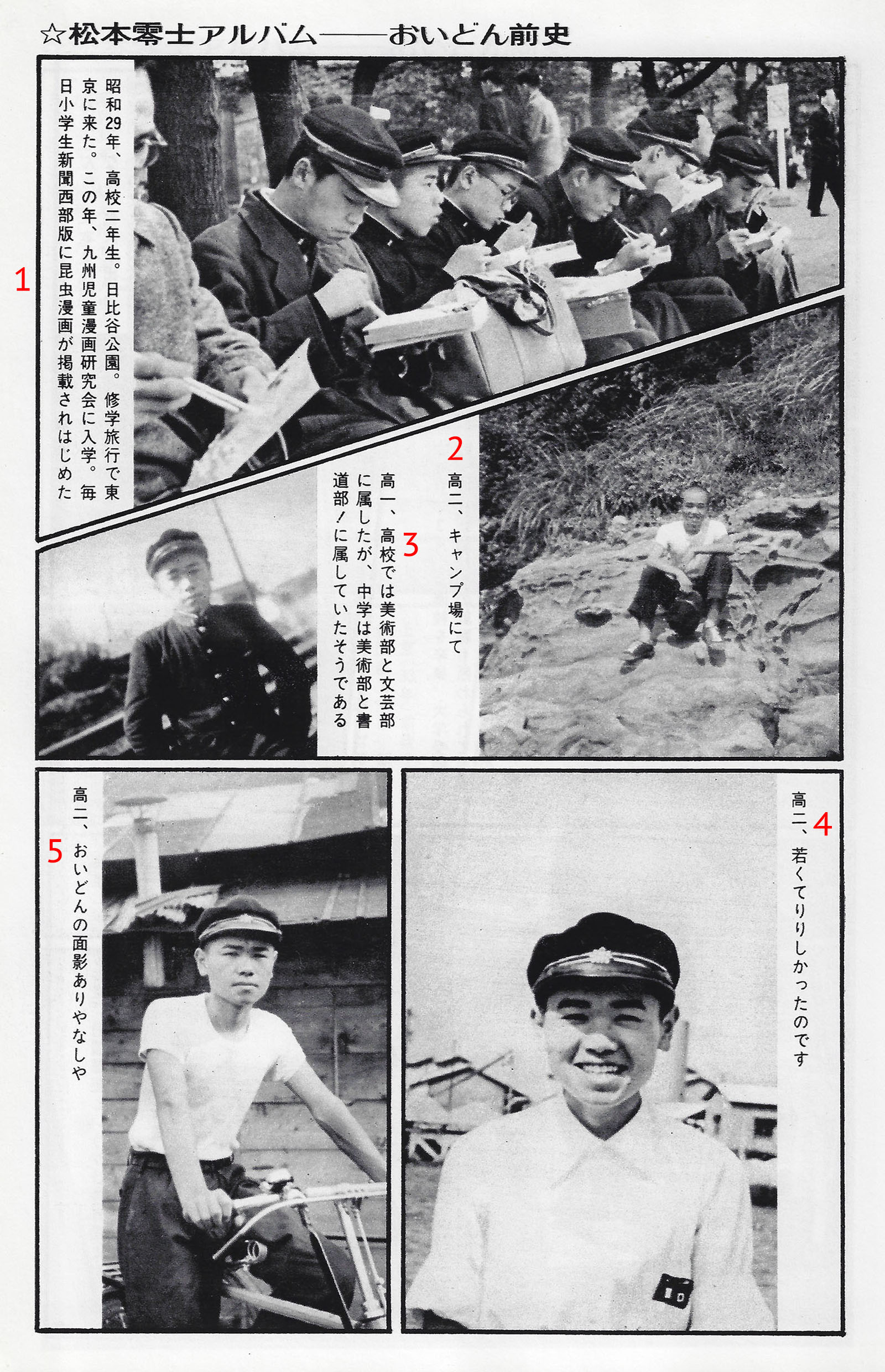
1. 1950, second year high school student, Hibiya Park. On a school trip to Higashi, he came to Kyoto. That same year, he helped form in the Kyushu Children’s Manga Research Group. His insect cartoons began to appear in the western edition of the Mainichi Elementary School newspaper.
2. Second year of high school, at the campsite.
3. First year of high school, art club and literature club. In junior high, he joined the art club and calligraphy club.
4. A young and dignified second-year high school student.
5. Second year of high school, starting to become himself.
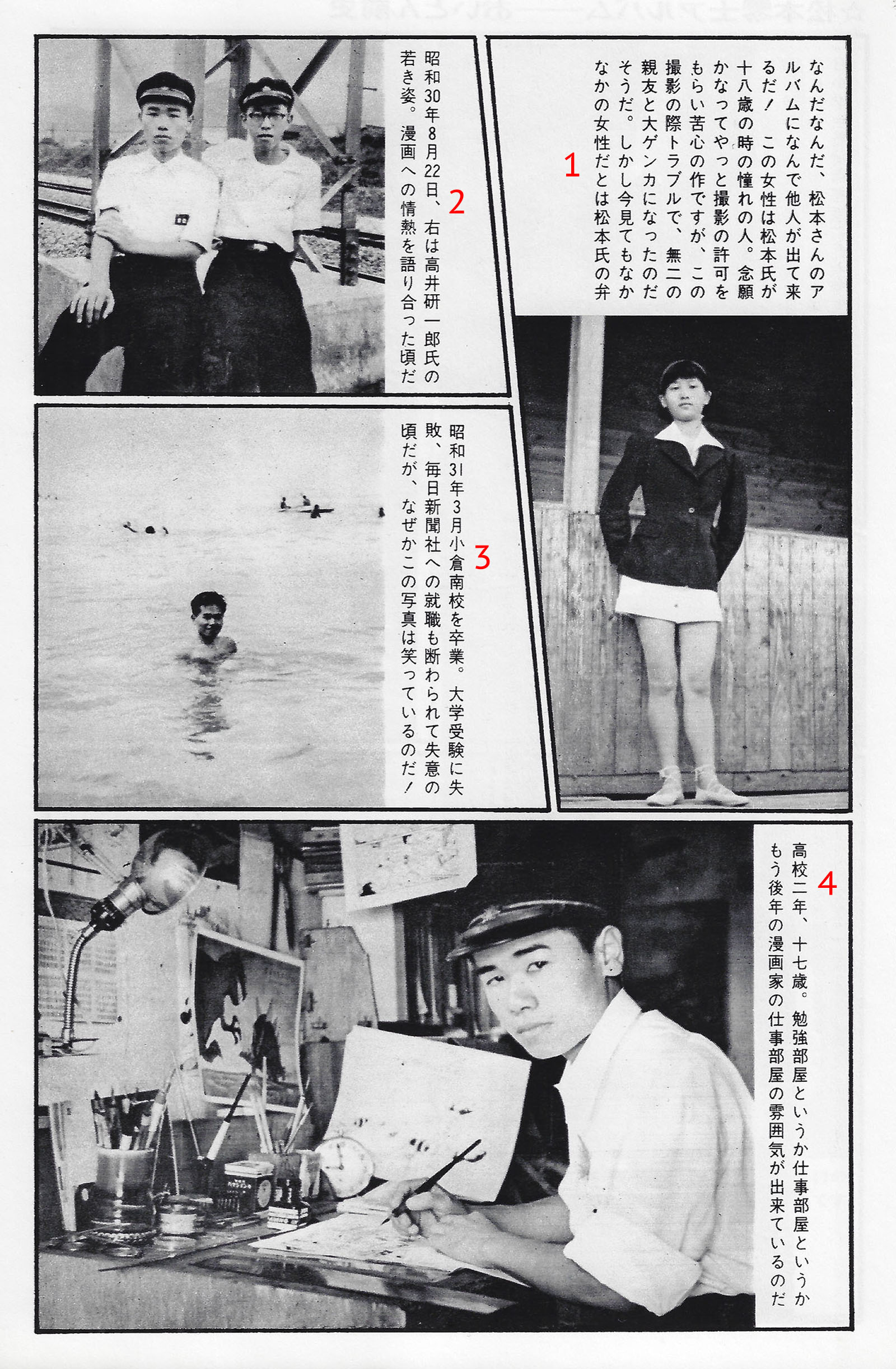
1. What’s going on? Why is someone else appearing in Matsumoto’s photo album? This woman is someone he liked when he was 18 years old. He finally got permission to photograph her and worked hard at it, but apparently there was some trouble during the shoot and he got into a huge fight with his best friend. However, Matsumoto says that even now, she is quite a woman.
2. On August 22, 1955, the young Kenichiro Takai (right) was talking about his passion for manga.
3. In 1958, disappointed after being rejected for a job at the Mainichi Newspaper company, he graduated from Kokura Minami High School in March.
4. Second year high school student, 17 years old. It was a study, or rather a work room, and it already had the atmosphere of a manga artist’s studio.
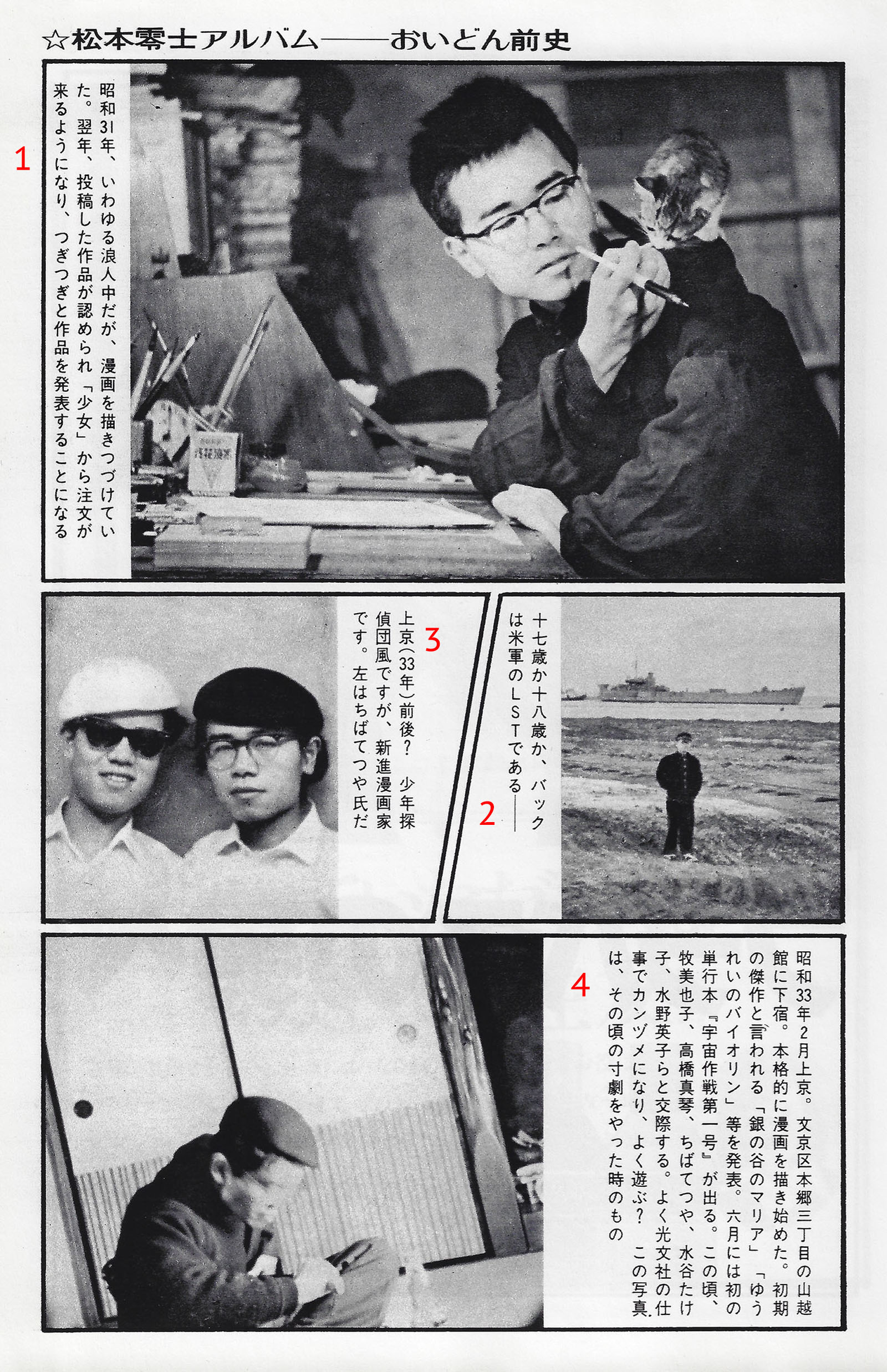
1. In 1956, he was a ronin (masterless samurai), but he continued to draw manga. The following year, his submitted works were recognized, and he began receiving orders from Shojo magazine, which published one work after another.
2. At age 17 or 18, a US army LST (Landing Ship, Tank) in the background…
3. Around the time he moved to Tokyo in 1958. He had a boy-detective style, but he was a budding manga artist. On the left is Tetsuya Chiba.
4. He moved to Tokyo in February 1958. He lived in a boarding house called Yamakoshikan in Hongo 3-chome, Bunkyo Ward. He began drawing manga in earnest, publishing such works as Maria of the Silver Valley and The Ghost Violin, which are considered his early masterpieces. In June, his first book Space Operation No. 1 was published. Around this time, he became acquainted with Miyako Maki, Makoto Takahashi, Tetsuya Chiba, Takeko Mizutani, and Eiko Mizuno. He was often confined to his work for Kobunsha Publishing, but also enjoyed acting. This photo was taken as he was performing a skit.
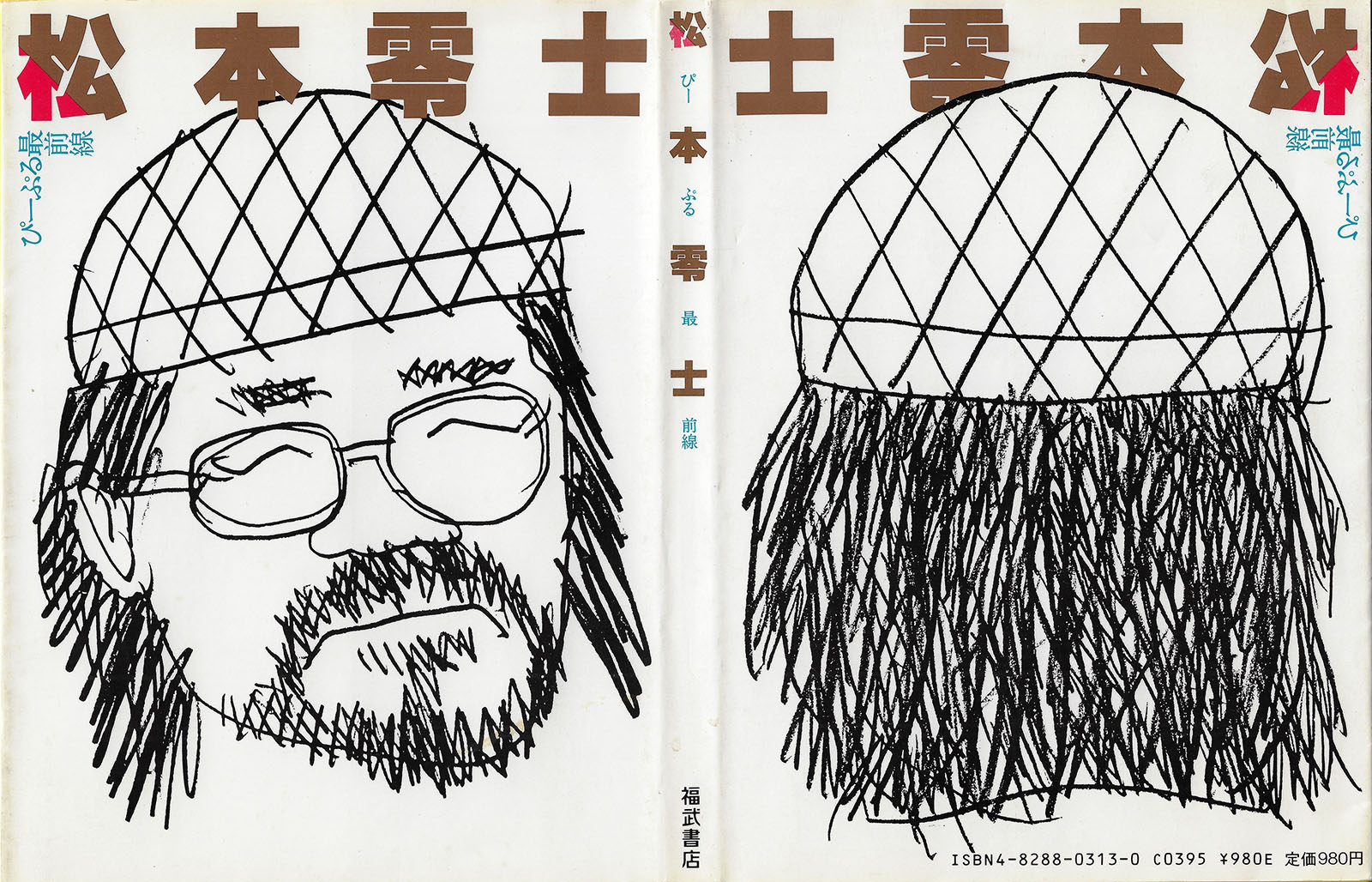
Frontline People, Leiji Matsumoto
ぴーぷる最前線 松本零士
189 pages, b&w
Fukutake Shoten, 1983
A collection of interviews, career analysis, and biographical pieces, heavily supported by photos and illustrations that captured the life of Matsumoto at 45 years old. The penultimate chapter of this book is presented here.
Document
Space Battleship Yamato, 999 Launch
Written by Kentaro Onishi
Illustrations by Noritaka Fukuda
(Photos and manga were sourced from other books)
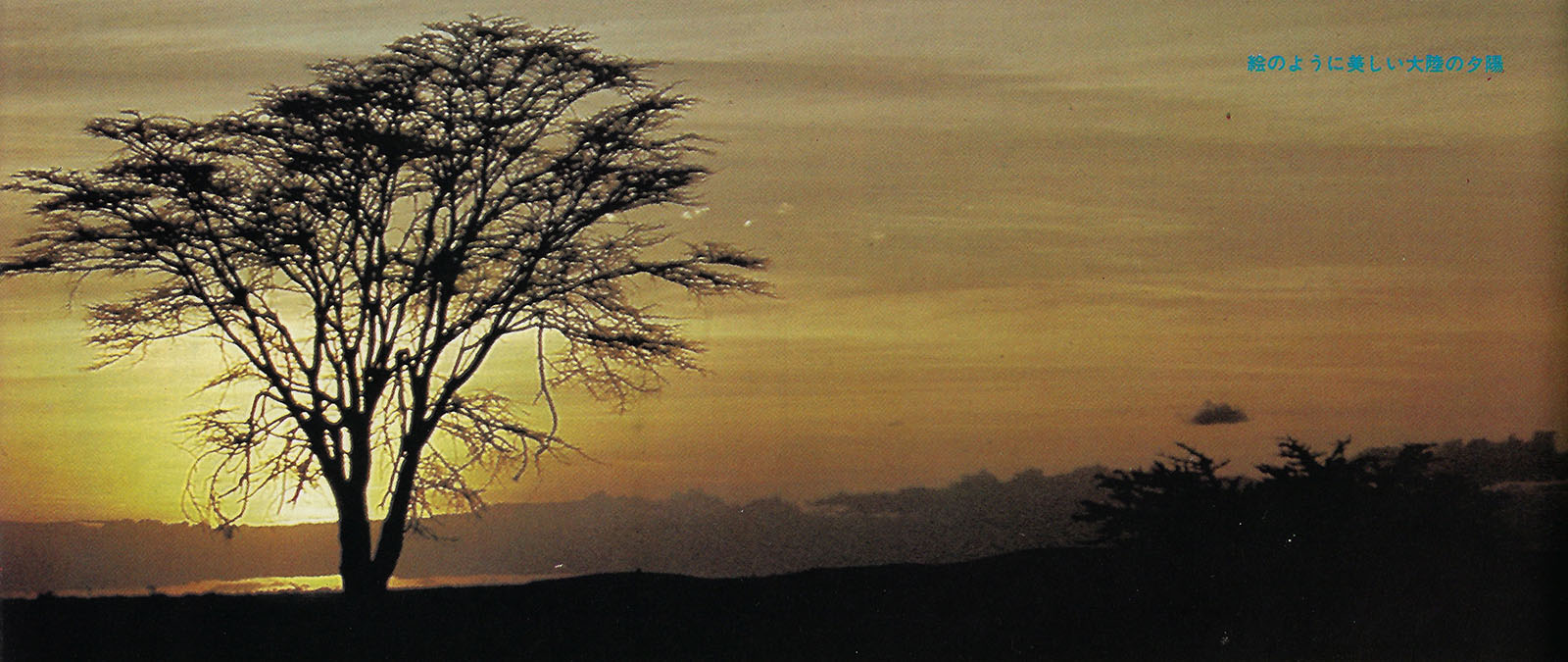
The blood of an antelope spurted onto the savanna
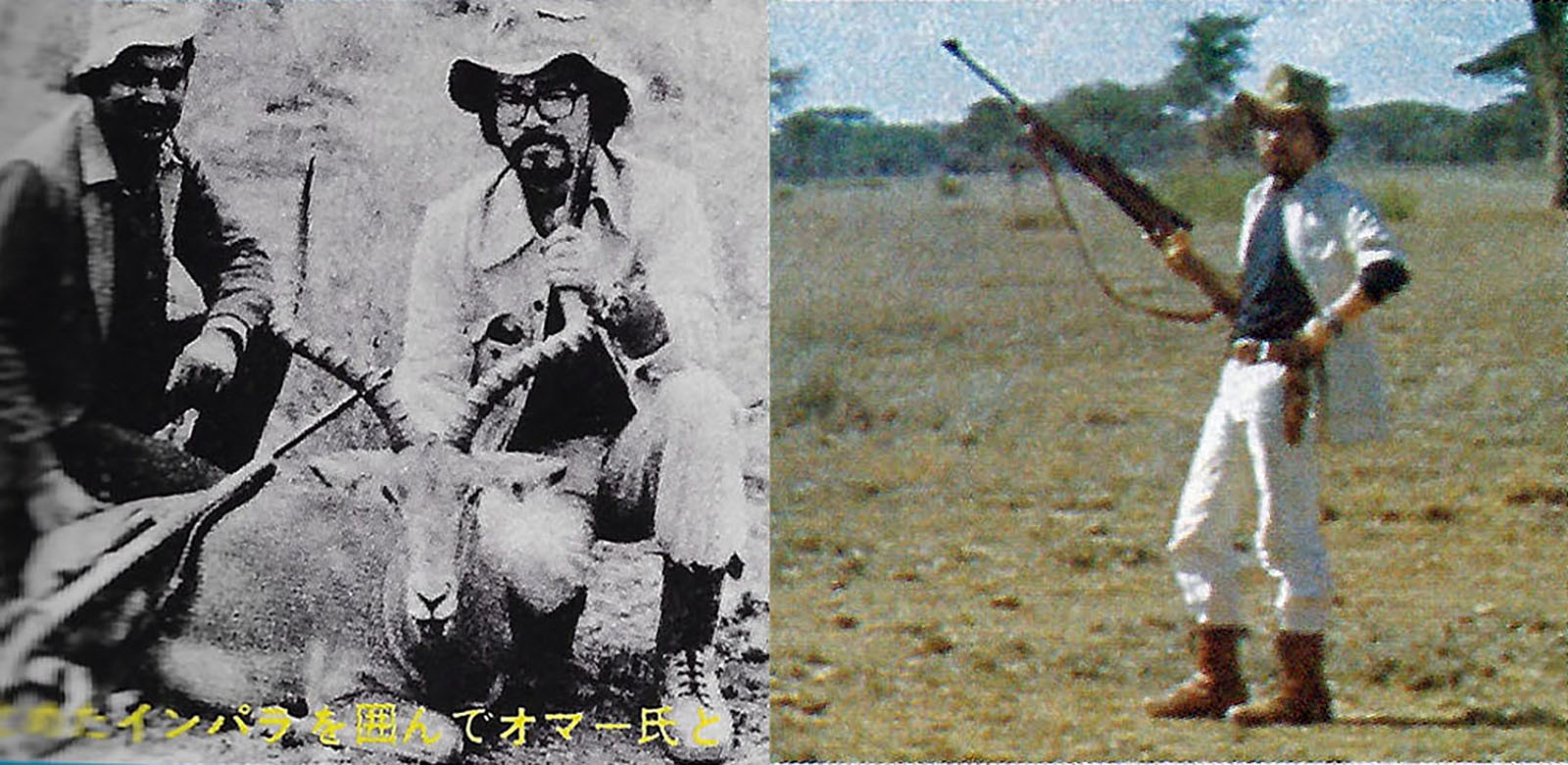
Autumn 1976. Leiji Matsumoto (real name Akira Matsumoto) left Japan and went to Kenya in Africa with only a rifle.
Nairobi, the capital of Kenya. The town was lined with modern white buildings and an engrossing blue sky stretched overhead. In this diverse town, there were Americans, French, and Alaskans walking along the beautiful street lined with trees. There were local street vendors selling wood, carvings and colorful stone ornaments to tourists. People from various countries lived here.
Once you stepped outside the town, the vast African landscape stretched out beyond the horizon. The air was clear, the grass was dry, and the smell of earth filled the air of the red land of Africa. There was a blazing heat in the breath of nature. The frustration that had been building up in Leiji’s heart when he left Japan disappeared as soon as he came into contact with the African air.
At the same time, Leiji recognize realized how insignificant his feelings were.
Along with manga, anime was his dream. He had a strong desire to turn his dreams into anime, and so he decided to make and submit proposals for Galaxy Express and Captain Harlock to a television company. But they didn’t go anywhere. It was a shock because he was absolutely confident in the work. This is an obstacle creators inevitably face. There are plenty of cases where a company rejected a TV adaptation of a work that the creator was confident in, but it was later picked up and became a hit.
However, the intense anger he felt at not being understood could only be resolved by venting it on something. He sought a location in the African continent where the scent of the primitive world hangs in the air.
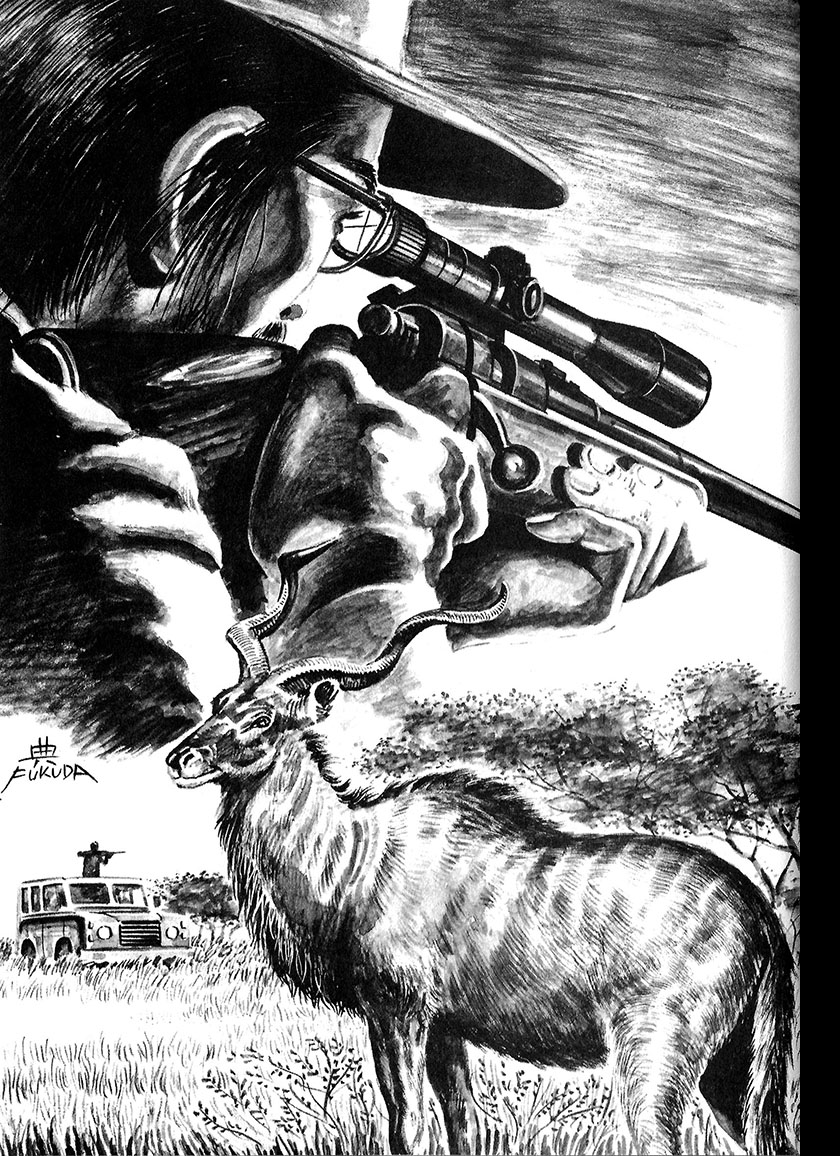
The next day, after unpacking at the hotel in Nairobi, Leji hired an African guide of Ethiopian descent. The guide spoke English, but Leiji’s English was broken. Still, they managed to communicate. Clad in matching jackets, Leiji and his guide raced across the African wilderness in a land cruiser.
Suddenly, a herd of zebras crossed in front of the car, and to their right, several giraffes ran past. Then the guide shouted, “there’s an antelope among the bushes on the left. It’s within firing range at this distance. Shoot quickly.”
Leiji had often fired rifles at shooting ranges in Japan, but had never from the top of a moving car. He aimed the cross hairs of the telescopic viewer viewfinder at the antelope. He held his breath. An overwhelming sense of tension ran through his whole body, and his mouth was completely dry.
His finger was sweaty on the rifle’s trigger. That’s when he pulled it. A gunshot rang out in the dry air. In the distance, he saw the antelope collapse, spurting blood like a fountain.
“Bingo!” The guard cheered. The car turned around and headed toward the antelope.
The antelope Leiji had killed with one shot laying in a pool of blood. The bullet had hit its heart. It was the first time he shot a live animal, and he was in shock. As regret, self-blame, and sentimentality weighed on Leiji’s heart, he realized that he could never be a hunter. Several vultures had gathered in the sky above, searching for the corpse.
Before long, night fell. Leiji set up the tent together with the guide. In the clear night sky, the stars scattered across the sky shone with astonishing closeness. A red hot campfire. The smell of greenery permeated the night air. He was now in Africa, the place once loved by the activist writer Hemingway. When he thought about it, a sweet sentimental feeling somehow tightened his chest. As he gazed blankly at the stars, memories from long ago came back to him.
His impressionable youth began with manga
Leiji’s father was an Air Force major in the army.
Leiji was born on January 25, 1938, as the second son of the Matsumoto family, in Kurume city, Fukuoka prefecture. The family moved frequently due to his father‘s military service, and by the time he entered Kikuryo Junior High School, the family was living in Kokura city. Leiji had been interested in manga since he was a child, and when he was 15 years old, he drew The Adventure of a Honeybee, and was selected as the first rookie of the year by Manga Shonen magazine.
At that time, he met fellow manga artists of the same generation. Kenichiro Takai, Satoshi Inoue, and Kunio Hase, and they formed the Kyushu Children’s Manga Research Group. This was a unique study group. Some boys aged 15 or 16 who were passionate about manga brought in their handmade comics, and Kenichiro Takai circulated them to other members of the group. They created a research magazine in Kyushu, far from Tokyo, dreaming of becoming manga artists.
Their handmade comics were circulated like a thick encyclopedia. The members, aspiring to become manga artists, devoured them thinking, “I wonder what kind of work he did this month?” When he saw a great masterpiece, Leiji was shocked and was determined not to lose this competition. Their circular magazine further fueled his passion for manga. However, the center for manga magazines was Tokyo.
Even if a manga in a circulating magazine was well received by his peers, there was no guarantee that it would be accepted in a top boys manga magazine. Leiji wanted to test his skills. He had already won the first rookie of the year award in Manga Shonen, but he needed to be recognized on a wider stage to become a professional manga artist.
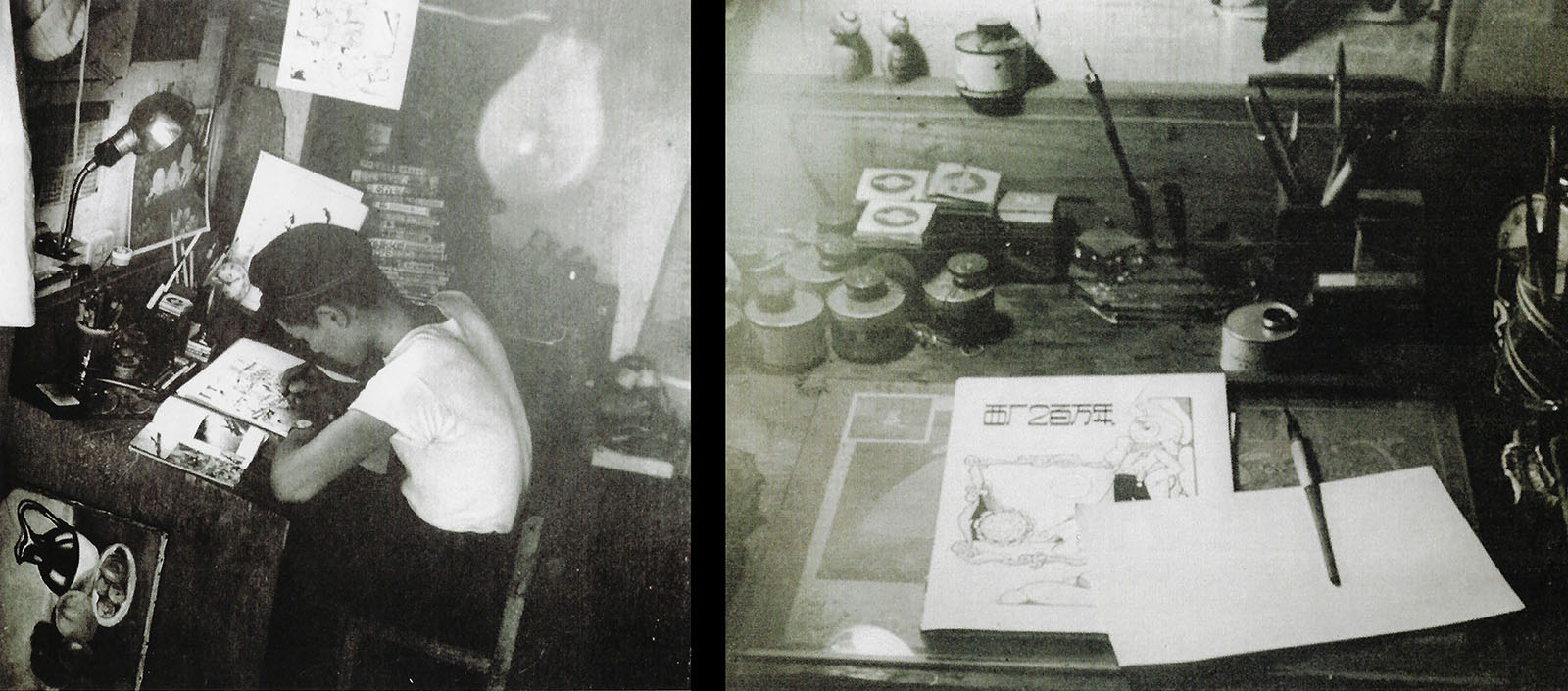
After entering high school, he continued to draw his favorite insect manga through the night. It was around this time that he developed the habit of drawing manga after school until the early hours of the morning.
At that time, one of his friends was working part-time at the Mainichi Elementary School newspaper, and knew about Leiji’s manga research group. When he visited that friend on the job, the overweight editor-in-chief called out to Leiji, who was wearing a school uniform and glasses.
“You draw manga?”
“That’s right.” Leiji answered. Then he said boldly, “would you like to see my work next time?”
The editor-in-chief shook his fat belly and laughed, “If you’re confident in it, I’ll give it a look.” Then he quickly left, looking like he was busy.
“There’s nothing I won’t show you,” Leiji said, and that was his chance. It was ringing in his head.
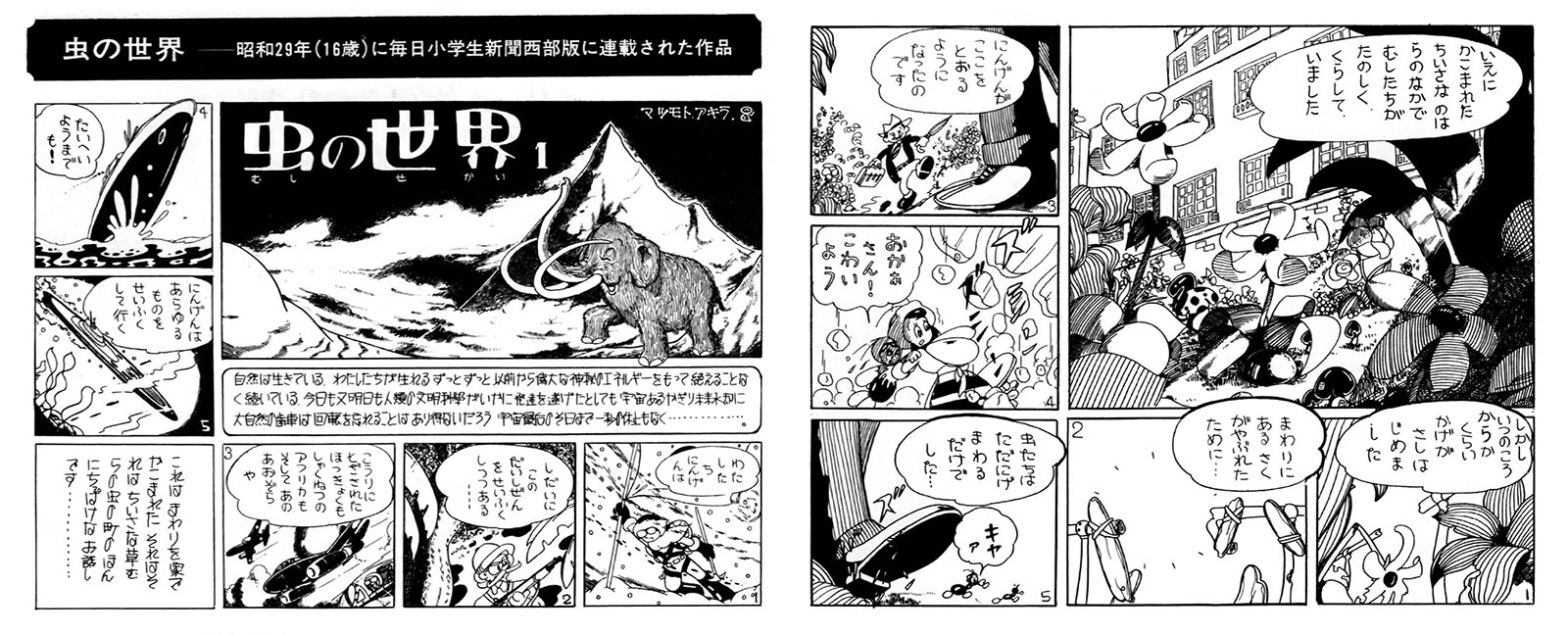
The next day, Leiji brought in the World of Insect manga he’d been drawing all this time. He wondered what the editor-in-chief would say if he saw it. He might just say no. When Leiji thought about it, he felt weak. But he made up his mind and opened the door to the editorial department. Everyone there seemed busy. A man was talking loudly on the phone, and at the desk next to him, a reporter was writing with a pencil on a piece of paper with astonishing speed.
The editorial department was full of energy, and Leiji thought this was what the world of media was like. In the midst of all this, the editor-in-chief he had met the day before was sitting at his desk. After exchanging greetings, Leiji said, “I brought my manga.”
“Oh, you brought it already? Let me see it.”
Leiji took them out of their wrapping and the editor carefully looked over each page. What could he say? Leiji sat in the chair in front of him, feeling a mixture of anxiety and anticipation. The editor forgot all about the cigarette he was smoking, leaving it half-finished in the ashtray.
After a while, the editor finished looking at the pages, put a new cigarette in his mouth, and said, “Matsumoto-kun, this is a very good piece. I like the idea of anthropomorphizing insects, and I think this will appeal to our readers. Let’s publish it. At this rate, it will take six days to serialize.”
“So you’ll put it in the paper every day for six days?”
“Of course. It’s a serial. Keep working hard and keep drawing manga.”
When Leiji went outside, the sunlight was dazzling. He was walking steadily, but his body felt like it was floating. As he walked, a smile naturally came to his face
“I did it! I did it!” the 16-year-old Leiji shouted in his heart over and over again. His insect comics were serialized for one week in the western edition of the Mainichi Elementary School newspaper, and were a huge hit.
With strong determination, he took the night train to Tokyo
At that time, Leiji was in the college prep class at Kokura Minami high school. He was aiming to go to university, but at the same time, he would diligently draw manga and submit it to the editorial department of Shojo magazine in Tokyo. At the time Shojo (from Kobunsha) was the most popular girls magazine. If the magazine recognized his work, it would open the way for him to become a professional manga artist.
However, what Leiji really wanted to draw was science-fiction manga centered around mecha. Although he liked insects, airplanes and rockets had been his dream since he was a child. This may be because he was descended from his father, a veteran warrior of the skies. The sharp angled design of a plane, with all unnecessary parts removed, evoked a strong man. A hero like his father would travel in space, riding futuristic jet planes, and rockets that traveled faster than light. He wanted to depict in manga the grand romance of a man fighting against his enemies.
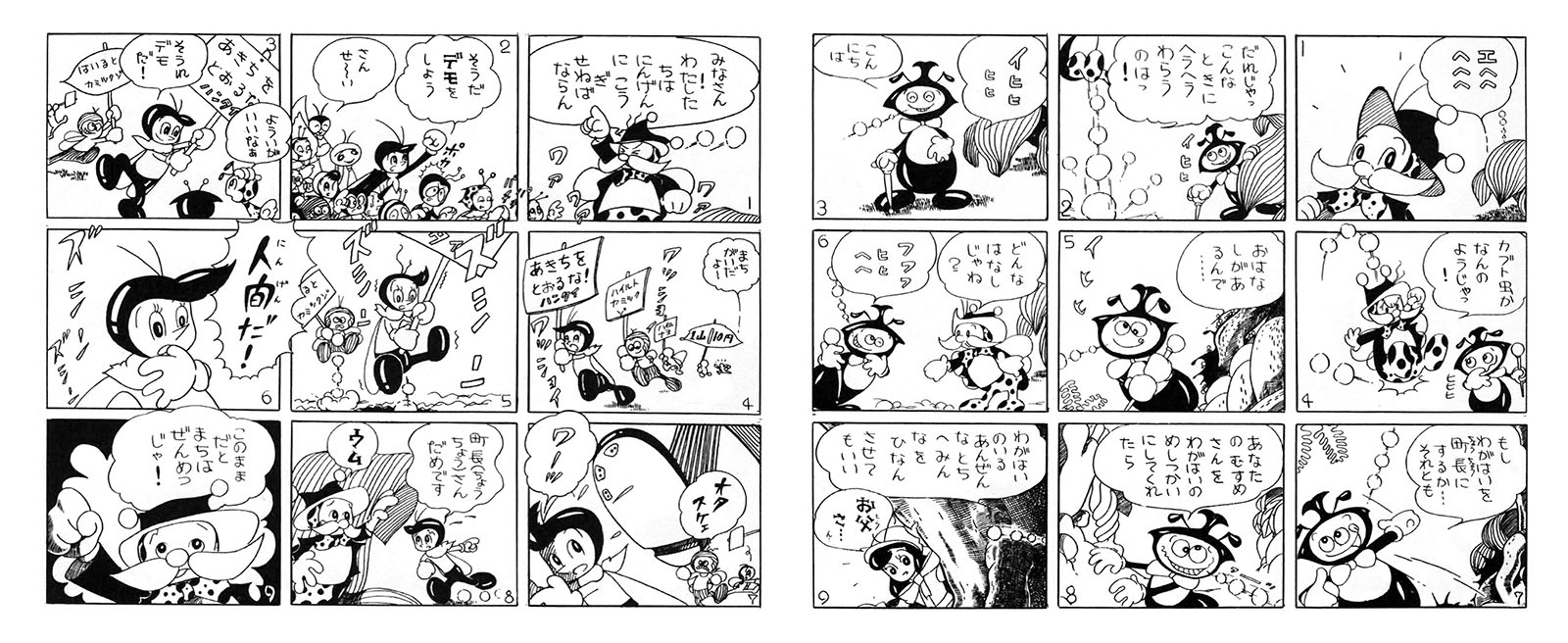
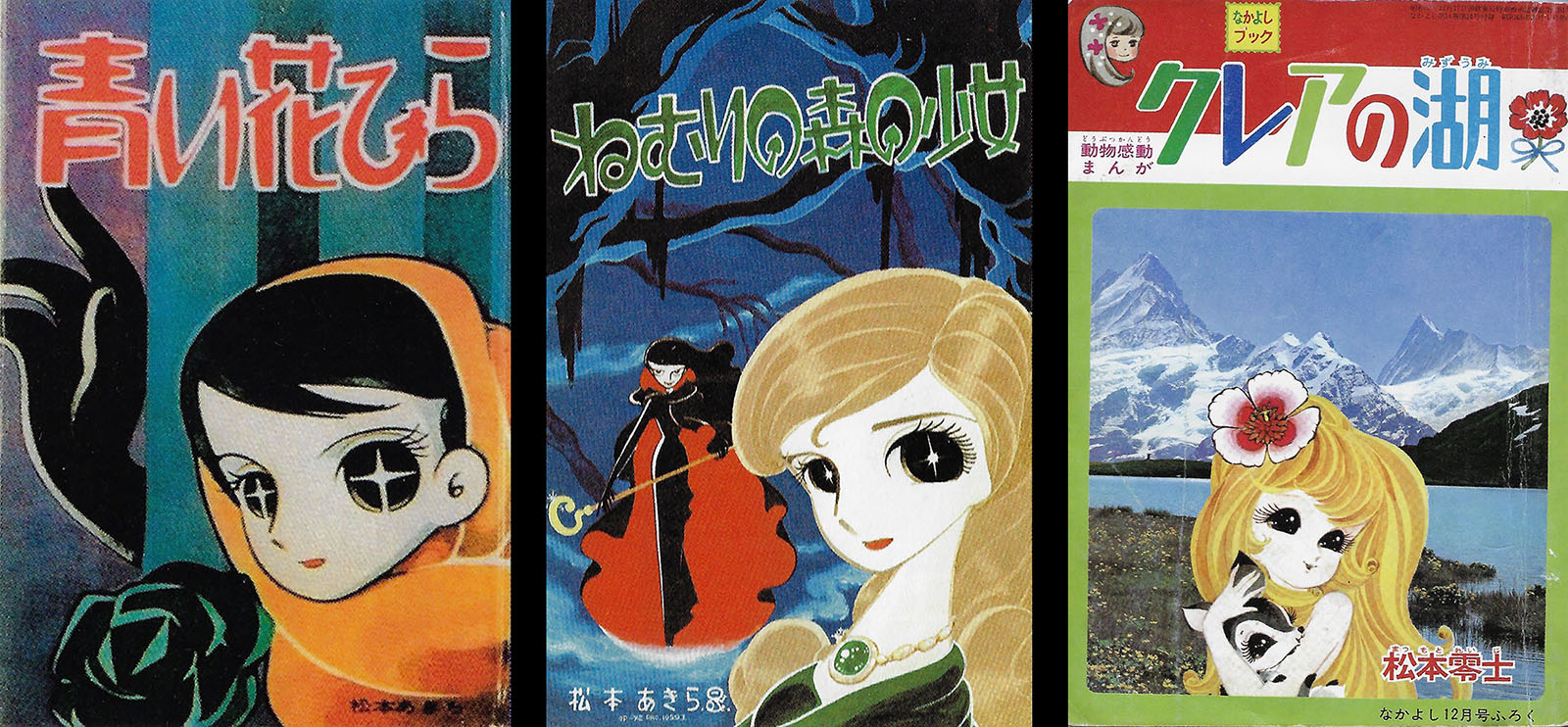
However, unlike today, the publishing world had a limited number of manga magazines, especially for the boys manga he wanted to draw. That world was one that a newcomer had no chance to enter. So he saw a place to shine in girls comics. Unlike boys manga magazines, girls magazines welcomed new manga artists. Eventually, after several submissions, his works were recognized, and requests began to come in from Shojo. His comics, including Tearful Piano Piece, Black Petals, and Evil Eyes and Angel Eyes, were featured in the pages of Shojo.
Leiji had been aiming to go to university, but his family was not able to afford it, so he gave up on that. After graduating from high school, he aimed to become a manga artist, but soon found himself in a major crisis. His father, a former soldier who was banned from public office at the end of the war, started a fruit and vegetable business to support his family. He got up early in the morning, went to buy vegetables, and put them on display in a store to sell. Leiji also took a break from drawing manga to help out at the shop.
On his bicycle, he pulled a cart loaded with mountains of Chinese cabbage and radishes to the store, where he stood in the doorway and called out to customers to come in. Every day was busy, but he felt like they could never get enough customers. The shop did well at first, but the business started by his military father was ultimately untethered.
Leiji’s father purchased vegetables in large quantities, thinking they would sell well, but they did not sell as expected. Vegetables were perishable, so if they were left untouched for a too long, they would deteriorate. To make up for the losses, they purchased large quantities of other vegetables, but these also did not sell as well as expected. The store gradually began to run at a loss, and the family‘s life was pushed to the brink of collapse.
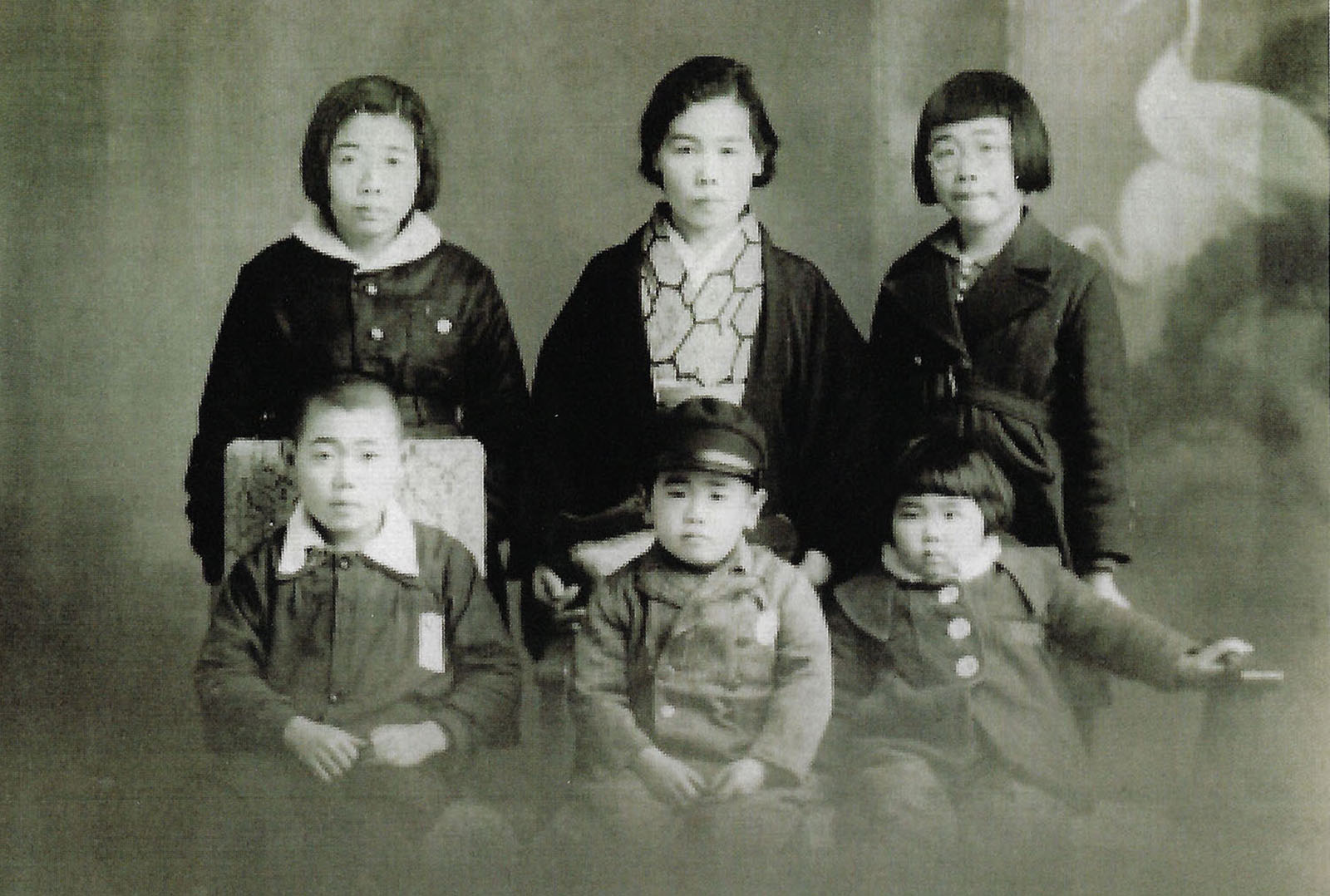
Family photo, April 1944. Back row: Kazuko, Masami (mother), and Noriko. Front row: Susumu, Akira (Leiji at age 6), Keiko.
Moreover, with the exception of Leiji and his older brother Susumu, all of their siblings were still young. In this situation, those who were able to had no choice but to go out and work to save their family from hardship. The only thing Leiji could work hard at was manga. Rather than getting a job at a company and becoming a salaryman, he wanted a career as a manga artist.
At that time, he received an invitation from a magazine company in Tokyo to come to the city if he wanted to make a living as a manga artist. Leiji made up his mind. He would go to Tokyo, draw manga that he loved, and send the money home. In stories about self-made men, the protagonist often makes a tragic decision and leaves his hometown. In Leiji’s case, he felt desperate.
That day, he told his parents and older brother about his decision.
“I’m going to Tokyo. I will definitely send you money.”
Neither his father, mother, nor siblings opposed him.
“You don’t have to come to the station to see me off. I don’t like that sort of thing,” Leiji said in a deliberately cheerful tone.
In 1958, he packed his bags and left home alone. It was night. A cold wind was blowing. Step by step, he left his beloved home, proudly saying, “if the wind’s going to blow, let it blow.”
He never showed any such behavior in front of his parents or siblings, but ever since he was little, Kyushu had been his body. The boy’s hot blood was boiling.
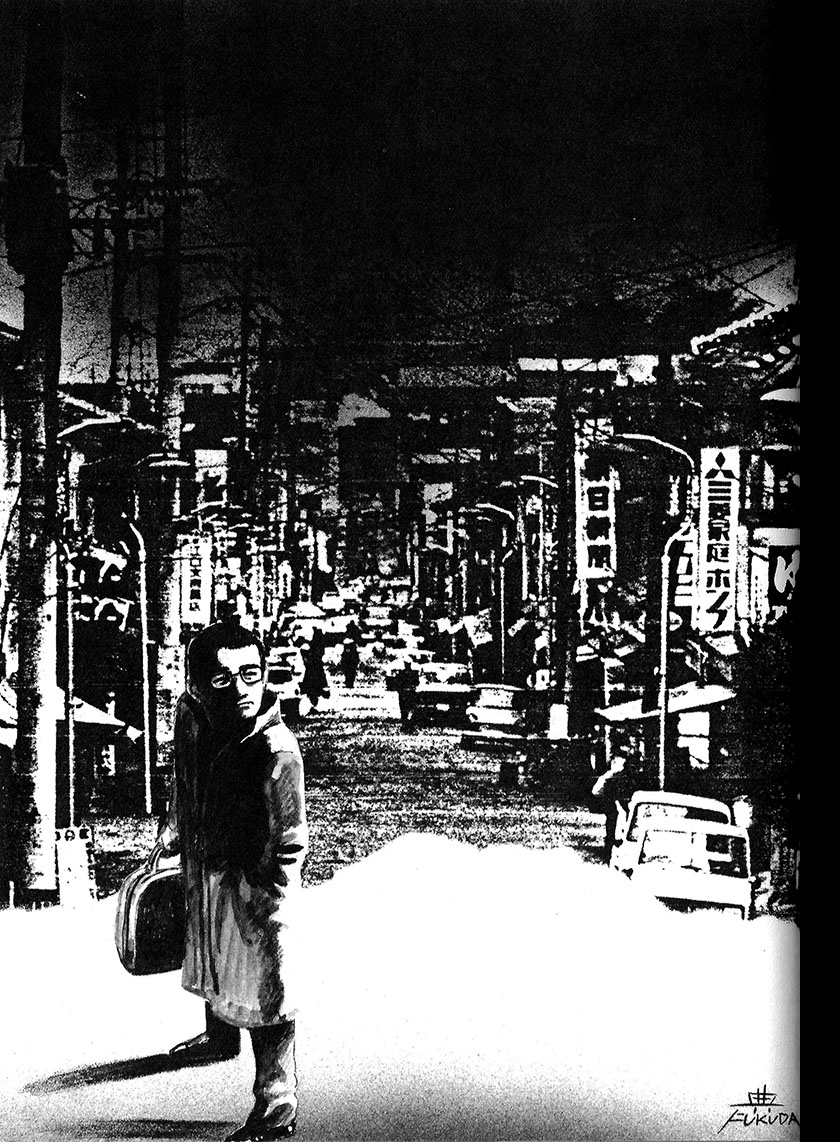
Carried on the night breeze, he heard a voice say, “big brother!”
He looked over and saw his younger brother waving from an overpass.
“Stay healthy and do your best,” Leiji shouted back.
His heart felt heavy, but Leiji shook off the sad thought. He wasn’t going to Tokyo with a gloomy feeling. He told himself that he was a boy leaving his hometown with high aspirations.
He waved once with all his might, then turned his back on his brother and hurried down the night street. Then he boarded the last train going out.
This was a time when the Shinkansen had not yet opened. The distance from Kyushu to Tokyo was incredibly long, take more taking more than 20 hours by train. Leiji gazed intently out the window at the town of Kokura as the train monotonously hummed along. The lights of houses shining in the distance felt warm to his eyes.
Behind each of those lights was the warm presence of a family. The business had failed and his family was in dire financial traits, but even so, at night the family lived behind the bright lights. He left home and headed for Tokyo.
He declared that he would send them money, but wondered if he would actually be able to make it as a manga artist. Thinking about the daily life that was about to begin in Tokyo, he was anxious. But when he felt that anxiety, he scolded himself for being weak-willed. He thought that if a man had a goal, he would be able to do his best.
With various thoughts running through his mind, Leiji gazed out the window of the night train. He had already passed out of Kokura long ago. The lights of the houses had faded, but the stars were twinkling in the night sky. They spoke to Leiji in silent words.
You’re going to support the family.
Create a great manga.
No matter what happens, don’t give up.
When he was little, he removed the lenses from his father‘s reading glasses, and his sister‘s nearsighted glasses, and combined them to make a telescope. He couldn’t see the moon or the stars through that homemade telescope, but now the stars he saw from the train window were even clearer than they were then. They were also more friendly and sent warm encouragement.
Finally, Space Battleship Yamato was born
Leiji was now in Africa, far away from Japan, remembering the time 18 years old 18 years ago when he gazed up at the stars. Whenever he felt anxiety, he would desperately fight it.
“When I think back to those days, it’s pretty pathetic to get depressed about a TV project not getting approved.”
Leiji was fired up to fight. At the same time, hunting in the rugged African continent lifted his spirits.
In 1977, the year after he returned from Africa, Leiji published his series Galaxy Express 999 in Shonen King magazine. He also serialized Space Pirate Captain Harlock in Playcomic. He was determined to publish these two works, which had been ignored by TV stations, in a magazine and one day have them recognized.
Just around that time, unexpected news came in: a proposal to make a theatrical film version of Space Battleship Yamato.
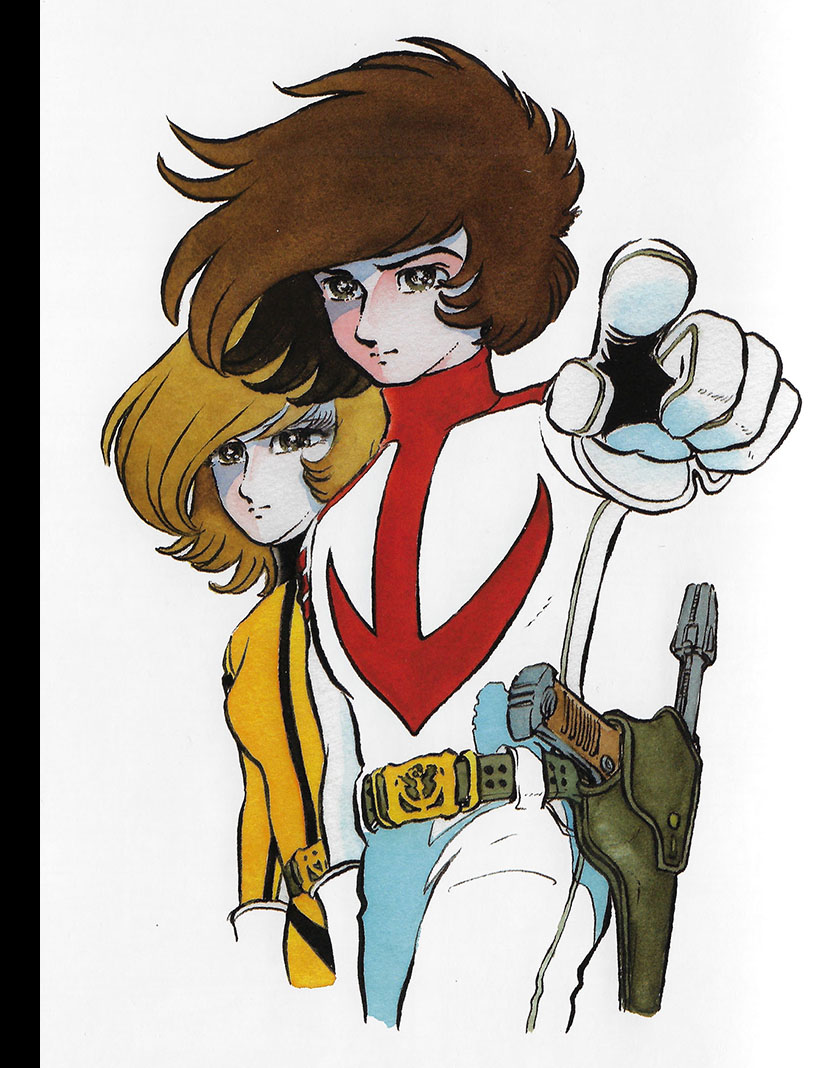
Yamato had been developed by an animation company in 1974, two years before Leiji went on his trip to Africa. The idea was brought to him, and Leiji took on the role of co-writer and co-director. The story was broadcast as a TV anime. He designed the characters and the ship.
The giant battleship Yamato, which the Japanese Navy used during the Pacific war, astonished the entire world. This epic space romance saw it come back to life, soar through space, and defeat its enemies. Inspiration for the story came from a TV program Leiji had seen before, Shinsengumi Keppuroku, which he had a strong memory of. The idea was to do a group drama about young people, centered around Shinsengumi Captain Isami Kondo, along with Souji Okita and other young soldiers, as inspiration for a science-fiction anime. The Earth defense force fought against the powerful, alien Gamilas army.
The flagship of the Japanese fleet, the battleship Yamato, was commanded by Captain Juzo Okita, along with the young officers Susumu Kodai and Daisuke Shima. This animated drama about a group of men set in the vast universe was well received on television. The TV version of Yamato aired from October 1974 to March of the following year, and then was edited into a theatrical film.
Leiji was stunned. However, there was a certain fear. The news was that Star Wars, directed by George Lucas, would be released at the same time.
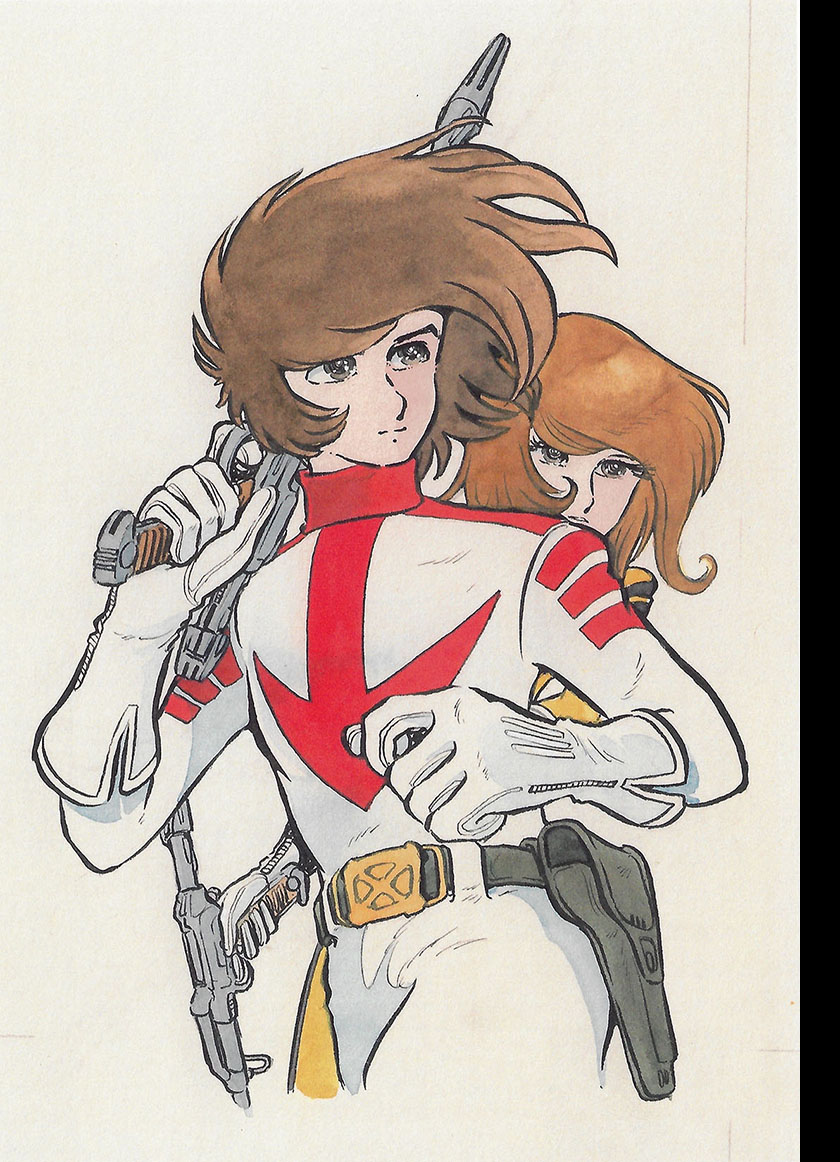
Of course, Leiji had absolute confidence in Space Battleship Yamato, but the competition was a science-fiction film made with a huge budget by Director Lucas, who was known as a Hollywood genius. It would be bad if they were to lose out in terms of the artwork. Besides, movies are a business. If the audience went to the heavily-promoted Star Wars, the release of Space Battleship Yamato would be a failure.
Once the production of the Yamato film was completed, Leiji flew to Hawaii with the staff. They went to see Star Wars, which had already been released in Hawaii. The cinema was packed. Eventually, the film began.
A young man named Luke Skywalker, robots named R2-D2 and C-3PO, and space pirate Han Solo were sent to rescue Princess Leia from the planet Alderaan. The great adventures of the various characters in space were wonderful, but Leiji was repeatedly crying out softly.
This was because details of the mecha of Star Wars were very similar to those drawn by Leiji for Space Battleship Yamato, adapted into an American style. The theatrical version of Yamato was released almost the same time as Star Wars, but the TV anime had been made years earlier. That’s why the Star Wars staff apparently used Leiji’s designs as a reference. He felt proud that his work had influence Hollywood’s top sci-fi staff, but was overwhelmed by the special effects technology.
That night, while gazing up at the stars on Waikiki Beach, Leiji thought to himself that he was about to face a formidable opponent. On the contrary, this awakened his fighting spirit. As he watched the stars twinkle, he said, “I won’t lose!“ If this opponent is huge, it’s worth the challenge.
The trip to Hawaii just to see Star Wars actually gave courage to Leiji and the staff. The release date of August 5 was fast approaching. Reports of advance reviews of Space Battleship Yamato came to Leiji every day.
“Advanced tickets are apparently selling like hot cakes.”
“The signs are that it’s going to be a big hit. Of course, Star Wars is also a big hit.”
The advanced reviews were good. But the real answer wouldn’t be known until the release date. If the movie didn’t do well, it would be all his fault.
“If I can’t give the audience visual satisfaction, everything I’ve built up till now will fall apart.”
The days continued to be unsettling. Looking back, working on anime had been a dream of his since he was young.
[Translator’s note: there’s a lot of dramatic license at work in this account that doesn’t line up with the historical record. Star Wars was released May 1977 in the west. Its instant success was publicized all over the world, but it wasn’t due in Japan until June 1978, so it was never in direct competition with Yamato. The Hawaii trip took place several months after Yamato‘s release. The staff saw the film there (along with Close Encounters) but were mainly there to begin work on Farewell to Yamato. Unfortunately, that takes some of the wind out of the sails in this story.]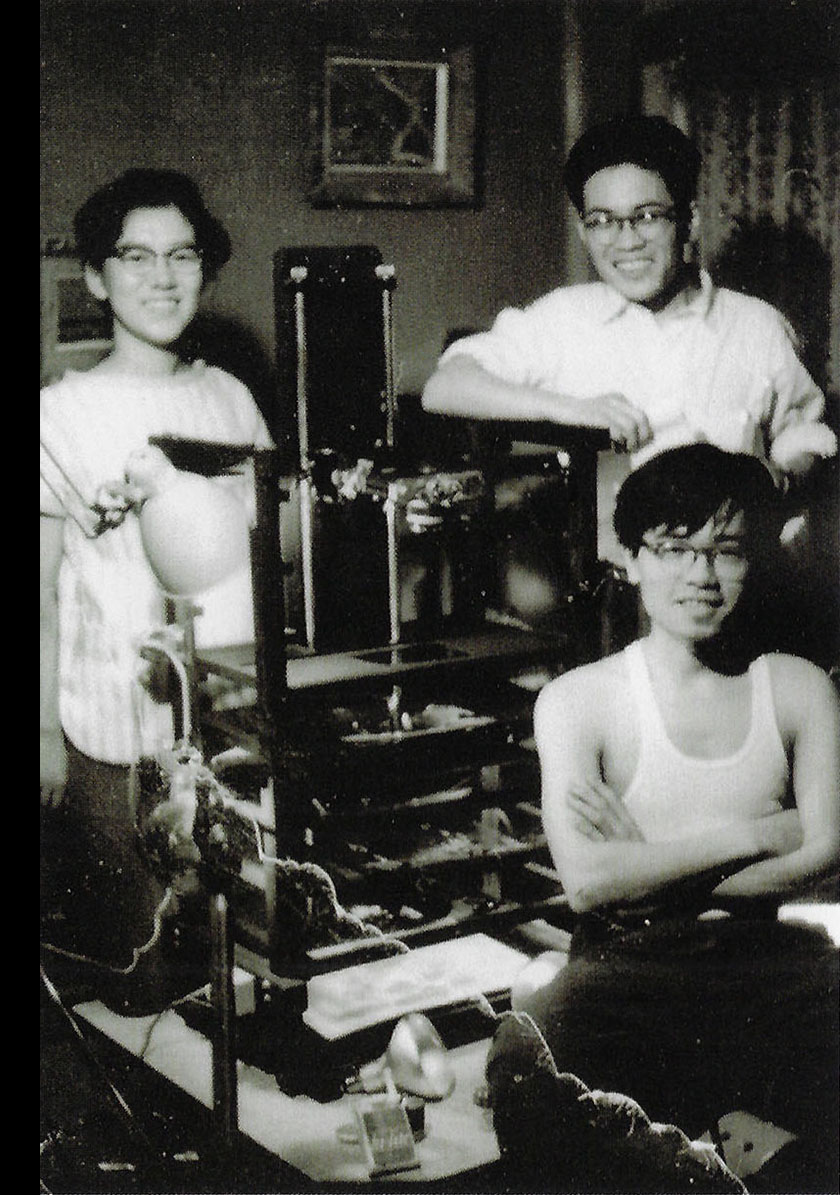
Homemade animation stand. Leiji is at the lower right.
His future wife Miyako Maki is at left.
Coexisting with Star Wars and E.T.
In 1961, shortly after moving to Tokyo, Leiji lived in a boarding house called Yamakoshikan in the Bunkyo ward where he diligently drew manga for five years. When he was only 23 years old, he bought a used 16 mm camera. The idea was to use this camera to shoot individual frames and turn them into animation. However, if you shoot in 16 mm, the cost of film can be quite high.
“I couldn’t afford it on my income. So I switched to a cheaper camera.”
Leiji switched to an 8 mm camera. He built a filming stand and installed lighting, and the tiny boardinghouse room was transformed into a small animation production studio. However, when he turned on the lights to take a picture, the fuse immediately blue. The lights were too bright.
“I didn’t know.” Leiji scratched his head.
At the time, there was no animation in the Japanese film industry. If his project had been completed, it would have been a groundbreaking work. Still, he turned off the lights and continued taking stop motion pictures. After much effort, a 30-second piece was completed.
“How does it look?” He eagerly waited for the film to be developed.
Eventually, the developed film was ready. He was excited when he put it into the projector. He pressed the start switch. The pictures he had taken were projected onto a white paper screen stuck to the wall, but it wasn’t really a picture. All he could see was something moving around on a pitch black background. The lighting had been too dim. If he were to turn on any brighter lights while living at the boarding house, the fuse would blow again.
His first film was a failure, but this failure taught Leiji the basics of animation. The bittersweet failures of his youth were now brought back to mind as the release date of Space Battleship Yamato approached.
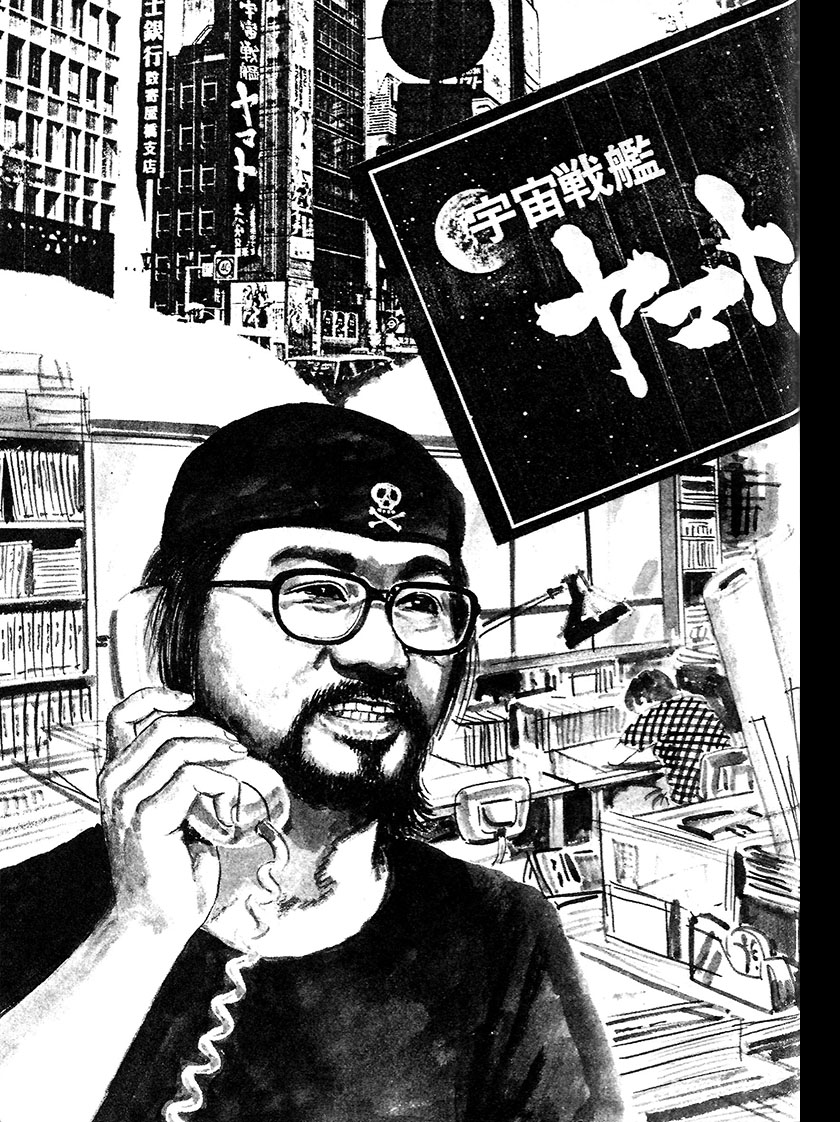
However, this time it was a theatrical film, different from the handmade animation he had created in the past. And so, the day before the movie finally arrived. Leiji was a night owl, and sometimes went without sleep. He wore a woolen hat with a skull mark on it. He went back back and forth to work.
His emotions were so high that he couldn’t stay still in one place. He tried to concentrate on work, but it was no use. No matter how hard he tried to forget, he couldn’t help but wonder about tomorrow’s release. Night came and the clock struck midnight. At that moment, the phone suddenly rang.
Leiji picked it up. It was a member of the production staff.
“Sir, we did it! Fans are lining up in front of the theaters all night. At this rate, we’re sure to hit the jackpot. We did it!”
“I see,” was all Leiji could say. After that, he was speechless and couldn’t say anything.
The film had been made with the cooperation of many people, including the producer, the people who drew the anime, and the camera operators, advertising personnel, etc. The hard work had paid off. By morning, long lines had formed in front of theaters, and police had to be called into control them.
Space Battleship Yamato took on the formidable rival Star Wars and became a hit that was just as big.
While the power of the staff was also hidden behind this, Leiji’s outstanding ability earned him enthusiastic support from fans all over the country.
In 1978 Space Pirate Captain Harlock was broadcast as a TV anime on TV Asahi. And in August, the animated film, Farewell to Yamato was released in theaters. The second Yamato film was also a huge hit. And finally, in October, Galaxy Express 999 was made into a TV anime and aired on Fuji TV.
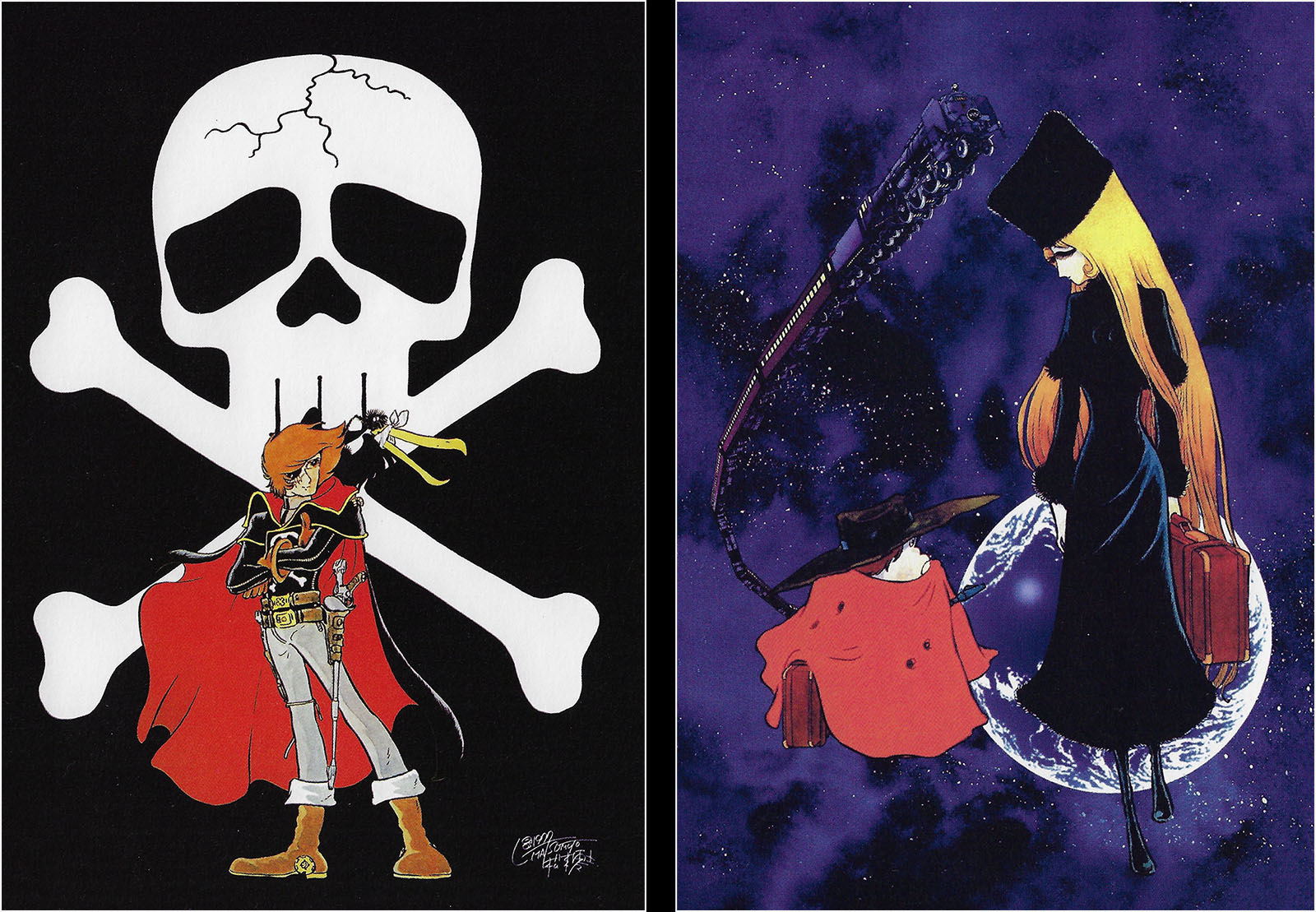
Before his trip to Africa, Leiji’s two space projects were ignored. Two years later, both were broadcast on TV and became popular. Galaxy Express 999 was made into a theatrical animated film the following year, and it was also a huge hit. Leiji’s passion for anime grew even stronger. And his creative energy welled up like a fountain. He then gave birth to Queen Millennia in 1982.
Three months later, Steven Spielberg’s E.T. was released. Leiji immediately went to see it. And again he cried out, “AH!” At the end of Queen Millennia, there was a line that went, “Yayoi will always be in your heart.”
Then the spaceship rises, glows, and disappears to the right of the screen. In the last scene of E.T., there’s a very similar line. E.T. says, “I’m in your heart,” and a spaceship rises and lights up the screen in a similar way. It disappears to the left. Although there are differences between right and left, Director Spielberg’s sensibilities were very similar to Leiji’s.
Leiji Matsumoto, who came to Tokyo from Kyushu and started out in a boarding house in Bunkyo, had pursued his own unique world.
“In this day and age, there’s a growing tendency towards childishness, and things in the world are being perceived in a somewhat feminine way. But deep down in a boy’s heart, there’s an admiration for things like powerful machines and airplanes that have been pushed to their limits, bearing countless scars. I think that’s the spiritual vitality of boys. I want to depict those kinds of things in my manga. Even though times change, I want boys to retain that vitality.”
Leiji Matsumoto, 45 years old. With the youthful passion of a young man, he is now pioneering a new world of manga.
It’s his crazy his birthday is a day before mine and I was born in 1999!