With the Final Yamato campaign fading into memory and most of the merchandising now out into the world, activity slowed down considerably in the summer months. But on the other side of the world, Yamato fever was in the process of waking up a sleeping giant. Here’s how it happened…
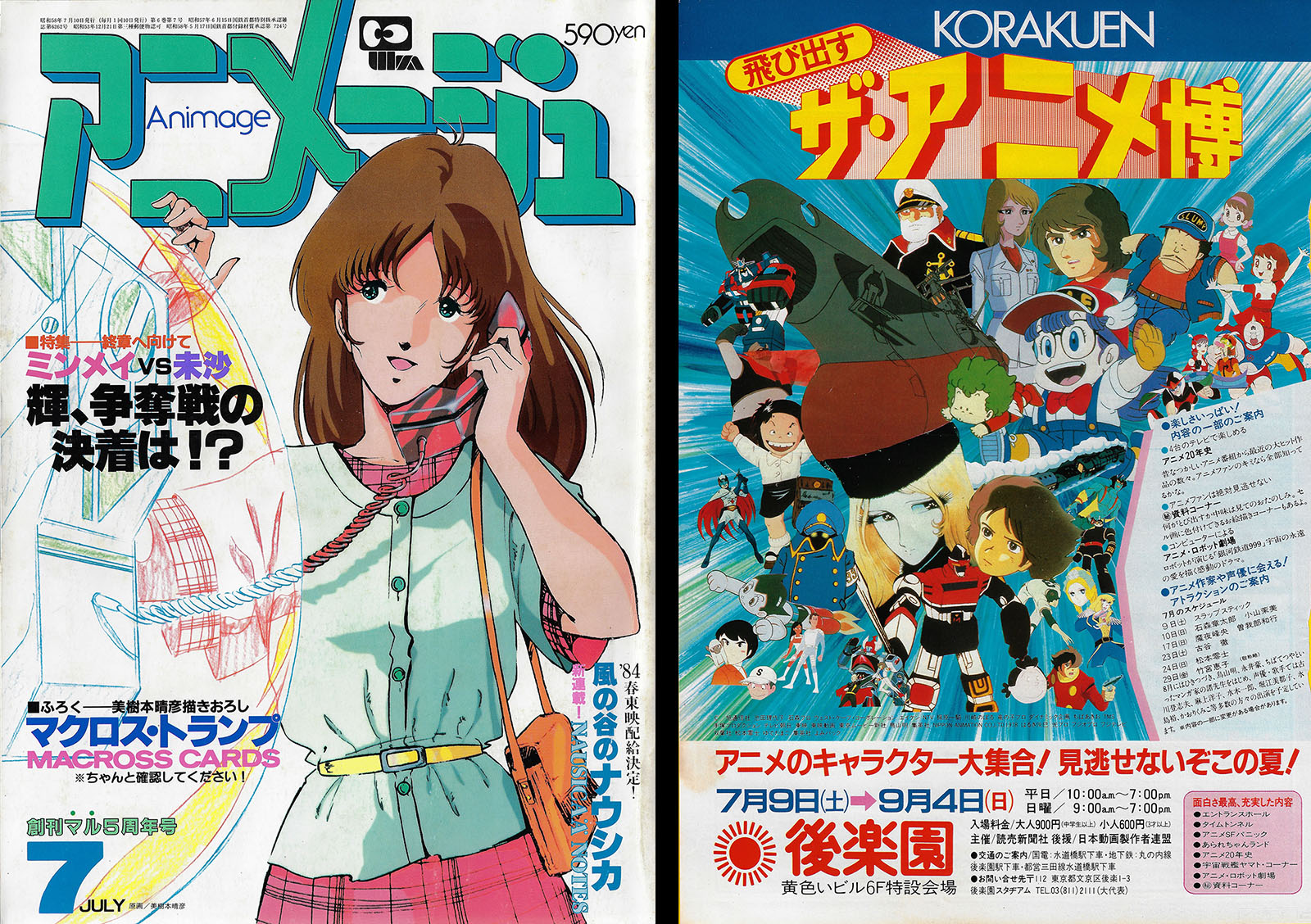
June 10: Animage Vol. 61
The days of Final Yamato coverage were over, but it was far from the last time Yamato would appear in the pages of Animage. The ad above right made this clear when the ship and its top three crew members figured prominently in a full-page ad for “The Anime Expo,” a two-month long event starting July 19 at Korakuen Hall, a sports arena in Tokyo.
The ad promised a great number of anime-related attractions such as exhibits, demos, appearances by artists and actors, and much more. Leiji Matsumoto himself was scheduled to appear on July 24 at a Yamato-centered event.
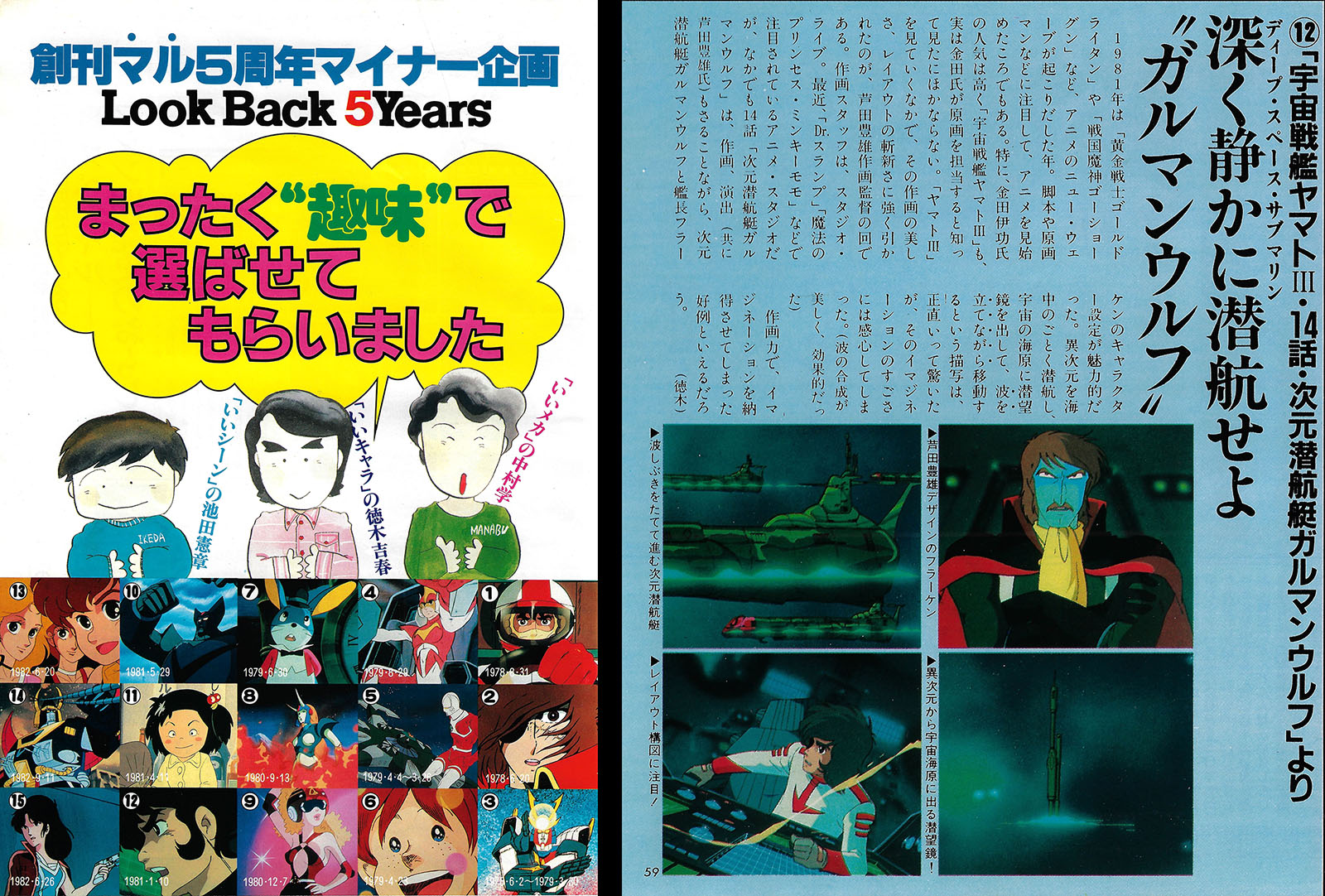
Since this was Animage‘s fifth anniversary issue, it contained a “Look Back” article in which three writers reviewed the last five years of anime to choose their favorites, one from each year. Manabu Nakamura looked at mecha, Tokugi Yoshiharu looked at characters, and Kensho Ikeda looked at scenes. Their picks ran the genre gamut from SF action to screwball comedy. Tokugi Yoshiharu chose the following from Yamato III…
Space Battleship Yamato III, episode 14: Dimensional Submarine Galman Wolf
Deep space submarine
Dive deep and quietly, “Galman Wolf.“
1981 was the year when a new wave of anime began to emerge, with work such as Gold Lightan, Go Shogun, and others. It was also around the time I started watching anime, paying attention to the scripts and key animators. Yoshinori Kanada was particularly popular, and I only watched Yamato III after learning that Kanada would be in charge of key animation.
As I watched Yamato III, I was drawn to the beauty of the drawings and the innovative layout of the episodes directed by Toyo Ashida. The animation staff was Studio Live. This studio has recently been attracting attention with work such as Dr. Slump and Minky Momo. Episode 14, Dimensional Submarine Galman Wolf, was particularly impressive, not only for its drawing and direction, both by Toyo Ashida, but also for the Dimensional Submarine Galman Wolf and its Captain Frakken.
The concept was fascinating; the depiction of a ship diving into another dimension, as if it were underwater, sticking a periscope out into the ocean of space, and moving while making waves. To be honest, I was surprised, but I was impressed by the incredible imagination. The synthesis of the waves was beautiful and effective. This is a good example of how drawing skills can capture the imagination.
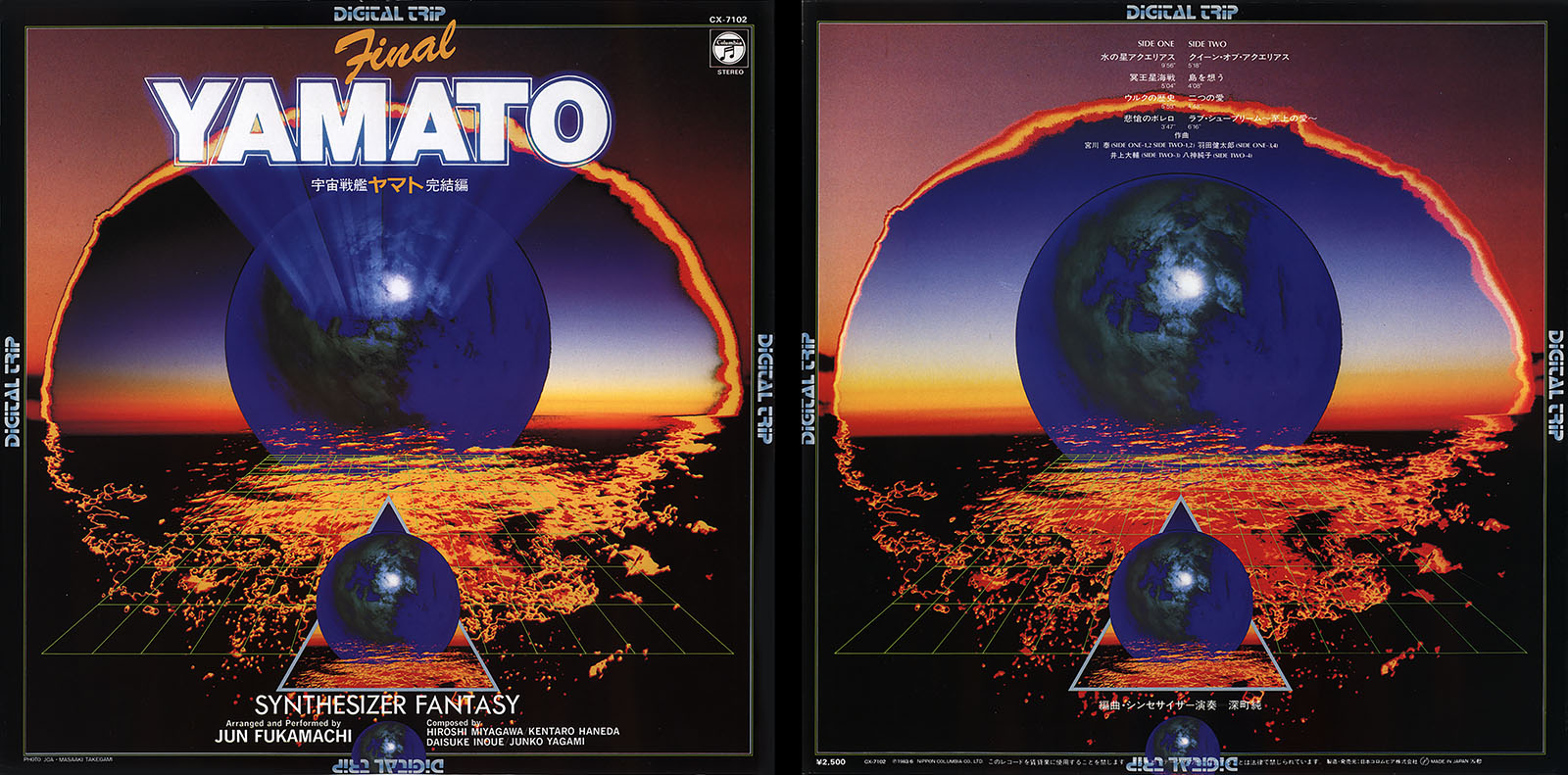
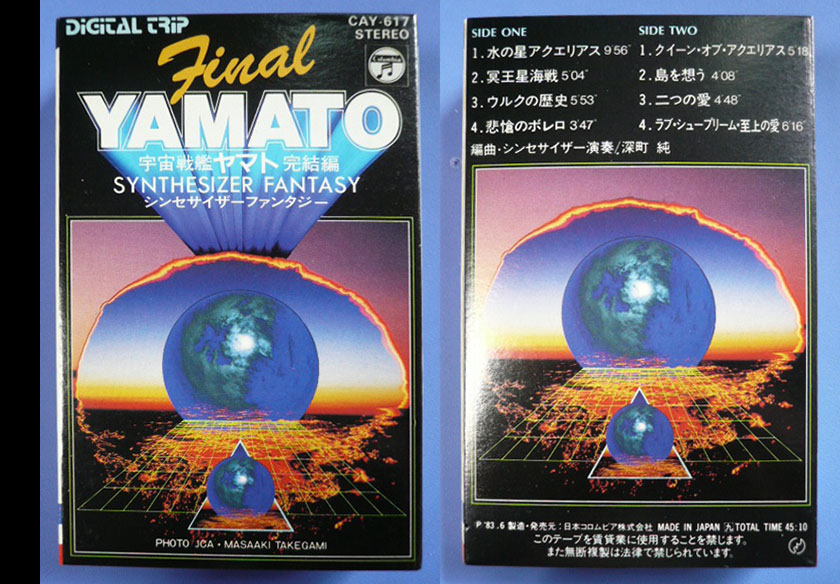
June 21: Final Yamato Digital Trip Synthesizer Fantasy album
This was the most unusual of Final Yamato‘s many albums, an all-synthesizer concept recording by artist Jun Fukamachi. It was actually his second effort, his first being the Space Battleship Yamato Digital Trip from a year earlier. He had also performed on synthesizer with Symphony Orchestra Yamato on the Prelude to Final album.
This album went out of print after its first release on LP and cassette, and a reissue would not appear until early 2014 as part of the Yamato Sound Almanac series. Read all about it here.
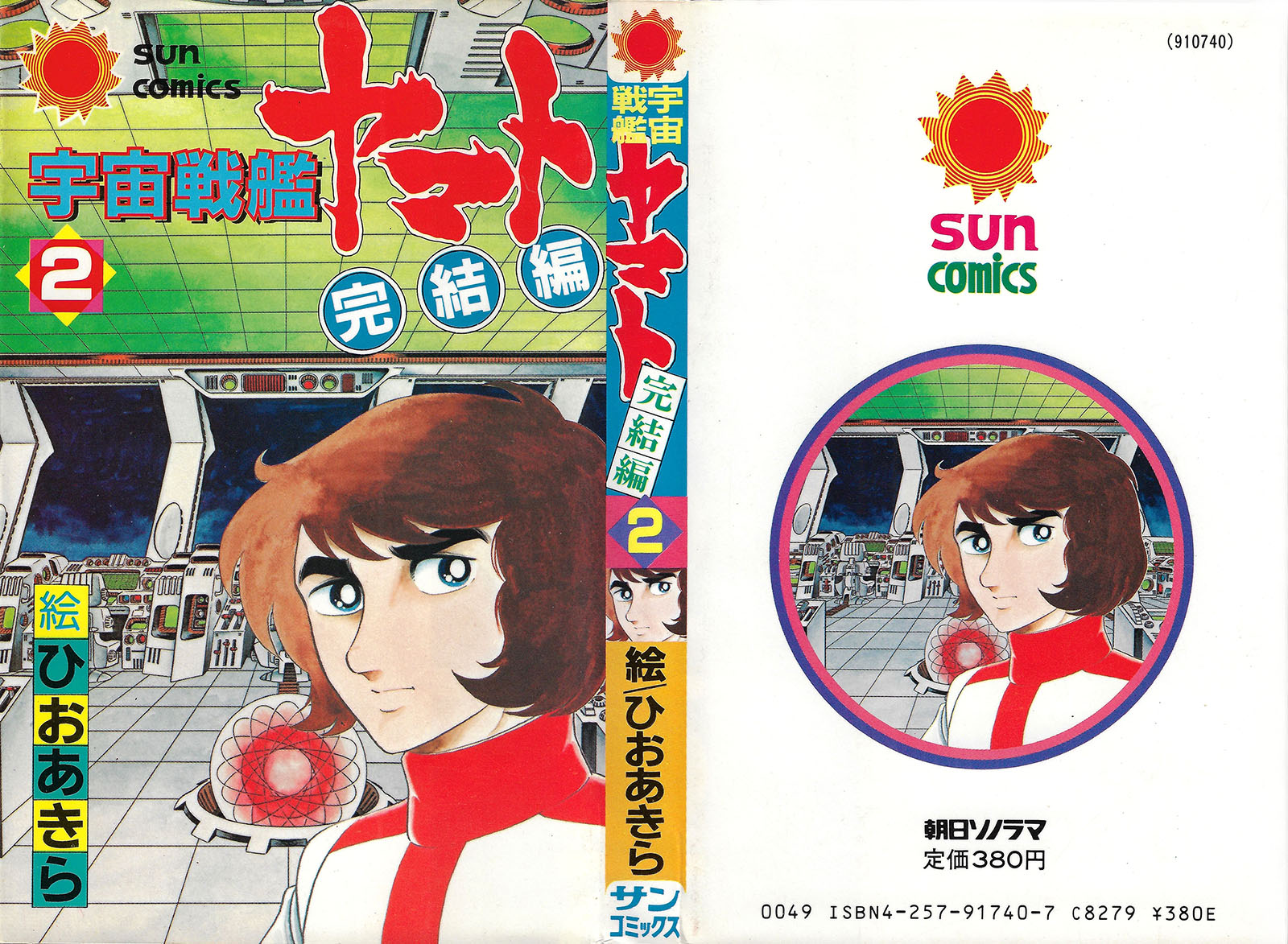
June 30: Final Yamato manga vol. 2
Akira Hio’s second volume followed his first by four months and had the movie itself to draw from as opposed to a screenplay and production art. The end result is that all the “extra” scenes were crowded into volume 1. We can only wonder what a Final Yamato manga based on an earlier script would have contained. Since the first draft is said to have been nearly four hours long (the screen-time equivalent of 10 TV episodes) the differences would have been substantial.
Read more about the Final Yamato manga here
Also spotted in June
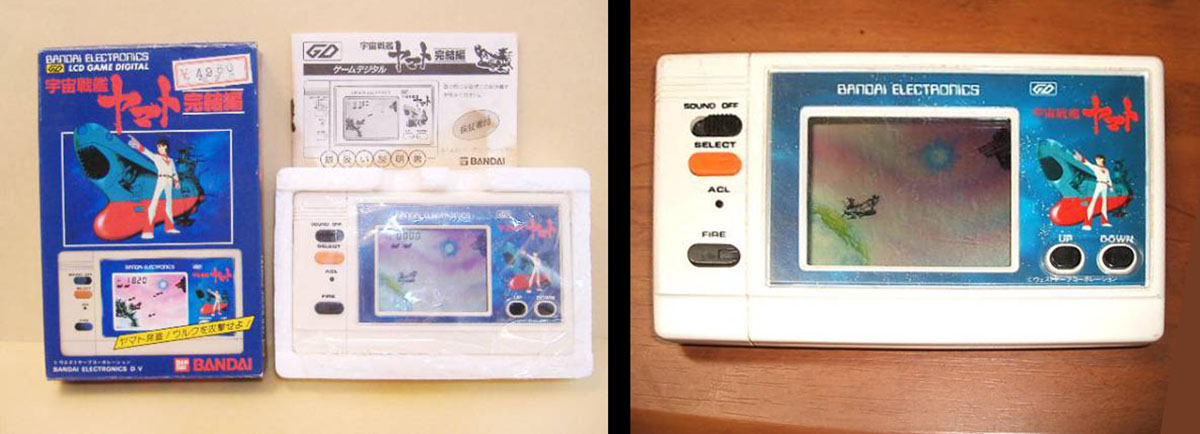
Final Yamato LCD game
The last of the games from the production years was, coincidentally, the harbinger of everything to come: a handheld Final Yamato LCD game from Bandai Electronics. The technology for this was first developed in the 1960s, then refined by Japanese electronics companies in the 70s for the first digital quartz wristwatches. From there it was an easy step to all sorts of applications, like this one.
In what was essentially a sideways version of Space Invaders, Yamato engaged in a shootout with City Satellite Uruk, scrolling up and down the tiny screen, building up energy for wave-motion blasts until only one was left standing. This was Yamato‘s first digital game, destined to be eclipsed many times over.
Anime magazines published in June


Two more covers for Macross this month; Animedia honors creator Yasuhiko Yoshikazu as he begins to develop the TV series Giant Gorg for 1984.
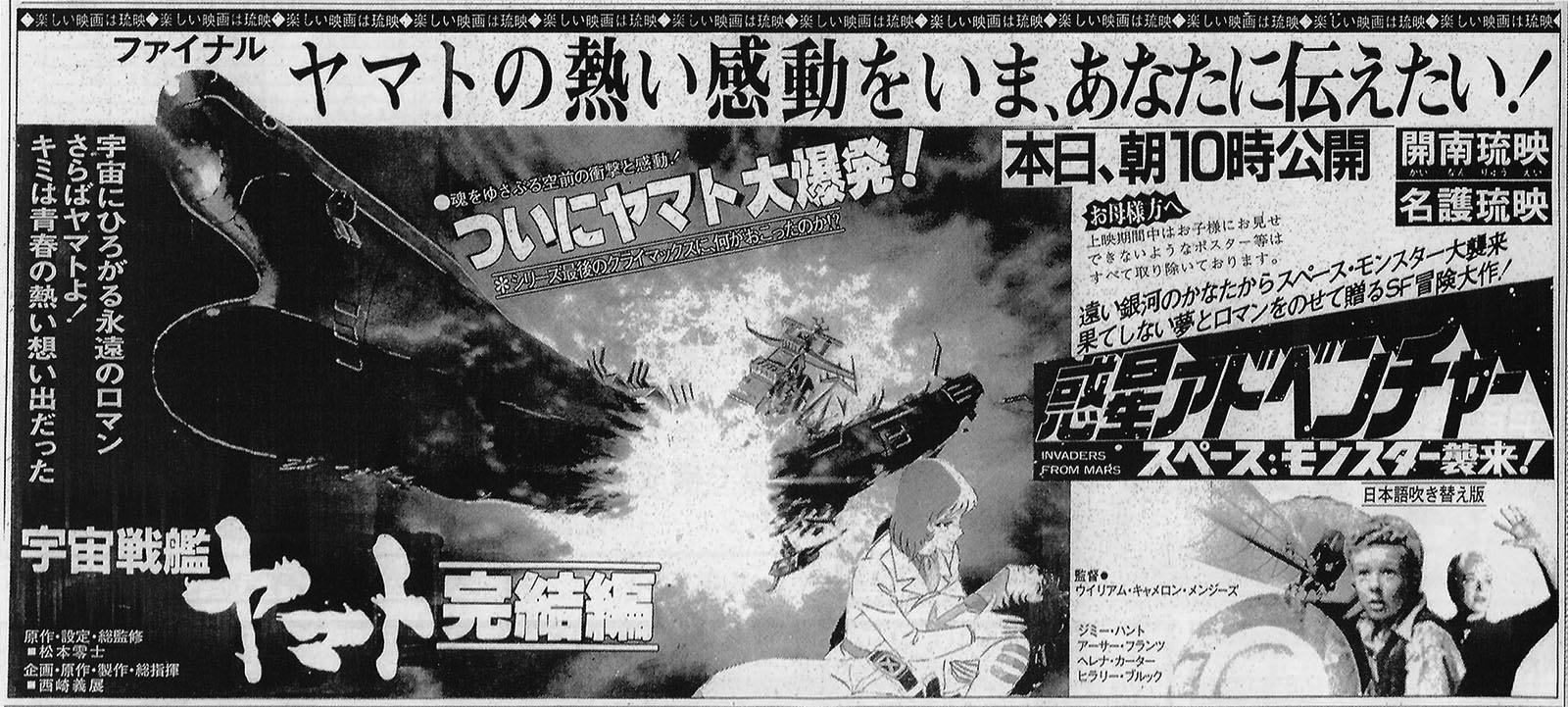
July 21: Final Yamato in Okinawa
All the mainland theaters had long finished their screenings of Final Yamato by this time, with the Shinjuku Toei Palace being the lone holdout in Tokyo through Golden Week (late April/early May). But summer vacation brought it back for a 3-week run at Kainana Ryuhei, a theater in Okinawa prefecture.
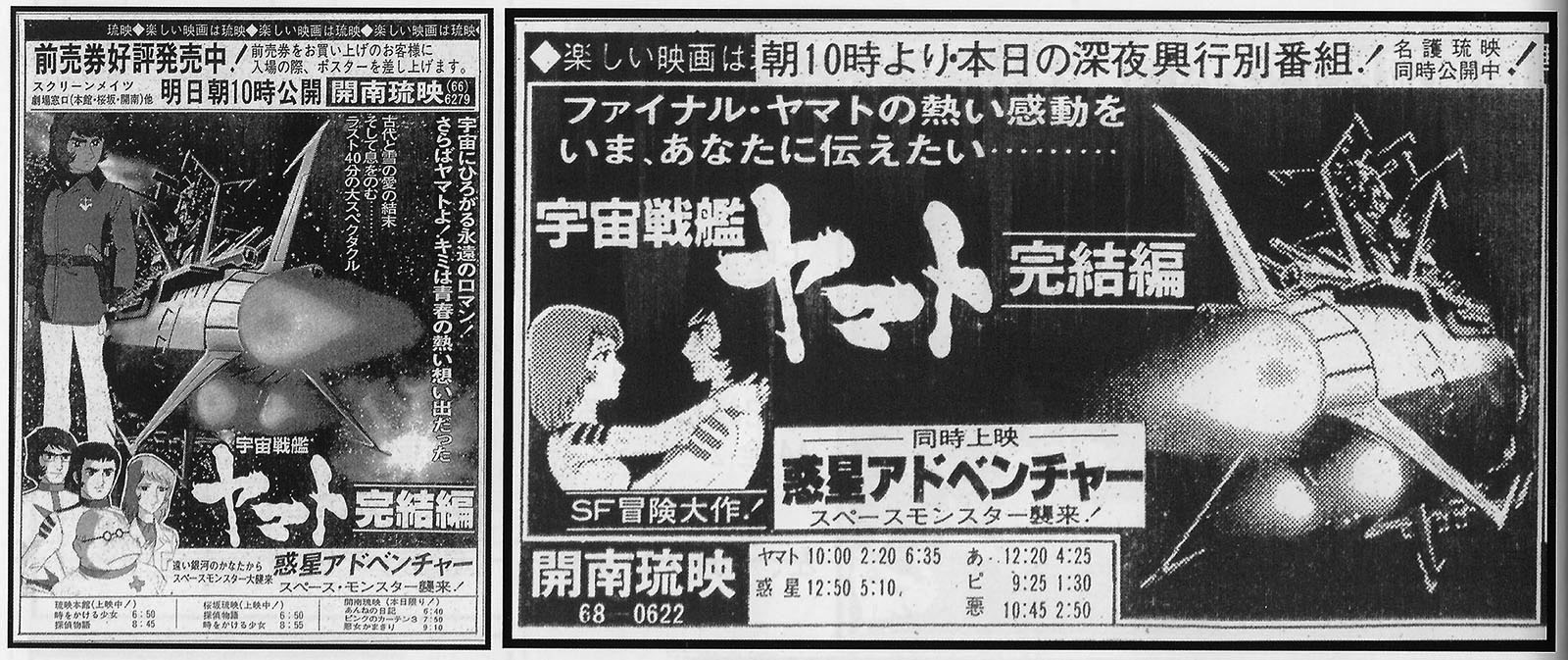
Seeking to attract the younger crowd, the theater booked it as a double feature. It was paired with Invaders From Mars (renamed Planet Adventure) in first week, Gundam III in second week, and Aladdin and his Magic Lamp in third week. The Gundam pairing was something that could only happen in a remote prefecture, since Toei and Shochiku were rival distributors on the mainland.

July 23: Yamato World Exhibition
The photo above is from a Yamato exhibition held in the summer of 1978, but it’s gratifying to know that these objects weren’t scrapped afterward. The Kodai and Yuki mannequins made a return appearance at a new Yamato exhibition held at Ikebukuro Sunshine City Cultural Hall in Tokyo. Also on hand were the first bridge diorama and “Precision Cut Model” that had last been seen in the summer of 1980. This exhibition lasted through August 31, and was not the only one you could find during this period.
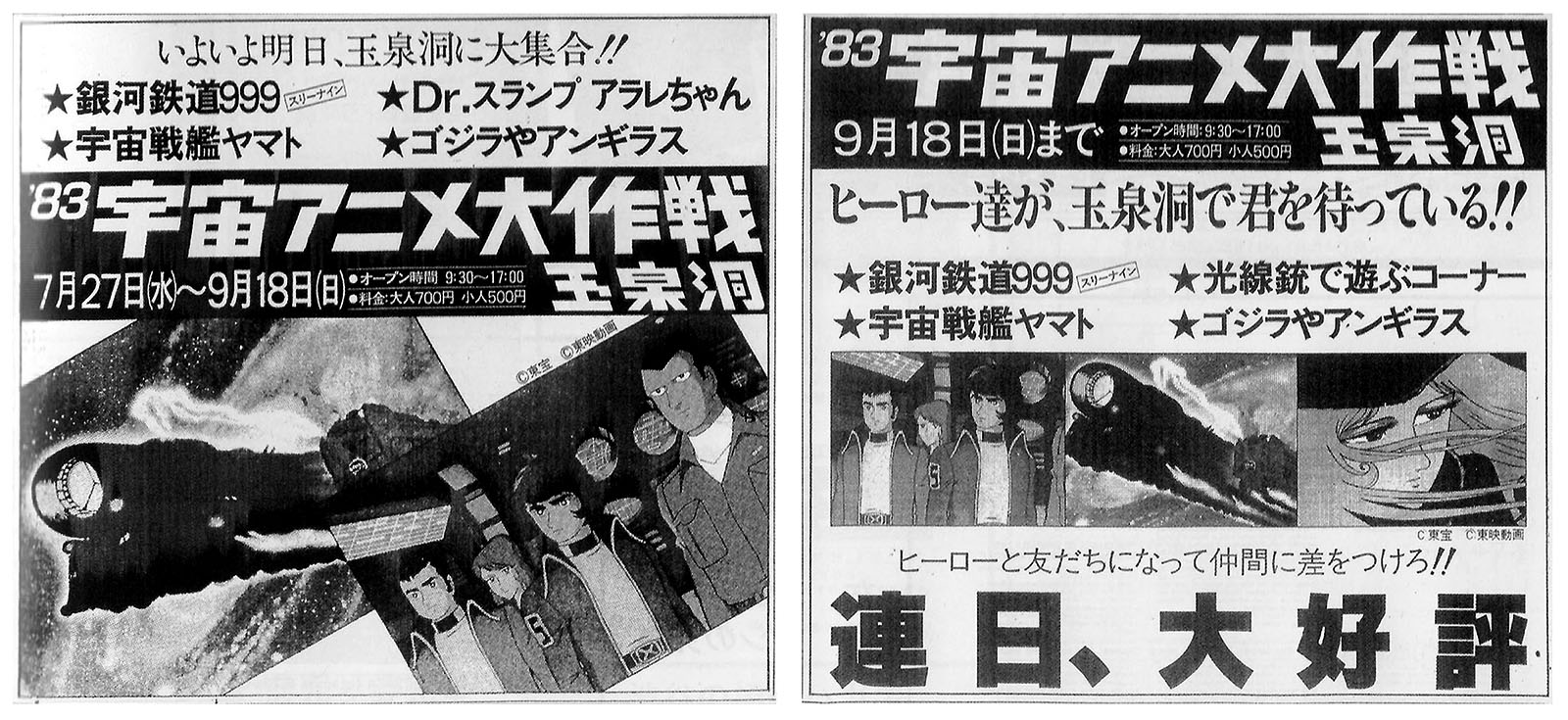
July 27: ’83 Space Anime Daisauksen [Big Operation]
If you made your way up north, you had a chance to see another Yamato exhibition in Okinawa World theme park (Nanjo City), specifically a section called Gyokusendo that contains a famous limestone cave. There, Yamato was in good company with attractions for Galaxy Express 999, Dr. Slump, and Godzilla.
The ads above announce, “The heroes are waiting for you at Gyokusendo” and “Make friends with heroes and stand out from the crowd.”
Also promoted was a “ray gun play area” to take your heroism to the next level.
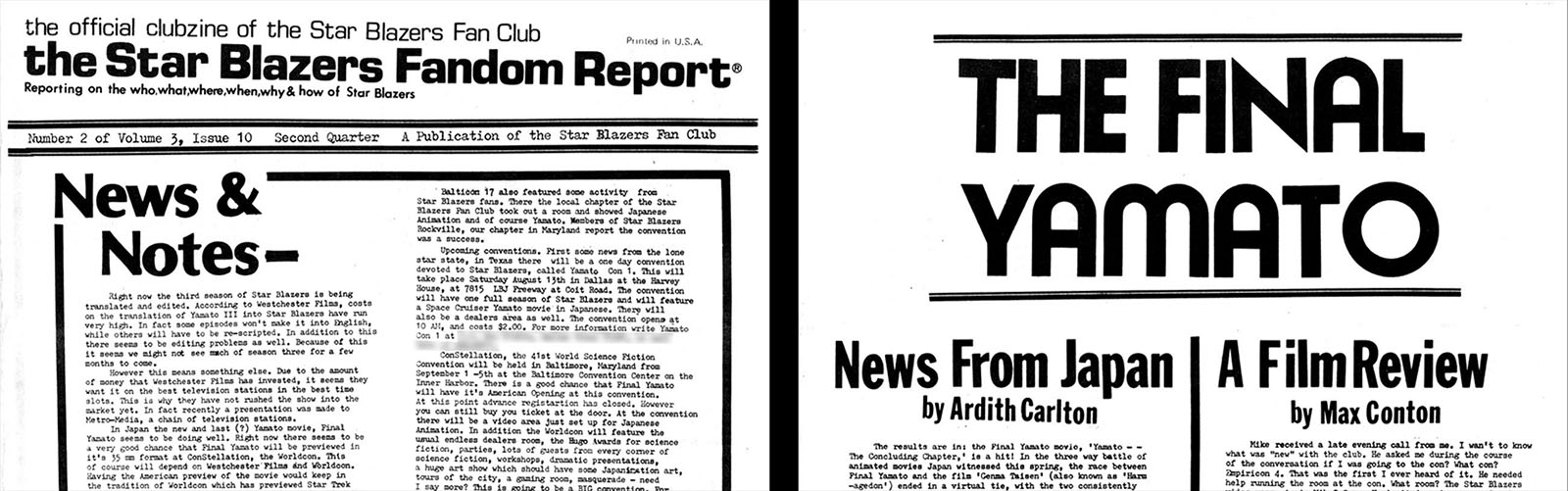
Star Blazers Fandom Report, issue 10
Covering the second quarter of 1983, this 10-page issue presented a roundup of “Star Blazers rooms” showing anime at recent SF conventions. This included Balticon 17 in Baltimore (April 9-11), Eastcon ’83 in New Jersey (June 24-26), and Empiricon 4 in New York City (July 1-4) . There was also a remarkably comprehensive roundup of the latest news from Japan and the first review of Final Yamato by an American viewer.
Read the issue here
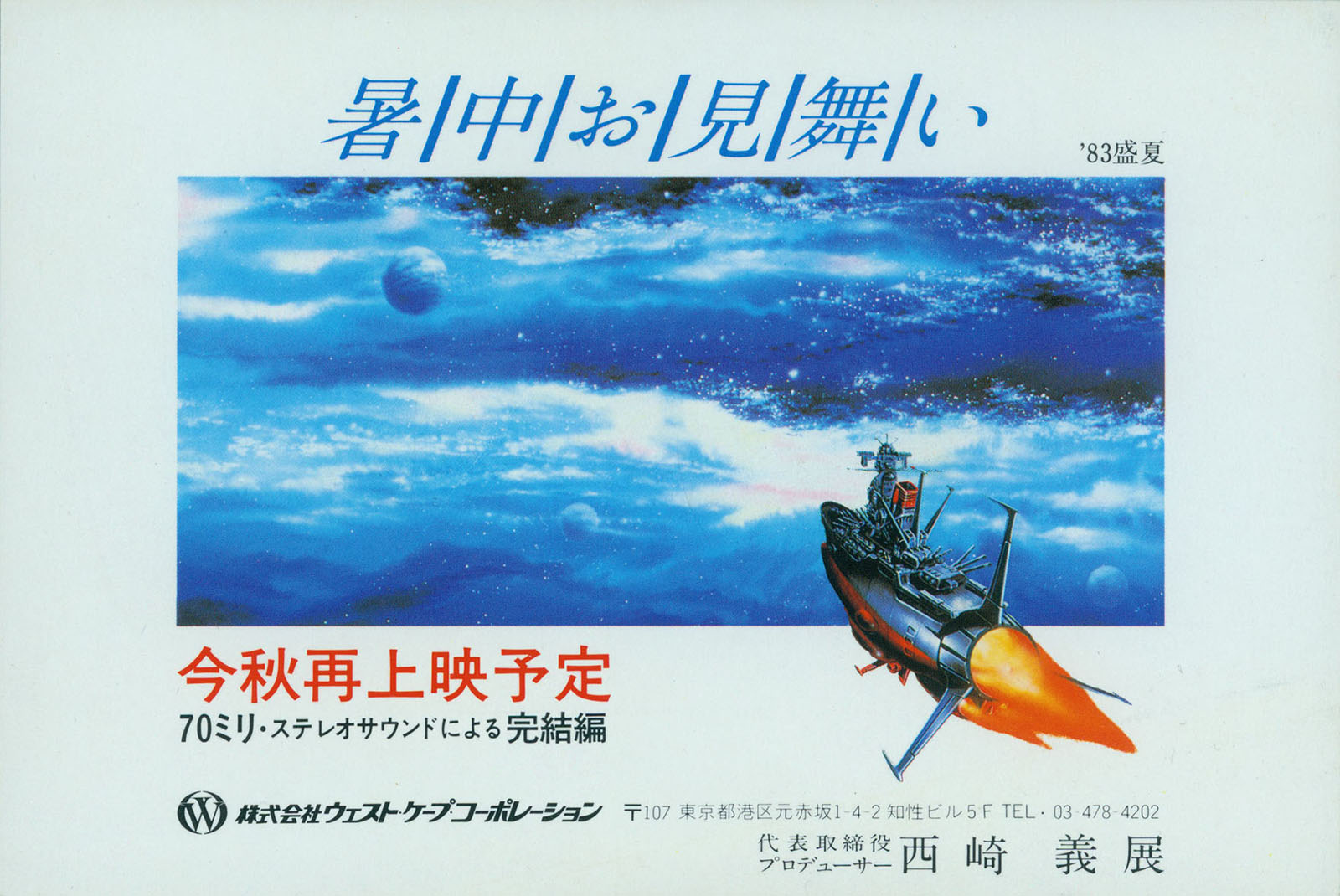
Fan club postcard
Members of the official fan club received this postcard with the following text:
Summer Greeting Card, ’83 midsummer
Returning to theaters this fall with 70mm stereo sound: The Final Chapter
Final Yamato Super Deluxe book promotion
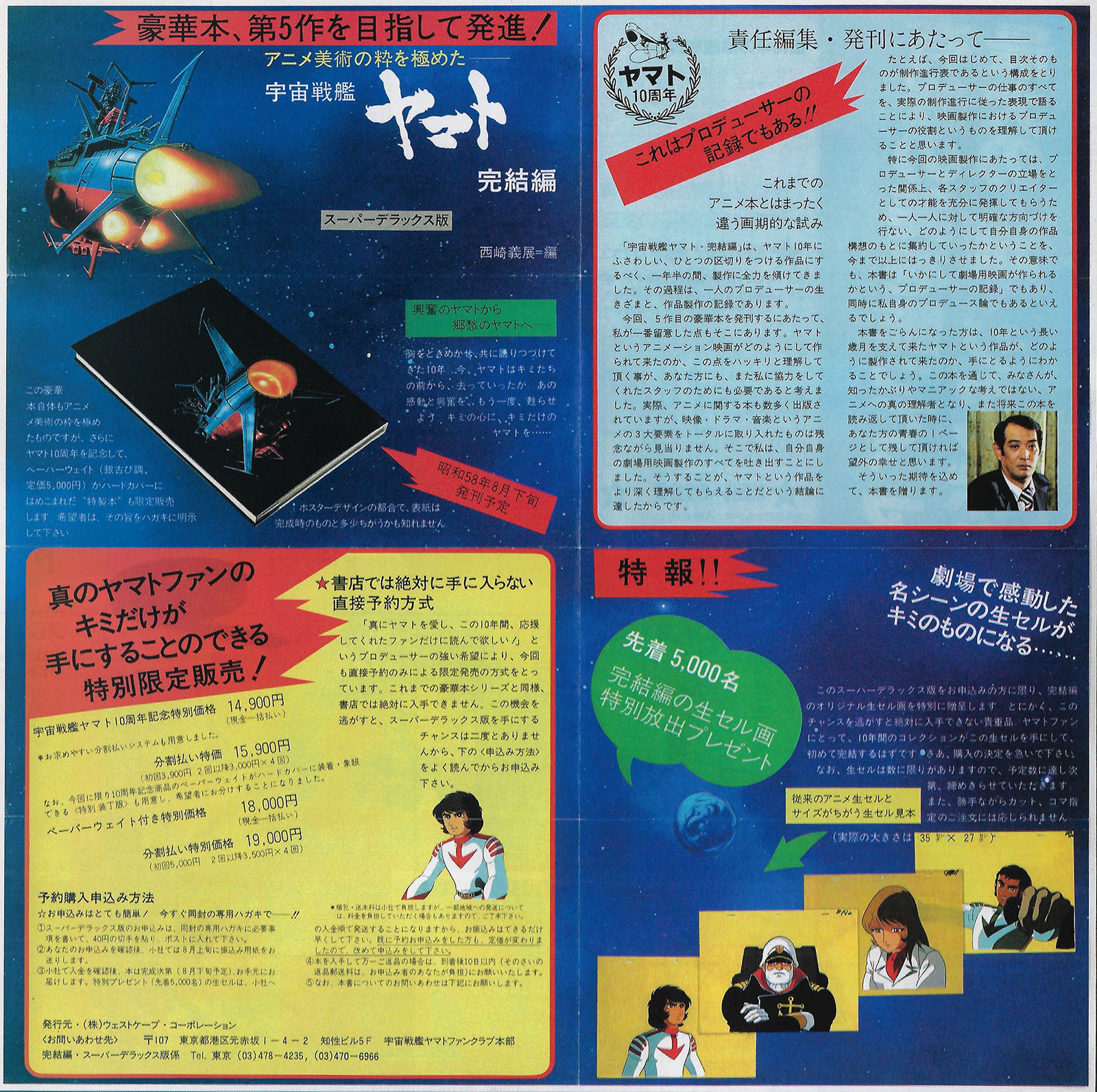
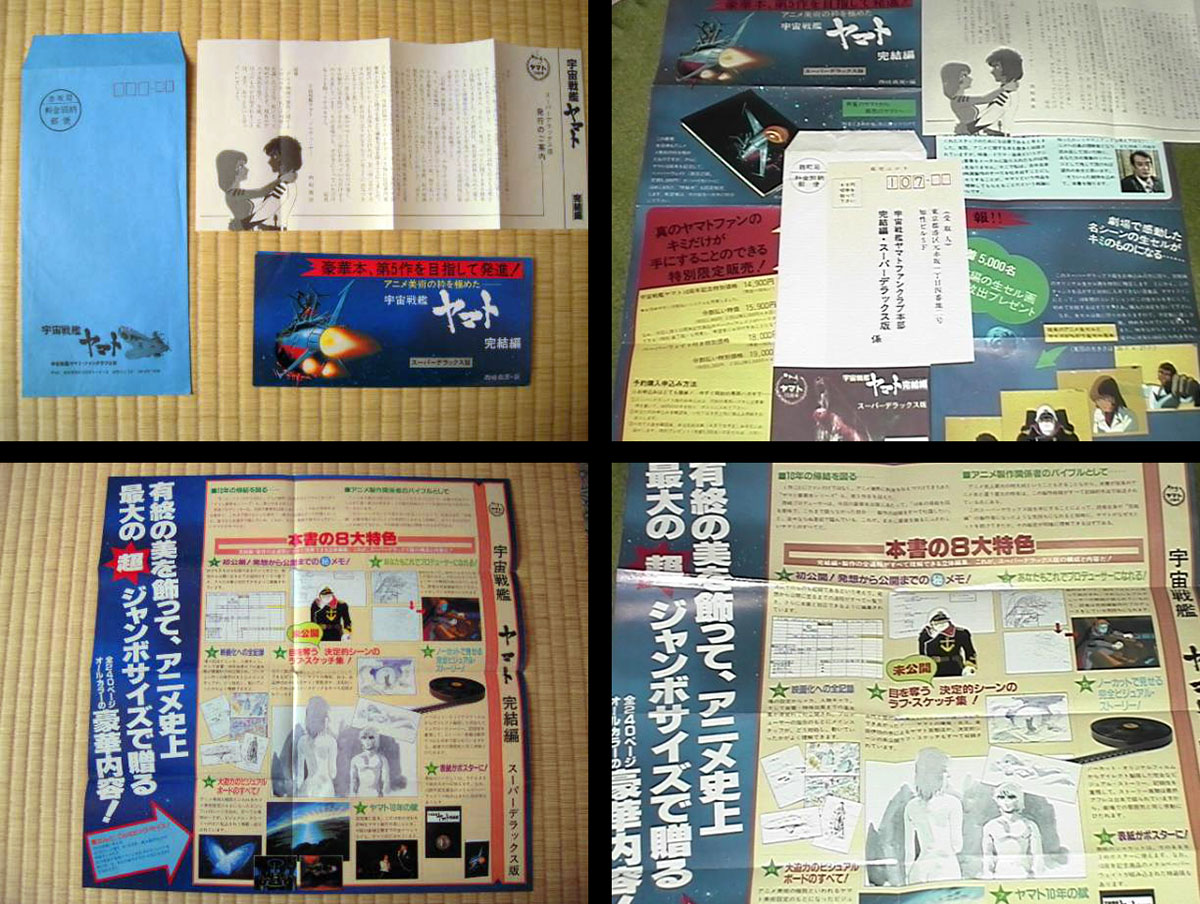
Right around the same time, the first promotional mailer for the upcoming hardcover from West Cape Corporation made it clear that the upcoming hardcover book for Final Yamato was going to be something special.
See enlargements of the 2-sided flyer at the end of this page.
Island Vol. 7 doujinshi
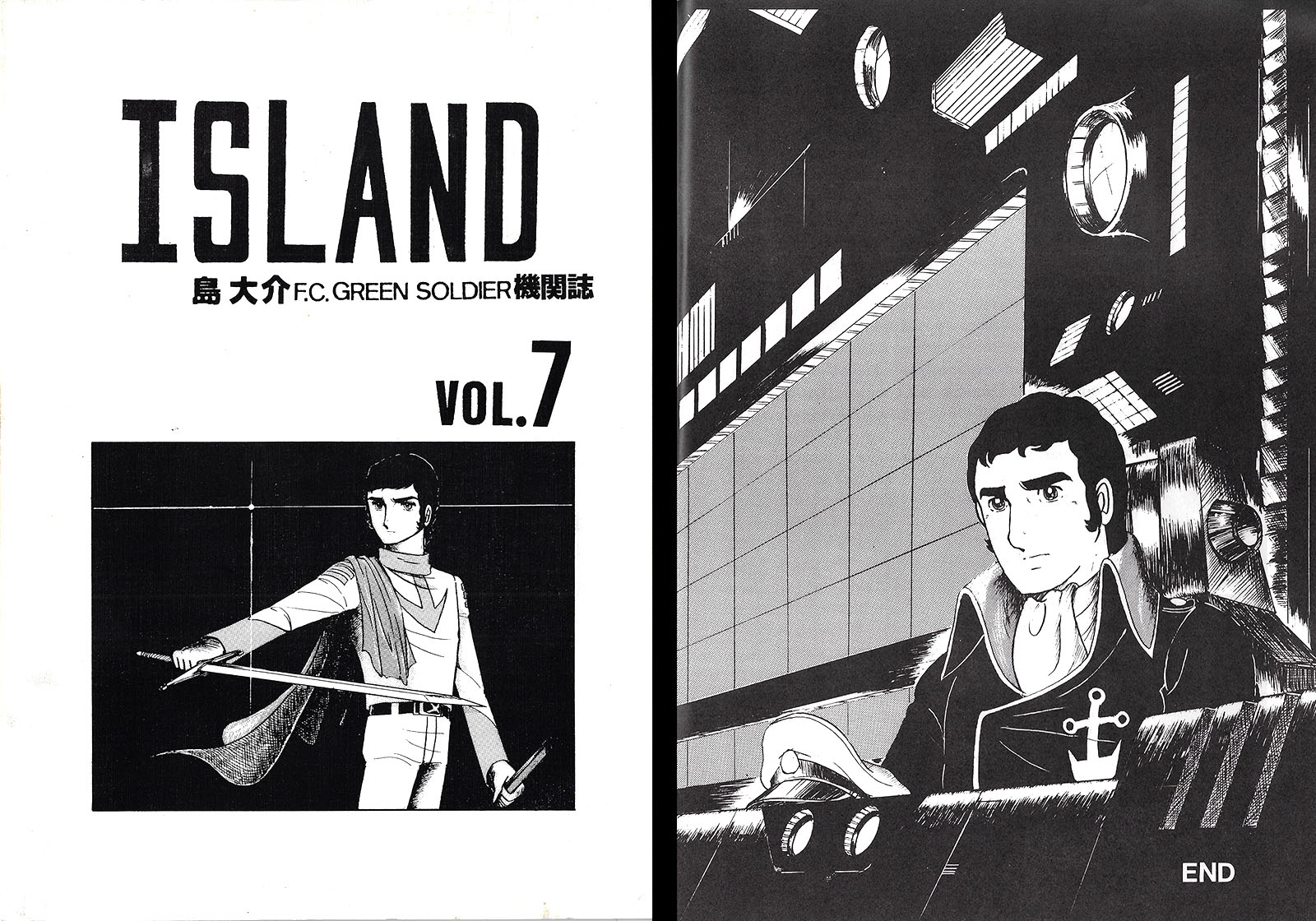
“Island” is the literal translation of “Shima,” and it should come as no surprise that Daisuke Shima was popular enough to not only have his own fan club, but that a dedicated doujinshi would last for at least 7 issues. The fan club was named F.C. Green Soldier, and since this 52-page issue was the first to appear after Shima’s fate was depicted in Final Yamato, the essays and fan art were loaded with passion.
See this issue from cover to cover here
July context
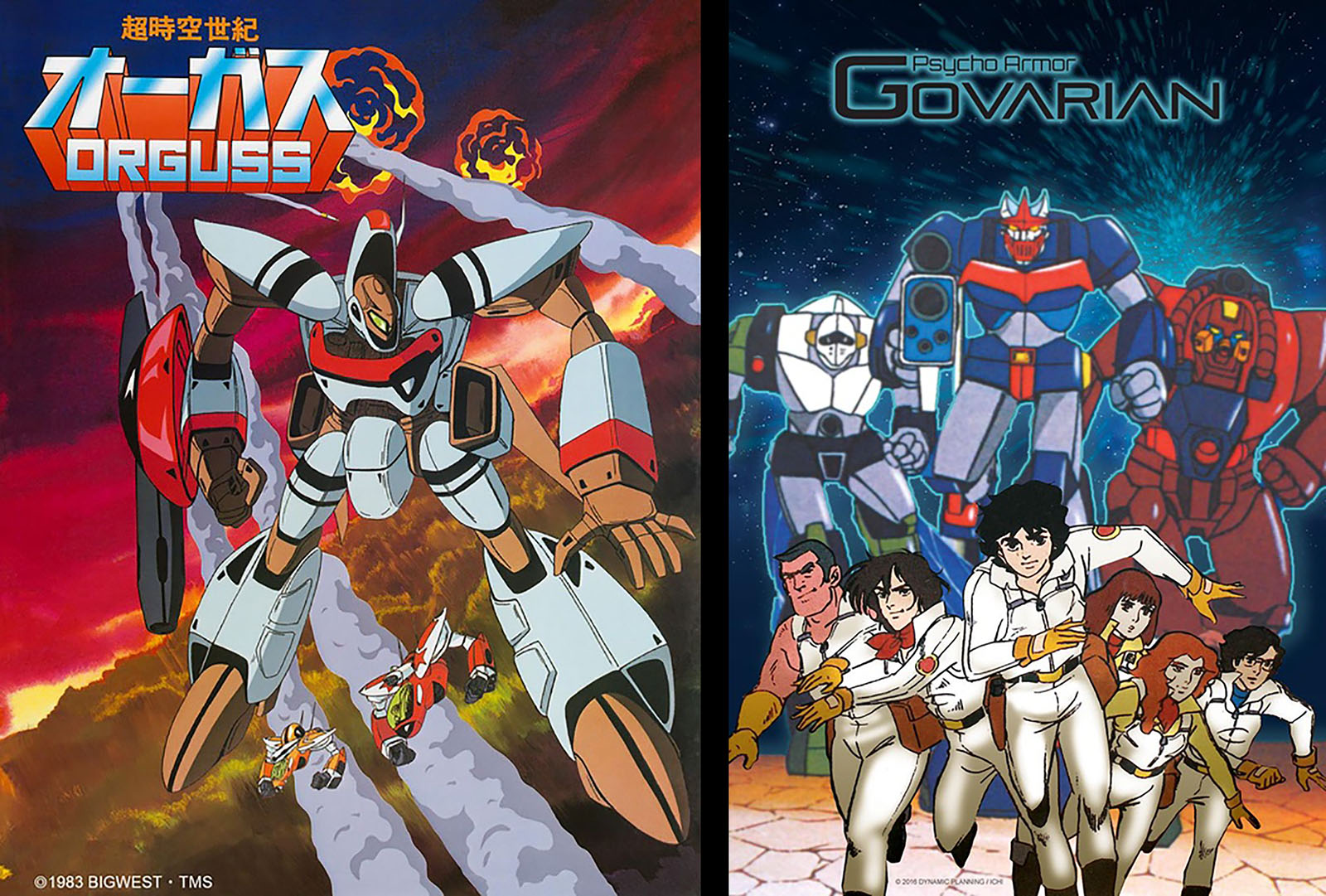
Two new SF anime series debuted on TV in July. Super Dimension Century Orguss, the next offering from the fine people who brought you Macross, arrived on July 3. Three days later, Psycho Armor Govarian became the latest entrant in the super robot category on July 6.
Anime magazines published in July


Two covers for the new TV series Superdimension Century Orguss, one each for Xabungle (movie) and Giant Gorg (which won’t debut on TV until next April).
August 7: Yoshinori Kanada fan club doujinshi vol. 4
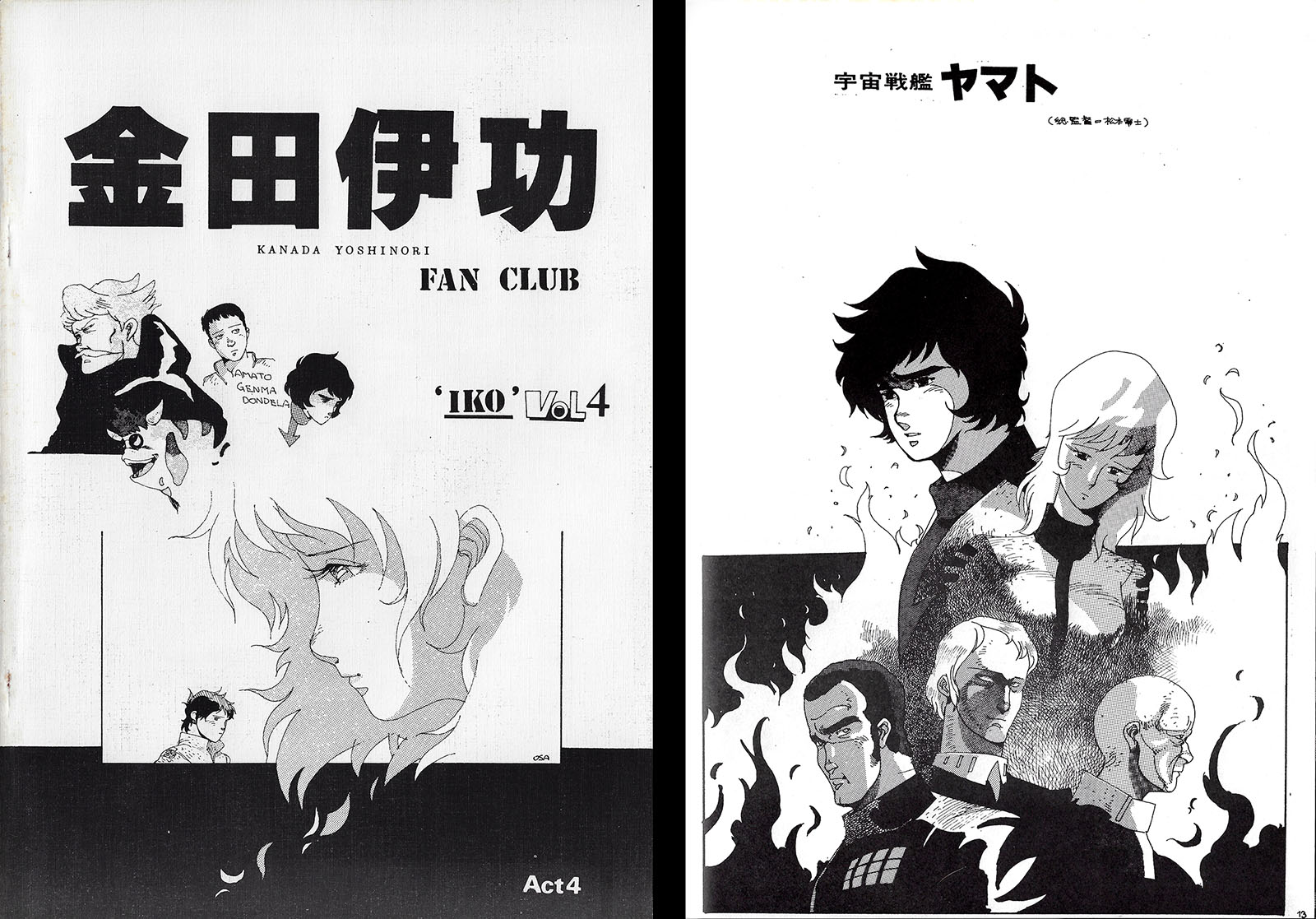
One of the greatest gifts Yamato brought to the anime community was recognition for the people who actually made anime. This allowed virtuosos like animator Yoshinori Kanada to enjoy fame of their own, independent of their attachment to one series or another. This 4th issue of a Kanada fan club’s doujinshi observed his latest work from 1983 and included 17 pages of analysis on his contributions to the entire Yamato saga.
Read this article here
To see what earned Yoshinori Kanada this level of devotion, click here
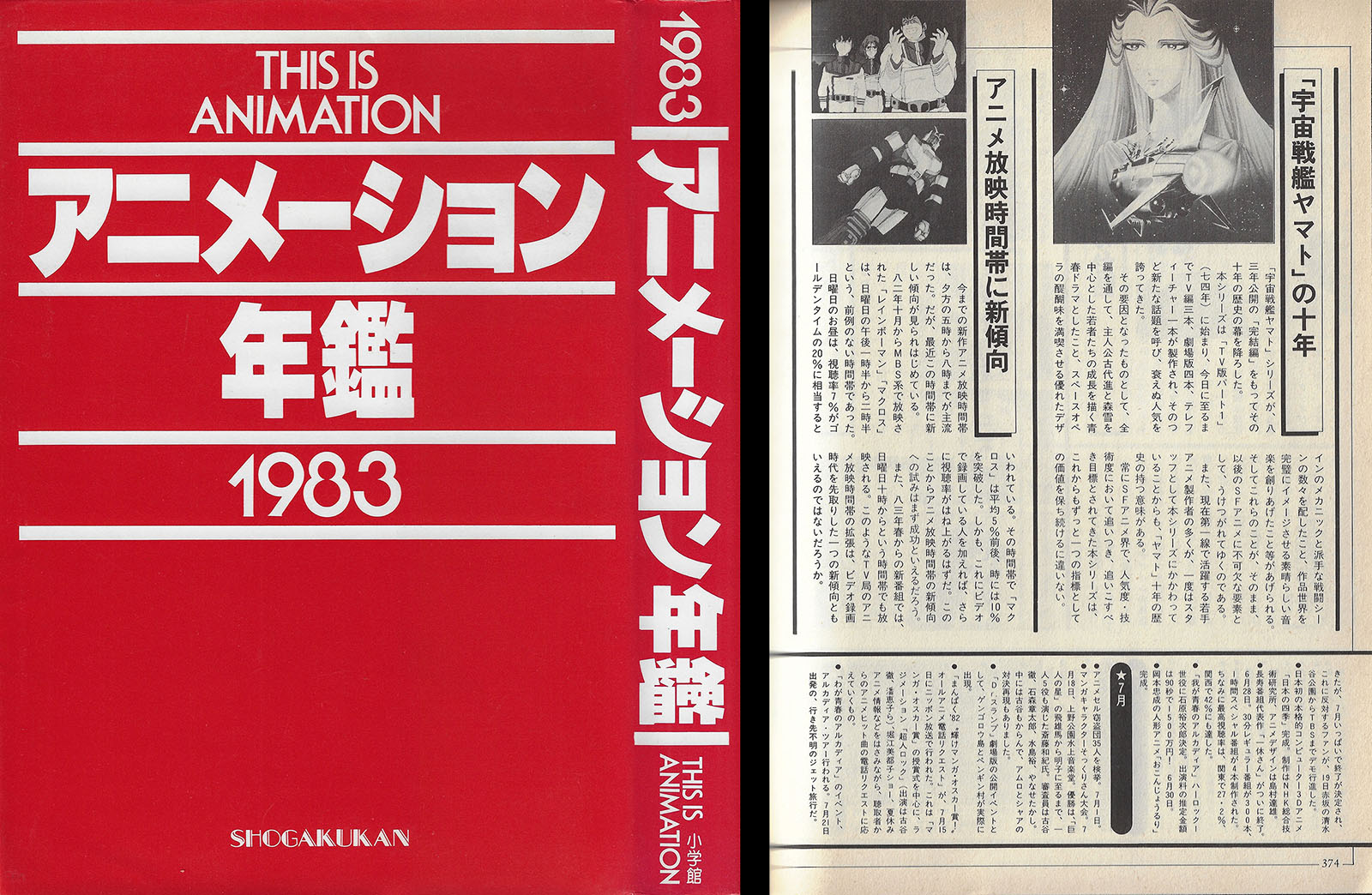
August 9: This is Animation, Animation Yearbook 1983
From publishing giant Shogakukan did the Lord’s work with this thick treasure trove (over 400 pages) summarizing ALL of the anime produced from March 1982 to March 1983. That’s every episode of every TV series and ever film that played in theaters. Since Final Yamato was part of that, it received a 2-page spread (shown below) and a brief explainer (above right).
The explainer text reads:
Ten Years of Space Battleship Yamato
The Space Battleship Yamato series drew to a close after ten years of history with the release of The Final Chapter in 1983. This series began with “TV Part 1” (1974) and has since produced three TV series, four feature films, and one telefeature, each of which generated new buzz and maintained its enduring popularity.
The reasons for this include the fact that the entire story is a coming-of-age drama depicting the growth of young people, centered around the main characters Susumu Kodai and Yuki Mori, and the excellent design that allows viewers to fully enjoy the essence of space opera. This includes the use of innovative mecha and a number of spectacular battle scenes, as well as the creation of fantastic music that perfectly evokes the world of the work. These elements have continued to be essential in subsequent science-fiction anime.
The ten year history of Yamato is also significant because many of the young anime producers currently active at the forefront of the industry were once involved in the series as staff members. This series has always been a benchmark to be surpassed in terms of popularity and technical quality in the world of sci-fi anime, and it is sure to continue to hold value as a benchmark for a long time to come.
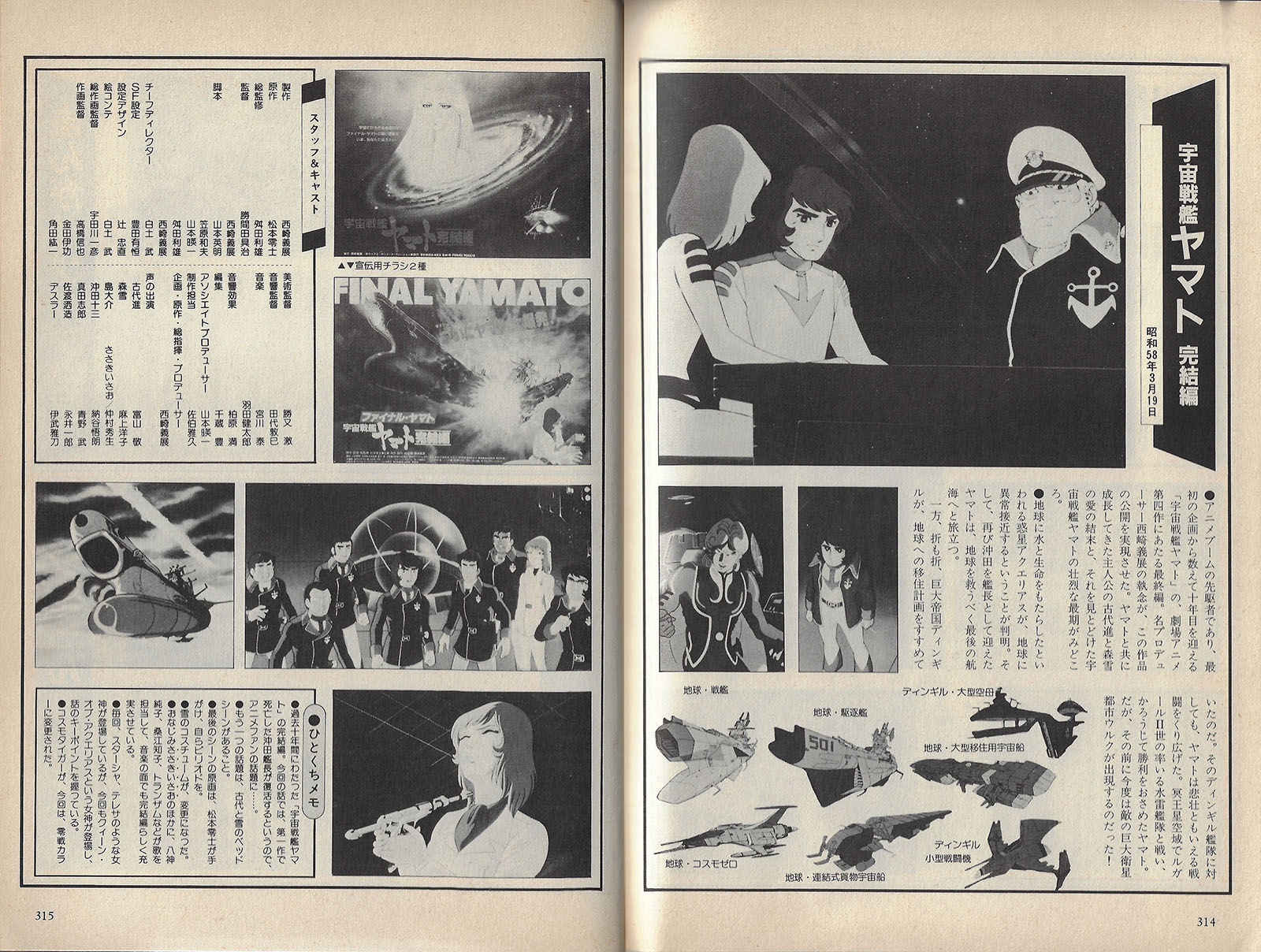
The text block at far left (bottom) reads:
Quick Memo
• This is the final chapter of Space Battleship Yamato, which has been running for the past ten years. In this episode, Captain Okita, who died in the first film, is resurrected, which became a hot topic among anime fans.
• Another topic of conversation is the love scene between Kodai and Yuki.
• The original artwork for the final scene was done by Leiji Matsumoto, who put an end to it himself.
• Yuki’s costume was changed.
• In addition to the familiar Isao Sasaki, song vocals were performed by Junko Yagami, Tomoko Kuwae, and Trans Am, making the musical aspect of the film a complete and fulfilling experience.
• In each story, a goddess appears, such as Starsha or Teresa. This time, a goddess called the Queen of Aquarius appears and holds the key to the story.
• This time, the Cosmo Tiger squadron has been modified into a regular fighting force (ground troops).
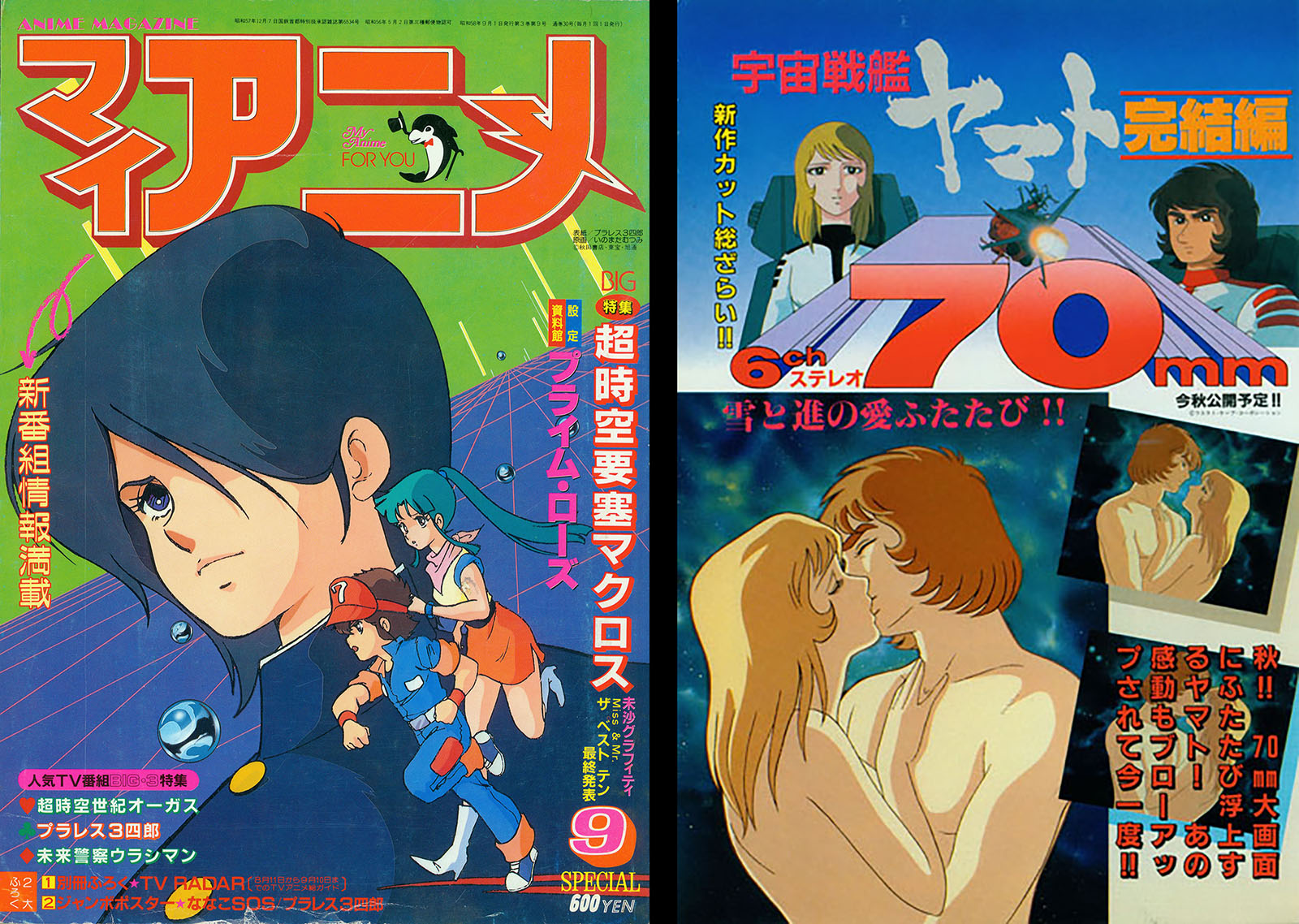
August 10: My Anime, September issue
With SF anime exploding on TV and Final Yamato now four months in the past, all the other anime magazines had their hands full – but My Anime dipped into the well again to bring word of the 70mm edition. It wasn’t much – three pages of stills and a short essay by Nishizaki – but it was a nice reminder of what was to come. And it even offered an explanation (sort of) for why the movie wasn’t initially released in 70mm as planned.
Read the article here
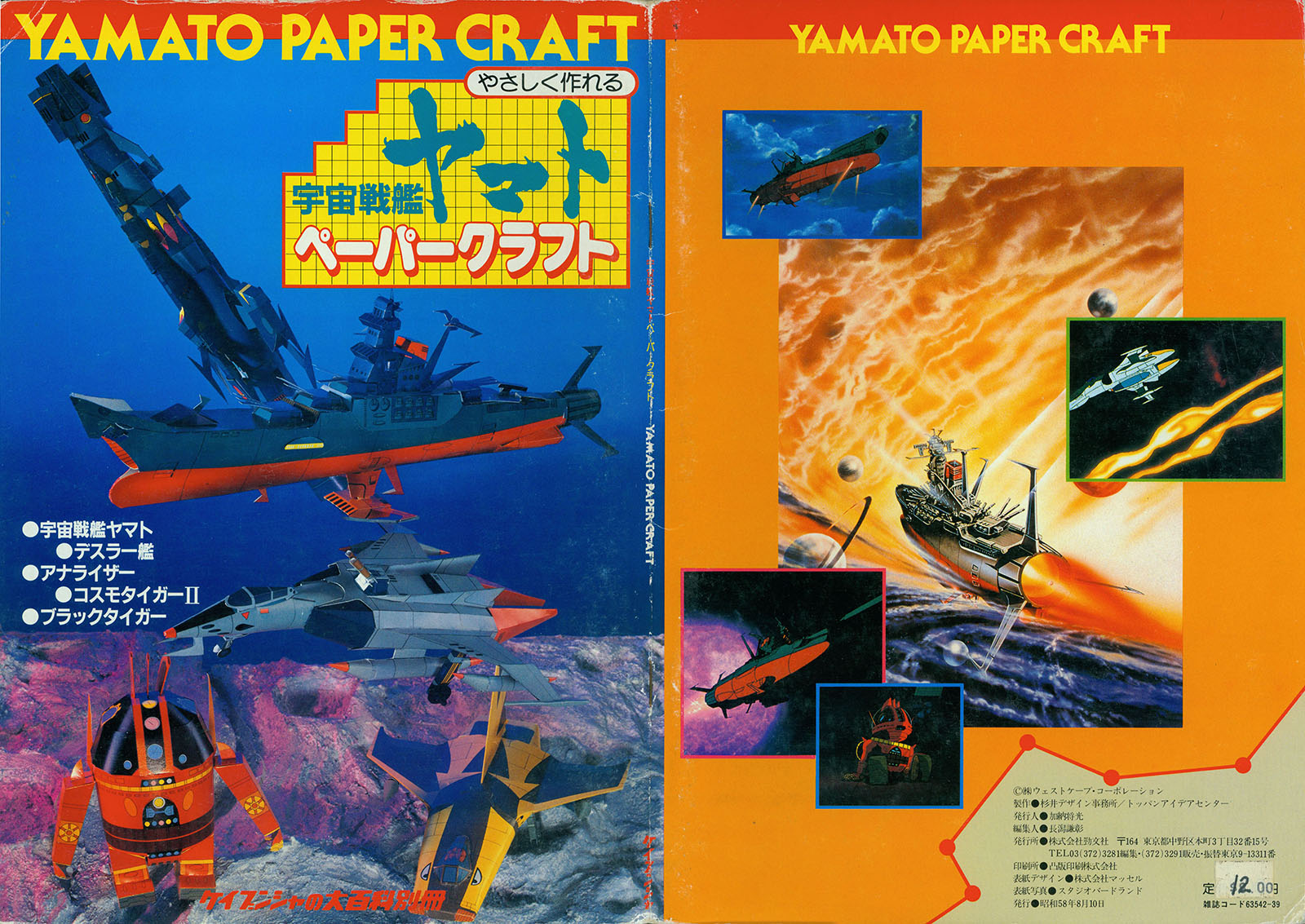
August 10: Space Battleship Yamato papercraft
Kodansha produced a number of papercraft books like this one for various different anime programs, but the fad was short-lived. On the other hand, it was an inexpensive alternative to plastic models and offered five construction projects in a single book: Yamato, Dessler’s battleship, a Black Tiger, a Cosmo Tiger, and Analyzer.
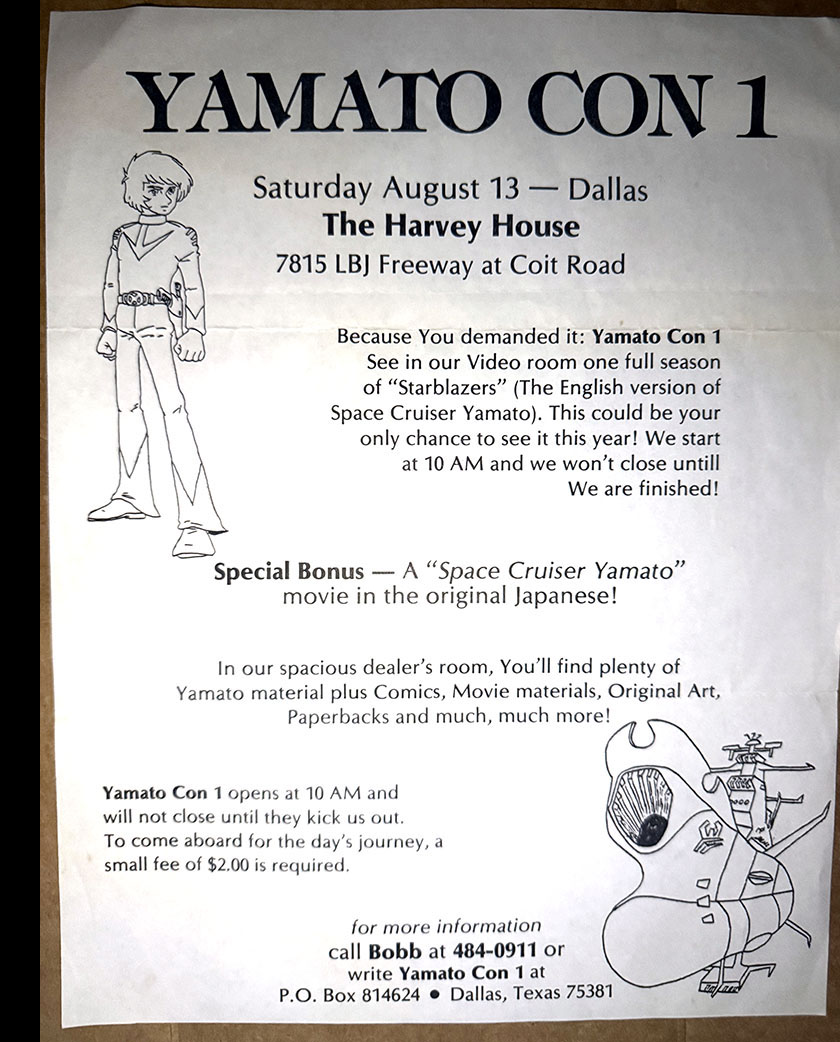
August 13: Yamato Con 1, Dallas TX
By the summer of 1983, enough time had passed for anime fandom in America to get up on its own two feet and start making waves of its own. The founding of the Star Blazers fan club on the upper east coast and the Earth Defense Command in the hotbed of Texas were just two of the ignition points. Star Blazers viewers had begun to catch the first trickle of Space Battleship Yamato thanks to private tape-trading with Japanese friends and the movies’ arrival on Japanese home video in late April.
The first anime con worthy of the name was none other than Yamato Con 1, which took place in Dallas on August 13. Read all about it in a detailed report by guest writer Dave Merrill here.
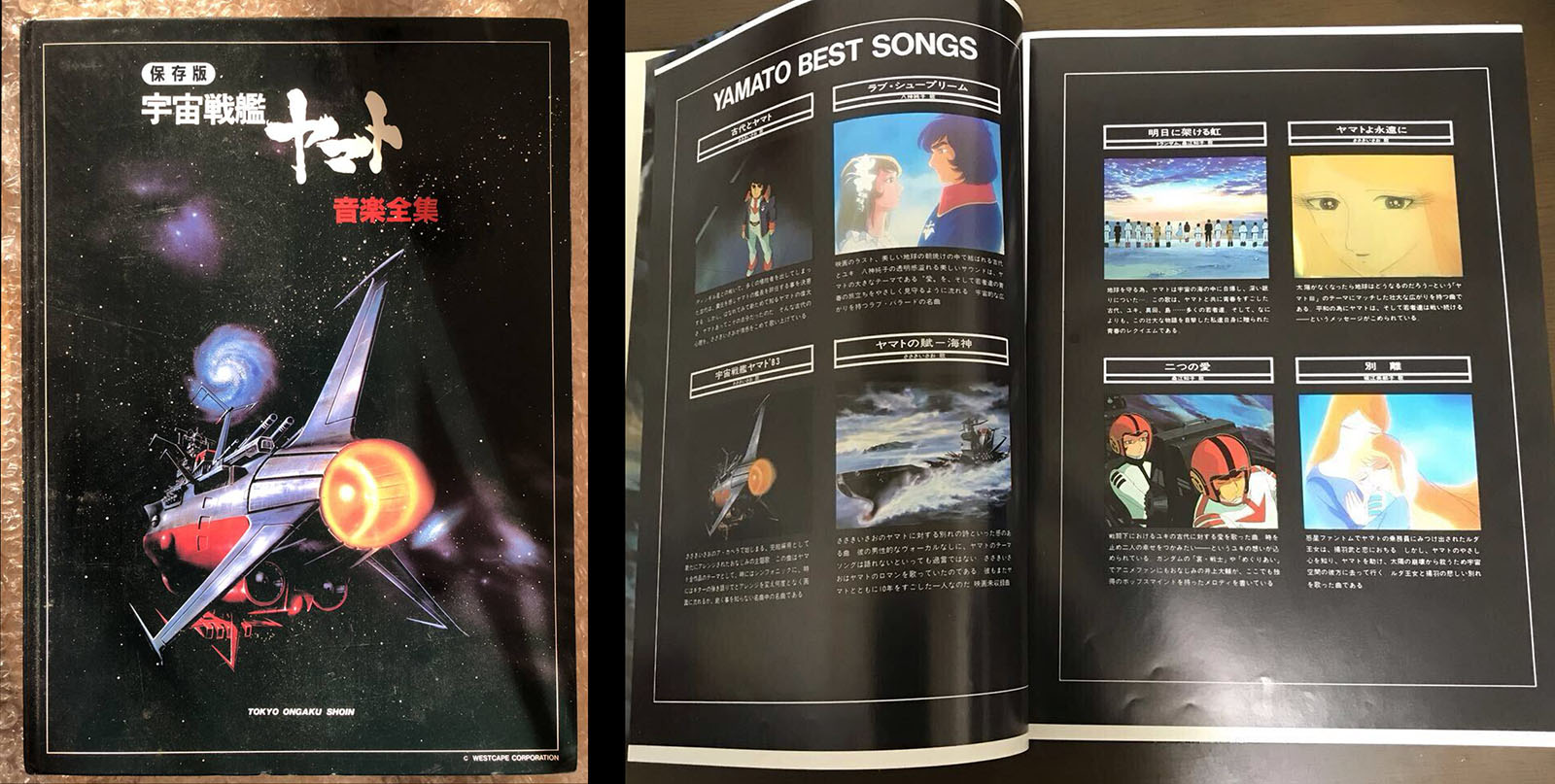
August 20: Space Battleship Yamato Complete Music Works
Tokyo Ongaku Shoin [Music Study] was a prodigious publisher of anime sheet music with one offering after another in the early 80s. Yamato was the leader in the anime category with several collections in both hardcover and softcover, all highly prized by collectors today. But once you got your hands on this saga-spanning omnibus, which ran over 300 pages, you were pretty much set for life. Inside were piano arrangements for 21 theme songs, 30 BGM compositions, and the entire Symphonic Suite. Also included was piano duo sheet music for the Yamato theme and The Scarlet Scarf.
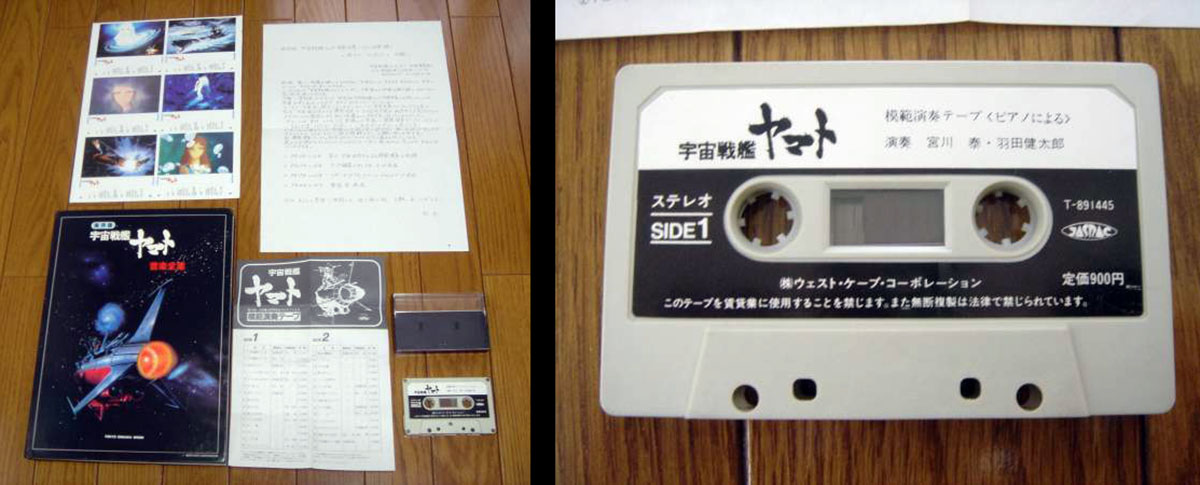
Fans who ordered the book from the official fan club could pay a little more and get a limited-edition 90-minute cassette tape titled Complete Music Works Model Performance. 29 tracks were selected from the score and performed on piano by Hiroshi Miyagawa and Kentaro Haneda. (It also came with a set of cassette labels as shown above left.) Only 2,000 tapes were made, so they disappeared quickly to become true collector’s items.
Fortunately for all of us, the recordings were revived as a series of bonus tracks in the Yamato Sound Almanac CD series in 2013. (Read about it here.)
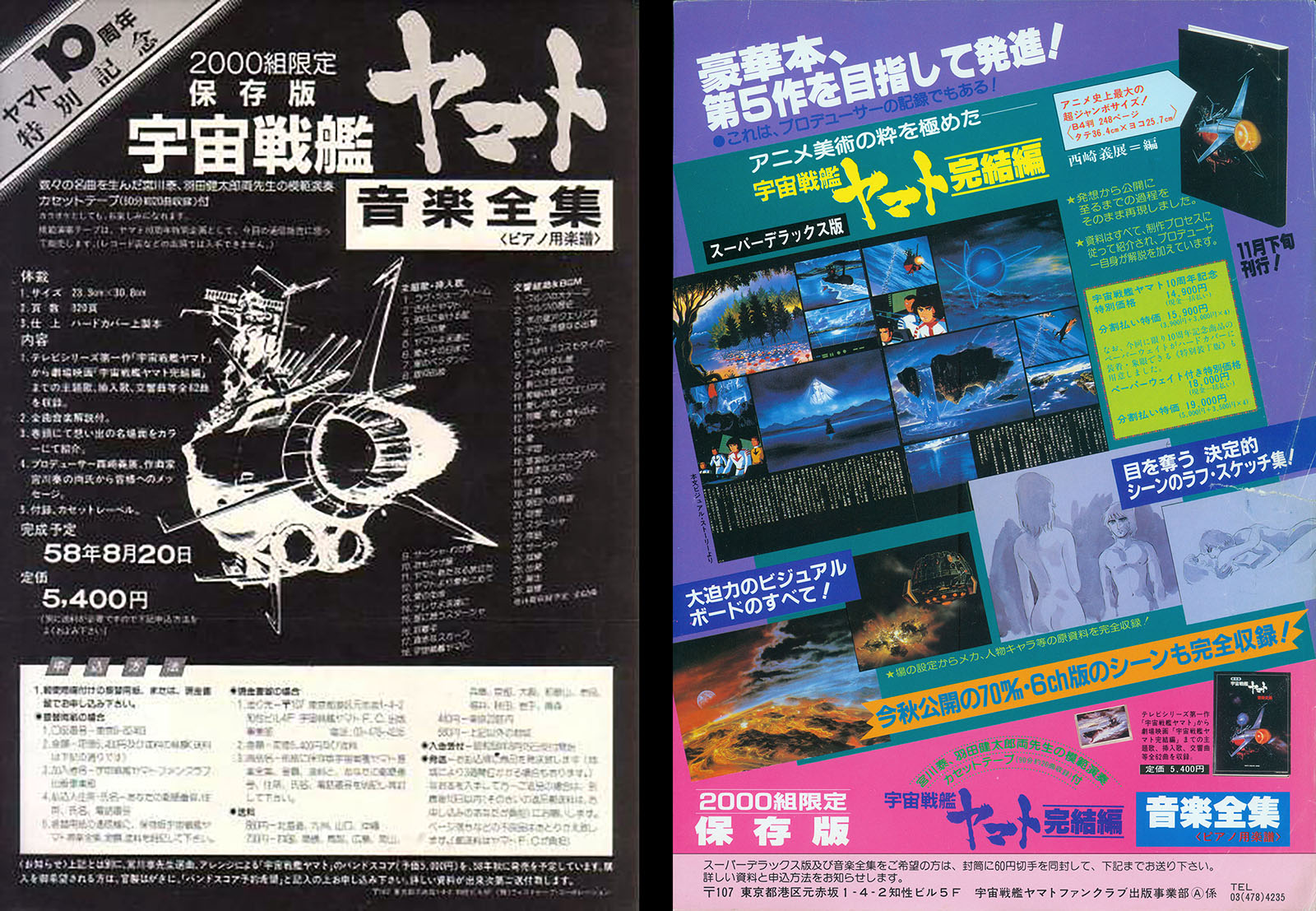
Flyers for the book/cassette combo. The one at right promotes the Final Yamato hardcover book at the top and the book/cassette combo at the bottom.
August 21: Final Yamato symphonic album 3
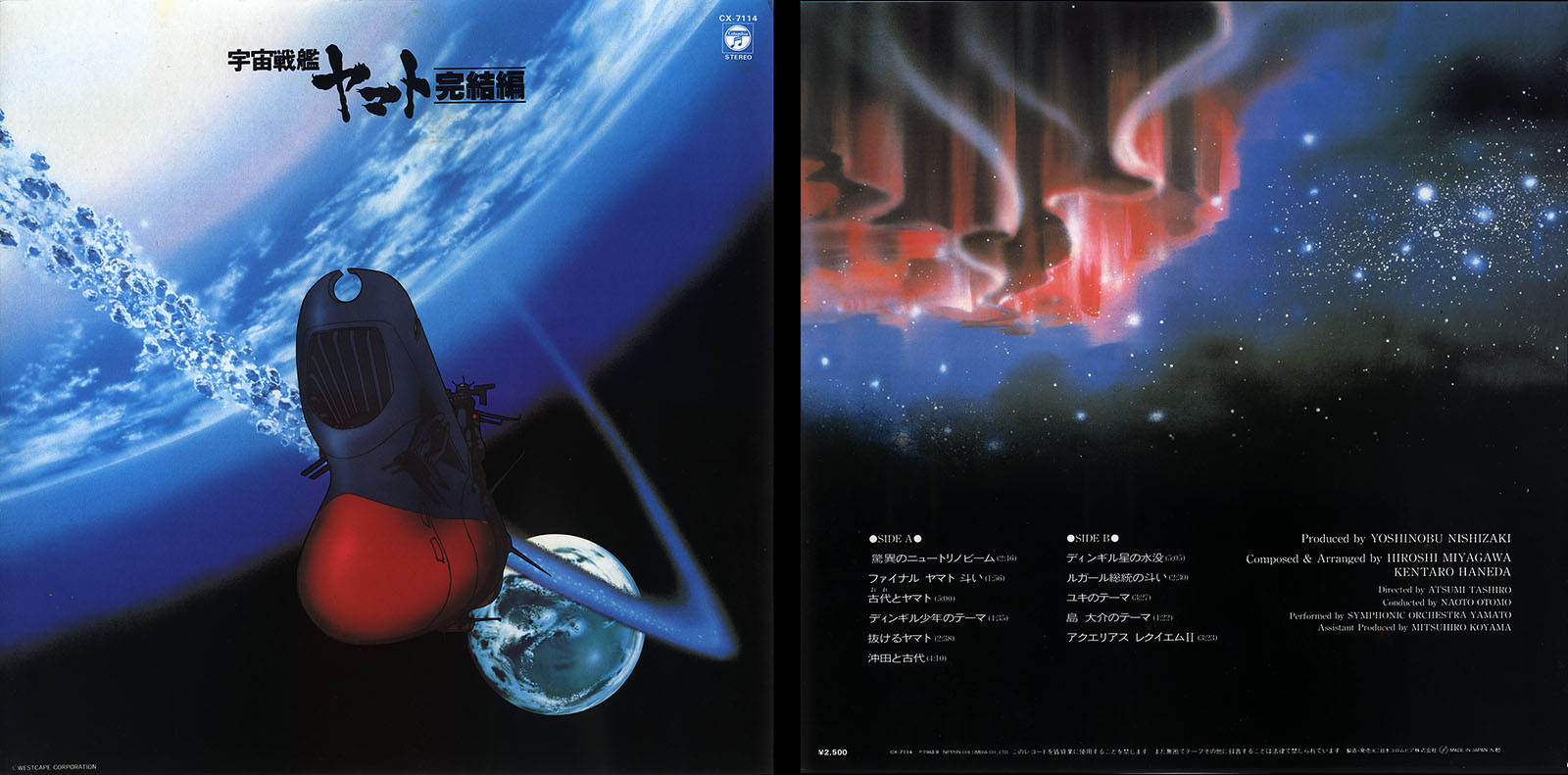
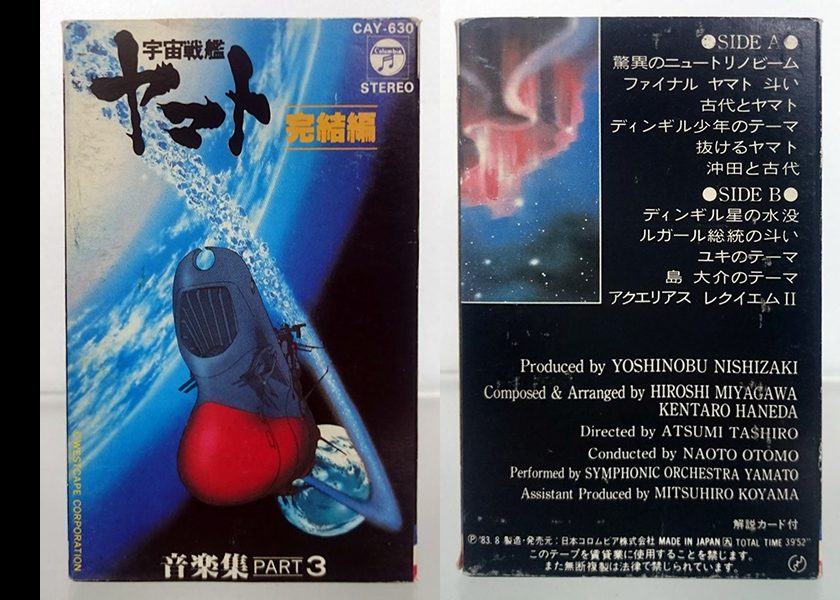
The third and last symphonic album from Columbia brought the grand total to five, counting the two releases from Tokuma/Animage. Fans would have to wait for another thirty years for every last scrap to come out of the vault, but there was plenty to chew on in the meantime. Volume 3 was organized more loosely than the others, providing a sort of ‘easy listening’ collection of varying styles.
Review the entire Final Yamato discography here
See a complete Final Yamato music index here
August 28/29: Farewell to Yamato screened at NYC Creation Con
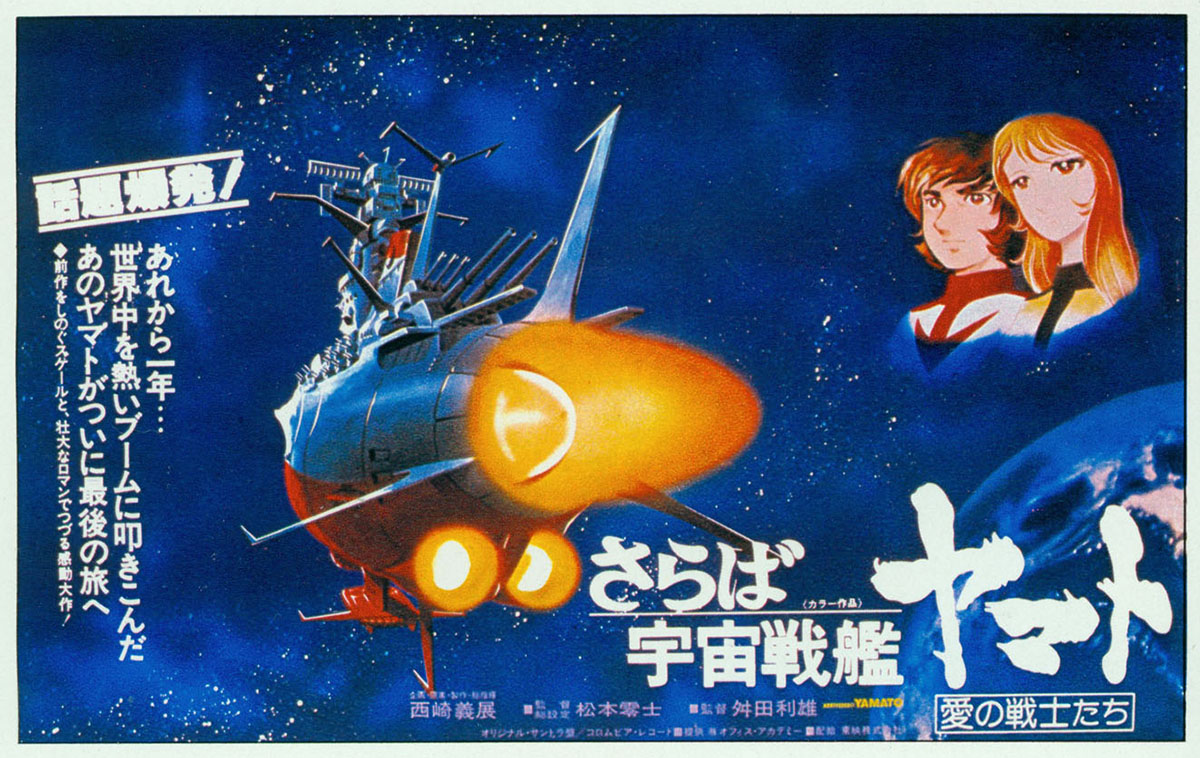
A 35mm print of Farewell to Yamato (still known as Arrivederci Yamato in those days) made two surprise appearances in America, first at Creation Convention New York (August 28/29) and then at ConStellation (the 41st World SF Con) in Baltimore (September 1-5, more info below).
August 29: Sydney Morning Herald article
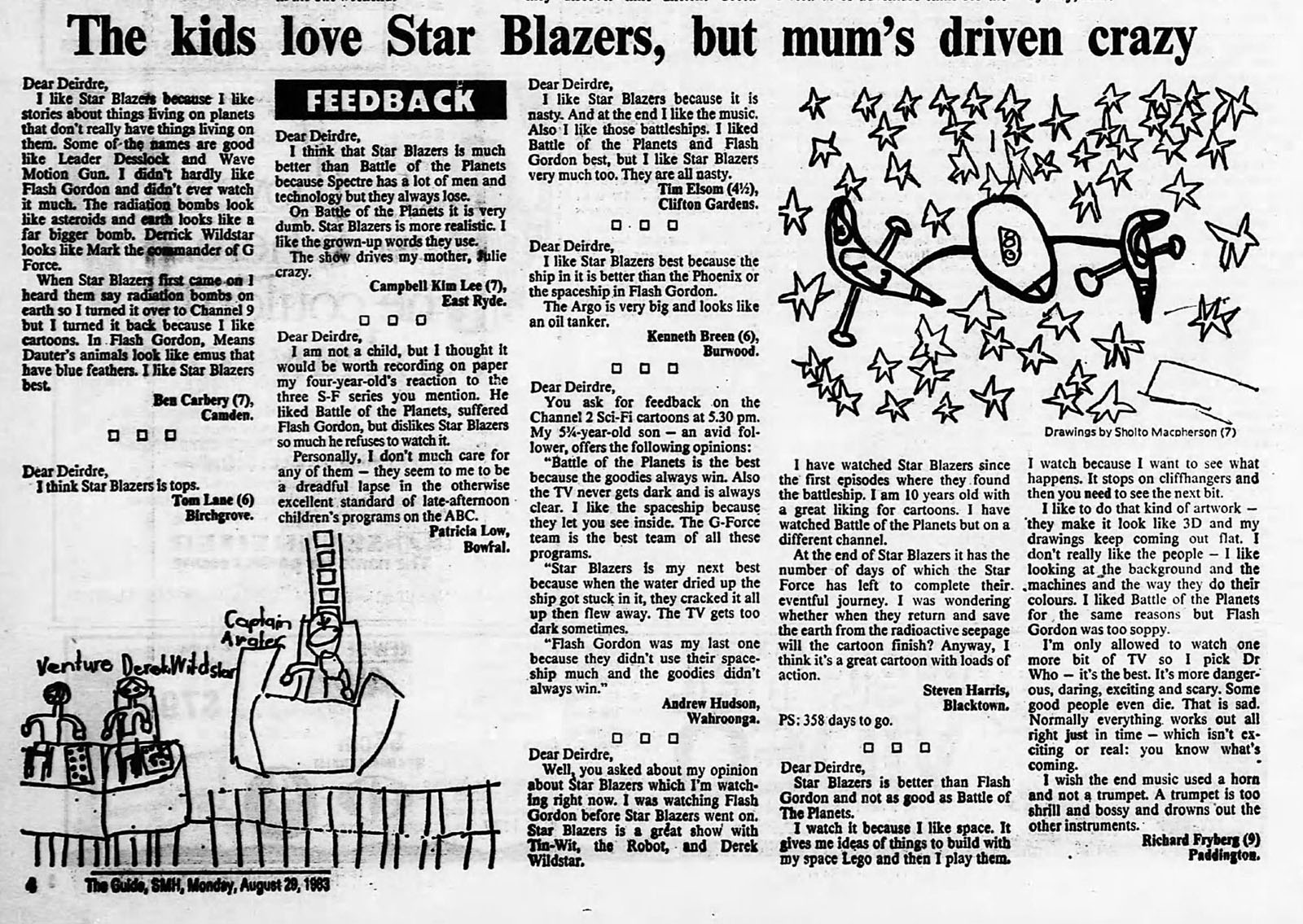
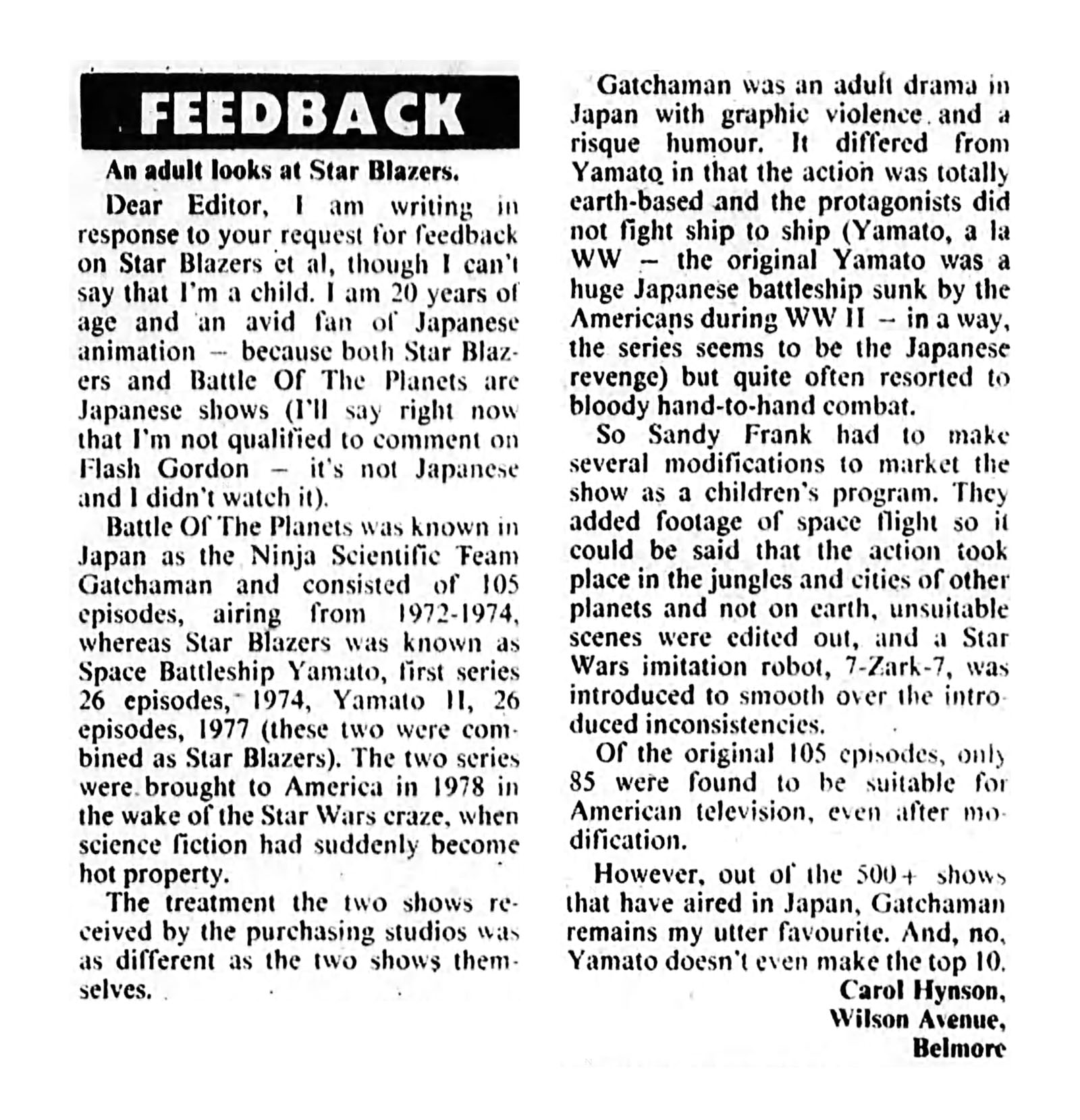
While Yamato was in a long winding-down phase in Japan, Star Blazers was still out there making TV syndication waves in the rest of the English-speaking world. This included Australia, as evidenced by this clipping from the letters column of the Sydney Morning Herald.
Click here to read a larger PDF
Special thanks to anime researcher Samantha Ferreira for this find!
Followup
On September 5, exactly one week later, the Sydney Morning Herald published this response to the August 29 column. In it, a fan named Carol Hynson took Australia to school with a very accurate primer on the anime phenomenon. However, this account didn’t quite end where you’d like it to.
Anime magazines published in August

Rapport Publishing stops alternating Animec with Fanroad and Animec is now monthly.

September 1-5: ConStellation (Baltimore Worldcon)
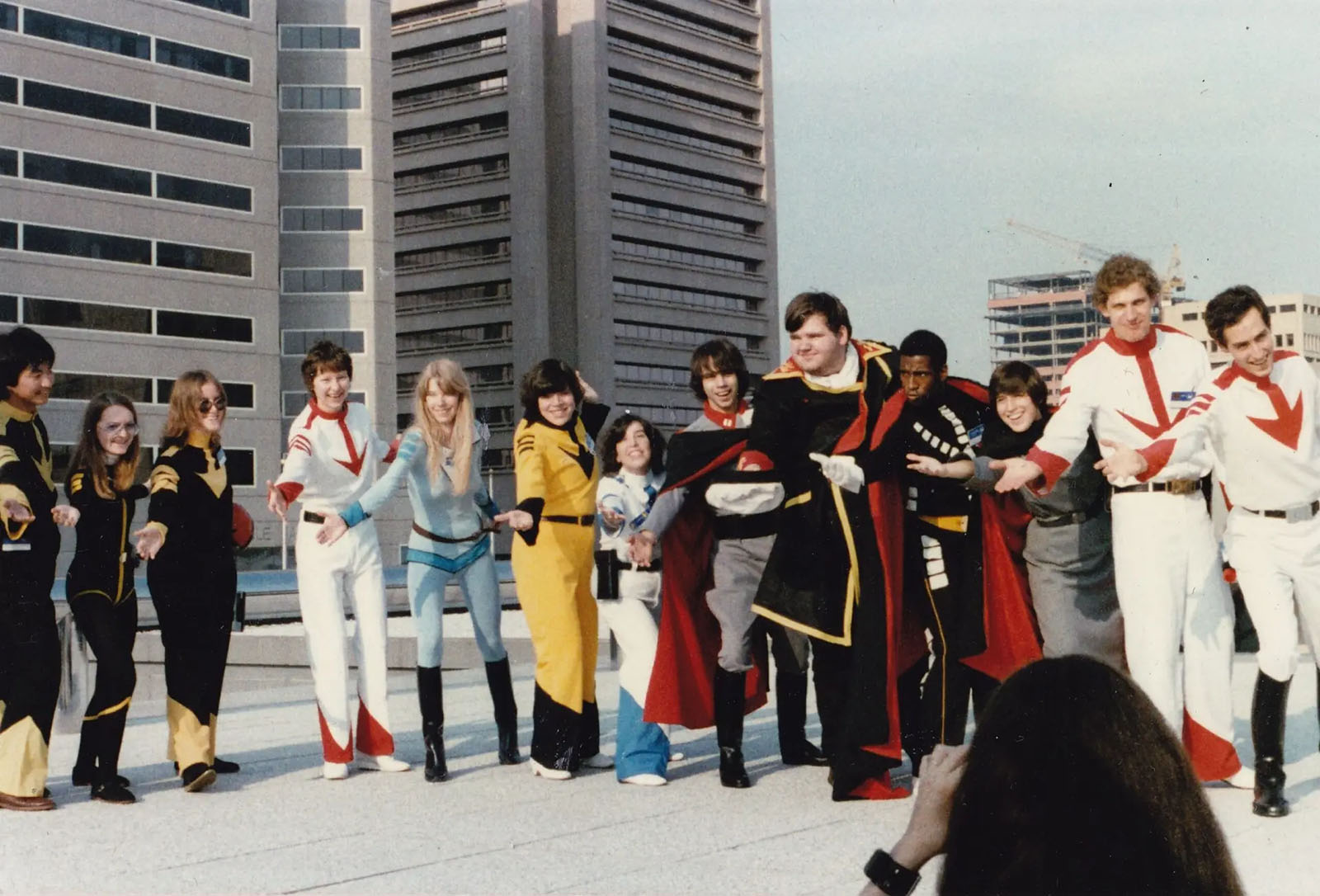
You have to search long and hard to find a bigger assemblage of Star Blazers cosplayers. This historic photo was taken on the roof of the Baltimore Convention Center and may in fact still be the record holder even after all the intervening decades.
Thanks to Robert Fenelon (who appeared in the photo as Desslok), we can go a little deeper into both this event and the Creation Con that took place in August. Click here to read an extensive interview with Anime Herald that is guaranteed to fill some gaps in your knowledge of anime fandom.
Star Blazers Fandom Report issue 11
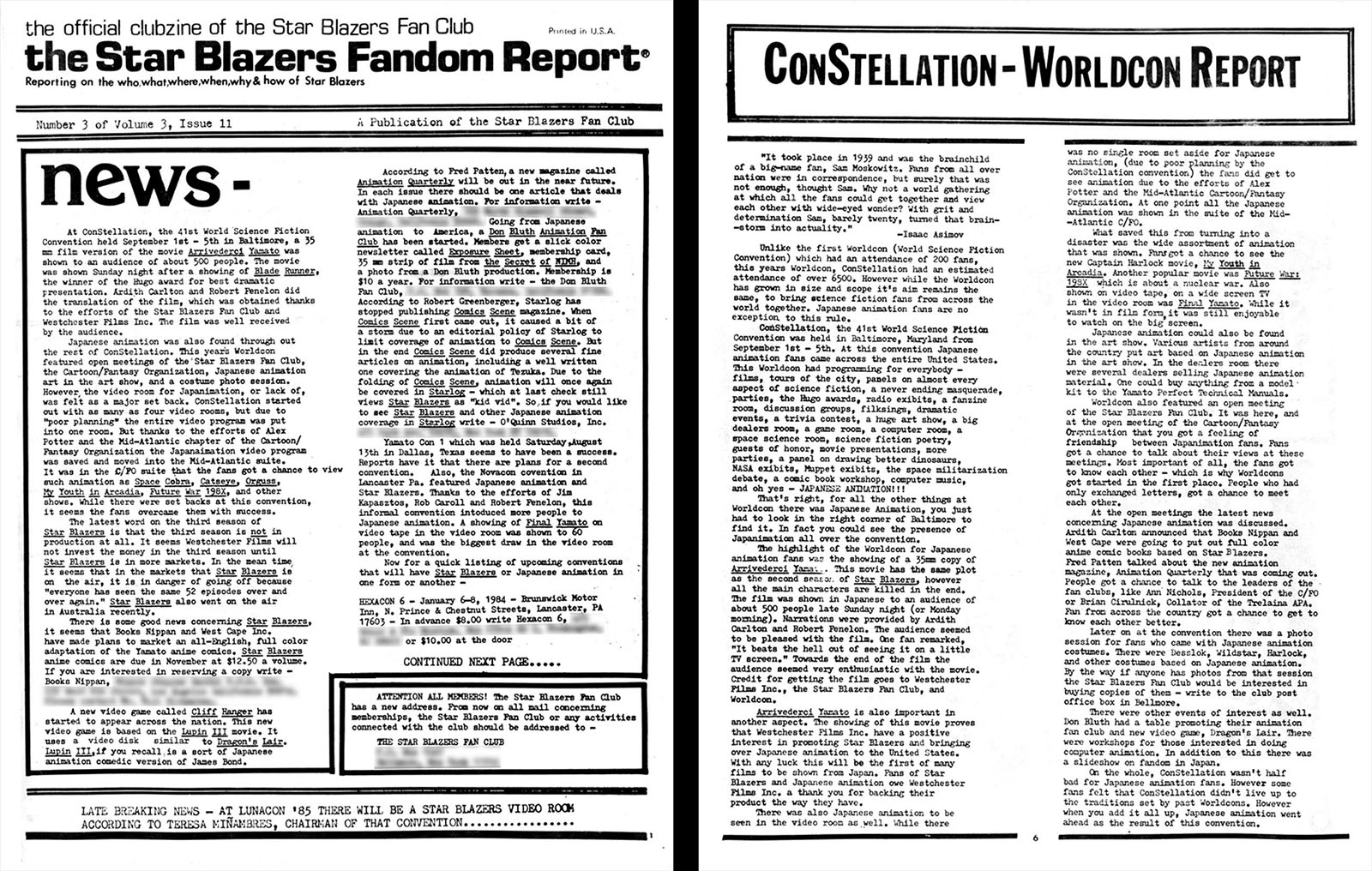
The 8-page newsletter for the third quarter of 1983 featured a detailed report on ConStellation and presented various news nuggets, such as the announcement for upcoming Star Blazers anime comics.
Read the entire issue here
September 19: “Encore Final Roadshow” press conference
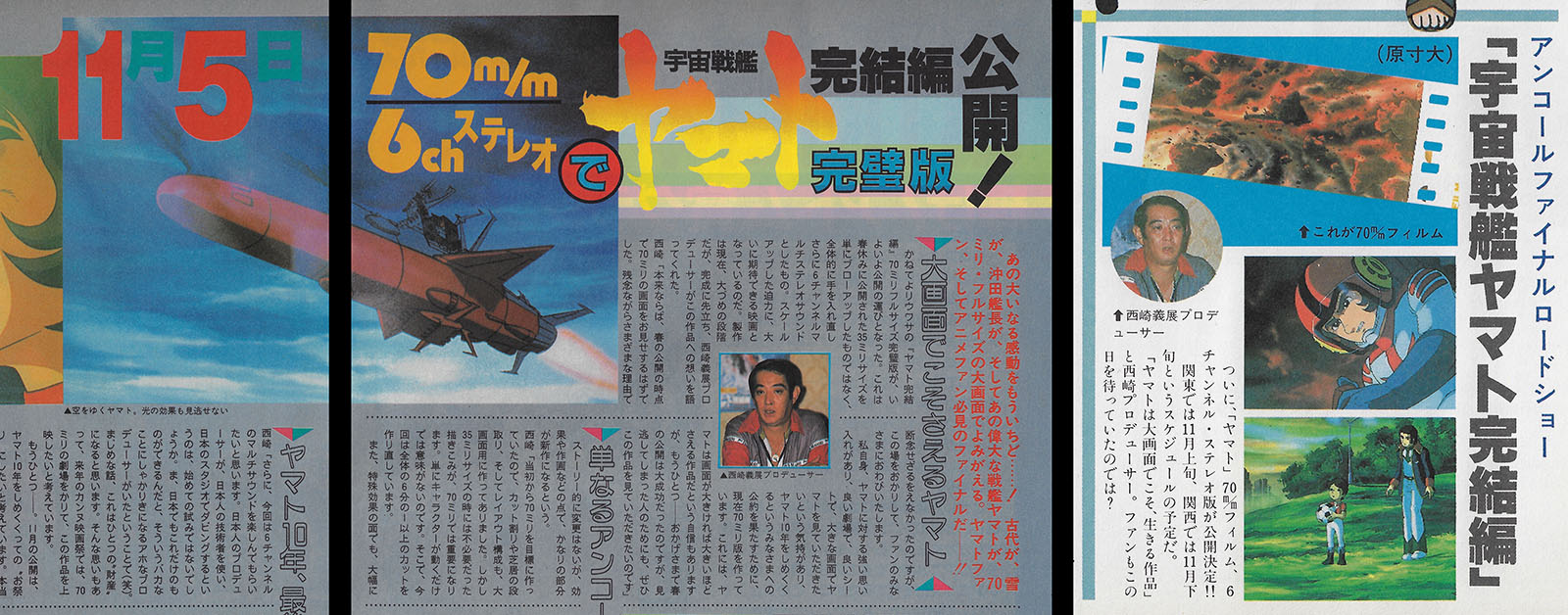
The last press gathering of the Yamato production era happened on this day when Yoshinobu Nishizaki gathered the media together to officially announce the details of the upgraded 70mm version of Final Yamato. He talked extensively about the improvements that had been made since the spring, including new footage, special effects, and sound engineering, and committed to a limited premiere date of November 5 in Tokyo and November 20 in Osaka. All the information would be communicated in magazines to be published in October (scraps shown above from The Anime and My Anime).
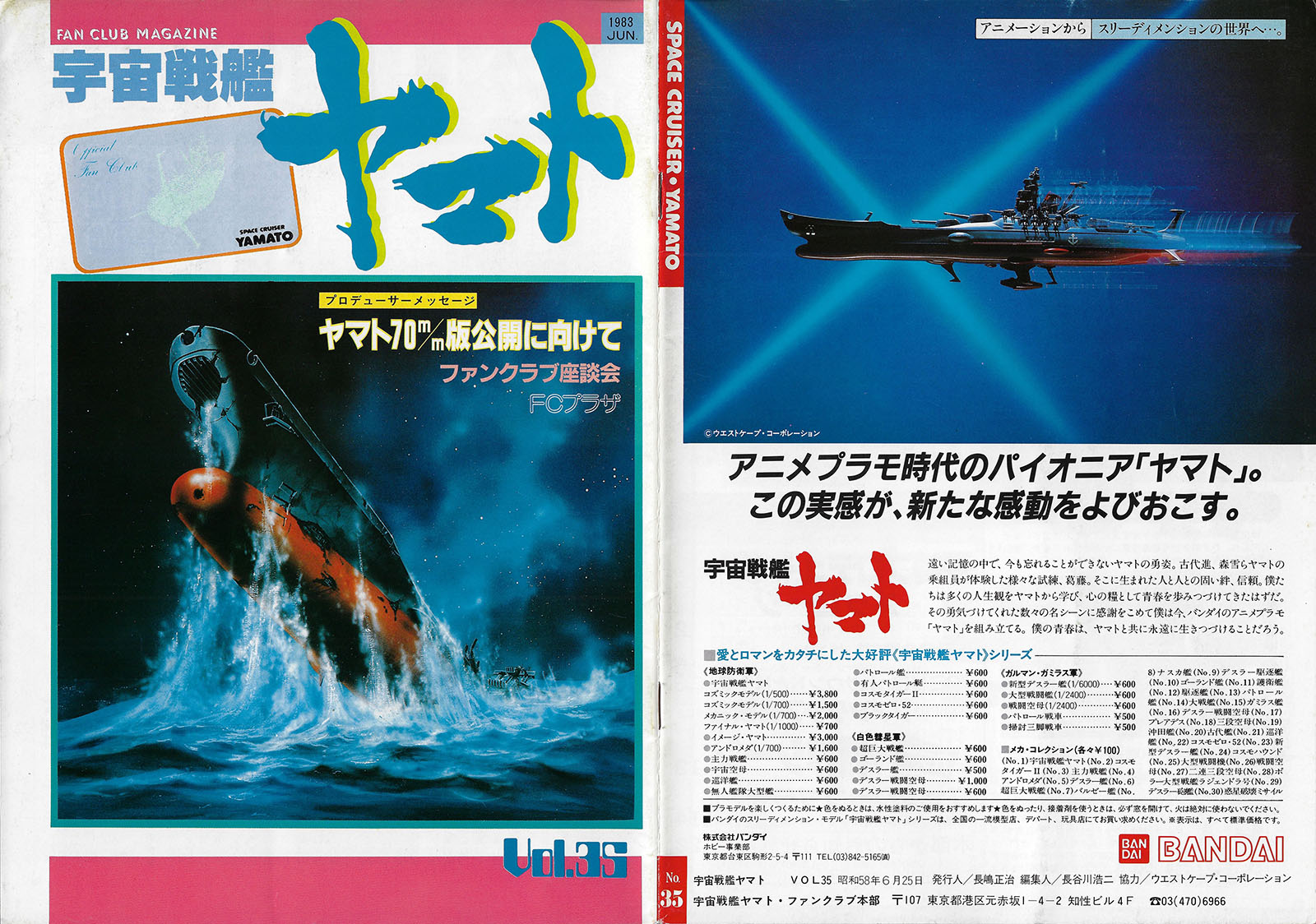
Fan club magazine Vol. 35
Released well after its “June 1983” cover date, this was the first issue of the magazine to be written and edited in the wake of Final Yamato‘s March premiere. It featured two followup articles: a producer’s message from Yoshinobu Nishizaki about what everyone could expect from the 70mm edition (a lot of the same information announced at the press conference), and the transcript of a round-table discussion between Nishizaki and several fans to share opinions on what they had seen in March. A similar pre-release discussion was published in an earlier issue, and this one was just as frank and candid. The fans were neither shy nor stingy with their thoughts, and Nishizaki did not seem entirely prepared for what they had to say…which kept it 100% real.
Read the producer’s message here
Read the round table discussion here
The back cover (above right) carried a new ad for Bandai model kits. The text reads:
Yamato was a pioneer in the era of anime plastic models. This realization brings about a new emotion.
Even now, the heroic figure of Yamato remains a distant memory, one I can never forget. The various trials and struggles experienced by Yamato‘s crew members, including Susum Kodai and Yuki Mori. The strong bonds and trust that were born from this experience between people. We learned many values from Yamato, and used it as nourishment to carry us through our youth. With gratitude for the many memorable scenes that gave us courage, I now assemble Bandai’s anime plastic model Yamato. My youth will live on forever with Yamato.
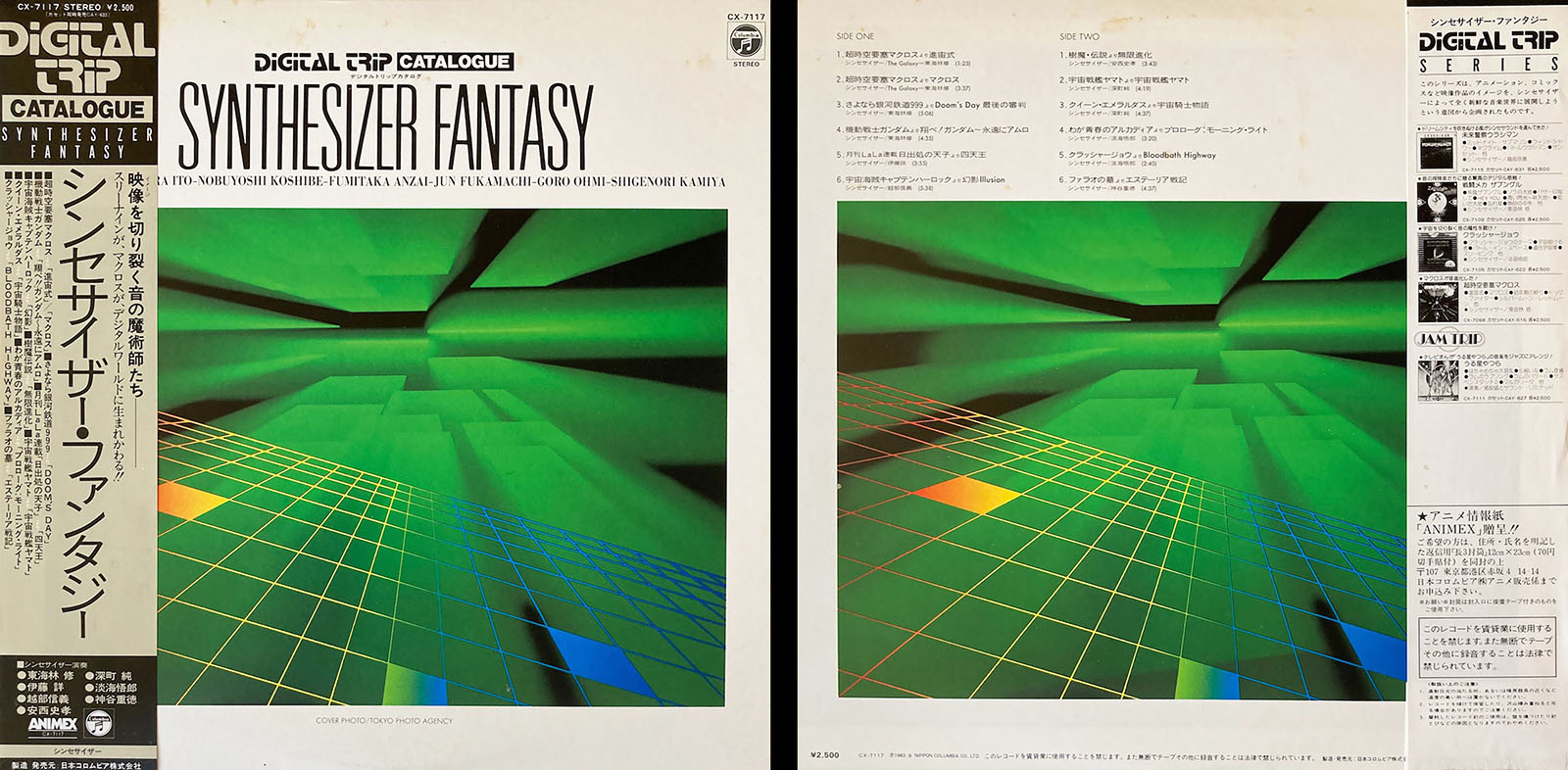
September 21: Digital Trip Catalogue Synthesizer Fantasy LP
Nippon Columbia, CX-7117
Nippon Columbia had been releasing Digital Trip albums for many years at this point, providing synth covers for songs and BGM compositions from various anime series (including two albums dedicated to Yamato). Someone decided it was time for a “best of,” so they rolled out a 12-track collection with themes from Macross, Galaxy Express 999, Gundam, Captain Harlock, Queen Emeraldas, Crusher Joe, and more. The Yamato theme was a guarantee.
Anime magazines published in September


Urashiman earns two more covers. My Anime continues the buildup to Giant Gorg, Animedia rolls out the first cover for Genesis Climber Mospeada, and Votoms reappears on OUT.
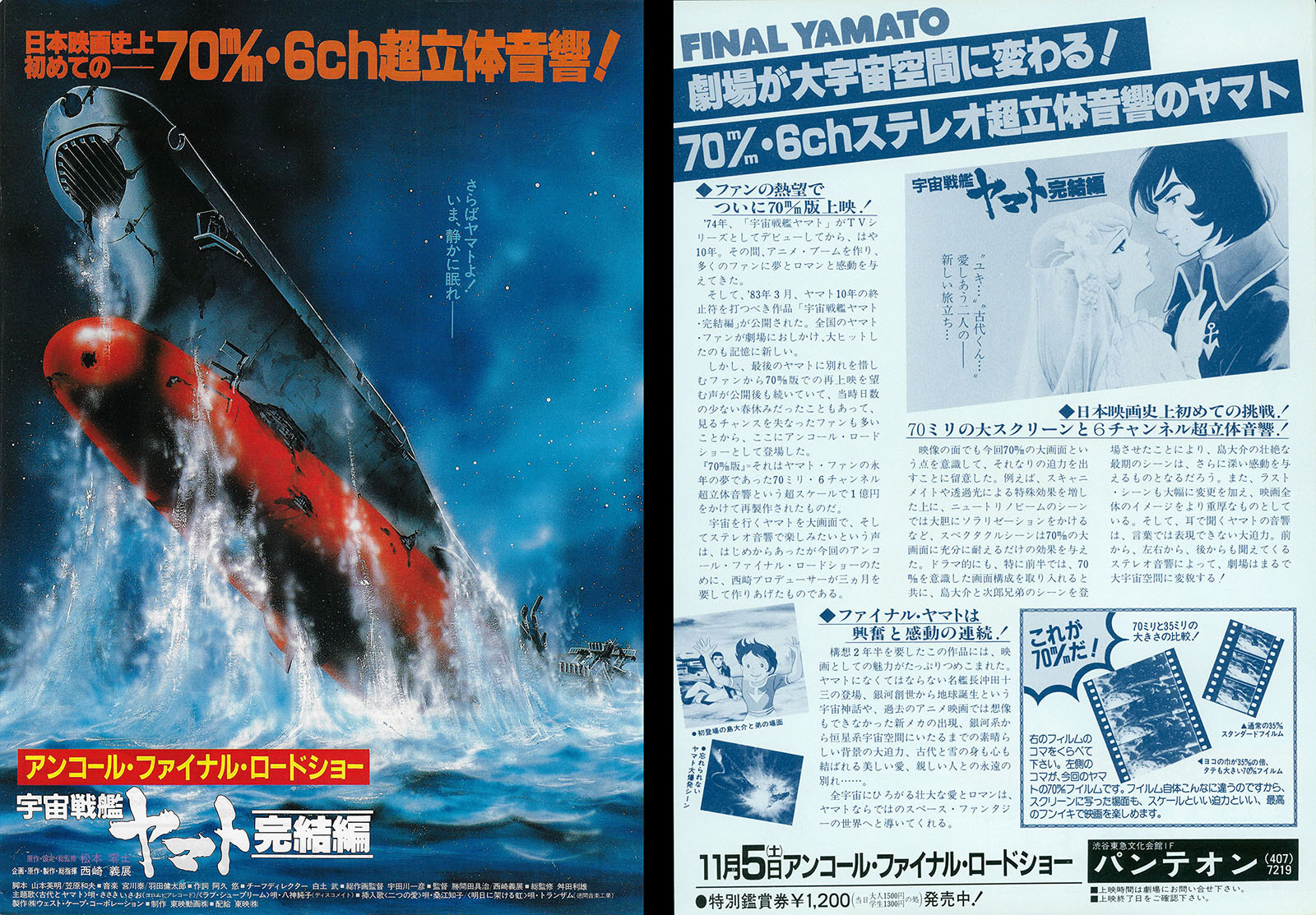
What’s next
Final Yamato makes its much-anticipated 70mm comeback, igniting one last wave of Yamato fever into the end of 1983 and the conclusion of the vintage years. Read all about it, and find out what’s coming next, in Vintage Report 47!
Final Yamato Super Deluxe hardcover book flyer
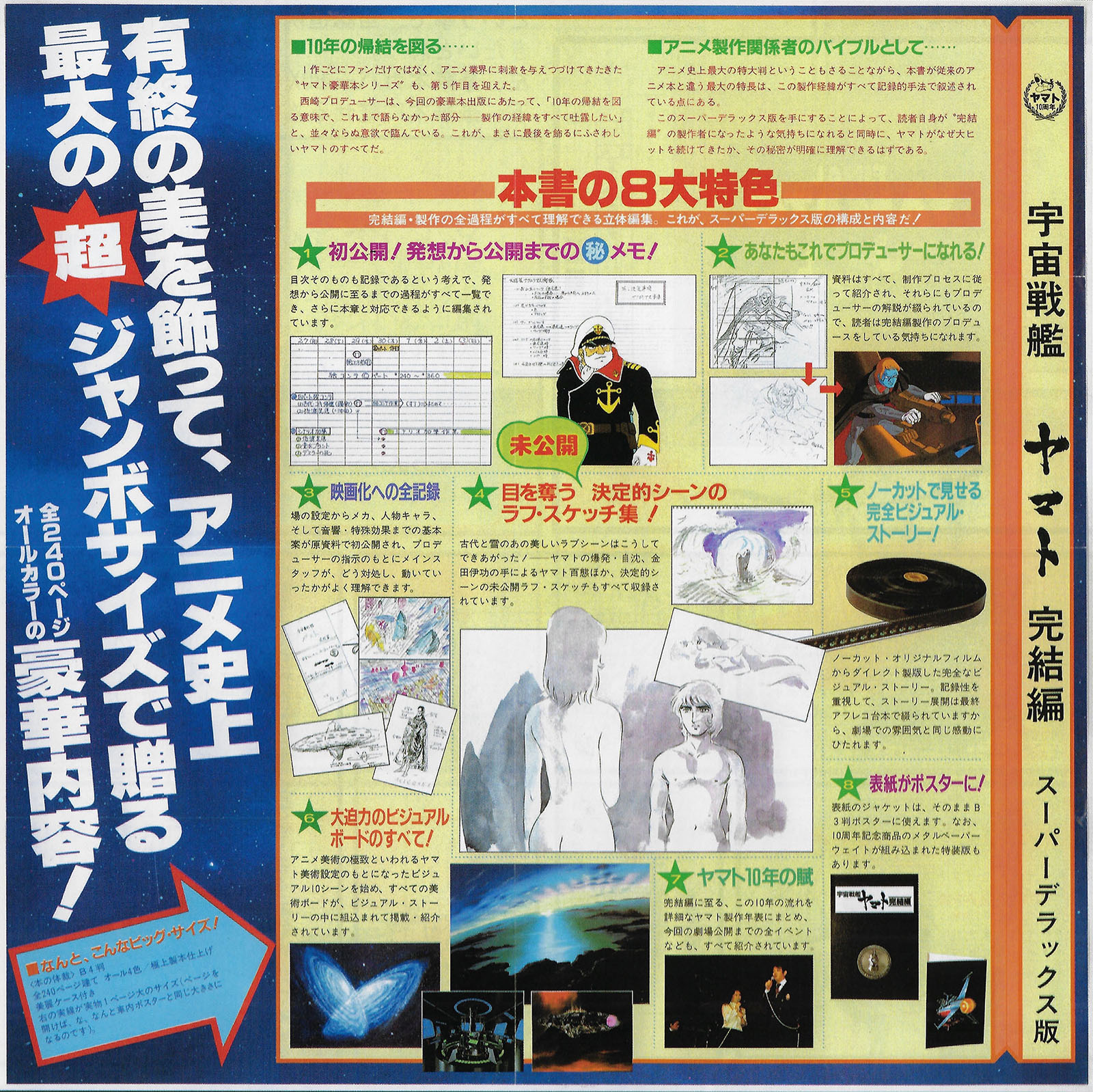
To communicate the huge size of the book, this flyer folded out to show you exactly how big it would be. The first 5,000 fans who pre-ordered a copy would receive an animation cel from the film. The cover price was a whopping 14900 yen (well over $100) and those who paid a little extra would get a metal paperweight. Publication was originally intended for late August, but would be delayed to November.