
Thoughts after watching Episode 23
See the original blog post here
This is one of the series’ finest episodes, presenting hope and despair side by side. After a long voyage, the crew arrives at Iscandar, only to discover it is a binary planet paired with their sworn enemy Gamilas’s home world, and Yamato finds itself plunging into a graveyard of concentrated sulfuric acid.
Reading this article will help you understand the ruthless decision Leader Dessler makes while bearing the fate of his dying home planet, the dialogue regarding ethics he shared with Queen Starsha, and the profound meaning behind Captain Okita’s words: “Consider the 99th mile to be the halfway point.”
Speaking from my perspective as someone who has spent 32 years working in the field and has now reached an age where I am contemplating the “end,” I would like to look back on the excitement and melancholy of that time with others of my generation. The first half covers my analysis, while the second half summarizes the plot.
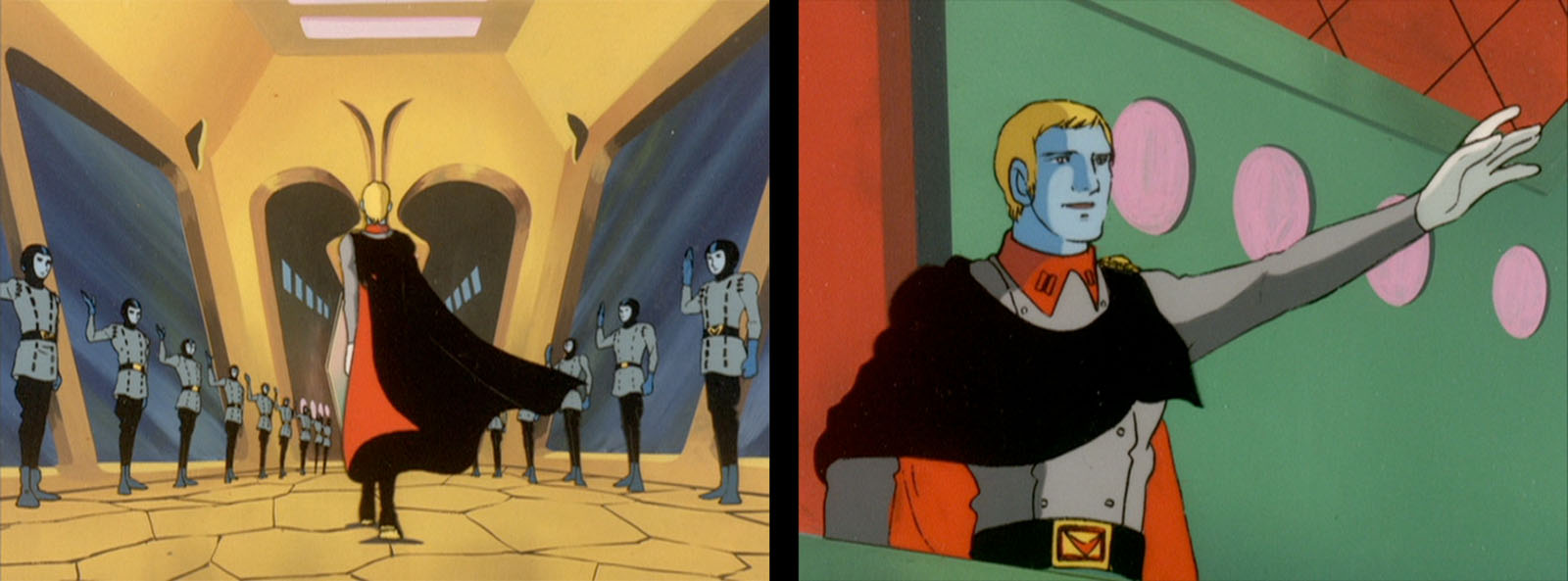
The logic of one bearing the burden of a dying home world; the ruthless decision made by Leader Dessler
Dessler’s choice to ensure survival by sacrificing others, all to save a home world nearing its end, epitomizes the solitude and resolve a leader must shoulder. His dialogue embodies the gravity of a decision that defies simple moral judgment.
The most moving part of Episode 23 is the dialogue between Leader Dessler of Gamilas and Queen Starsha of Iscandar. In this scene, the fact that both of their planets are nearing the end of their lifespans is quietly revealed.
The invasion of Earth was undertaken to secure a new home for the Gamilas people, saving them from their dying planet.
“The Gamilas people have a right to survive. Even if it means destroying others.”
So declares Dessler. His words, rejecting Starsha’s philosophy of accepting their planet’s inevitable demise, are steeped in profound sorrow and unyielding determination.
Having spent 32 years maintaining aging equipment amidst harsh weather conditions, I understand all too well the crushing pressure of bearing responsibility for a massive system that has reached its limits.
How should an operator act when a system can no longer be kept alive? Do they step back and quietly let it expire, or do they sacrifice other lines to keep the main line running? There were many nights on the job that demanded such resolve.
In the figure of Dessler, seeking a path to survival even at the cost of others, one can see the absolute solitude of a leader that transcends simple notions of good and evil. I, too, have faced “insurmountable walls” time and again on the front lines, enduring nights where I had to make agonizing decisions. That chilling sensation deep in the gut from those moments resonates painfully with the image of Dessler.
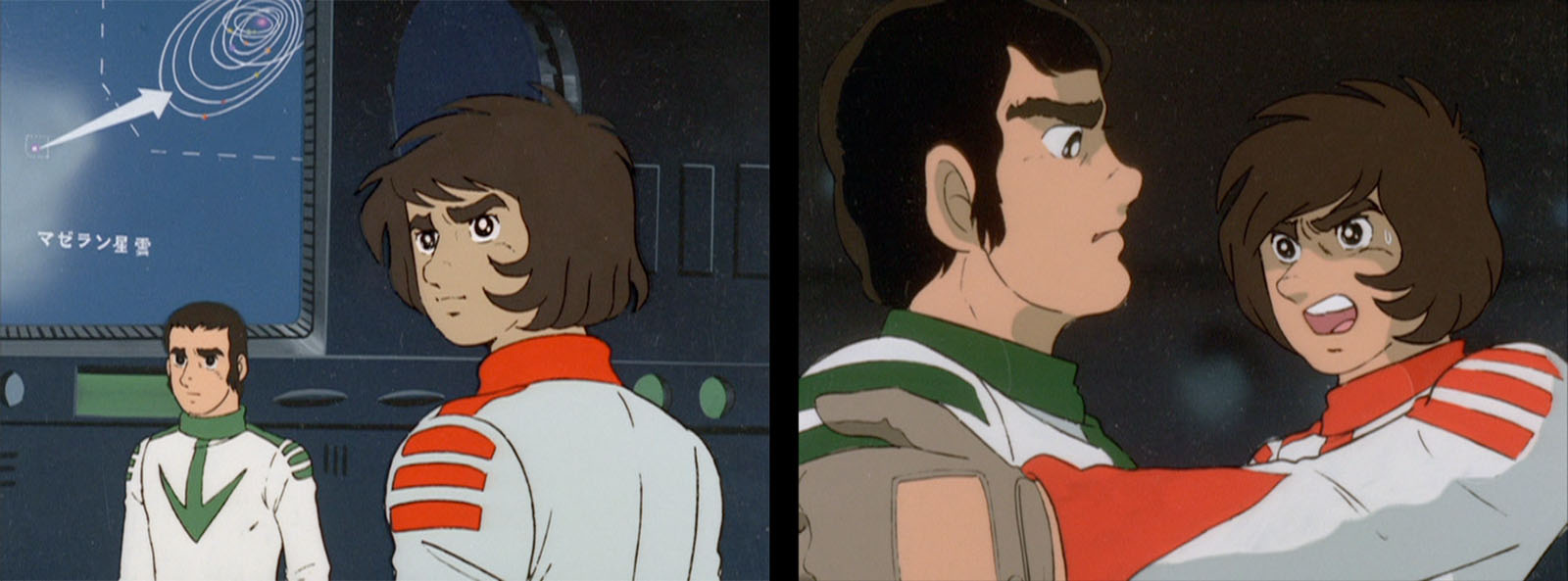
A trap plunging them into a sea of concentrated sulfuric acid, and words of reconciliation between Kodai and Shima
Amidst a desperate situation where instruments and armor alike turn against them, Kodai and Shima, long at odds, finally acknowledge one another. That moment when these young, imperfect men humble themselves marks the birth of a strength that will eventually allow them to protect what matters.
To drag Yamato to his home planet, Dessler sets a trap that disrupts communications and instrumentation. Pulled by a powerful magnetic force, Yamato begins to plummet toward the Gamilas homeworld.
For anyone who has maintained machinery in the field, the terror of this situation, where instruments go haywire, protective armor melts, and the very environment turns hostile, is unfathomable. Knowing firsthand how a single faulty valve or pipe can spell disaster, I found the sequence where Yamato is plunged into a triple-threat corrosive environment (sulfurous gas, dilute sulfuric acid rain, and a sea of concentrated sulfuric acid) absolutely breathtaking in its intensity.
And it is precisely in the moments leading up to this desperate crisis, the instant Starsha’s distress signal is cut off by interference, that human nature is laid bare. It is the scene where Susumu Kodai and Daisuke Shima, who had clashed so often, finally acknowledge each other.
“You proved your mettle as a navigation officer. I apologize for my attitude earlier. Please forgive me.”
These words are spoken by Kodai at the very moment he resolves that there is no other path left but to break through Gamilas’s blockade on their own and reach Iscandar.
Seeing these young people, who are far from perfect heroes, yet strive to move forward despite their immaturity, I cannot help but see a reflection of my own younger self, running around in work clothes stained with grease on those passionate summer days.
That moment, just before facing a critical juncture, when he bows his head to his comrades, admitting his fault and entrusting the mission to them…we know now that such naivety and youthful inexperience will eventually transform into the strength needed to protect what matters.
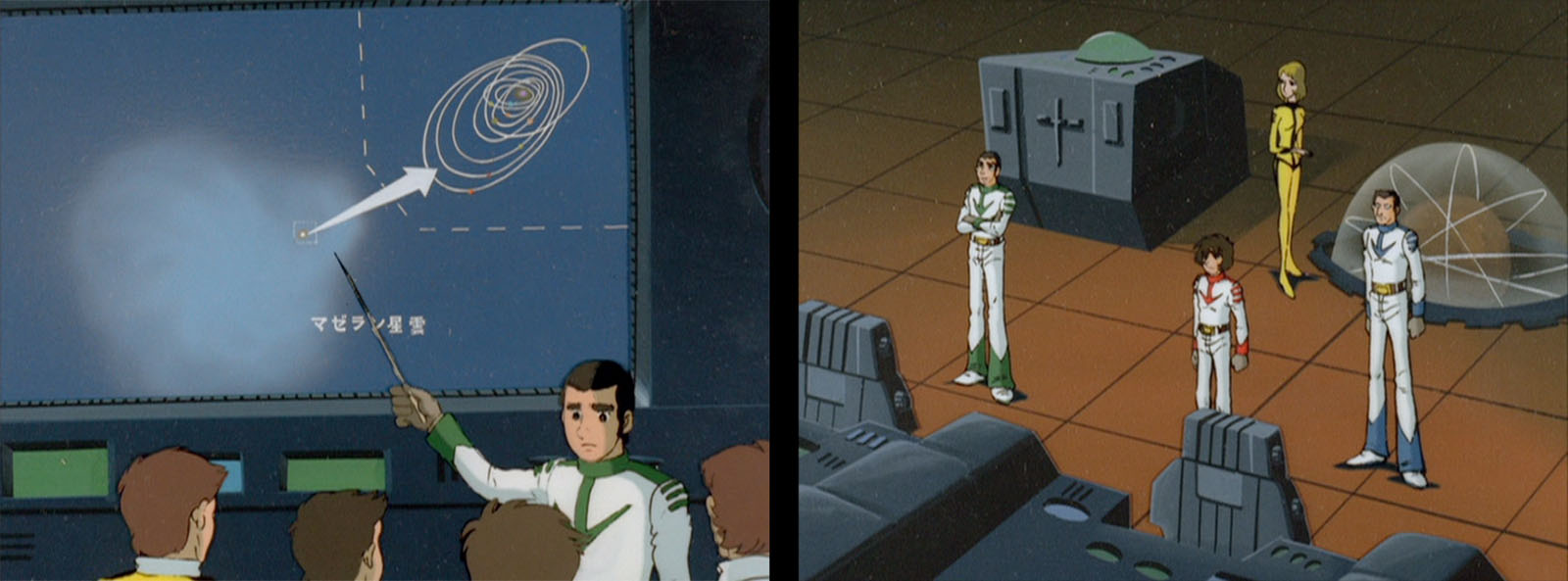
A cruel reality thrust upon them by the cosmos: the planet of hope and the arch-enemy’s stronghold, side by side
Iscandar, the planet of salvation they finally reached, turns out to be a twin planet, separated from their sworn enemy by a mere 16,000 miles. Deep darkness yawning open just as the light shines through; this cruel reversal is the true essence of this story.
Yamato‘s crew faces the crushing despair of realizing that the planet of salvation, reached only after agonizing, blood-sweating hardship, is right next door to the stronghold of a hated enemy. Isn’t life much the same? As we grow older, we learn all too well that a sanctuary reached after a long, hard struggle can often turn out to be the gateway to the next grueling trial.
The moment they finally receive a guidance signal from Iscandar, the signal they had longed for, I, too, found myself clenching my fist in front of the TV, thinking, “We’re finally going to be saved.” Yet, immediately following that, the reality that confronts Yamato is the existence of a “binary planet of despair.”
• Iscandar = Hope
Radiation removal device
Starsha’s guidance signal
The last hope for humanity
• Gamilas = Despair
Seas of concentrated sulfuric acid and acid storms
Dessler’s annihilation campaign
The sworn enemy that destroyed Earth
Hope and despair existing back-to-back, separated by a distance of 16,000 miles, this is the cosmic configuration revealed in Episode 23.
This cruel reversal of fortune is precisely what proves that this story transcends the boundaries of a mere children’s anime. The moment a ray of light shines through, an even deeper darkness awaits. Episode 23 repeatedly confronts us with this tangible reality.
Synopsis of Episode 23
Let’s look at how the scenes discussed in my analysis were actually depicted in the story.
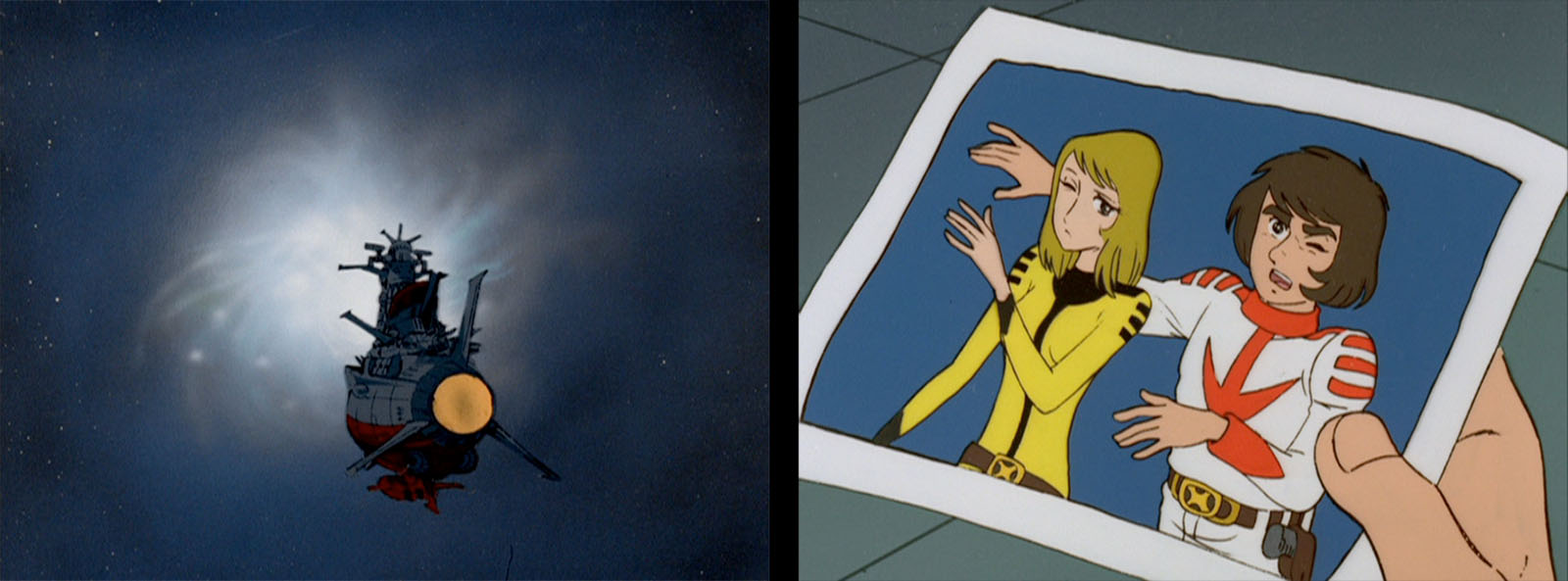
198 Days Since Departure, The Magellanic Cloud Finally in Sight
Having overcome unimaginable hardships and fierce interceptions by Gamilas forces, a full 198 days have passed since Yamato‘s voyage began.
Amidst this grueling journey, a faint audio signal echoes through the ship, seemingly announcing their approach to the Magellanic Cloud and their ultimate destination: the planet Iscandar. “This is Starsha of Iscandar. Can you hear me, everyone on Yamato…?”
The signal picked up by Aihara, the communications chief, is indeed a message from Starsha, Queen of Iscandar, guiding Yamato from the far reaches of space. A wave of jubilation begins to sweep through the ship at the realization that they have finally reached their destination.
At the same time, there are the bonds the crew has forged during their long battle, as well as moments of fleeting, everyday normalcy. Kodai and Yuki take photos using a self-timer, speaking of a future together.
“Let’s keep these as memories for when we tell our children about the days of our youth.”
Even while immersed in the conflict, they continue their journey believing not only in Earth’s future but also in their own modest happiness.
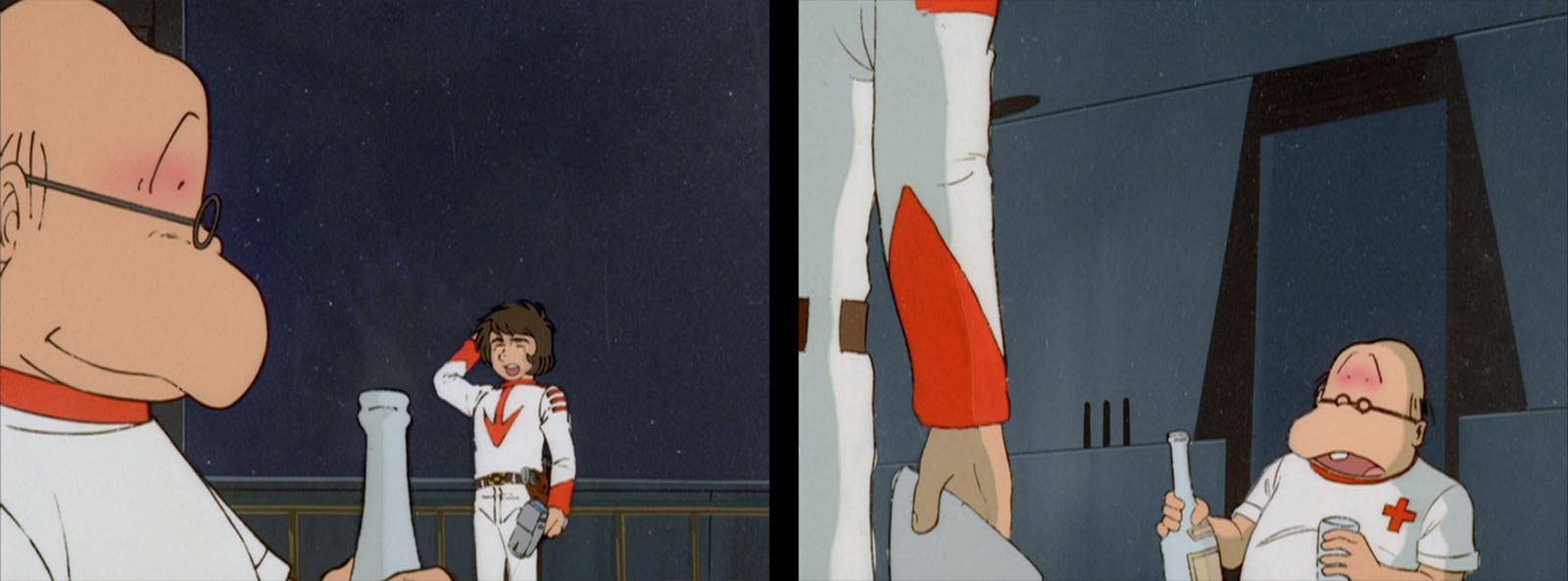
Dr. Sado’s admonition: “Consider 99 to be halfway to 100.”
However, the moment the end of a long journey comes into view is precisely when a deceptive calm, and danger, lurks. Dr. Sado steadies Kodai by quoting an old proverb:
“When traveling a hundred kilometers, think of the 99th kilometer as the halfway point.”
In other words, it is a warning never to let one’s guard down just because the destination is in sight. No one has yet laid eyes on the real Iscandar. The abyss of space, where anything can happen until the very end, looms right before them.
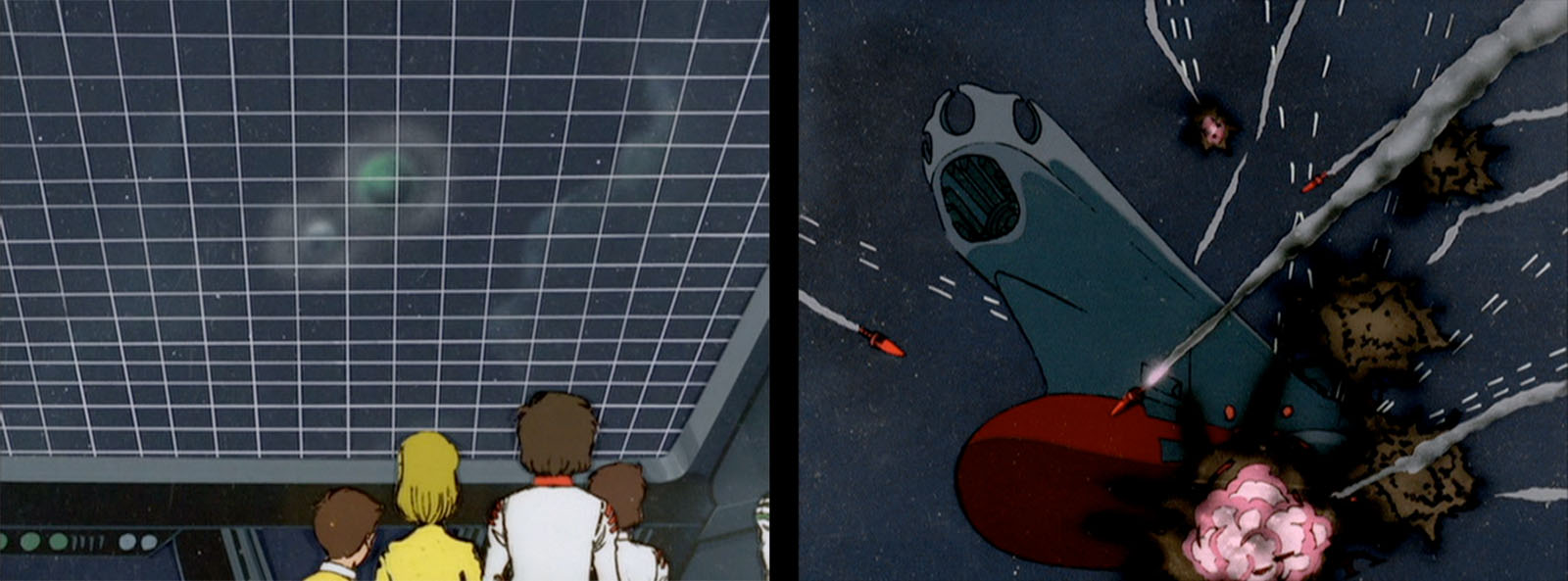
The Binary Planet Revealed: Gamilas lies Beside Iscandar
The guidance signal from Iscandar, which has been leading Yamato, suddenly cuts out. Tension sweeps through the bridge.
Daisuke Shima, the navigation officer, cross-references the star charts with radar data and reports a shocking discovery. Projected onto the main monitor is a sight no one had ever anticipated.
At the coordinates where the target, the eighth planet, was supposed to be, two celestial bodies appear on the screen. Located approximately 300 million miles from the central sun and roughly 1.3 times the size of Earth, they are two massive worlds orbiting in tandem, locked in a gravitational dance.
Shima announces the conclusion with a trembling voice: there is no other way to interpret the data. Iscandar is one half of a binary planet system.
As Shima, Chief Engineer Sanada, and the technical team continue their analysis, an alarm suddenly blares: some sixty missiles are rapidly closing in on Yamato from the very direction of their destination.
The range is a mere 200 kilometers.
“That’s Iscandar over there, why are they attacking us?”
Even as Kodai shouts this, Yamato prepares to intercept the relentless incoming missiles by opening fire. Beams from the main guns and secondary batteries, along with interceptor missiles, explode across the void of space, shattering the enemy missiles one after another. It seems, for a moment, that the crisis has been averted. However, this was merely the opening move in a terrifying scheme orchestrated by Gamilas.
The enemy missile’s objective was not to destroy Yamato directly. Upon its destruction, the missiles release a mysterious jamming substance that instantly scatters into space, enveloping Yamato. This completely disrupts the ship’s precision navigation systems and radar, effectively blinding and deafening it.
An enraged Susumu Kodai struggles with the uncertainty: is this the work of Gamilas, or is Iscandar, the planet he had trusted, actually an enemy?
Sanada analyzes the recovered missile fragments and speaks in a grave tone: “This is a Gamilas missile. Could it be that we haven’t arrived at Iscandar, but at Gamilas instead? Or perhaps…could these two planets actually be one and the same, Gamilas itself?”
The worst possible truth comes to light: the home planet of Gamilas, Earth’s sworn enemy, exists as a twin world right on the doorstep of Iscandar, the planet of hope.
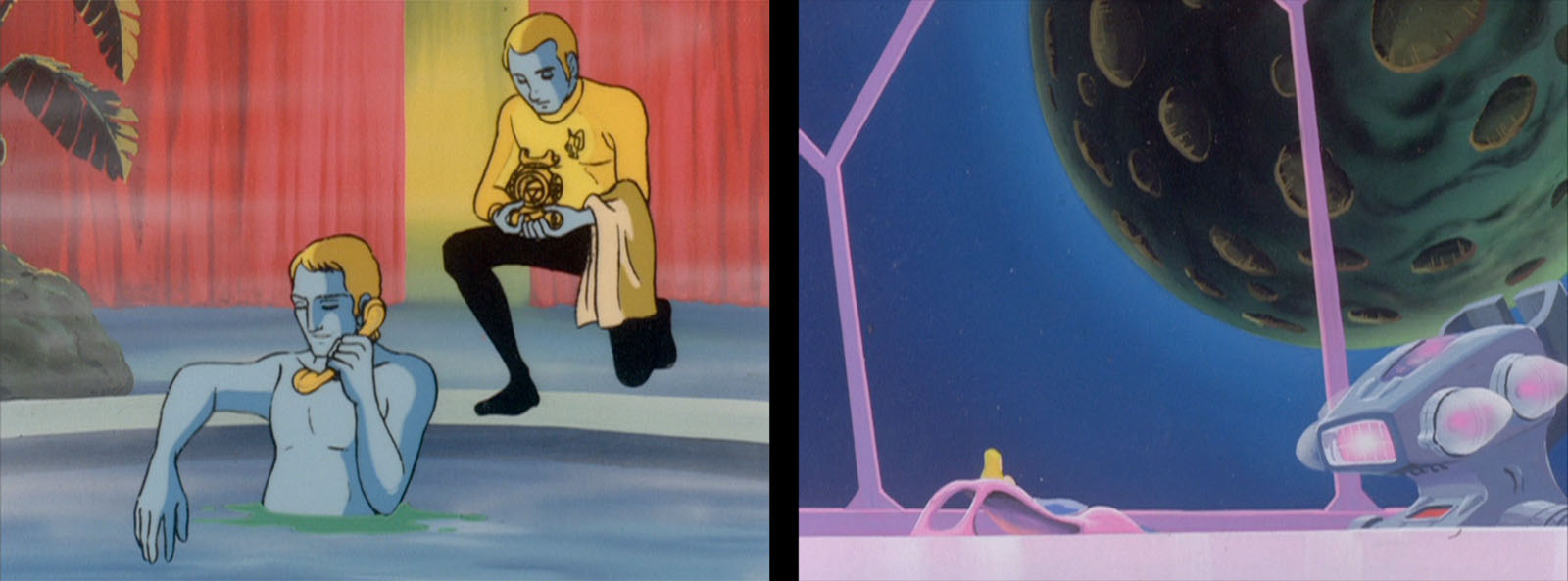
A Hotline Between Twin Planets: The Communication That Severs Ties Between Dessler and Starsha
Meanwhile, on the twin planets, a cold, dispassionate dialogue that could determine the fate of the universe is taking place.
A hotline connection is established between Leader Dessler of the Gamilas Empire and Starsha of Iscandar. It was a link between the rulers of the twin planets, a line of contact that had been silent for years. Starsha protests to Dessler, asking why he is jamming the guidance signals meant for Yamato. Yet Dessler, a cold-blooded dictator, merely smiles, an expression at once utterly elegant and arrogant.
He remarks that whenever she contacts him, it is only to protest. He asks if he might not hear a kind word for a change, noting that they are, after all, like siblings living on twin planets.
“And yet, despite being twin worlds, you, unlike us, are far too adept at committing evil.” Starsha levels this accusation with a resolute air.
But Dessler’s logic remains unshaken. To him, the invasion of Earth and the ravaging of other star systems are nothing more than means to achieve an absolute objective: the survival of the Gamilas people.
“Both my Gamilas and your Iscandar have little time left as planets. That’s why I have used every ounce of my power to search the cosmos for a new home for my people. What’s wrong with that?” Dessler asserts this argument in a calm, unwavering voice.
Starsha persists in her argument. She points out that Dessler has set his sights on Earth, intending to annihilate humanity and colonize the planet. She asserts that, despite their inferior scientific capabilities, Earthlings are human beings just like them, and possess the right to live.
Faced with her impassioned plea, Dessler coldly delivers that infamous line, articulating a logic that prioritizes survival at the cost of destroying others, and the dialogue breaks down.
Starsha declares that if Yamato can overcome Gamilas’ interference and reach Iscandar under its own power, she will certainly hand over the radiation-removal device. In response, Dessler boldly cuts the transmission, stating:
“As long as I, Dessler, am alive, I will not let Yamato reach you.”
Dessler immediately issues orders to his entire military force. A terrifying operation begins, one designed to intercept Yamato, Earth’s last hope, using the full might of the Gamilas home planet to utterly destroy it.
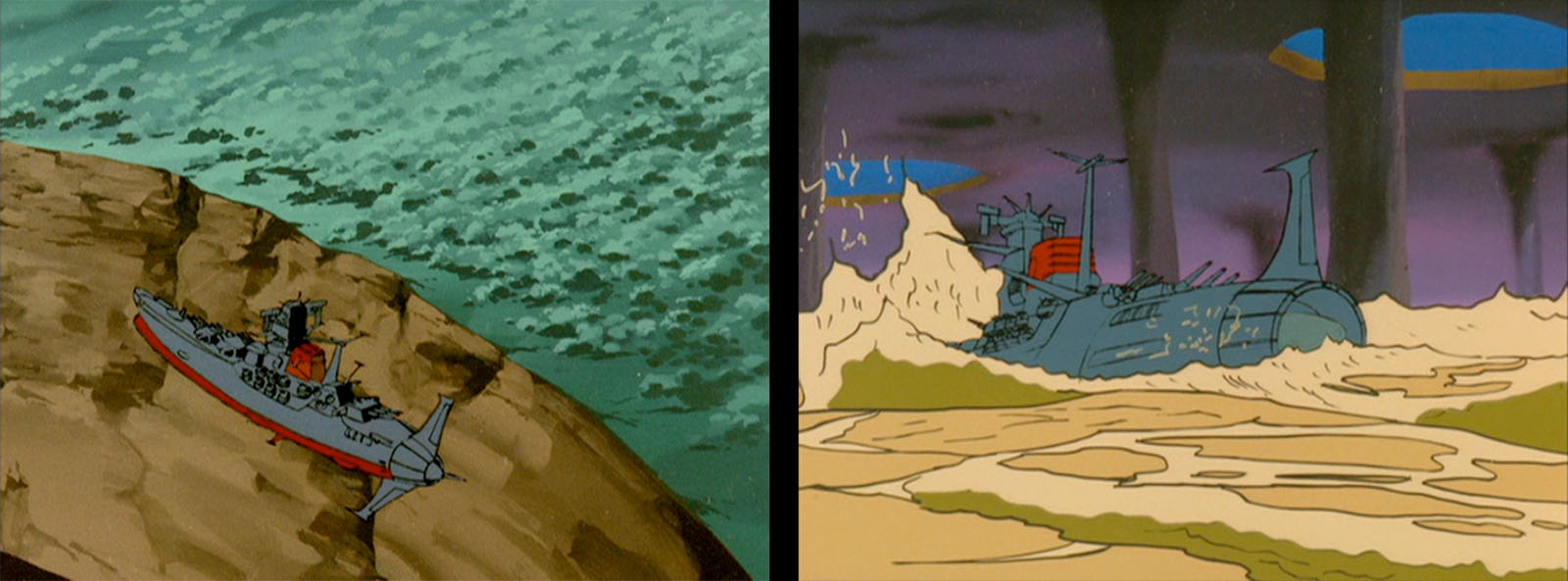
The Dual-Layered Structure of the Gamilas Home Planet and Dessler’s Four-Stage Annihilation Plan
The structure of the Gamilas home planet, as revealed by Dessler to his forces, is highly unusual. Eons of erosion has formed vast internal cavities, creating a subterranean world with a “dual-layered structure” in which a sturdy outer rock shell completely encases an inner planetary core.
On the surface of Gamilas, now heavily sulfurized and nearing the end of its life cycle, violent plumes of sulfurous acid gas rise from volcanoes, and the subterranean seas have transformed into oceans of concentrated sulfuric acid capable of melting any substance into sludge.
Let’s summarize the specifications of the Gamilas home planet as depicted in this episode:
Planet Diameter: 16,000 km
Outer Shell (Bedrock) Thickness: 10 km
Structure: Double-layered (an outer bedrock shell encasing an inner core planet)
Surface Condition: Nearing the end of its lifespan; sulfurization is underway, with sulfurous acid gas spewing from volcanoes
Subterranean World: A vast hollow space; the ocean is filled with concentrated sulfuric acid
Dessler’s strategy is to turn this hellish environment into a graveyard for Yamato. The cold, calculated annihilation procedure consists of the following four stages:
1. Dispersal of Interfering Matter
Using a missile attack, a cloud of ferromagnetic ferrite is scattered around Yamato. This special magnetic substance completely disrupts the ship’s communications and instruments.
2. Magnetic Traction
Powerful magnetic emitters on the Gamilas side are activated; like iron sand drawn to a magnet, Yamato is pulled in the desired direction toward the Gamilas home planet.
3. Dragging into the Subterranean World
With its course disrupted, Yamato is forced down through a fissure in the outer shell into the interior hollow, the subterranean world where the ocean of concentrated sulfuric acid lies.
4. Annihilation via Storms and Depth Charges
Atmospheric pressure transformers generate a severe low-pressure system, whipping up storms and rain of concentrated sulfuric acid. Furthermore, countless batteries positioned along the coast rain down depth charges to deliver Yamato its final blow.
“Yamato‘s fate, gentlemen…is that of a cockroach fallen into a vat of sulfuric acid.”
Dessler’s cold, mocking laughter echoes through the Gamilas command center. A tiny insect struggling in vain within the confines of a sealed jar, the malicious nature of this metaphor instantly lays bare the true essence of the man known as Dessler.
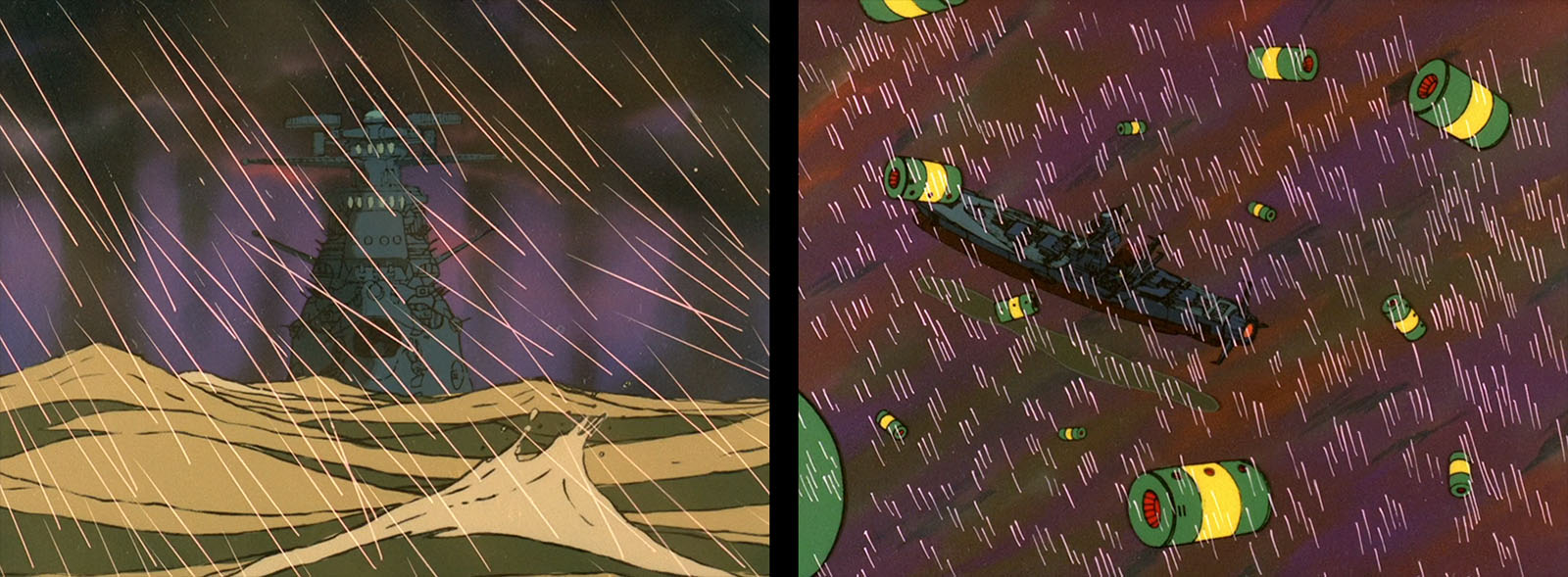
An atmosphere of sulfurous acid gas, rain of dilute sulfuric acid, and a sea of concentrated sulfuric acid: a triple-layered corrosive hell
While trapped in Gamilas’ powerful magnetic snare, a dire situation unfolds aboard Yamato. As the ship is subjected to the intense magnetic pull dragging it toward Gamilas, anguished reports echo across the bridge.
No matter how the helm is operated, the ship loses control and is rapidly sucked into a sinister fissure in the bedrock. All resistance proves futile; Yamato arrives at a place where a thick layer of rock forms a ceiling over an unknown, eerily churning sea.
“An open sea deep underground…what a bizarre planet,” the crew murmurs in stunned disbelief. Just then, violent tremors shake the ship. Simultaneously, heavy rain clouds spread overhead, and rain of an eerie hue begins to batter Yamato‘s hull.
Sanada and Analyzer from the technical team rush to analyze the surrounding environmental composition. When the results reach the bridge, the blood drains from everyone’s faces.
The atmosphere is sulfurous acid gas, the rain is dilute sulfuric acid, and the sea itself is composed entirely of highly concentrated sulfuric acid. The environment surrounding Yamato is saturated with corrosive, sulfuric acid-based substances.
To summarize, it is a hellish scenario:
Atmosphere: Sulfurous acid gas – Toxic environment making extravehicular activity impossible
Rain: Dilute sulfuric acid – Gradually corrodes the ship’s armor
Sea: Concentrated sulfuric acid – Dissolves all metals; sinking will mean total destruction of the ship
The sea upon which Yamato floats is no ordinary ocean. It is a terrifying sea of concentrated sulfuric acid capable of violently corroding and completely dissolving any metal. Chief Engineer Tokugawa opens the main engines to full power, attempting an immediate vertical ascent to escape this treacherous sea. However, Yamato is robbed of any means of escape by a storm generated by magnetic and atmospheric pressure devices, combined with the shockwaves of depth charges relentlessly hurled from surrounding gun emplacements.
Violent, highly corrosive rain and wind slowly eat away at Yamato‘s sturdy armor. Should the hull disintegrate, the only fate awaiting the ship is to sink into a sea of concentrated sulfuric acid and dissolve without a trace. With its retreat cut off and having fallen completely into a powerful Gamilas trap, is there any move left for Yamato?
Far away on Earth, people endure suffering as they await Yamato‘s return. Yet, time is running out. 164 days remain until the extinction of humanity.
Yamato now faces the greatest and most dire despair of its long journey.
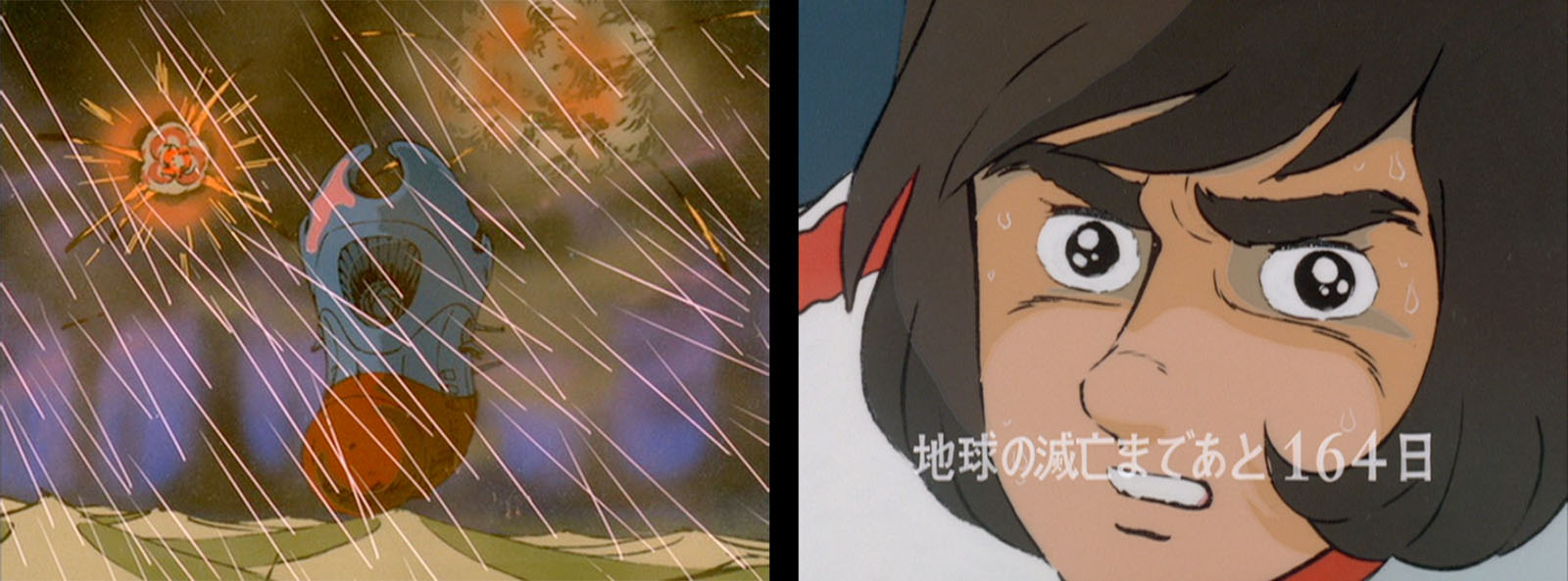
Left in despair, revisiting the story now
164 days until humanity’s extinction. Episode 23 closes with Yamato stranded in a graveyard of concentrated sulfuric acid. Back then, left in a truly desperate, no-win situation as the episode ended, one could only sit before the television in stunned silence.
We now live in an era where we can easily watch the continuation on streaming services. It feels like a different age compared to the days of pedaling furiously on a bicycle, sweating all the way, just to reach a video rental store. In an era where safe, predictable words are the norm, I find myself drawn to words that still carry the scent of sweat and exertion. There are vistas visible only at this stage of life, perspectives that allow one to sense the shadow of the end even at the very beginning.
When I revisit this work after so many years, the figures struggling on the screen cease to be mere anime characters. I see the preciousness of the “will to live”, forged in the mud by imperfect human beings.
I find myself idly imagining a day when I might sit at a table with young people and passionately discuss a rough-hewn story like this one. With that thought in mind, I intend to live out this quiet, fleeting summer day in Sapporo.
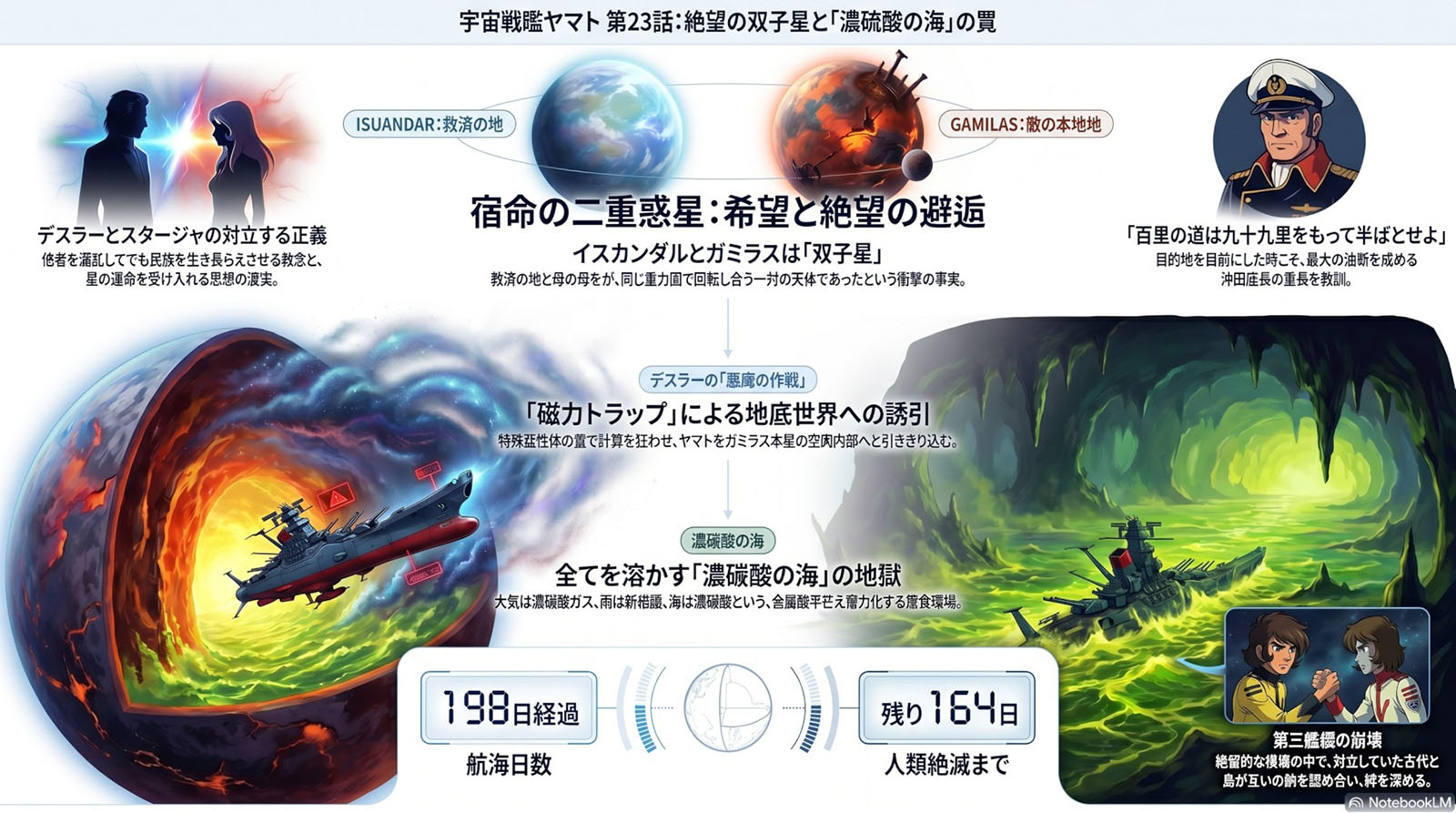
An explanatory infographic that illustrates the binary planet structure of Iscandar and Gamilas, the magnetic trap, the sea of concentrated sulfuric acid, and the breakdown of the voyage’s elapsed and remaining days. It illustrates the fateful relationship between Iscandar and Gamilas, as well as the threat posed to Yamato by the sea of concentrated sulfuric acid.
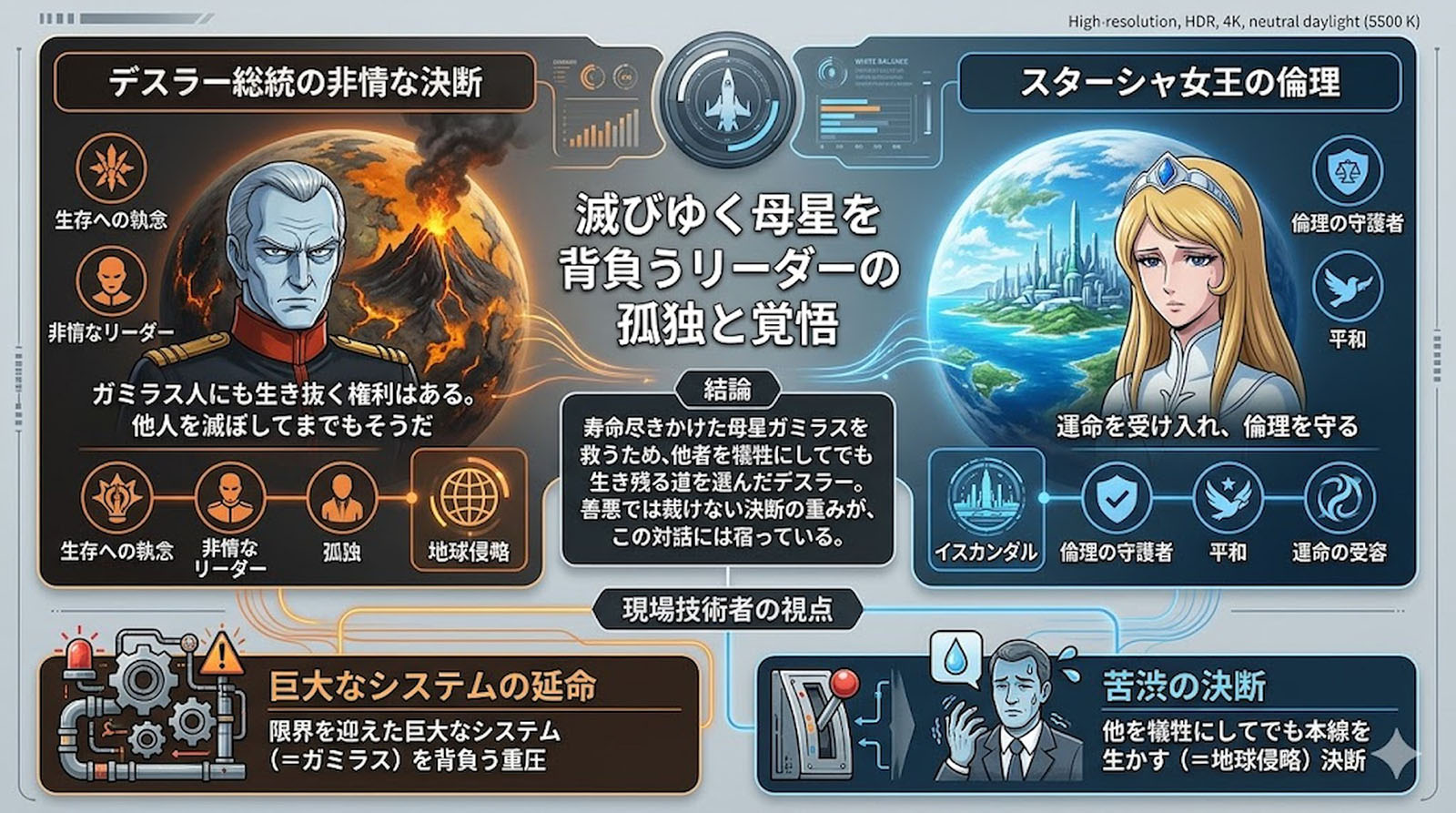
An infographic comparing the values of Dessler, who chooses sacrifice to save his dying home world, and Queen Starsha, who prioritizes ethics and peace.
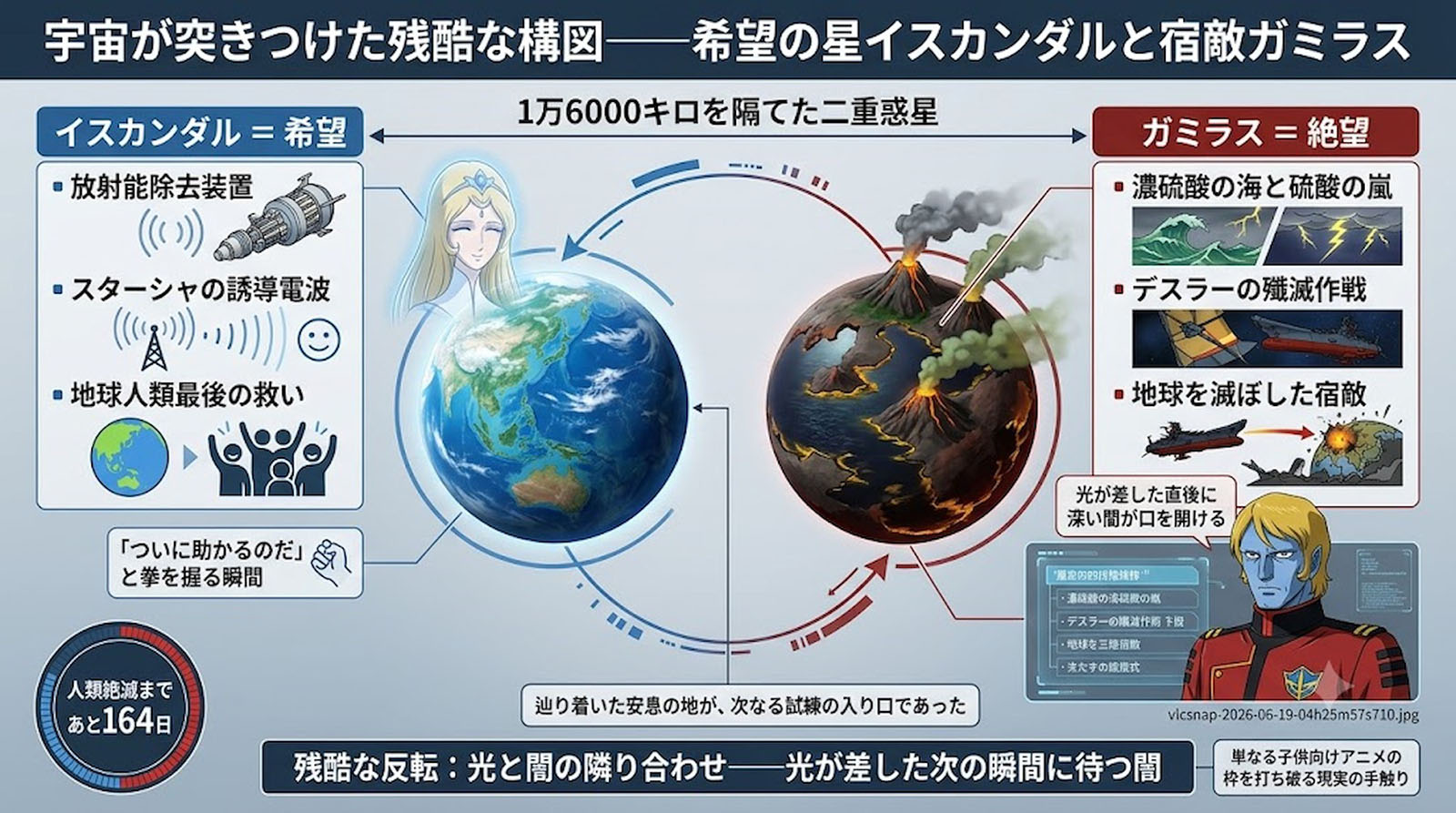
An infographic illustrating the contrast between the hopeful Iscandar and the despair-ridden Gamilas, as well as the relationship between the two planets and the history of Earth’s salvation versus the invasion. Light and darkness exist side by side.
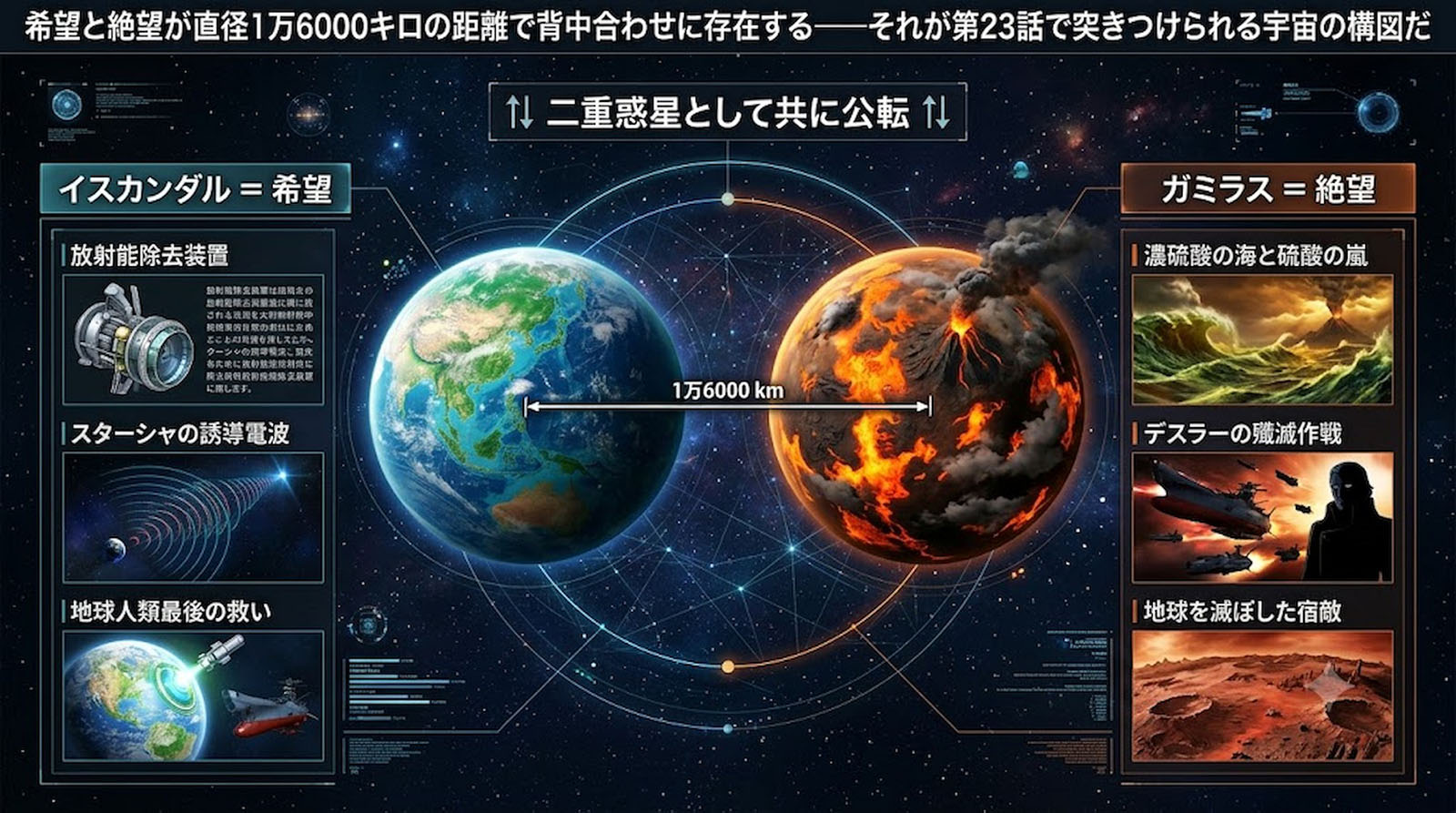
A space infographic illustrating the binary planet structure where Iscandar (symbolizing hope) and Gamilas (symbolizing despair) sit side-by-side, separated by a distance of approximately 16,000 miles as they orbit together.
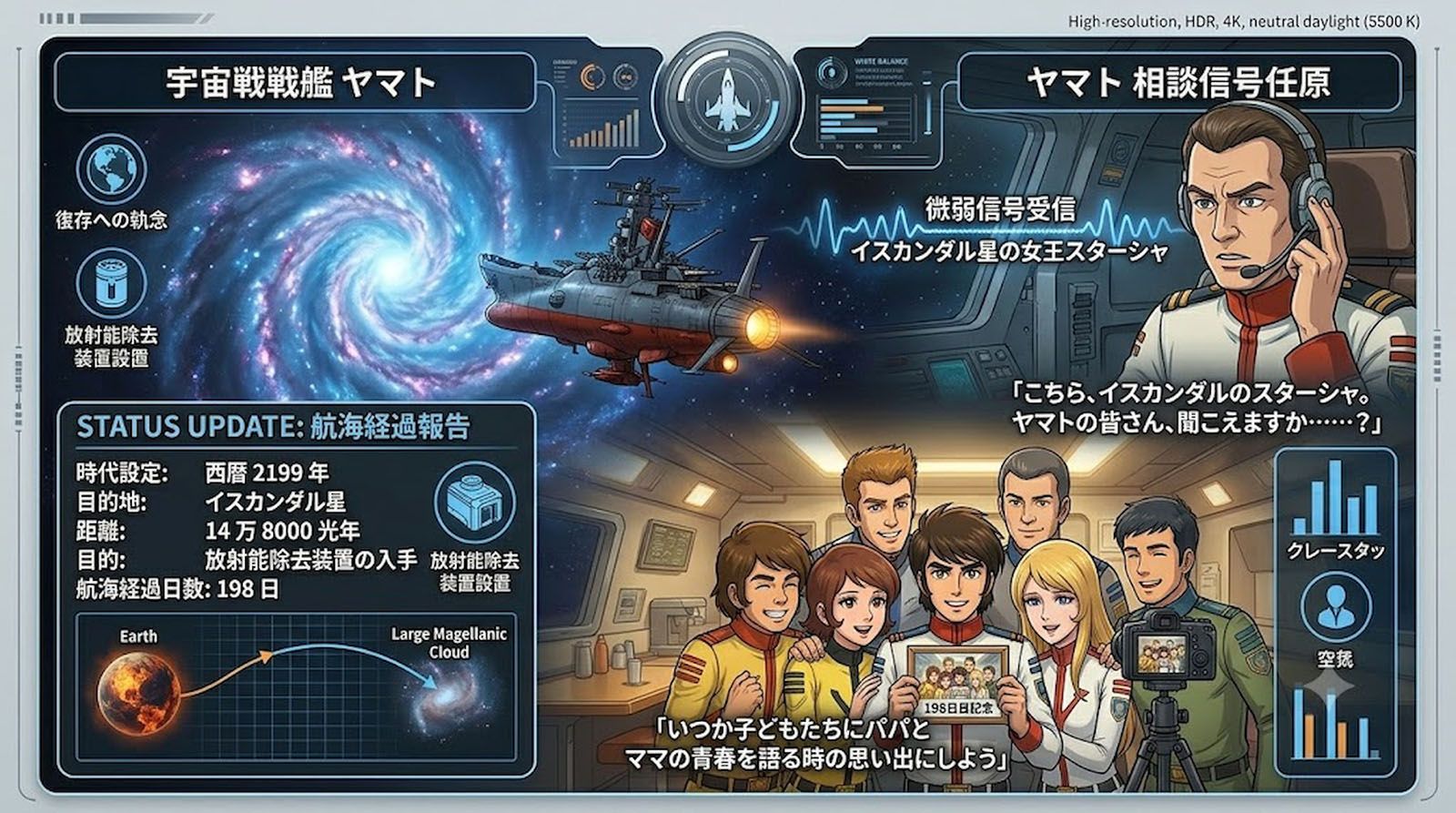
A sci-fi infographic illustrating the moment Yamato, while continuing its voyage, receives a faint transmission from Starsha of Iscandar. Her message, arriving after a long journey, brings renewed hope to the crew.
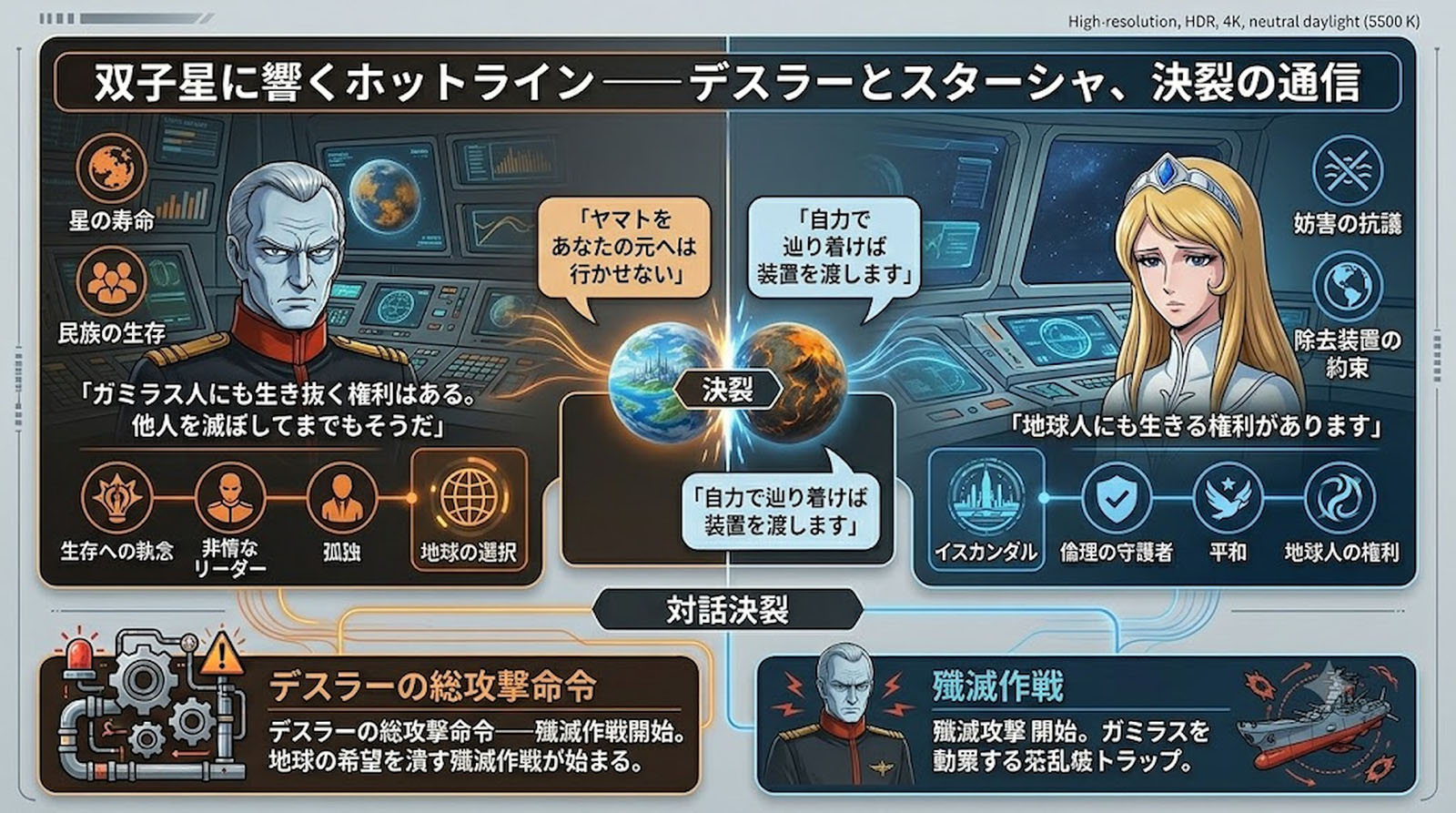
An infographic illustrating the clash of values between Dessler and Starsha during their communication, a conflict centering on the salvation of humanity versus the survival of Gamilas.
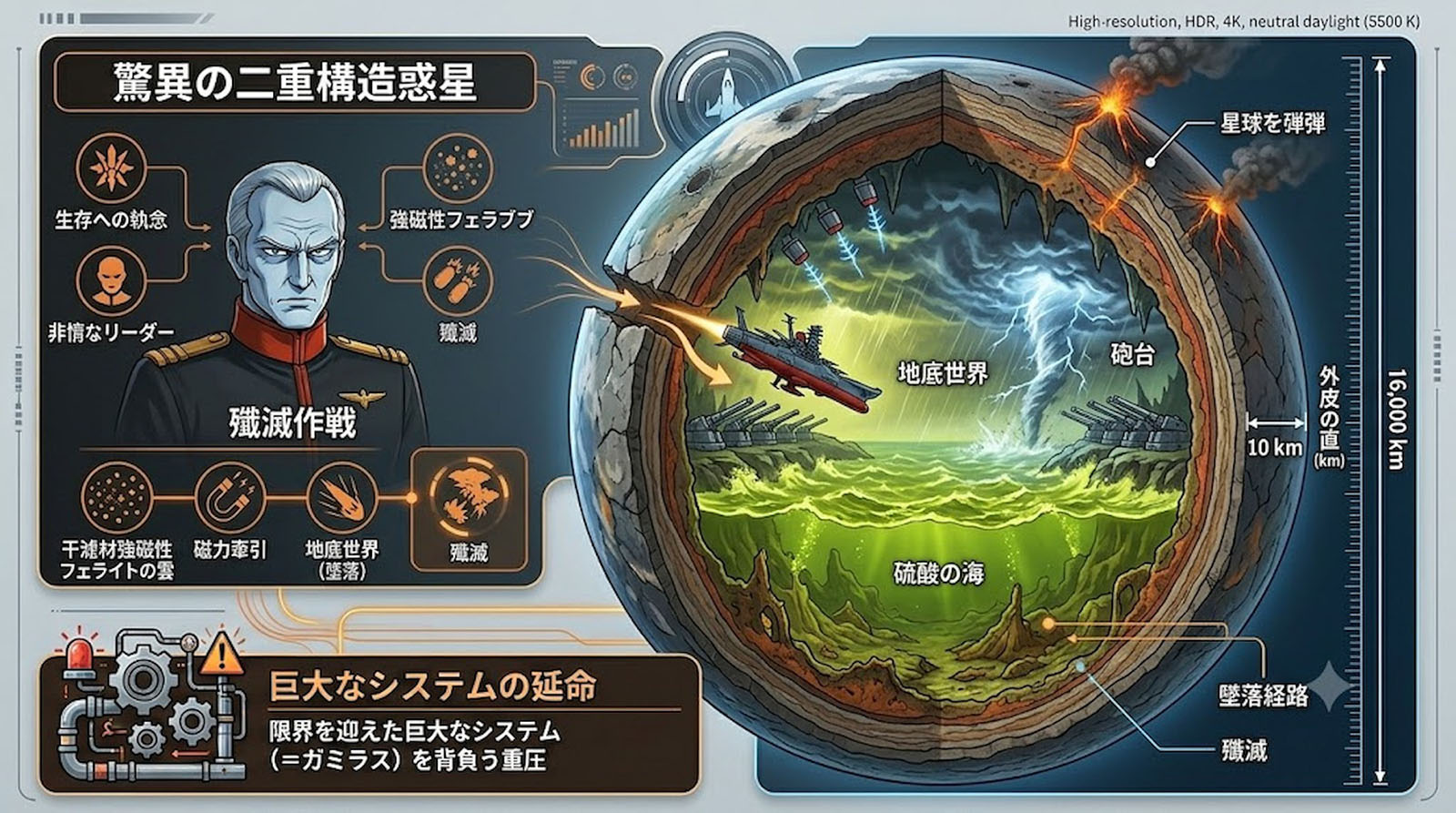
A cross-section infographic detailing the internal structure of the planet Gamilas, including its subterranean world, battery emplacements, seas of sulfuric acid, and magnetic shields.
Thank you for reading to the end.