
Thoughts after watching Episode 26
See the original blog post here
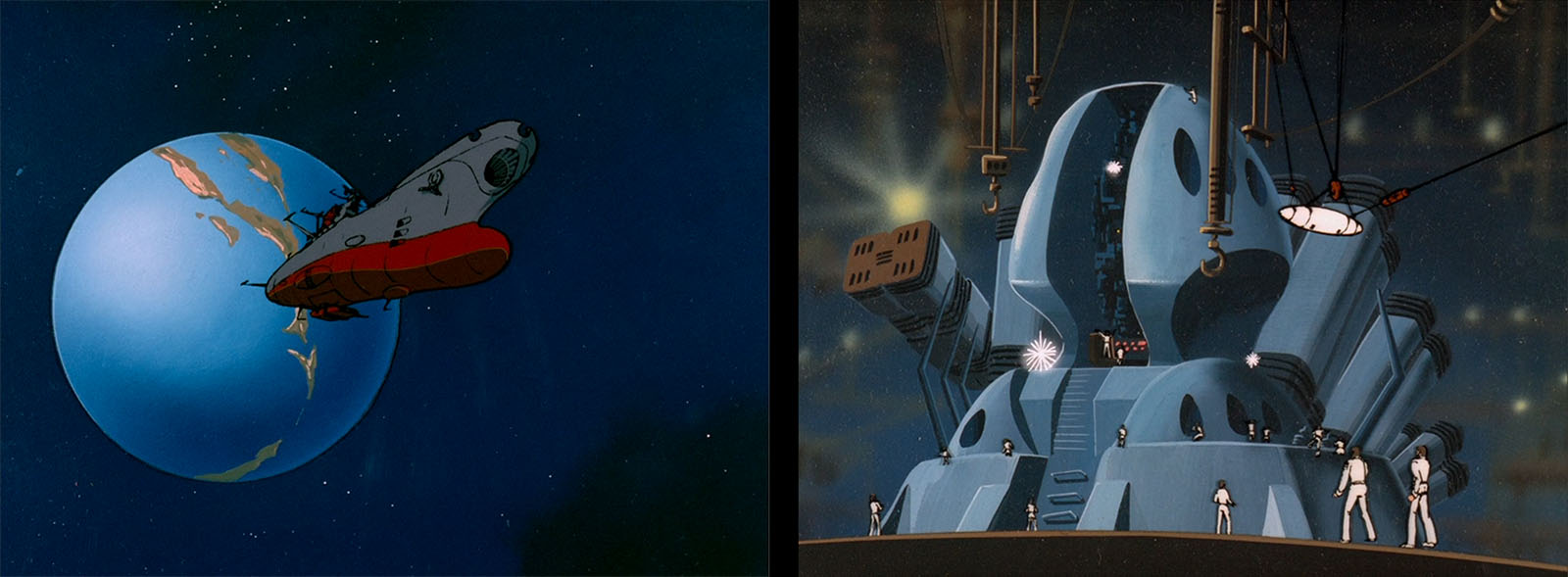
Episode 26: a story that has held me in its grip since I was a boy sitting in front of a CRT TV in 1974, and which I still cannot escape now that I am 62. To put it simply, this is not merely a happy ending where they return to Earth. It is a story of love, woven together with loss and farewells.
What you will learn from this article:
The return of Dessler, the sacrifice of Yuki Mori, and the role played by Shiro Sanada’s “Space Magnetic Plating.”
The weight of the answer Susumu Kodai arrives at: the meaning of “loving one another.”
The true resonance of Captain Okita’s final words: “Earth…everything brings back such memories.”
A re-examination of the finale from the perspective of someone who spent 32 years working in the LPG industry.
Five Highlights of Episode 26
■ Leader Dessler
Despite being presumed dead, he docks his ship alongside Yamato and launches a boarding assault, pumping radioactive gas into the vessel.
■ Yuki Mori
She risks her life to activate the unfinished Cosmo Cleaner D; while she saves the crew, she collapses from oxygen deprivation.
■ Chief Engineer Sanada
He saves Yamato by deflecting a direct hit from the Dessler Cannon using a “spatial magnetic plating” he had secretly installed.
■ Susumu Kodai
Confronted with Yuki’s lifeless body, he voices his feelings of love for her for the very first time.
■ Captain Okita
He gazes out the window at the blue Earth and quietly breathes his last, uttering the words: “Earth…everything brings back such memories.”
The Return Journey from Iscandar: Captain Okita’s Fading Life
In September of the year 2200, Yamato sails straight toward Earth, driven by the fervent hope of saving humanity from annihilation.
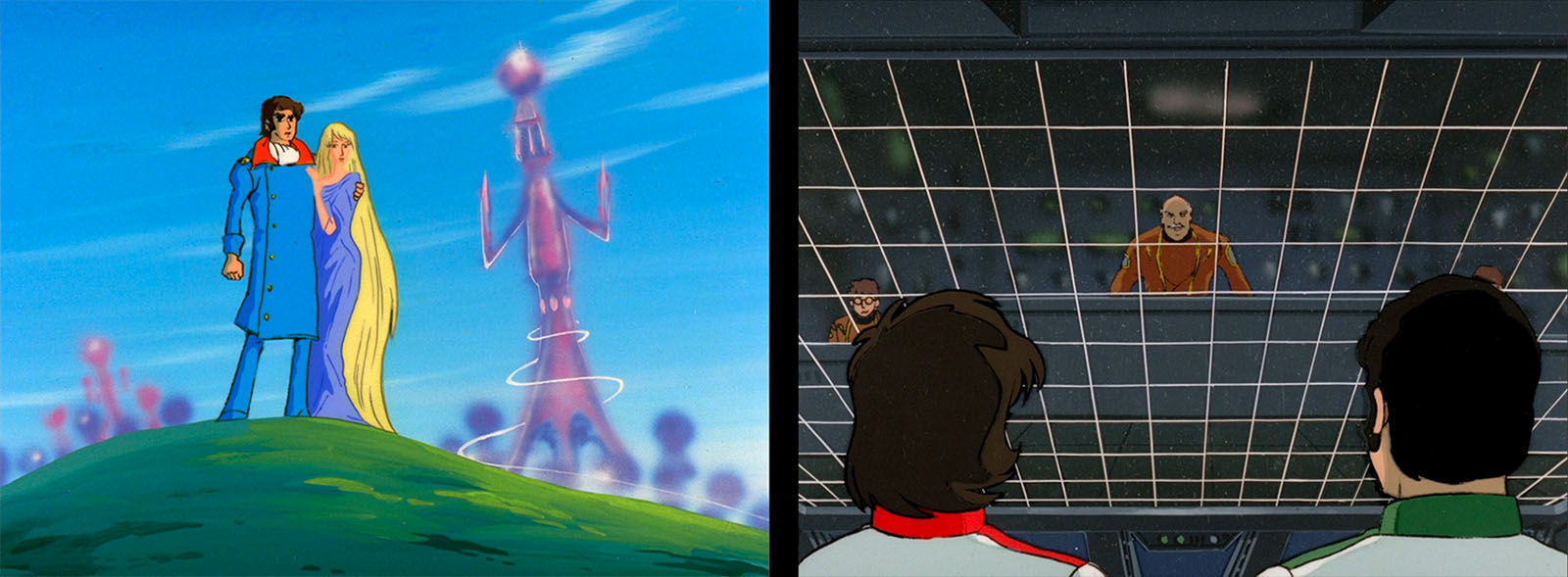
Just days earlier, Yamato had finally secured the long-sought-after “radiation removal device” and departed from Iscandar. At that time, Mamoru Kodai, older brother to Susumu Kodai, made the decision to remain on the planet. He chose to nurture the love that had blossomed between him and Starsha and to rebuild the nation of Iscandar. It was a moment when the baton of hope was passed from older brother to younger brother, and ultimately to all of humanity.
Inside the ship, the assembly of the radiation removal device proceeds at a rapid pace in an effort to make up for lost time. Communication with Earth is temporarily restored, and the crew reports that the device is nearly complete. Yet, the glimmer of hope that Earth might be saved at the last possible moment is fleeting; the harsh reality is also revealed that Earth’s power output is unstable and its energy reserves are nearly depleted.
Furthermore, Captain Okita’s condition, suffering from space radiation sickness, is steadily worsening.
“I absolutely will not die until I see Earth once more.”
Though Captain Okita displays such strong determination, the light of his life is quietly burning out; he speaks of how the soul leaves the body upon death and asks Dr. Sado about the destination of his own soul.
How Did Dessler Survive?
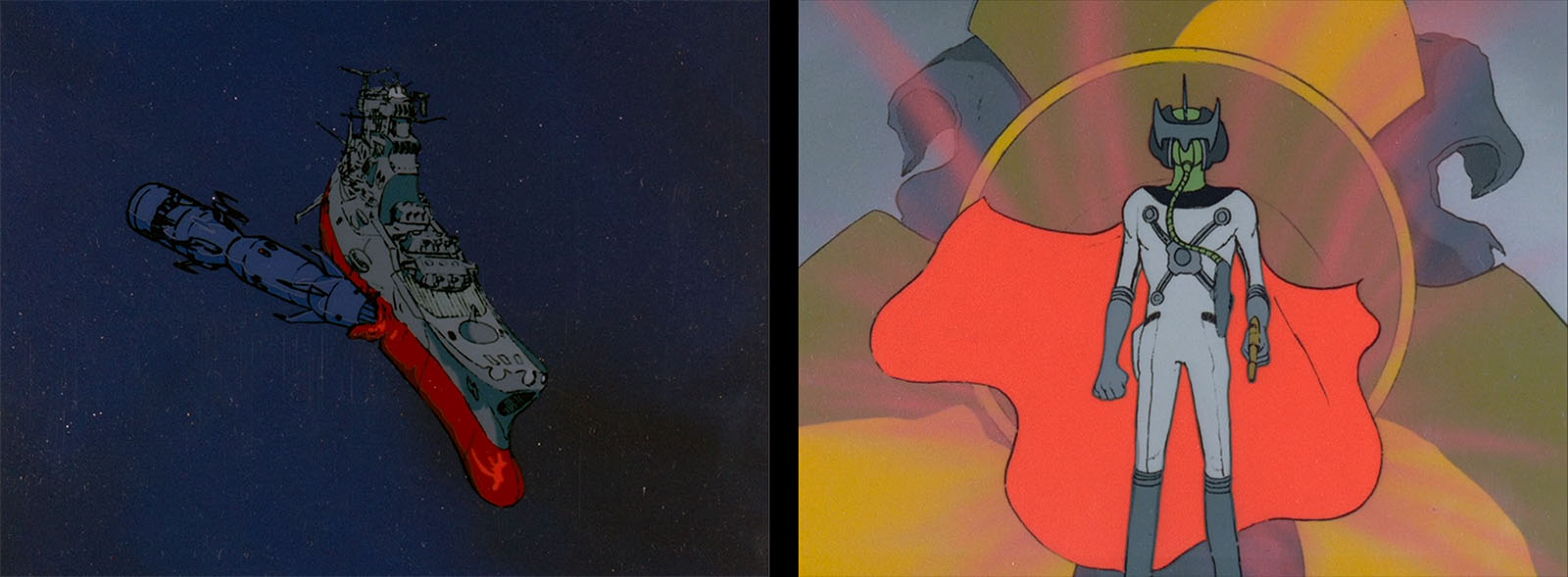
Leader Dessler was thought to have perished alongside his home planet following a desperate battle on the Gamilas homeworld. I had always wondered, ever since I was a child, how exactly he managed to survive. In truth, Episode 26 offers no clear explanation for his survival or the details of his escape. Some might scoff at the lack of explanation. Yet, I find myself unable to fault it.
The story simply posits that, by a stroke of coincidence, his ship emerges from warp and rams into the side of Yamato. Without waiting for Yamato to detect him, Dessler immediately orders a boarding assault and pumps radioactive gas into the ship, intending to transform its interior into an environment identical to the “Red Earth.” This gas, harmless to Gamilass but lethal to Earthlings, causes crew members to collapse one after another, coughing up blood. It is an act of ruthless retribution by a man who has lost his own world.
As a child, the sudden appearance of Dessler just as the blue Earth came into view filled me with a bottomless sense of despair. It was perhaps akin to the anxiety one feels when summer vacation is drawing to a close, yet the mountain of homework has barely shrunk.
Looking back now, however, I realize this was no mere battle scene. It makes perfect sense to me now that it was depicting the cycle of hatred left in the wake of war. The scenario where a supposedly defeated enemy returns, driven by a grudge, confronts us, with cruel clarity, with just how difficult it is to achieve true peace.
I spent 32 years handling facility security and gas-filling operations at an automated gas station. In the field, I often experienced the dread of a problem I thought was “resolved” suddenly flaring up again, like overlooking a tiny gas cylinder leak, only to have the alarm go off again the next morning. Dessler’s relentless tenacity reminds me of that kind of “resurgence of a supposedly finished problem.” That is why I cannot view this scene merely as a battle.
The reason Yuki Mori activates the Cosmo Cleaner at the cost of her life
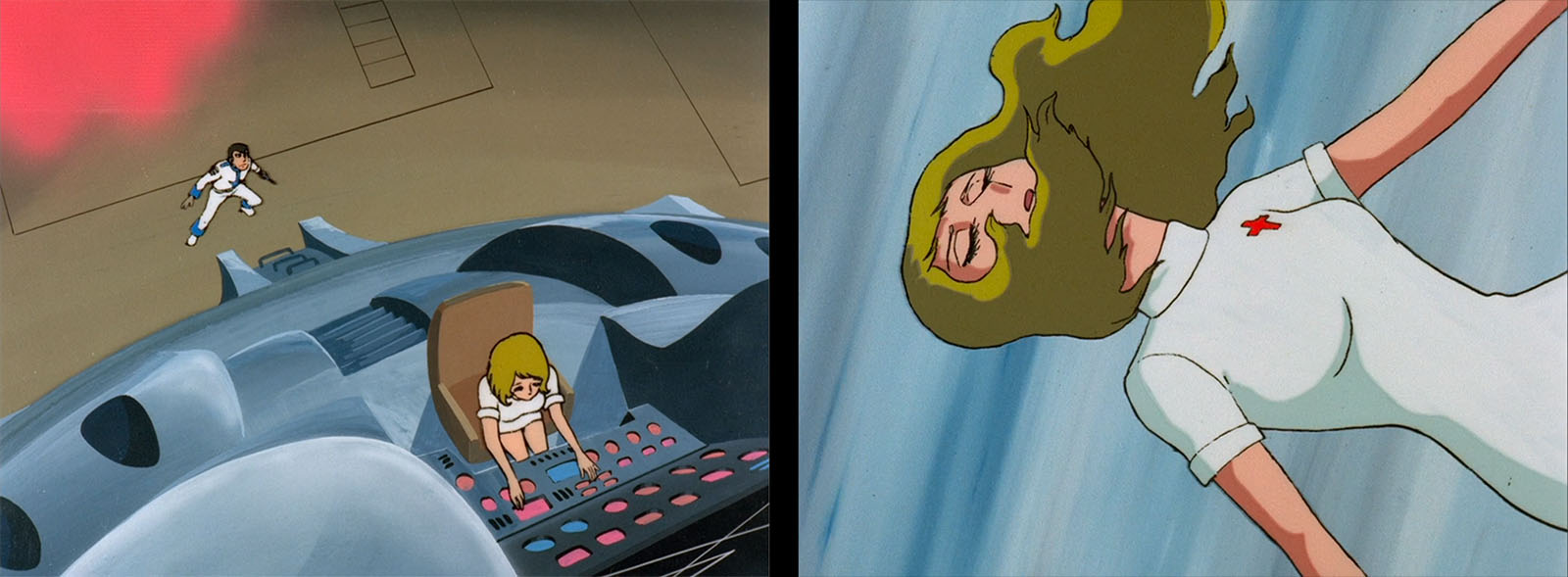
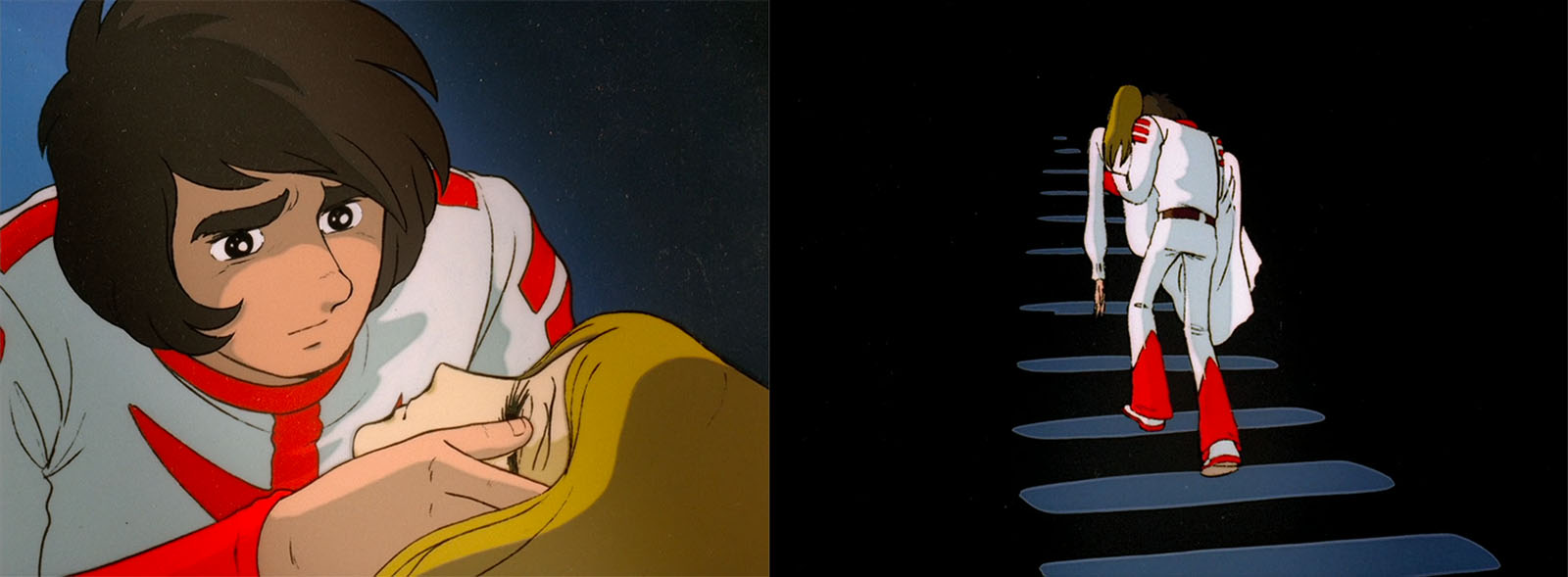
is Yuki Mori who saves Yamato from this absolute crisis of death. She activates the unfinished Cosmo Cleaner D, which Chief Engineer Sanada had warned her not to use because testing wasn’t complete, knowing it would cost her her life.
In the story, Yuki sees Susumu Kodai and the others collapsing in agony from the radioactive gas…
“Kodai-kun is going to die!” she screams. Shaking off attempts to stop her, she rushes into the activation room. You surely remember that tense scene. Her action is more than just simple self-sacrifice; it stems from a deeply personal and overwhelming desire to save the man she loves, Susumu Kodai.
The sequence from activation to oxygen deprivation
1: Driven by the desperate desire to save her comrades from the radioactive gas filling the machinery room, Yuki initiates the plasma-driven rotation.
2: The radioactive gas is successfully eliminated, forcing the Gamilas soldiers, who lack protective suits, to retreat.
3: However, during the process of clearing the radiation, the air briefly transforms into a state of lethal oxygen deprivation.
4: Even though an emergency spacesuit is nearby, Yuki sacrifices her own life, effectively revealing a critical flaw in the device.
The radioactive gas is successfully neutralized. However, the purification process generates a gas that causes oxygen deprivation. Yuki inhales it directly and collapses on the spot. She is so close to Earth, yet quietly closes her eyes in Kodai’s arms. The weight of her resolve, acting without hesitation to save the one she loves, pierces my heart no matter how many times I see it.
Outside the window, it is the late twilight of Hokkaido. Even past seven o’clock, the sky stubbornly holds onto its blue hue. Watching this scene alone at such an hour hits me all the harder. I tell myself, “You fool, act your age,” but it’s no use; I can’t help how I feel.
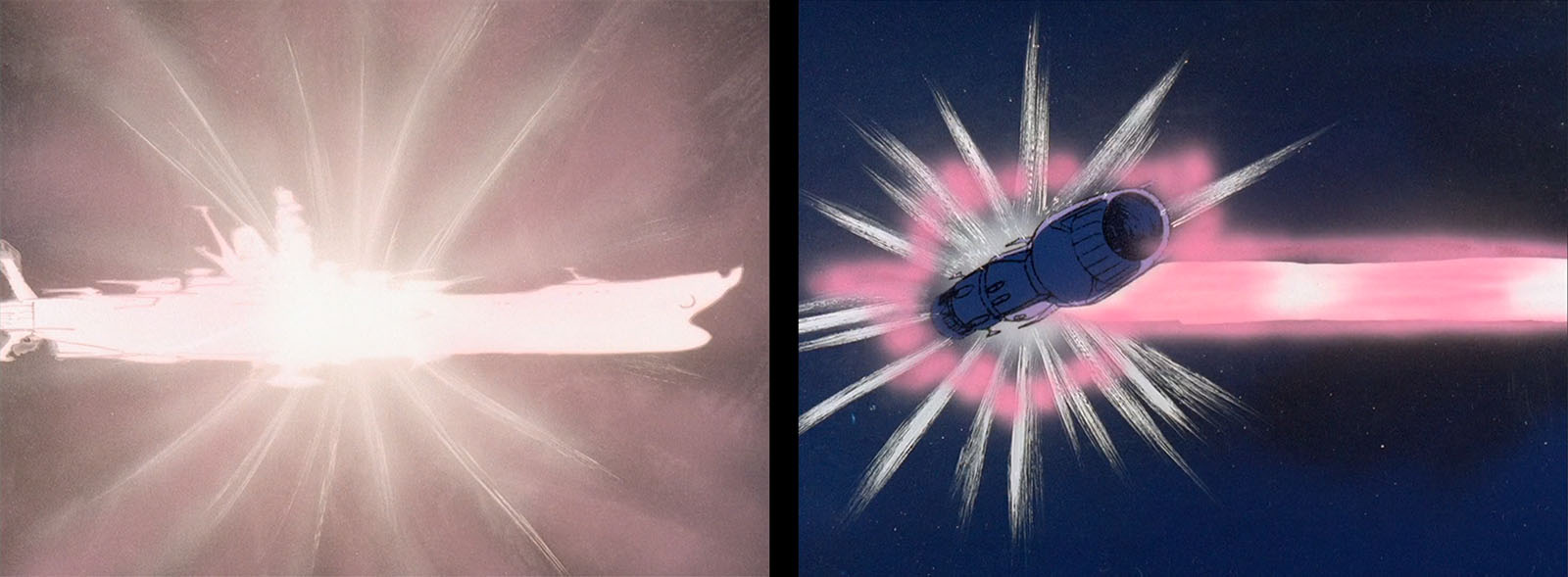
Space Magnetic Coating, A Reflective Shield Born from the Bitter Memories of Pluto
Having failed in close-quarters combat, Dessler targets Yamato with a powerful energy cannon, intent on reducing the ship to cosmic dust. There is no longer any room to escape.
What saves them from this dire predicament is the “spatial magnetic coating” that Shiro Sanada, the chief of the technical division, secretly applied to the ship. The lethal beam fired at them appears to strike Yamato, but is brilliantly deflected by the spatial magnetic coating. Dessler is defeated by the very blow he unleashed.
What makes this device so impressive is that it was inspired by the technology behind the “Reflection Satellite Gun,” which once tormented Yamato at the Pluto base. It wasn’t just some convenient gadget that appeared out of nowhere; it was the product of painful past experiences.
As someone who has spent over thirty years on the front lines grappling with issues of pressure and leaks, I deeply understand this line of thinking. On the front lines, thoroughly analyzing anomalies and incorporating those lessons into future safety measures was an absolute necessity for protecting lives. I believe the spatial magnetic coating is the crystallization of Sanada’s tenacity and preparedness as an engineer, the result of his refusal to forget the bitter memories of Pluto and his steady, painstaking work.
How Susumu Kodai Came to Realize the Value of “Loving One Another”
To truly appreciate the final episode, one must understand the emotional growth of Susumu Kodai. Initially, he was driven solely by a desire for revenge against the enemy that had taken his brother, Mamoru Kodai, and other family members. However, during the journey to Iscandar, he encounters Starsha’s sentiments and learns what it means to love a specific individual. From there, he grows to deeply understand that the enemy, too, has a home planet and people they cherish.
From Revenge to Love: The Four Stages of Susumu Kodai
◇ At Departure
A desire for revenge against Gamilas, the force that took his brother and family.
◇ During the Journey
Learns to “love a specific person” through encounters with Starsha and his comrades.
◇ Near the End
Comes to understand that the enemy also had a world and people they loved.
◇ The Final Episode
Faced with Yuki’s death, he realizes they should have loved one another rather than fought.
This growth is epitomized by a memorable line spoken just before the finale. Overwhelmed by despair at the staggering number of sacrifices, Kodai wrings out these words:
“We shouldn’t have fought. We should have loved one another.”
A personal wish to save someone precious ultimately leads to the salvation of all humanity. I believe this is the universal theme of love that runs through the very core of Space Battleship Yamato.
As a boy sitting in front of the television back in 1974, I did not grasp the true weight of those words. But now, having lived for 62 years and sharing a home with my mother and sister, Kodai’s words resonate with me in a profound way. With age, I am finally beginning to understand both the difficulty and the value of loving one another.
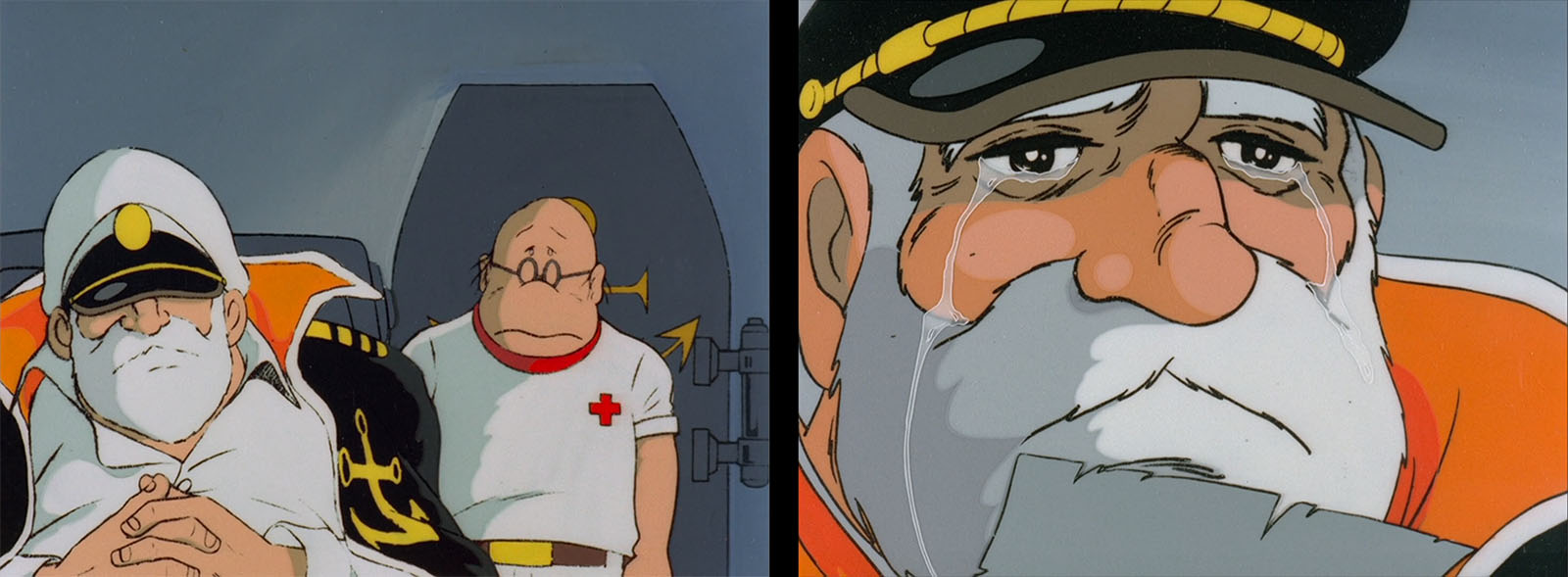
Captain Okita’s Final Moments: The Meaning Behind “Earth… It All Brings Back Such Memories”
While the young crew members rejoices at their imminent return, Captain Okita, with Earth right before his eyes, asks his ship’s doctor, Sado Sazo:
“Could you leave me alone for a while?”
He then spends his final moments alone in his quarters, gazing out at his home. Just before that, he had spoken gently yet powerfully to Kodai, who was sinking into despair:
“Do you think you’re all alone? There are so many people back on Earth waiting for Yamato.”
He explained that it was precisely because his heart was connected to those waiting on Earth that he could not die without seeing it one last time. He counseled Kodai that, through this voyage, they had learned what it means to love more people.
And then, he utters those incredibly famous words: “Earth…it all brings back such memories.”
It was an arduous journey during which he continued to guide his young crew even as his body was ravaged by space radiation sickness. In those final moments, what he saw was likely not merely the image of a blue planet. It was surely the memories of the family and comrades he had lost, the very life he had lived.
Perhaps the place a human being ultimately returns to is not a geographical location, but a place within their memories. Now that I am older, that idea resonates with me deeply. I, too, sometimes recall the scents of the workplace I visited for 32 years, or the trivial, lighthearted exchanges I shared with my colleagues. Even though I will never smell those scents again, they remain strangely vivid in my memory.
The Earth Captain Okita gazed upon is surely a culmination of such memories.
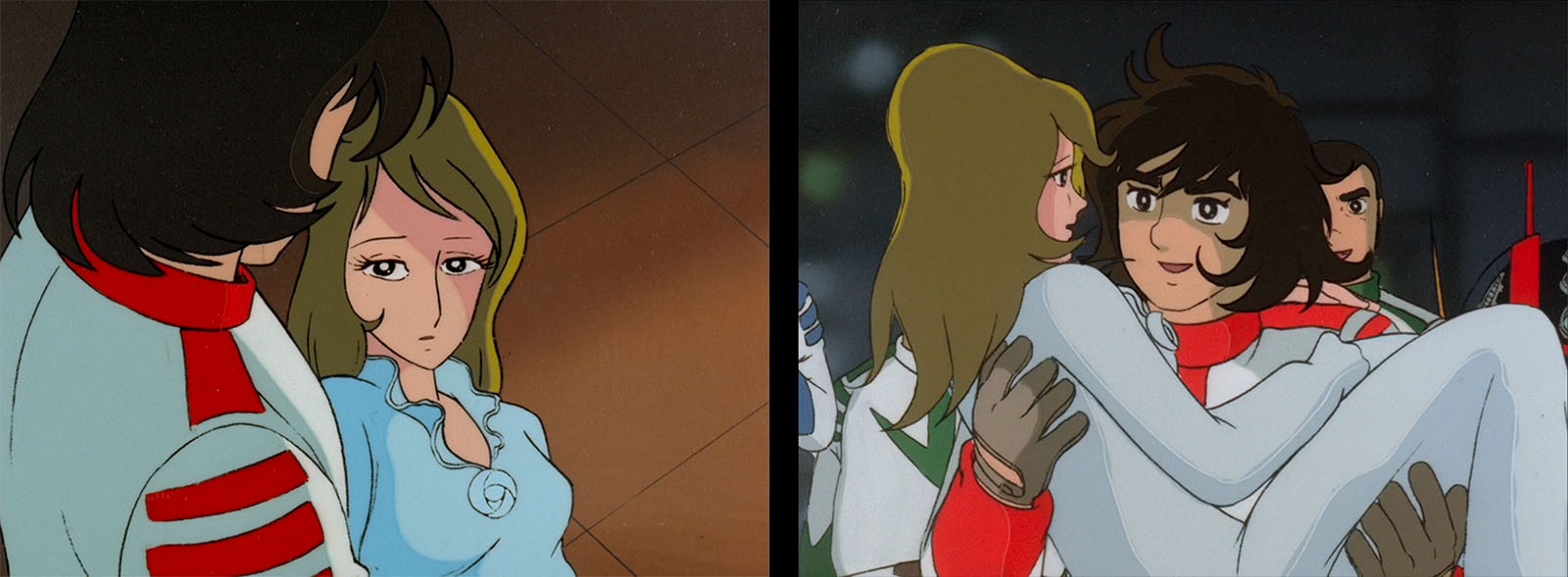
Why did Yuki Mori come back to life?
A miracle, arriving at the very depths of despair, envelops the tearful pair and their comrades in a light of hope.
The battle ends, and Yamato finally enters Earth’s gravitational sphere. Yet, the heart of Susumu Kodai remains mired in despair. Clutching Yuki Mori’s cold, lifeless body, he whispers: “I’ll tell you when we reach Earth safely. No, I will tell you that I love you.”
For the first time since losing her, he gives voice to his true feelings. But then, amidst the light as Yamato heads toward the blue Earth, Yuki Mori draws breath again and says, “Kodai-kun… you made it back safely.”
How to Interpret Yuki Mori’s Revival: Two Perspectives
◆ Scientific Interpretation
A realistic reading: she had merely fallen into a state of suspended animation due to oxygen deprivation, and her breathing returned naturally as time passed and the air quality inside the ship was restored.
◆ Narrative Interpretation
A reading that views it as a miracle born of the power of love, transcending scientific explanation, where the force that brings a person back to life is, ultimately, the human heart’s longing for another.
I don’t think this scene needs to be explained solely through logic. The scientific interpretation holds water, certainly. But there is no doubt that the creators consciously depicted the moment of confession and the moment of revival as overlapping events. Trying to pin down a single interpretation is a mistake in itself. Yamato isn’t that simple an anime.
What brings a person back to life in the end is the human heart’s longing for another. Embedded in that moment is the power of love, something that goes beyond scientific explanation, and I take this as a deliberate statement of intent from the creators.
When you reach the age of 62, you’ve encountered things that can’t be neatly explained by logic. There are moments when human emotion truly moves someone. I’ve witnessed it firsthand many times. It isn’t a miracle; it’s a testament to what it means to be human. That is what I feel every time I watch this scene.
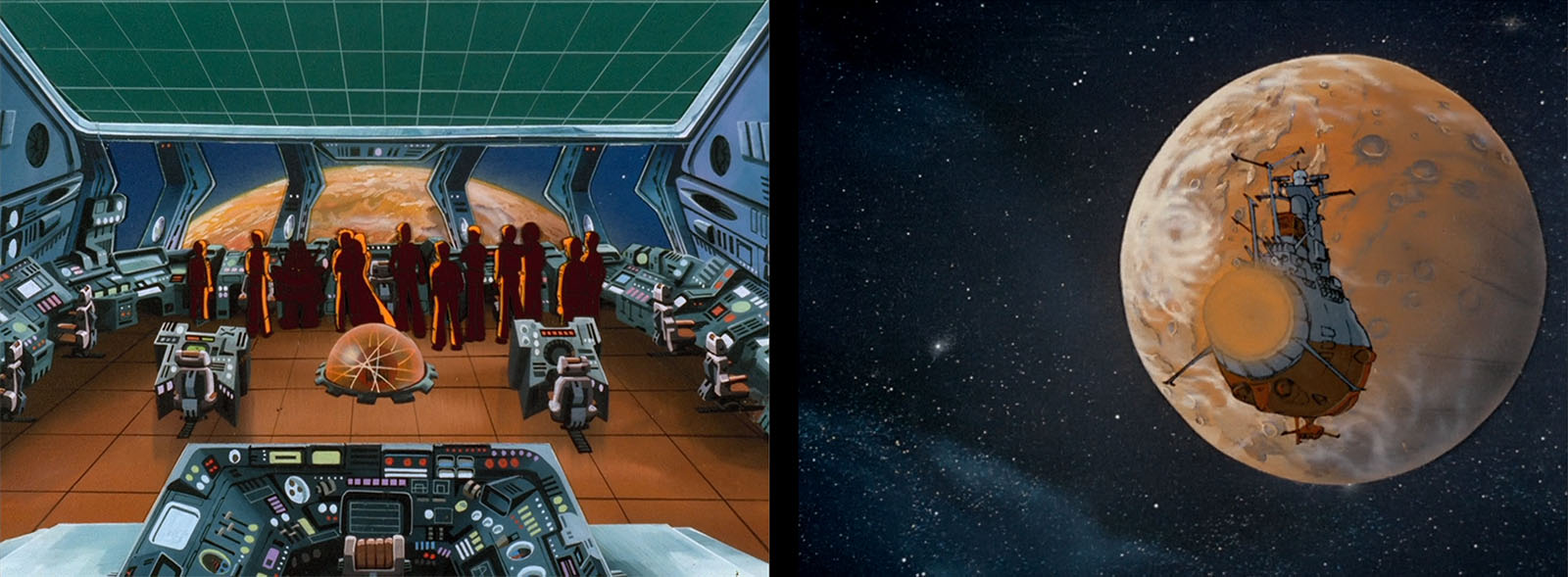
What the Finale Left Behind: Gains and Losses
As a child, I viewed this ending simply as a happy story about Yamato returning to Earth. But now, I see it as a story of loss and farewell.
Earth is saved. Yet, in the shadow of that salvation lie many, Captain Okita foremost among them, who never again set foot on their home soil.
Gains and Losses: Two Emotions Intersecting in the Finale
◆ Gains
The salvation of Earth
The fulfillment of the love between Kodai and Yuki
The lesson of “loving one another” learned by the young crew.
◆ Losses
Captain Okita’s life
Many comrades who never returned home
The innocence of youth, gone forever.
The joy of returning to Earth and the quiet death of the leader intersect within the same frame. The resolve that to gain something, one must also lose something. I, too, am walking the second half of my life. I live with my mother and sister, spending my days handling household chores and writing manuscripts.
At night, the electric fan slowly oscillates, and the sounds of insects drift in from beyond the screen door. Occasionally, a beetle bumps against the mesh, and I find myself chuckling at how I jump a little every time it happens. The view before me now is certainly different from the days of my youth, when I’d sit glued to the CRT TV, thrilled by the firing of the Wave-Motion Gun. Even the way I pull the mosquito coil out of the storage shed has become far more practiced than it used to be.
Yet, the quiet emotion that lingers at the end remains unchanged. “You aren’t here, are you?” Even knowing that, there are nights when I feel an urge to speak to Captain Okita.

In Conclusion: An Old Man’s Musings
Yamato, welcome home, truly. And Captain Okita…thank you for your tireless service throughout this long voyage.
If, after reading this, even a single thought remains with you, then that is enough.
Returning to Earth is not the only goal. I want you to remember one thing above all else: do not let the feelings you hold for someone slip away before you can put them into words.
Written by Kenichi
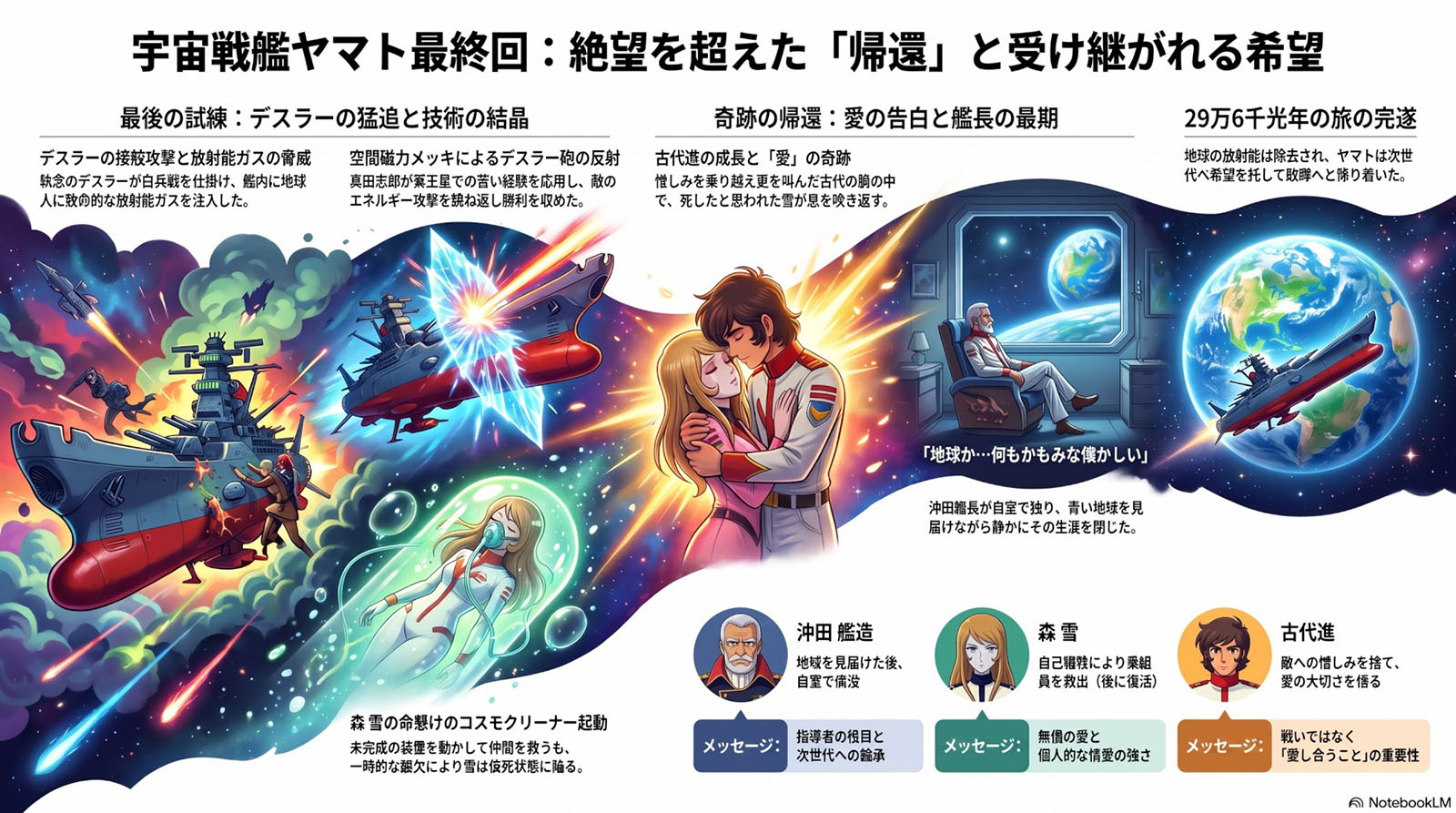
A narrative overview depicting the journey from the final battle to the return to Earth, highlighting scenes of combat, love, sacrifice, and hope. Having overcome a desperate final battle and carrying the weight of love and sacrifice, Yamato returns to Earth after a journey spanning 296,000 light-years.
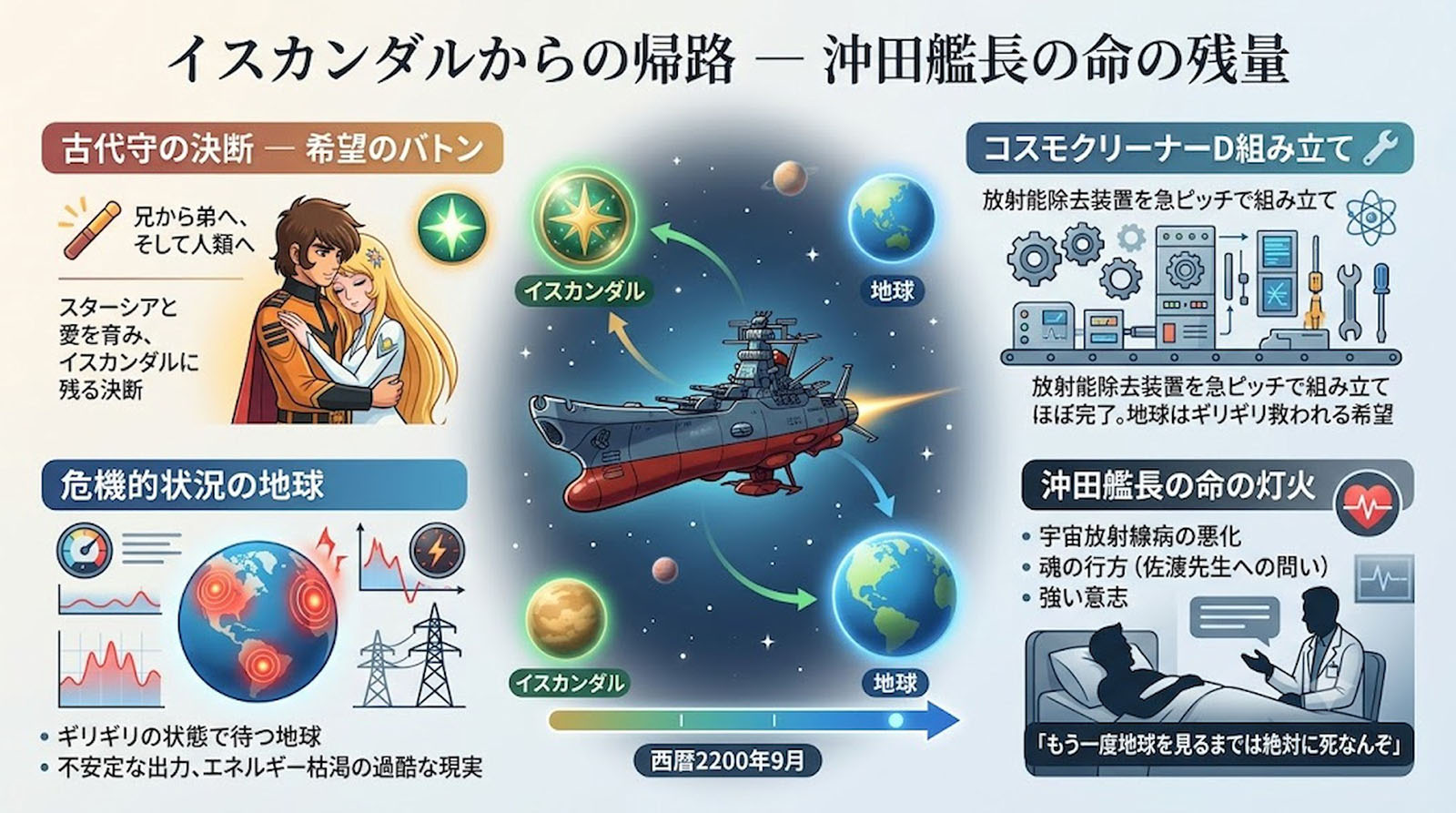
An infographic depicting the story of the space battleship’s return from Iscandar to Earth in the year 2200, covering Mamoru Kodai’s decision, the crisis facing Earth, the assembly of the radiation removal device, and Captain Okita’s battle with illness.
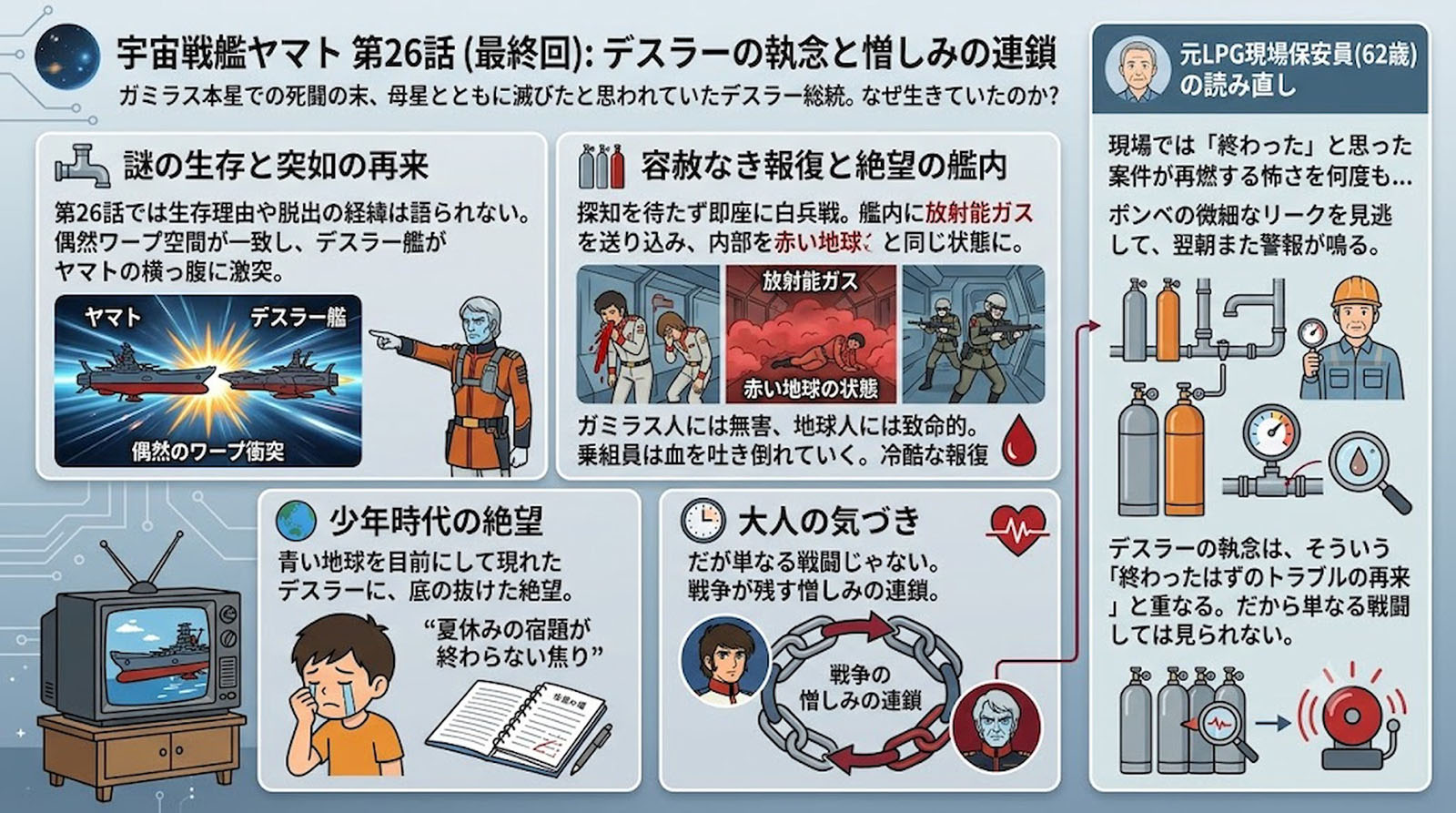
A Japanese infographic explaining Dessler’s survival, including his revenge-fueled attack on the ship, the despair of his youth, and the cycle of hatred left behind by war.
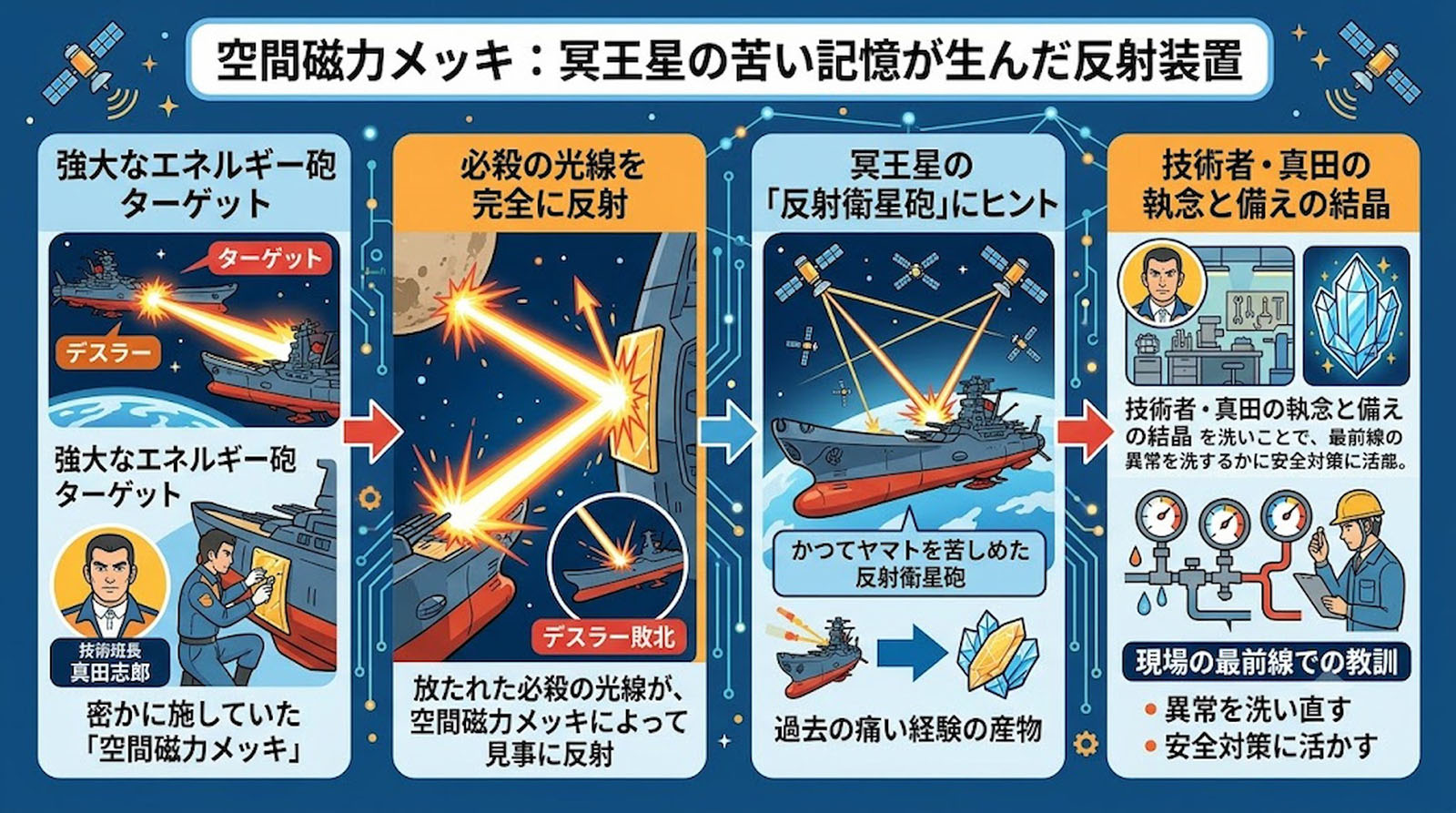
Reflective technology, born from a bitter experience at Pluto, deflects a lethal beam and paves the way for future safety measures.
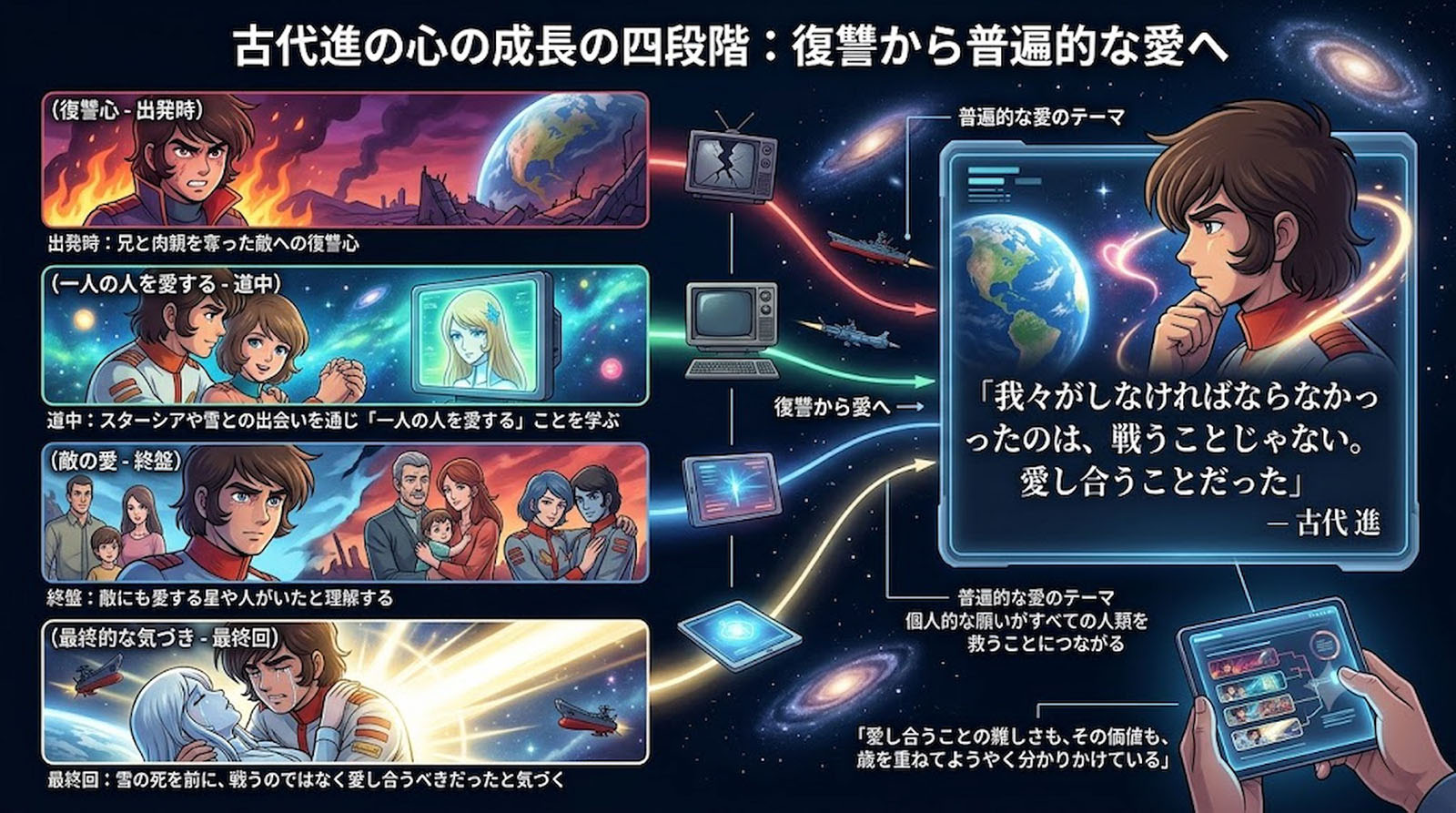
An infographic illustrating the four stages of Susumu Kodai’s growth: from a desire for revenge to loving a specific person, understanding the enemy, and finally embracing universal love.
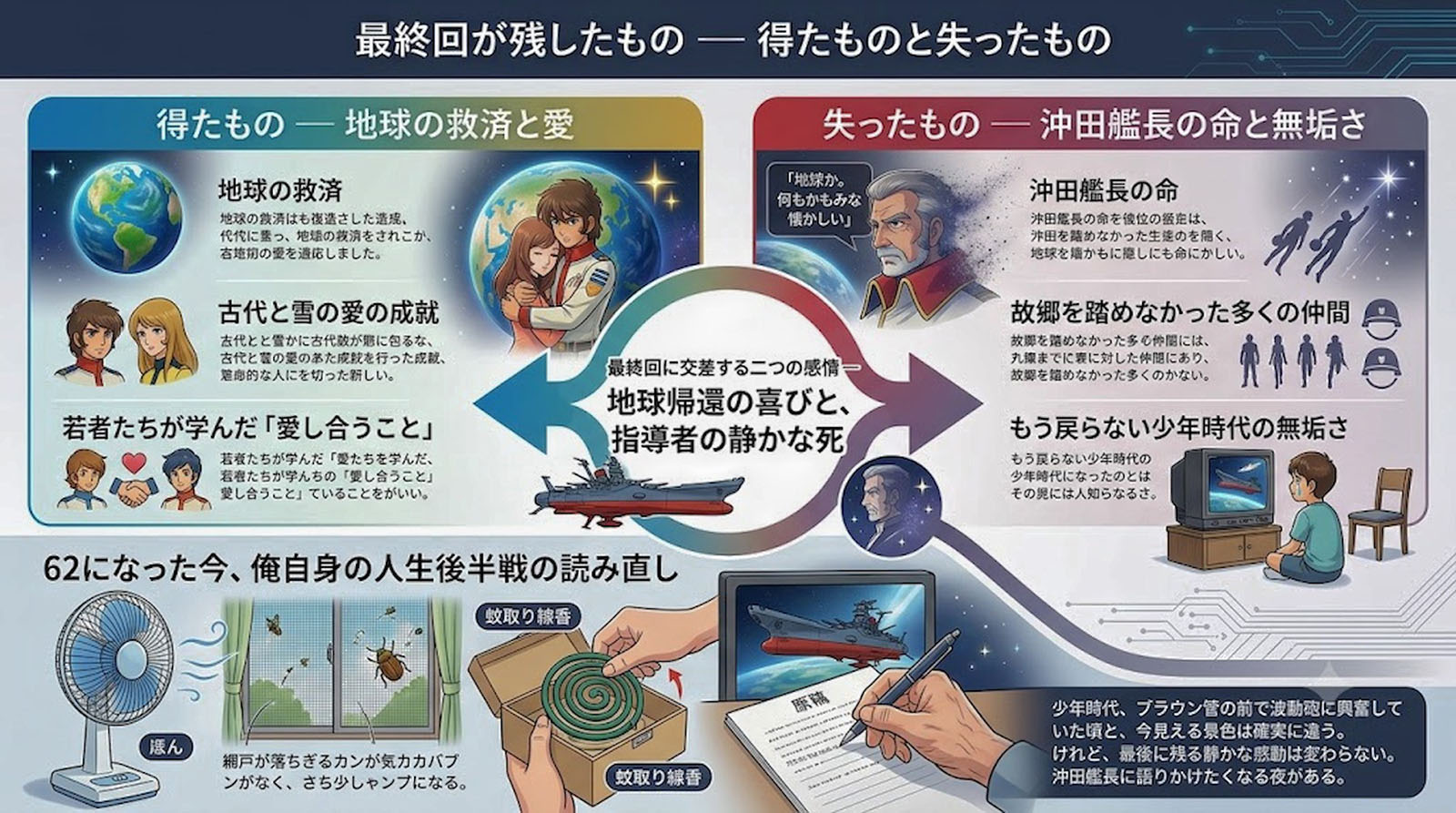
An infographic reflecting on life from the perspective of a 62-year-old, contrasting the salvation of Earth and the love found in the Yamato finale with the loss of the captain, comrades, and the innocence of youth that can never be reclaimed.
NEXT: Yamato has safely returned to Earth. It paid a heavy price, yet taught us the true meaning of “love.” However, the journey is not over yet. A new threat is closing in on Earth. In the next installment, we will continue to follow the journey of Yamato.
Thank you for reading to the end.