

Pilot Film musicology
For years after it was made, the temp score for the pilot film languished in obscurity. But superfans in Japan kept digging, and all the pieces were eventually identified. First, watch and listen to the pilot film (with subtitles) here.
Then hear the source tracks one by one on Youtube:
Track 1: Spirit of Summer by Eumir Deodato. From the album Prelude (1973).
Track 2: Love theme from The Getaway by Quincy Jones. From the album You’ve Got it Bad Girl (1973).
Track 3: Chump Change by Quincy Jones. From the album You’ve Got it Bad Girl (1973).
Track 4: Also Sprach Zarathustra cover by Eumir Deodato (original composition by Richard Strauss). From the album Prelude (1973).
Eumir Deodata is a Brazilian musician and producer whose rendition of Zarathustra reached number 2 on the Billboard Hot 100 in March 1973. Read more about him here.
Quincy Jones is a legendary musician and producer who needs no introduction, but you can read more about him here.
Prior to entering the anime world, Yamato‘s Executive Producer Yoshinobu Nishizaki spent at least a decade in the world of music, producing stage shows, spinning discs on the radio, and seeing live shows all over the world. The likelihood is very high that he made all of these selections himself, perhaps supplying the tracks from his own personal collection. They were almost certainly unlicensed at the time, since the pilot film was only intended for private screenings. The fact that it was later released fully intact means there is more information to be discovered at another time.

Fall: Sonosheet singles
Asahi Sonorama was in the business of releasing TV songs on flexidiscs in 1974. They were called phonosheets in Japan, and Sonorama branded their own as “sonosheets.” They were EPs that put the Yamato theme on the same disc as other contemporaries. This “Sonorama Golden Puppy Series” edition combined Yamato and Great Mazinger with two live action shows: Kamen Rider Amazon and Monkey Army.
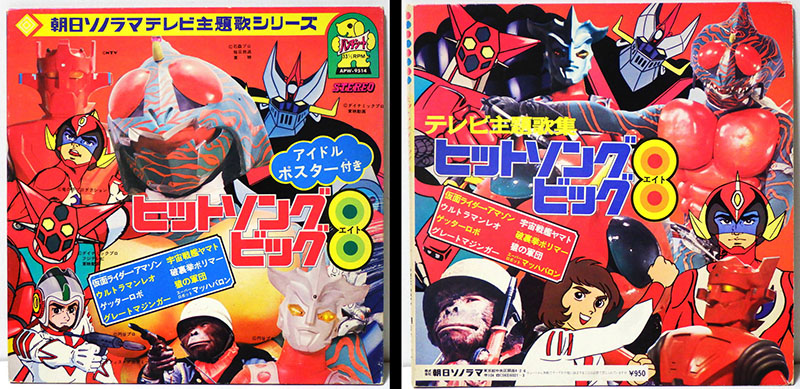
Hit Song Big 8 added four more titles to that same mix: Ultraman Leo, Getta Robo, Hurricane Polymer, and Mach Baron.
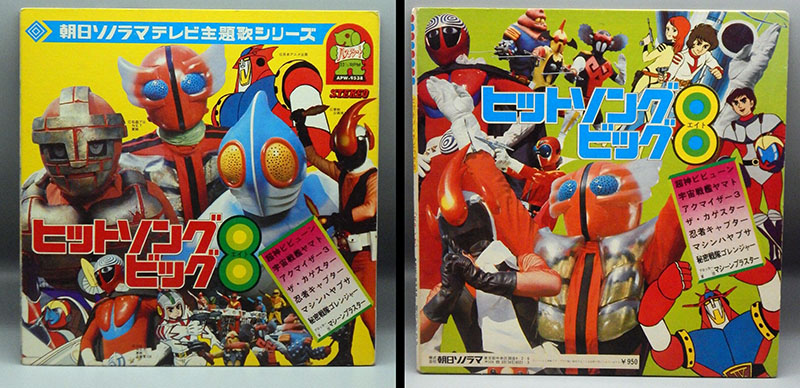
Another edition (exact date unknown) leaned heavily toward tokusatsu titles, pairing the Yamato theme with Akumaizer 3, Machine Hayabusa, and Machine Blaster and others. It’s obvious in hindsight which title had staying power.
Cross-pollination such as this was common practice at the time, and was not limited to Sonorama products as we’ll see below.

December 10: Terebi Manga Action Series Crossover single
Nippon Columbia was no slouch when it came to music marketing, finding every opportunity to cross-pollenate the hits. This crossover paired the opening and end themes with those of the live-action Kamen Rider Amazon, adding voices and sound effects to the music. (Listen to the Yamato tracks here.)

Many more of these “combo singles” would follow, especially when Yamato started climbing the charts. (See a bunch of them here.)

December: Golden Terebi Manga Big Hit Song 17 LP
The Yamato themes landed on an LP for the first time as the origin year drew to a close. Columbia was already accustomed to collecting OP and ED themes onto records for kids, and this was the first (of many) to include Space Battleship Yamato and The Scarlet Scarf. It was in odd company, as can be seen by the array of characters on the jacket, but it was compilations like this one that would bring more eyes to the show.

It was still too early for actual soundtrack music to reach the marketplace, but its day was coming, and Yamato would deliver the wakeup call. (So to speak.)