
Just before the premiere of chapter 7, Interview with Director Naomichi Yamato
Reaching the final chapter after everyone’s struggle
Director Naomichi Yamato has been “struggling” on the front lines Alphongside the staff to complete this lengthy work. What comes across from that word is not just a strong commitment to the work itself, but also a deep respect for each and every staff member, their skills, and their lives.
To preserve the power of the imagery of Yamato for future generations
“These days, if you want to make a hard-hitting anime, 3D is the main method, and I think that even the characters are becoming more stylized rather than having a traditionally dramatic manga style.”
In current animation, the use of 3D is becoming commonplace. Amidst this trend, the director insisted that “Yamato somehow hold its own in a world where the traditional emphasis on the power of visuals is becoming increasingly rare.” To achieve this, the efforts of a single director Alphone were simply insufficient.
“It was created through the efforts of many people, and I’ve had to work hard Alphongside many others. I’ve somehow managed to reach this point.”
The director used the word “struggle” many times. This didn’t simply mean that they had a hard time. It meant that each and every staff member continued to search for what they could do in their respective roles right up to the end to make the visuals look better. That was also a point the director insisted on, something he wouldn’t compromise on.
“Each and every member of the staff has fought their own battle, and the battle against the work itself, in order to make it better.”
As a director, from the perspective of someone commissioning production, a staff member’s meticulousness can sometimes appear as unnecessary extra work. But this director doesn’t overlook that.
“Those who are responsible for placing orders need to be mindful of that, otherwise the hard work and effort put in will go to waste. In reality, each drawing represents the lives of those artists. More than the technical aspects of the work itself, it reflects the skills and experience they’ve cultivated up to that point.”
A single image, a single movement, a single detail. Even in the parts that the viewer might overlook in an instant, the skill and experience of the person who created it are packed into it.
“I want to do my best to make the most of the dedication and attention to detail that I can perceive from the staff.”
What Director Yamato values most is how to capture the unique talents of the animators, CG staff, illustrators, and actors on screen.
A compelling human drama adds depth to the work
The story is full of unexpected twists and turns, but the part that moved the director the most was apparently the drama on the Earth side.
“I was always worried that the audience would want to see Susumu Kodai and Yamato in action, and that the depictions of Earth would feel superfluous. However, everyone, especially those who have been watching Yamato since the Showa era, has experienced internal conflicts and struggled in relationships with those around them. The people who appear in the scenes on Earth are by no means pure and innocent. They waiver, making mistakes, and sometimes take actions that are criticized by those around them.”
The scenes were Kosaka, a schoolteacher, reveals his human weaknesses amidst his internal conflicts are particularly symbolic.
“During script meetings, I did ask Mr. Fukui, ‘Is this depiction OK?’ But the way he desperately tries to live, despite making mistakes, is what makes him human, and it adds depth to the work. In fact, I myself am single, just like Kosaka, and it’s because I can dedicated all my private time to the project that I was able to take on such a weighty work as Yamato. I also relate to the character because he’s someone I can empathize with, since he’s someone who constantly bows his head to the staff on site and causes them trouble.”
In Chapter 7, Arizona finally reveals its full form
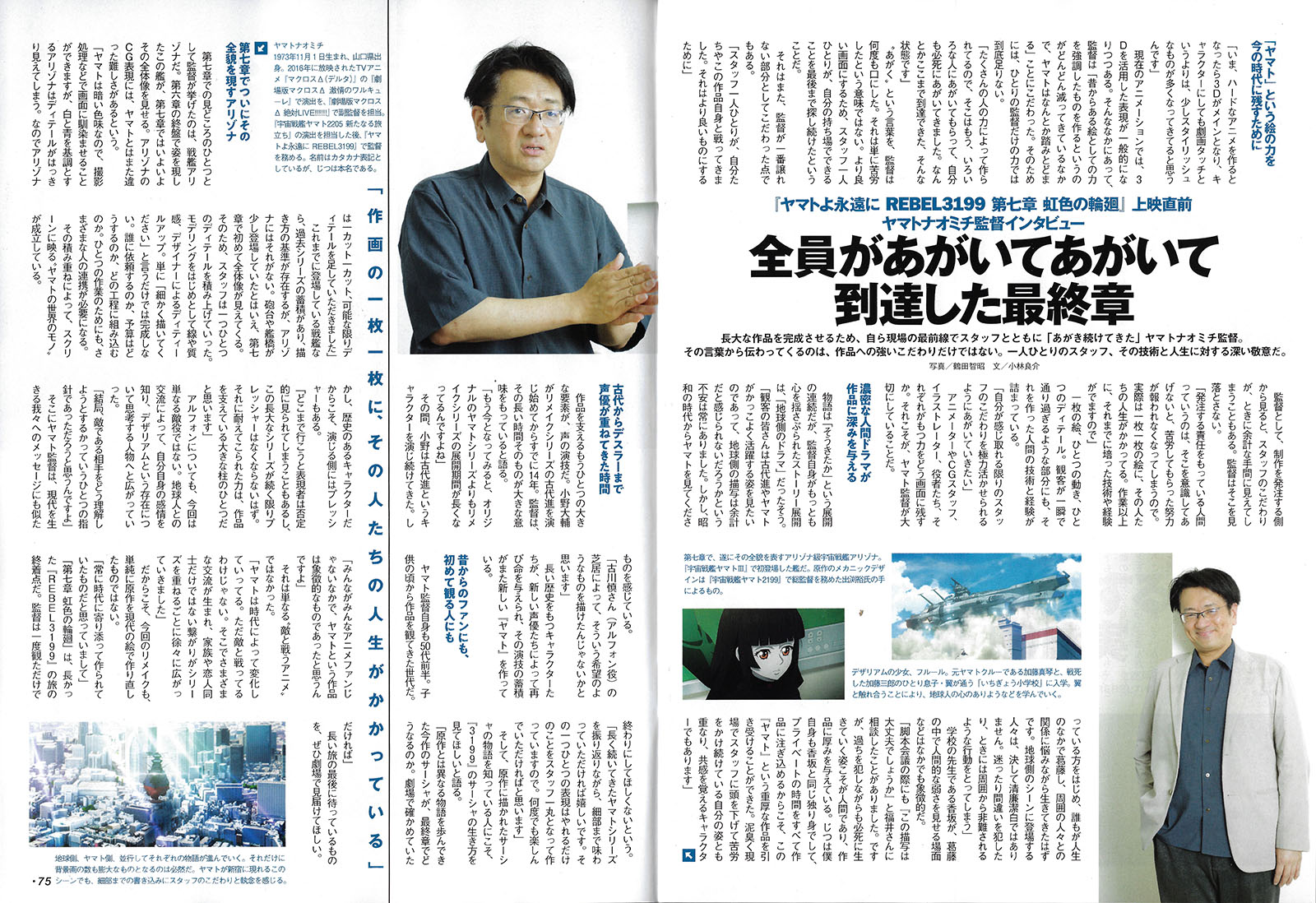
One of the highlights of Chapter 7, according to the director, is the battleship Arizona. This ship, which appeared at the end of Chapter 6, will finally reveal its full form in Chapter 7. The director says that rendering Arizona with CG created different challenges compared to rendering Yamato.
“Yamato has a dark color scheme, so it can be made to blend into the visuals through post processing, but Arizona, which is white and blue, has details that are clearly visible. So we cut out parts of Arizona and added as much detail as possible.”
With battleships that have appeared so far, there is a history of past series and a standard for how to depict them, but there is nothing like that for Arizona. Although the gun turrets and bridge have only appeared briefly, the full image of the ship is only revealed for the first time in Chapter 7. Therefore, the staff built up each detail one by one from modeling to lines, textures, and detail enhancements by designers. It wouldn’t be completed simply by saying, “please draw it in detail.” Who to commission, what the budget will be, and which stage to incorporat it into – even for a single task, coordination among various people is necessary.
It is through the accumulation of these elements that the world of Yamato that unfolds on screen comes to life.
The time that voice actors have accumulated, from Kodai to Dessler
Another major element supporting the work is the voice acting. It has been 14 years since Daisuke Ono began voicing Susumu Kodai in the remake series. The director says that this long period of time itself is a great significance.
“Looking at it now, the remake series has actually run longer than the original Yamato series.”
During that time, Ono continued to play the character of Kodai. However, because it is a character with a long history, there is pressure on the actor playing the role.
“No matter how far you go, artists can sometimes be viewed negatively, and as long as this lengthy series continues, the pressure will never go away. I believe the strength that allowed them to endure that is one of the major pillars supporting the work.”
Ask for Alphon, this time he’s not just as simple antagonist. Through his interactions with humans, he comes to understand his own emotions and develops into a character who contemplate the existence of Dezarium.
“Ultimately, I think it’s served as a guideline for how to understand the enemy.”
In this work, Director Yamato sees something akin to a message for us living in the modern age.
“I think we were able to portray a sense of hope through the acting of Makoto Furukawa, who plays Alphon.”
Characters with a long history are given new life by new voice actors, and the accumulation of their performances is creating a new Yamato once again.
For longtime fans, and those seeing it for the first time
Director Yamato himself is in his early 50s. He belongs to the generation that has been watching the series since childhood.
“I think that in a world where not everyone is an anime fan, the Yamato series is a symbolic work. Yamato is constantly evolving with the times. It’s not just about fighting enemies. Various interactions are born, and connections that go beyond just family and lovers gradually expand with each passing series.”
That’s why this isn’t simply a modern remake of the original.
“I believe it has always been something that has been created in line with the times.”
Chapter 7 marks the end of the long journey of REBEL 3199. The director doesn’t want it to be a one-time viewing experience.
“We hope you’ll enjoy looking back on the long-running Yamato series and appreciate every detail. Every single detail has been meticulously crafted by the entire staff, so we hope you’ll enjoy it again and again.”
He also said that he wants people who are familiar with Sasha’s story as depicted in the original work to see how Sasha performs in 3199.
“Sasha’s story in this film has taken a different turn from the original, so what will become of her in the final chapter? Please go to the theater to find out.”
We hope you’ll go to the theater and see what awaits you at the end of this long journey.