

Love and Romance of the “Community of Destiny”
The Unsinkable Battleship Yamato SINKS
By Makiko Awano
Yamato is finally coming to an end. Planned in 1973, Space Battleship Yamato was an overwhelming hit among children, sparking an anime boom. After 10 years, the film Space Battleship Yamato, The Final Chapter will be released on March 19. what will be Yamato‘s final moments? What will be the fates of Susumu Kodai and Yuki Mori? And what will become of Yamato‘s themes of love and romance?
Okita, who was thought to be dead, reappears
Summary of The Final Chapter
The year is 2203…
On the far side of the Milky Way, another galaxy suddenly appears from a dimensional fault, causing many collisions between stars in the Galactic core
Meanwhile, perhaps, as a result of this, the Water planet Aquarius, which is said to have brought water and the seeds of life to the Earth, bringing tons of rain to the burning rock 4 billion years ago, has begun to approach Earth again. Earth is now once again facing a crisis similar to that of Noah’s flood.
Furthermore, the Grand Priest Lugal of the planet Dengil, which had been submerged earlier by Aquarius, plans to take over earth. To achieve this, he plans to warp Aquarius with super thermonuclear energy, causing earth to be flooded quickly, and then migrate there afterward.
With just nine days until Aquarius approaches earth, only Yamato can stand against the enemy. After losing many crew members in the previous battle, Susumu Kodai takes responsibility and resigns as captain of Yamato. However, he returns as combat team leader under captain Juzo Okita, who has recently recovered from an illness, and sets out to save Earth.
That’s roughly how the story of the movie unfolds.
Highlights of the film are the reappearance of Juzo Okita, the ship’s first captain (who was thought to have died of space radiation sickness in the previous film), the romance between Kodai and Yuki, and the final scene of Yamato, exploding and sinking into the ocean of space. In the final 14 minutes, along with the majestic figure of the sinking Yamato, a full scale love scene never before seen in anime will unfold.
The main theme has been “love” since the first Yamato film. Producer Yoshinobu, Nishizaki, the well-known creator of Yamato, includes the following message in a pamphlet, outlining the project’s purpose:
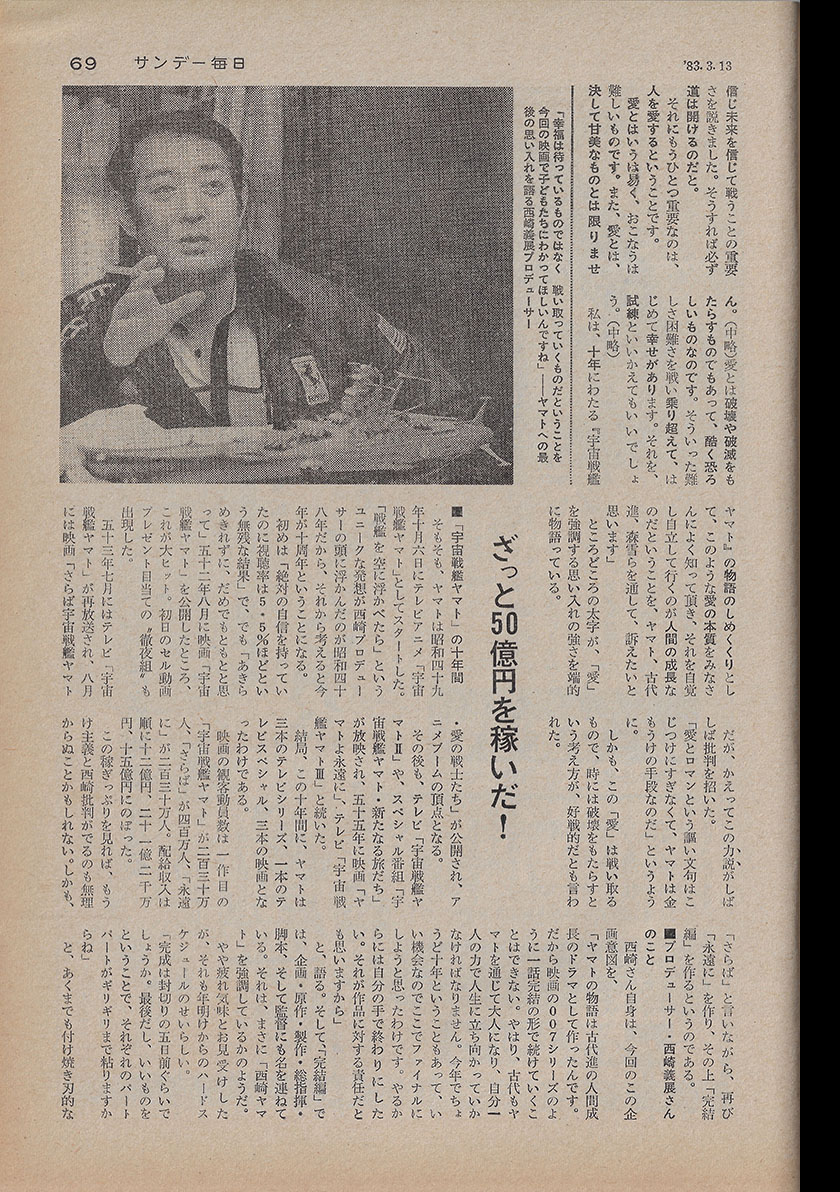
Photo caption: “I want children to understand through this film that happiness is not something that waits for you, but something that you fight for,” says producer Yoshinobu Nishizaki, speaking of his final thoughts about Yamato.
“Through Yamato, I have preached the importance of believing in humanity and the future. If you fight for it, a path will surely open up.
Another important thing is to love people. Love is easy to say, but difficult to put into practice. Also, love is not always sweet. Love can also bring about destruction and ruin, and can be a terrible and frightening thing. Only by fighting and overcoming such difficulties can happiness be found. You could even call it a trial.
As I conclude the 10 year story of Space Battleship Yamato, I want everyone to understand the true nature of this love, and through Yamato, Susumu Kodai, Yuki Mori, and others, I want to convey that human growth comes from being aware of it and becoming independent.”
The bold statements here and there clearly show the strength of the feelings that emphasize “love.” However, this assertion has often drawn criticism.
“The slogan of love and romance is just a fabrication, and Yamato is just a way to make money.”
Moreover, the idea that this “love“ is something that needs to be fought for, and that sometimes brings destruction has been described as warlike.
He earned roughly ¥15 billion!
10 years of Space Battleship Yamato
Yamato originally began as the TV anime Space Battleship Yamato on October 6, 1974. The unique idea of “flying a battleship in the sky” came to producer Nishizaki’s mind in 1973, so this year marks the 10th anniversary since then.
At first, “I was absolutely confident, but the viewer ratings were a dismal 5.5%. But I couldn’t give up, and I thought well, what can I do?“
When the movie Space Battleship Yamato was released in August 1977, it became a huge hit. There were even “all-nighters“ who came out on the first day to watch the the film and receive a free animation cel.
In July 1978, the TV series was re-broadcast, and in August the film Farewell to Yamato was released, marking the peak of the anime boom. After that, the TV series, Yamato 2 and the special program The New Voyage were broadcast, followed in 1980 by the film Be Forever Yamato, and the TV series Yamato III.
In the end, over the course of the decade, Yamato has been made into three television series, one television special, and three films. The first film, Space Battleship Yamato, attracted 1.3 million movie goers, Farewell to Yamato 4 million, and B forever 2.3 million. The box office revenues were ¥1.2 billion, ¥2.12 billion, and ¥1.5 billion, respectively.
Looking at how much he makes, it’s not surprising that people criticize Nishizaki for being profit driven. After saying Farewell, he created Be Forever, and now The Final Chapter.
About producer Yoshinobu Nishizaki
Nishizaki himself explains the intention behind his work.
“The story of Yamato was created as a drama about the growth of Susumu Kodai as a person. That’s why we can’t continue with self-contained stories like the 007 movie series. After all, Kodai also grows up through Yamato and must face life on his own. This year marks exactly 10 years, so I thought it would be a good opportunity to make this the finale. If I’m going to do it, I want to end it with my own hands. I also think that’s my responsibility to the work.”
For The Final Chapter, he is listed as the planner, original author, producer, chief director, scriptwriter, and director. This truly emphasizes the “Nishizaki Yamato” aspect of the series.
He seems a little tired, but that is probably due to his busy schedule since the beginning of the year. “It will probably be completed about five days before the premiere. It’s the last one, so I will stick to each part until the very last moment to make sure it’s a good one.”
He emphasizes that this is not a quick and dirty work.

Nishizaki was born in 1934. He was raised in a prestigious family and was the nephew of the elite Japanese dancer, Midori Nishizaki, but he did not follow the expected path to becoming an elite dancer himself. After enrolling at Bungaku, he worked as a nightclub host and bartender before moving on to producing stage productions and shows.
Becoming Osamu Tezuka’s general manager led to his encountered with animation, and in 1970 he founded Academy Co. Ltd. Prior to the TV anime Space Battleship Yamato, he produced two other series, but they were completely unsuccessful. Yamato also initially flopped, but it later became a huge hit, apparently because its popularity had been gradually building up overtime.
“Looking back, I think the rival programs were strong. But word-of-mouth spread little by little that Yamato was interesting. Good things are recognized in the end,” says Nishizaki proudly.
From the beginning, the staff included top talent, such as Leiji Matsumoto, the popular manga artist, and Hiroshi Miyagawa for music. After the first movie became a hit, Nishizaki also became a major producer in the anime industry.
This really is the final part
In 1980, Academy went bankrupt due to poor management and was re-launched as West Cape Corporation. Nishizaki‘s rapid progress is often compared to that of Haruki Kadokawa, President of Kadokawa publishing. Nishizaki says, “we are different types of producers. I come from the creative world, but he is a businessman after all. I don’t think about it that way.“
That being said, Kadokawa Pictures’ first animated film Harmagedon will be released on March 12. Whether you like it or not, you can’t help but be aware of it.
When it comes to that topic, “to be honest, I want to say that the world of anime is not that easy. After all, we’ve been doing this for 10 years, so we can’t lose,” Nishizaki exclaimed, his breathing becoming heavier, and his face showing signs of fighting spirit.
Yamato fan voices
By the way, what are Yamato‘s avid fans expecting from The Final Chapter?
Ria Ichikawa, a first year university student who has been a member of the Yamato fan club for the past four years, says, “I love anime that does things I can’t do. Yamato showed us the importance of sticking to one’s own way of life. I feel sad that it’s ending here, but I hope it will end in a spectacular in dignified way, sticking to its ideals of love for humanity and for the universe.”
That’s what it means. Rather than being sad to say goodbye to Yamato, they want an ending worthy of a masterpiece.
“After Farewell, they said they wouldn’t make any more, but then they made Be Forever. The first Yamato was a masterpiece, so I don’t want to tarnish its name. In this one, Okita, who was supposed to have died, also appears. I hear there’s some thought behind it, but it’s a bit…“
The more of a fan you are, the more critical you are of the work.
However, in response to criticism that Yamato is “a dangerous anime that glorifies death,” he firmly states, “those of us who have never experienced war learned about the horrors of war through Yamato. Anime fans are not so stupid to say that death is glorified.”
Koichiro Wada, a third year university student who is also a member of the fan club, said, “I think the themes of Yamato are love, romance, and adventure. There are battle scenes, but there’s also a line that goes, ‘We shouldn’t have killed each other. We should have loved each other.’ To be honest, I could only keep up with it up to Farewell. But I wonder what will happen to Yamato. Personally, I want it to return to the sea. If the fan club disbands, there won’t be anything to pass on the story of Yamato. That’s why I’m thinking about it now.”
Producer Nishizaki is known by fans as a go-getter, but unless he creates a masterpiece that lives up to the Yamato name, fans will not support him. And he must make this truly the last one, once and for all.
“Well, nothing more is going to happen after all this.” Nishizaki laughs and says that in the future he would like to make feature films aimed at people age 18 and over. So, what kind of conclusion will Yamato, which has sparked controversy among both children and adults in many ways, bring to the final episode? We look forward to seeing it on the 19th.