Gaipellon-class Multi-deck Space Carrier Lambea
From Yamato 2199 to REBEL 3199, a series explaining the mechanics of battleships and other vessels appearing in the Space Battleship Yamato remake series. In the 24th installment, we will explain the Gaipellon-class Multi-deck Space Carrier Lambea, which participated in the Battle of the Rainbow Star Cluster as part of Domel’s mobile fleet, and continues to play a key role in the fleet strength, even after the founding of Galman-Garmillas.
Explanation: Yuka Minagawa
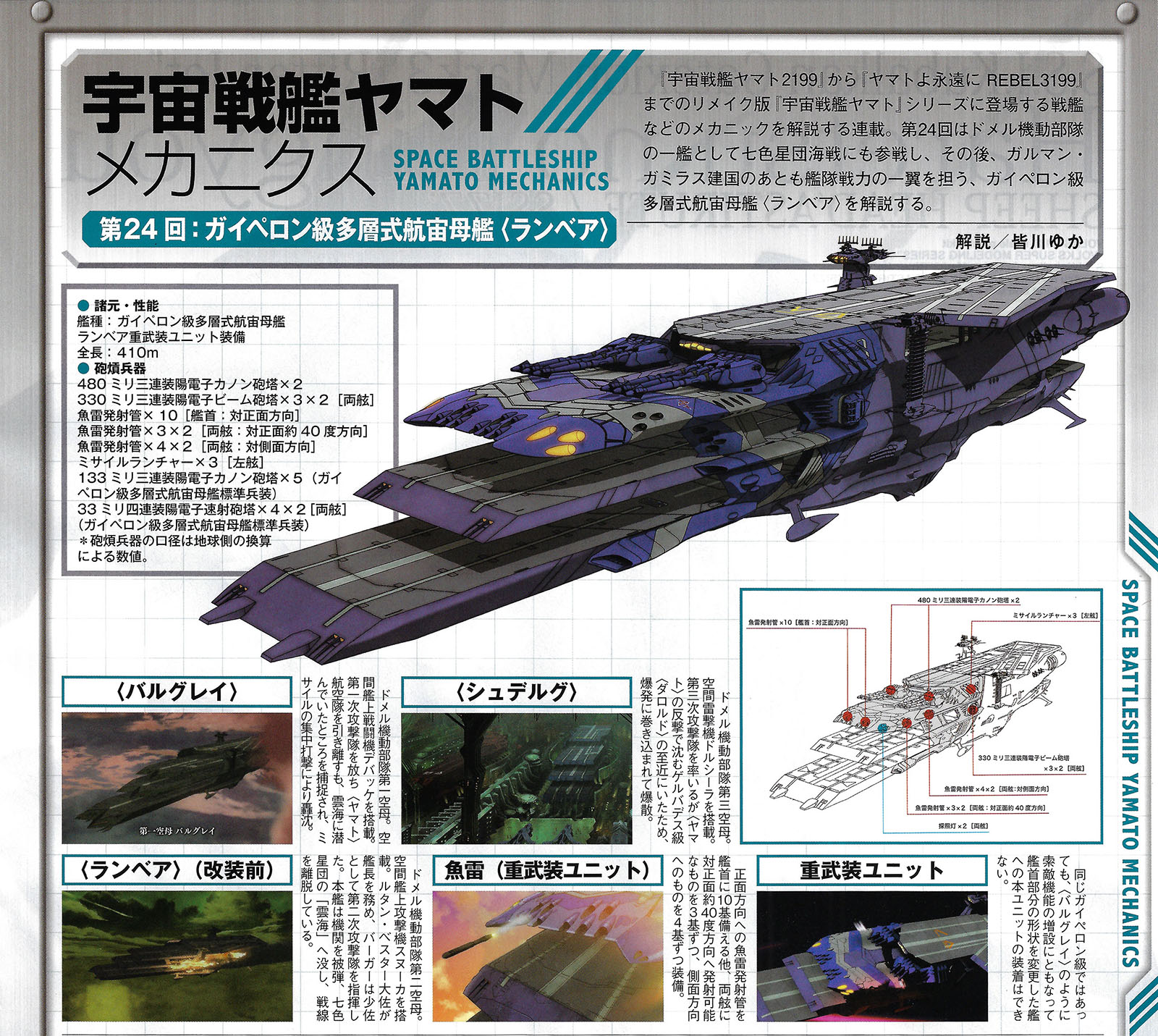
Specifications/performance
Ship type: Gaipellon-class Multi-deck Space Carrier Lambea
Equipped with Heavy Arms Unit
Length: 410m
Armament:
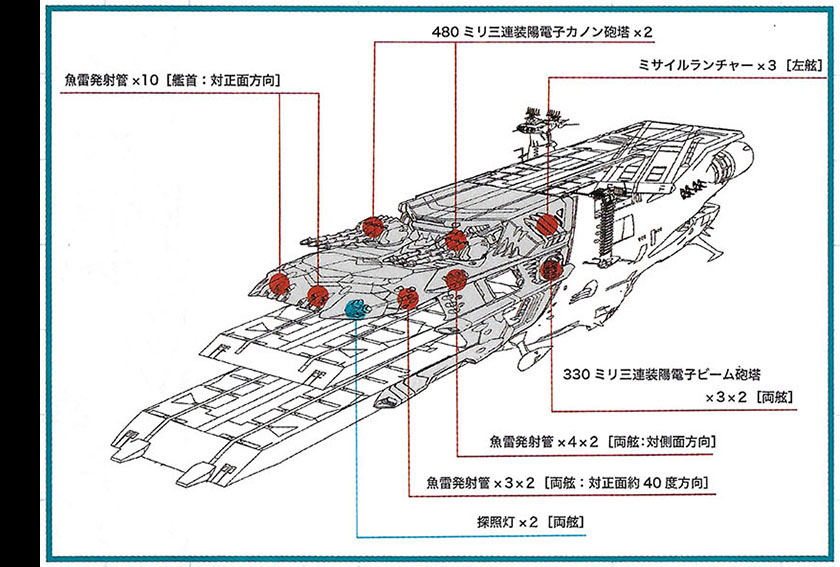
480mm triple positron cannon turret x 2
330mm triple positron beam sub turret x 3 x 2 (both sides)
Torpedo tube x 10 (Bow: facing the front)
Torpedo tube × 3 x 2 (Both sides: facing about 40 degrees forward)
Torpedo tube × 4 x 2 (Both sides: facing sideways)
Missile launcher × 3 (port side)
133mm triple positron cannon turret x 5 (Gaipellon-class multi-deck space carrier standard armament)
33mm quadruple positron rapid-fire turrets x 4 x 2 (both sides) (Gaipellon-class multi-deck space carrier standard armament)
*The calibers of the weapons are based on Earth metrics.
Balgray
The first aircraft carrier of the Domel task force. Equipped with the Debakke space fighter. It launched the first attack wave, separating Yamato‘s air force, but was intercepted while hiding in the sea of clouds and sunk by a concentrated missile strike.
Lambea (before remodeling)
The second aircraft carrier of the Domel task force. Equipped with Snuka space attack aircraft. Colonel Lutan Bester served as captain, and Major Berger commanded the second attack wave. The ship was hit in the engines and sank into the sea of clouds of the Rainbow Star Cluster, withdrawing from the front lines.
Schderg
The third aircraft carrier of the Domel task force. Equipped with the space torpedo bomber Dolcia. Leading the third attack wave, it was in close proximity to the Gelvades-class ship Darold, which was sunk by Yamato‘s counterattack, and was caught in the explosion and destroyed.
Torpedoes (Heavy Arms Unit)
In addition to ten torpedo tubes at the bow that fire straight ahead, the ship is equipped with three torpedo tubes on each side that can fire at an angle of approximately 40° to the front, and four torpedo tubes on each side that fire to the sides.
Heavy Arms Unit
Even among ships of the same Gaipellon class, this unit could not be installed on ships like Balgray, which had its bow section reshaped to accommodate added reconnaissance capabilities.
The Gaipellon-class Multi-deck Space Carrier Lambea was built during the great Garmillas Empire era and continues to play a vital role in the fleet strength, even after the founding of Galman-Garmillas.
The Gaipellon-class carriers have a flight deck divided into four levels. The upper (first), middle (second), and lower (third) decks are dedicated to takeoffs, while the lowest (fourth) deck is dedicated to landings, though it can also be used for takeoff in emergencies. During takeoffs, two electromagnetic catapults installed on each flight deck rapidly launch the aircraft. During landings, aircraft approach from the aft of the fourth deck, and are slowed and guided by a tractor beam (arrival deacceleration device) projected onto the aircraft. There are no enclosed hangers inside the ship, and aircraft are moored on each deck. It is rare to operate all four levels at once, and during long-term operations, weapons containers are sometimes loaded onto the third deck.
The early ships that entered service, such as Schderg and Balmes, had a single, forward facing flight deck, but later ships like this one and Balgray were equipped with angled decks, improving the operational efficiency of carrier-based aircraft.
This ship participated in the Battle of the Rainbow Star Cluster as one of the aircraft carriers that made up the Domel task force, and was the only ship to escape being sunk. Coincidentally, it engaged in combat with Yamato against a Gatlantis task force, and after returning to its home country, it entered dry dock for long-term maintenance and repairs.
On this occasion, the ship was selected as a test bed for a newly developed “Heavy Arms Unit.“ This unit is equipped with two triple-barrel positron canon turrets on the front and triple-barrel positron beam turrets on both sides to enhance firepower. These are almost identical to those mounted on the special first-class combat spacecraft carrier Deusula III, which had been under construction for some time. On the special first-class combat space carrier, the triple-barrel positron cannon turrets are the main armament, and the triple-barrel positron beam turrets are the secondary armament.
Furthermore, this unit also aims to improve long-term operational capabilities by expanding its living quarters. As mentioned earlier, the hanger previously occupied most of the ship’s body, resulting in extremely cramped living quarters on the Gaipellon-class carriers. Therefore, it was difficult to accomodate the activity of the personnel necessary to service the required number of aircraft for extended periods. This made it unsuitable for long-term operations. On the remodeled Lambea, approximately three levels on the second deck are reserved as living quarters, enabling long-term operations (however, the total number of aircraft was reduced).
Equipped with its Heavy Arms Unit, Lambea, under the command of Lieutenant Colonel Fomto Berger, engaged in combat with the Dezarium that launched a surprise attack on the planet Garmillas, and worked diligently to protect refugees and recapture the planet Iscandar. It later participated in the liberation of the planet Galman from the Bolar Federation, and the founding of Galman-Garmillas. It now serves as the flagship of the mobile fleet, repelling the Bolar fleet that invaded the Galman star system on various fronts.
Lambea achieved outstanding service for an extended period among the Gaipellon-class carriers. This can be attributed to the addition of its Heavy Arms Unit and superior air operations capabilities, which effectively constituted a modernization upgrade.
More pages from Hobby Japan #689