
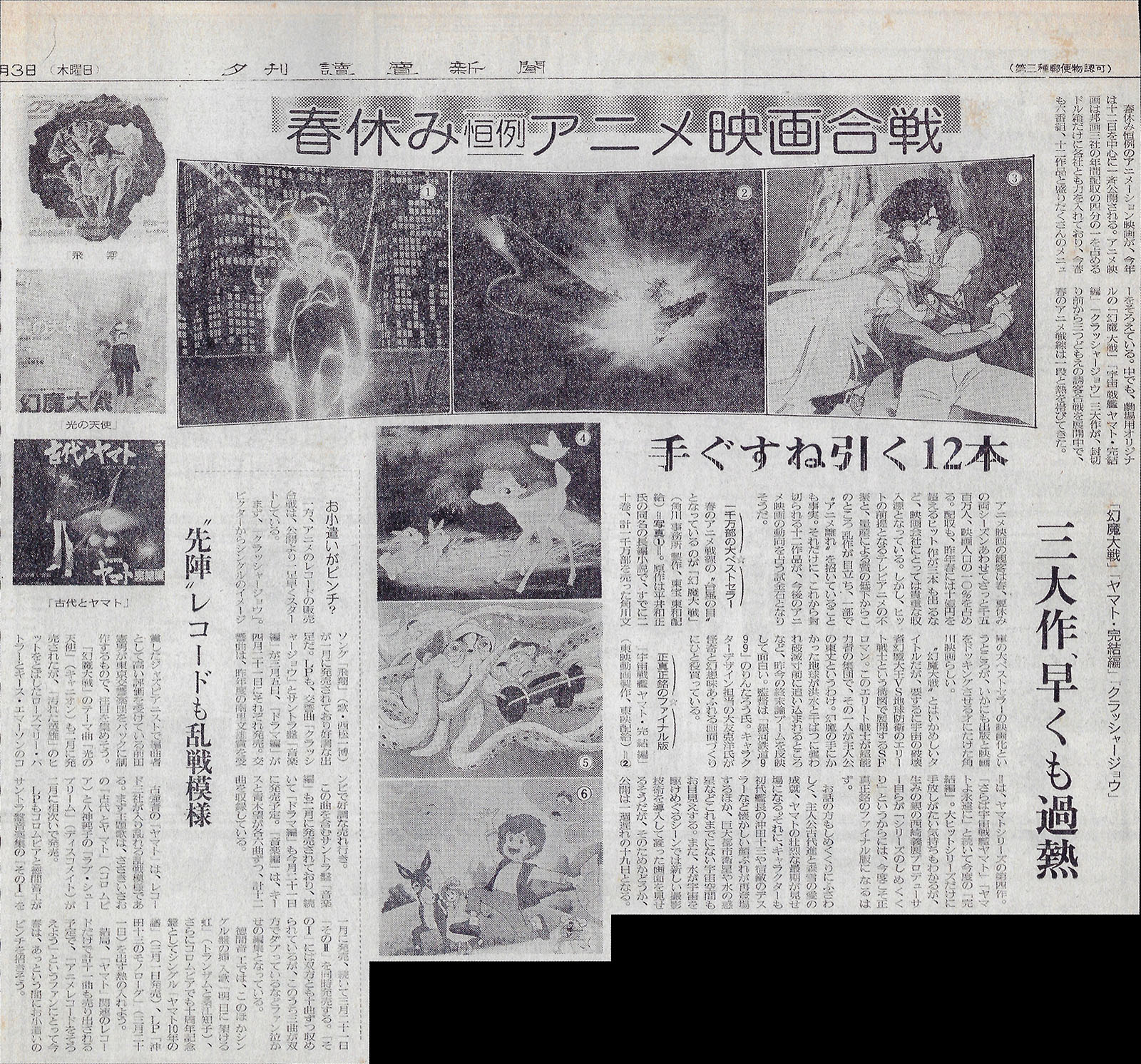
Spring Break Annual Anime Movie Battle
12 things to look forward to
This year, animated films, a traditional spring break event, will be released simultaneously around the 12th. Since animated films are a cash cow, accounting for a quarter of the annual box office of the three Japanese film companies, each company is putting a lot of effort into them. This spring, they have lined up a packed menu of six programs and 12 films. Among them, the three major originals, Harmagedon, Final Yamato, and Crusher Joe, have been engaged in a three-way battle to attract audiences even before their releases, making the spring anime battle even more heated.
The three major works are already heating up
The audience for anime movies during both the spring and summer vacation seasons is roughly 15 million. Distribution revenues are a valuable source of income for film companies, with three hit films exceeding 1 billion yen last spring. However, the slump in TV anime, which is a prerequisite for a hit, and the decline in quality due to mass production, have led to a noticeable lack of production recently, and it is also true that this has led to some people “moving away from anime.” For this reason, the 12 films that will be released in the future are likely to be a litmus test for the future trends of anime films.
A huge bestseller, 10 million copies sold
The eye of the storm on the spring anime front is Harmagedon (produced by Haruki Kadokawa Corporation, distributed by Toho/Towa). The original work is a full-length novel of the same name by Kazumasa Hirai, a huge bestseller from Kadokawa that has already sold 20 volumes and a total of 10 million copies, making it a typical film adaptation for Kadokawa Pictures, which has a knack for combining publishing and film.
Harmagedon is an intimidating title, but in essence it unfolds as a battle between the cosmic destroyer King Genma and elite warriors defending the Earth. These warriors are a group of psychic-powered individuals, one of whom is the protagonist Joe Azuma. The scenes where Earth, under Genma’s control, is hit by floods and droughts and brought to the brink of destruction, are interesting and reflect the current boom in apocalyptic theories. The film is directed by Rintaro, who also directed Galaxy Express 999. Character designer Katsuhiro Otomo helps create visuals full of mystery and fantasy.
The true final chapter
Space Battleship Yamato, The Final Chapter (produced by Toei Animation, distributed by Toei Pictures) is the fourth film in the Yamato series. Following Farewell to Yamato and Be Forever Yamato, this latest installment is “The Final Chapter.” It’s understandable that it’s hard to let go of such a hugely successful series, but with creator/producer Yoshinobu Nishizaki himself calling it “the conclusion of the story,” this should truly be the final installment.
As a fitting conclusion to the story, the film will feature the fulfillment of love between protagonists Susumu Kodai and Yuki Mori, as well as Yamato‘s tragic end. Additionally, familiar faces, such as the ship’s first captain Juzo Okita, and its nemesis Dessler, will make a reappearance. The film will also showcase never-before-seen outer space scenes, including a gigantic city-satellite and a water planet. New filming techniques will apparently be used to create an elaborate scene in which water races through space. But perhaps for this reason, the film’s release will be delayed by a week to the 19th.
How well will the newcomer do?
Crusher Joe (produced by Nippon Sunrise, distributed by Shochiku/Fuji) is an animated adaptation of a novel by the duo of Haruka Takachiko (author) and Yasuhiko Yoshikazu (illustrator), who also wrote the screenplay.
A “Crusher” is a space jack-of-all-trades. However, he is not a scoundrel, but an elite of the universe who uses spaceships and weapons to lend a hand in legitimate work. One of these, named Joe, is the protagonist of this sci-fi adventure story. Yasuhiko, creator of the smash-hit Mobile Suit Gundam anime film series, is not only the screenwriter but also the character designer and director, showing his outstanding talent. It will be interesting to see how much an anime film that is not based on a popular TV anime or a bestseller will attract audiences.
There are also triple and quadruple features
In addition to these three films, there is a double-feature of Disney’s Bambi and The Fox and the Hound, released by Toho’s foreign film group. There is also a triple feature of Doreamon, Hattori-Kun, and Paman, released by Toho’s Japanese film group. And there is a quadruple feature of Manga Aesop’s Fables, Dr. Slump, Dynaman, and Batten Robomaru released by Toei’s Japanese film group. Of these, only the Toei quadruple feature will be released on the 13th.
The “Vanguard” record is also in a state of chaos
Pocket Money PINCH?
Meanwhile, the sales battle for LP records from these anime films has already begun even before their premiere.
First up is Crusher Joe. The single theme song was released by Victor in January and is off to a good start. Three LPs will also be released: the Crusher Joe symphony, the “music edition” soundtrack, and the “drama edition” on April 21st. The symphony will be produced by Norio Maeda, a highly-acclaimed jazz pianist and arranger who won the Fumio Nanri Award last year. With the Tokyo Symphony Orchestra behind it, this is likely to attract attention.
Angel of Light, the theme song for Harmagedon, was released by Canyon in February, and sold well thanks to the combination of Rosemary Butler and Keith Emerson, who had a hit with Dirty Hero. The “music edition” soundtrack album, which includes this song, was released in February, and the “drama edition” is scheduled to be released on the 21st of this month. The “music edition” contains a total of 12 tracks, six by Emerson and six by Aoki Nozomi.
The long-running Yamato series brings us a melee battle between three record companies. First, the theme song Kodai and Yamato by Isao Sasaki (Columbia) and Love Supreme by Junko Yagami (Discomate) were released one after another in February. Columbia and Tokuma both released “part 1” soundtrack music collections in January, to be followed by Part 2 on March 21st [later delayed to April]. Both the “part 1” LPs contained ten tracks, but three of them overlap, making the editing a nightmare for fans.
Tokuma is also putting a lot of effort into releasing the insert song Rainbow To Tomorrow (Tranzam and Tomoko Kuwae) as a single, and Columbia is also releasing a Yamato 10-Year Tribute single (on sale March 1) and an LP titled Juzo Okita’s Monologue (on sale May 21) as part of the 10th anniversary.
[Translator’s note: release dates for the singles indicated above are full of errors; see previous Vintage Reports for the correct ones. The Juzo Okita Monologue album was canceled, unfortunately.]In the end, a total of eleven Yamato-related records are scheduled to be released, meaning that fans looking to collect anime records may find themselves in a financial pinch this spring.
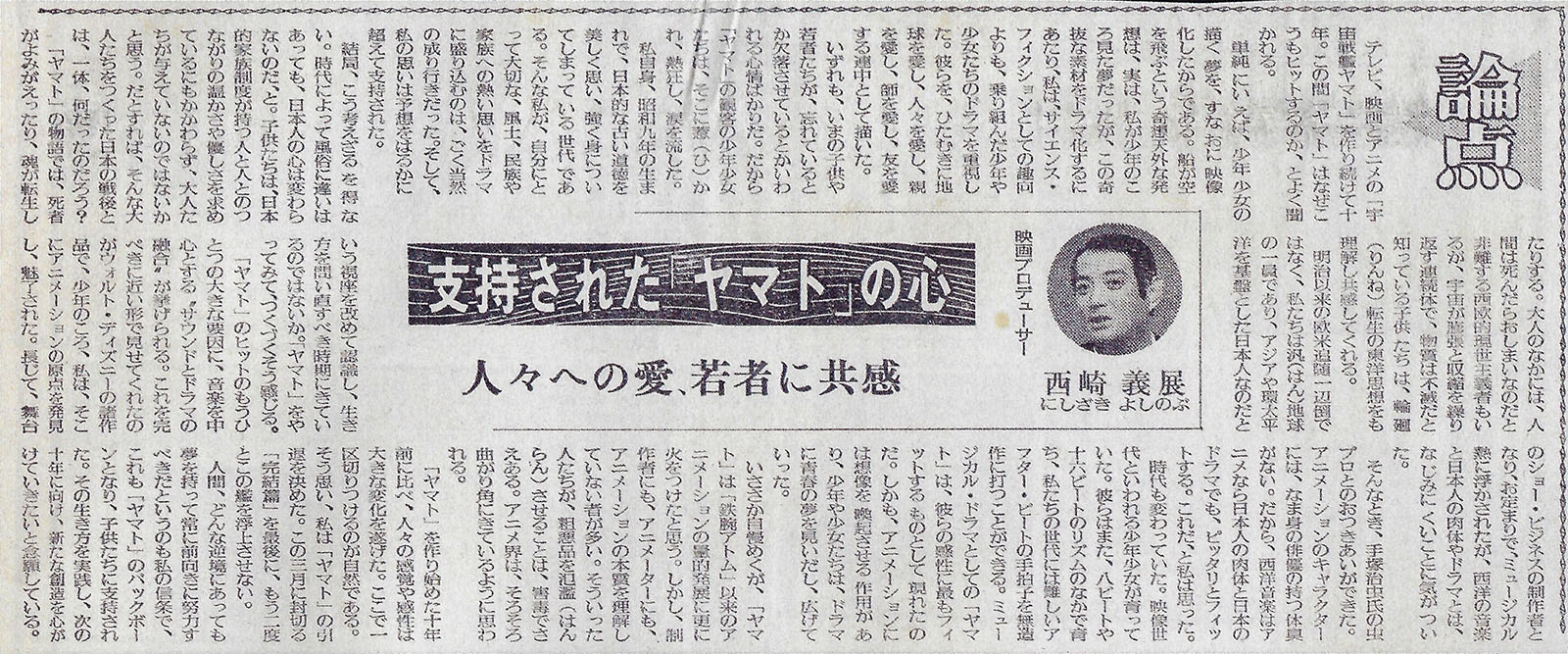
Key Issues (column)
The Spirit of Yamato
Love for people, empathy for young people
by Yoshinobu Nishizaki
It has been 10 years since I started working on the TV, film, and anime series Space Battleship Yamato. During this time, I have often been asked why Yamato has become such a hit.
Simply put, it’s because it is a straightforward portrayal of the dreams of young boys and girls. The fantastical idea of a ship flying through the sky is actually something I dreamed about as a boy. But in adapting this extra extraordinary material into a drama, I placed more importance on the story of the boys and girls on board, than on the science-fiction aspect. I portrayed them as people who wholeheartedly love the Earth, its people, their parents, their teachers, and their friends.
These are all feelings that today’s children and young people are sometimes missing or have forgotten. And so the young boys and girls in the Yamato audience were captivated, enthralled, and moved to tears.
I was born in 1934, and belong to a generation that values and deeply engrains old Japanese morals. For someone like me, it was only natural that I would incorporate my passionate feelings about the local climate, people, and family, which are so important to me, into the story. And my ideas were supported far beyond my expectations.
Ultimately, I can’t help but think this way. Even though customs change with the times, the Japanese heart remains the same. I think children are seeking the warmth and kindness of the interpersonal connections that the Japanese family system provides, but adults are not providing this to them. If that’s the case, then what was it about Japan’s post war period that created such adult adults?
In the story of Yamato, the dead are resurrected and souls are reincarnated. Some adults are western style materialists, who insist on the idea that death is the end for humans. But children, who know that the universe is a continuous entity that repeatedly expands and contracts, and that matter is immortal, can also understand and sympathize with the eastern idea of reincarnation.
Rather than solely following the west, as we have since the Meiji era, perhaps we have reached a time when we need to re-examine our perspective as part of a global society. As Japanese people with Asia and the pacific rim as our foundation, perhaps we should re-examine our way of life. This is something I feel deeply after working on Yamato.
Another major factor in the success of Yamato is the fusion of sound and drama centered on music. This was demonstrated in a near perfect form in the works of Walt Disney. I discovered the origins of animation there as a boy, and was fascinated. As I grew older and became a producer in the stage show business, I was swept up in the usual enthusiasm for music, but I realized that western music was not compatible with the Japanese physique and drama style.
At that time, I became acquainted with Osama Tezuka‘s Mushi Productions. Animated characters lack the restlessness of actors. So, where anime is concerned, western music fits perfectly. This is it, I thought.
Times were changing. A generation of boys and girls called “the visual generation” was growing up. They were also brought up in the rhythm of haptic and 16-beat music. They can casually clap along to the backbeat, which is difficult for our generation. Yamato, as a musical drama, appeared to be the perfect fit for their sensibilities. Moreover, animation has the power to stimulate the imagination. Boys and girls discovered and expanded their youthful dreams in the story.
I may be bragging a little, but I believe Yamato further sparked the quantitative development of animation since Astro Boy. However, there are many producers and animators who do not understand the true essence of animation. It is even harmful for such people to allow the proliferation of inferior products. It seems to me that the anime industry is nearing a turning point.
Compared to 10 years ago when I started making Yamato, people’s senses and sensibilities have undergone great changes. It is only natural to draw an end to this now. With this in mind, I have decided to retire from Yamato. With The Final Chapter opening in March as the finale, this ship will never surface again.
I believe people should always have dreams and strive to be positive, no matter what adversity they face. This also became the backbone of Yamato and was supported by children. I hope to put this way of life into practice and strive to create new things for the next decade.