
Thoughts after watching Episode 11
See the original blog post here
It’s been a while since I last found myself typing away on a keyboard while out and about.
Although it is March, the morning air, seeping in through the gaps in the window sash, gradually chills my feet. Listening to the stove occasionally let out a soft whoosh, like a contented purr, I sit alone, sipping on my now-lukewarm tea. It is nearly 2:00 PM. I wonder if my mother and sister are currently breathing softly in their sleep. Here I am, making use of my waiting time to write this article.
For 32 years, I worked as a maintenance technician on the front lines of an LPG fueling station. Working outdoors in Sapporo during the winter is, no exaggeration, an experience where you completely lose all sensation in your fingertips. The wrenches used to tighten pipes are cold as ice, and the sweat that dampens your thermal gear eventually turns into a biting chill against your skin by the time the work is done. That scent of oil and steel…
And that “intuition” of the field, something that defies all pure logic. What brought back those gritty memories was Episode 11 of Space Battleship Yamato, which I rewatched tonight.
In our modern era, where efficiency and data often take precedence, I felt this episode reaffirmed that living truth, imbued with human warmth, is found precisely within the “heated exchanges” and “gritty manual labor” performed under extreme conditions. It is an episode that allows us to rediscover that soulful passion that resonates deeply with the professional pride of engineers who have dedicated years to holding the front lines, and the human pride that are so vitally needed in our increasingly automated modern world.
What you will learn from this article:
A Human Drama Deciphered Through “The Reality of the Field”
Drawing on the perspective of a former engineer who spent 32 years battling on the front lines of an auto-gas service station, you will gain insight into the truth behind the “sense of responsibility” and “fear” inherent to professionalism. These are the true forces driving the heated exchanges and critical decisions made by the crew of Yamato.
Character Analysis: Insights Only a Senior in His 60s Could Offer
Explore the solitary resolve of Captain Okita, the craftsman’s spirit embodied by Analyzer, and the unique aesthetic of Dessler. Discover character assessments that differ distinctly from those of the younger generation, perspectives born only from a lifetime of accumulated experience.
The Value of “Gritty Passion” That Shines Brightest in an Efficiency-Driven Society
Through the image of Yamato, breaking through crises that neither AI nor data can solve using only “human hands” and “intuition,” we are reminded of the preciousness of a quality often lost in modern society: the power to carve out one’s future with one’s own hands.
Shouting at the scene is proof of “seriousness”
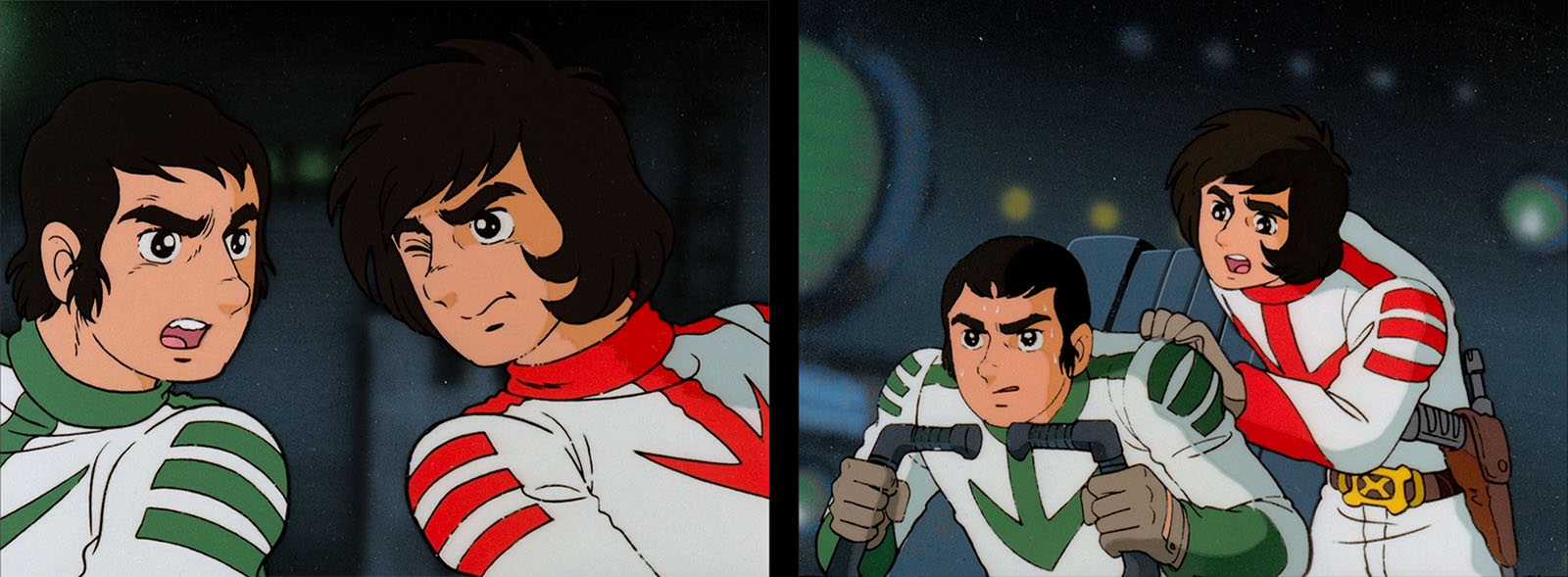
In the story, combat chief Susumu Kodai and navigation chief Daisuke Shima are shouting insults at each other over the slowness of the evasion, calling each other “slowpoke” and “loser driver.” Some viewers might laugh at this and think it’s “childish.” But speaking from my 32 years of experience in the field, this is an extremely realistic depiction.
In the midst of trouble, when people are pushed to their limits, they cannot control their emotions. When I was younger, I myself yelled at my seniors countless times while turning frozen valves.
That cry of, “You idiot, we’re doing our best too,” is a mix of professional responsibility and fear. An AI would present the shortest solution without emotion, but humans cannot. I believe that this very “ugliness” is the essence of a real, human-centered workplace.
Character Analysis: A View from a 60-Something “Old-Timer”
Here, I would like to take a moment to unpack the various characters featured in this 11th episode, offering a perspective from someone who has lived through the very same era in which this story is set.
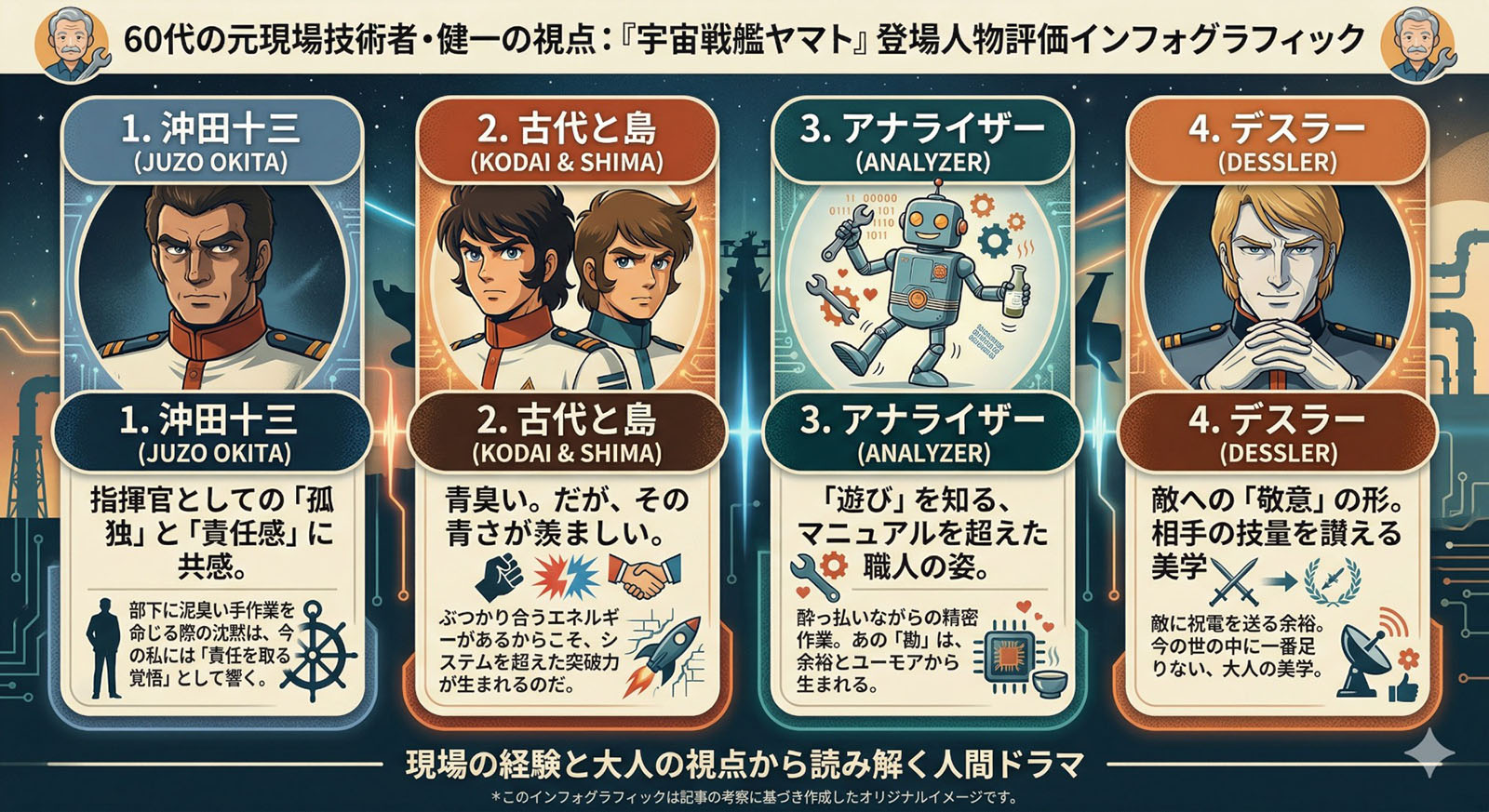
Juzo Okita
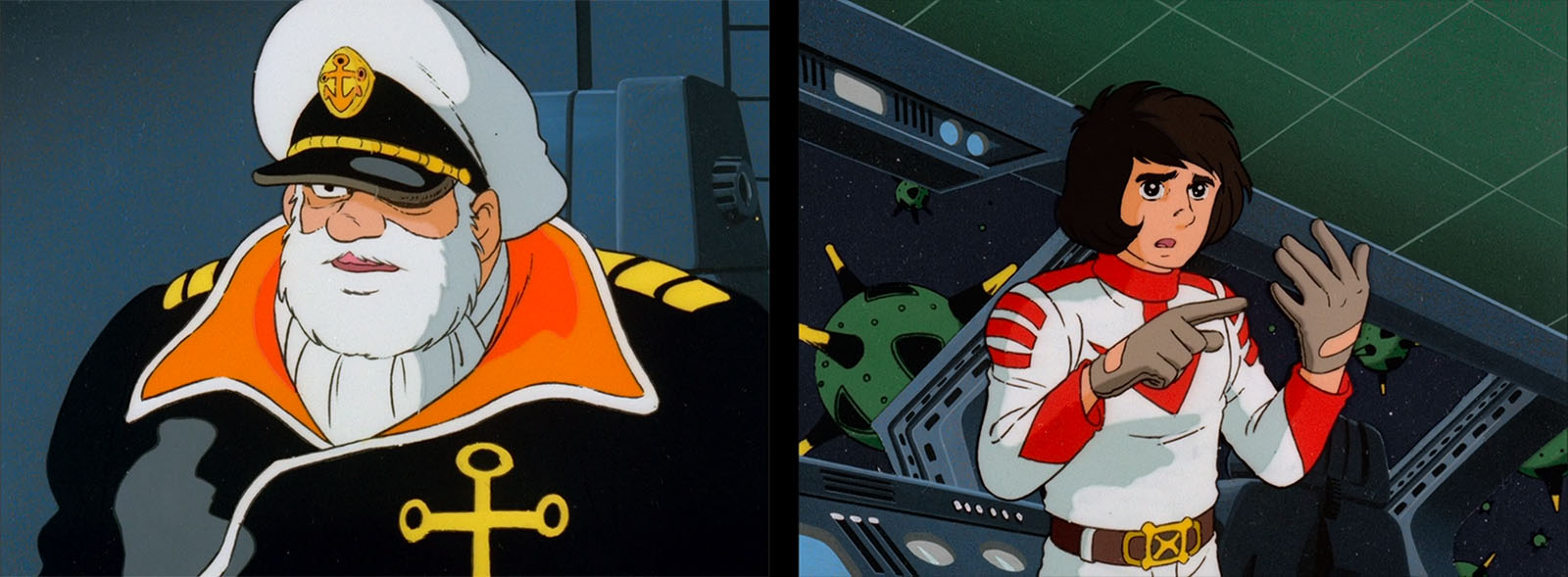
The “loneliness” of a commander truly tugs at my heartstrings. The silence he maintains when ordering his subordinates to undertake gritty manual labor resonates with me now as a profound “readiness to accept full responsibility.”
Kodai & Shima
They are so green, so naive. Yet, I find myself envying that very naivety. It is precisely because they possess the energy to clash and butt heads that they are able to generate a breakthrough force that transcends the limitations of any system.
Analyzer
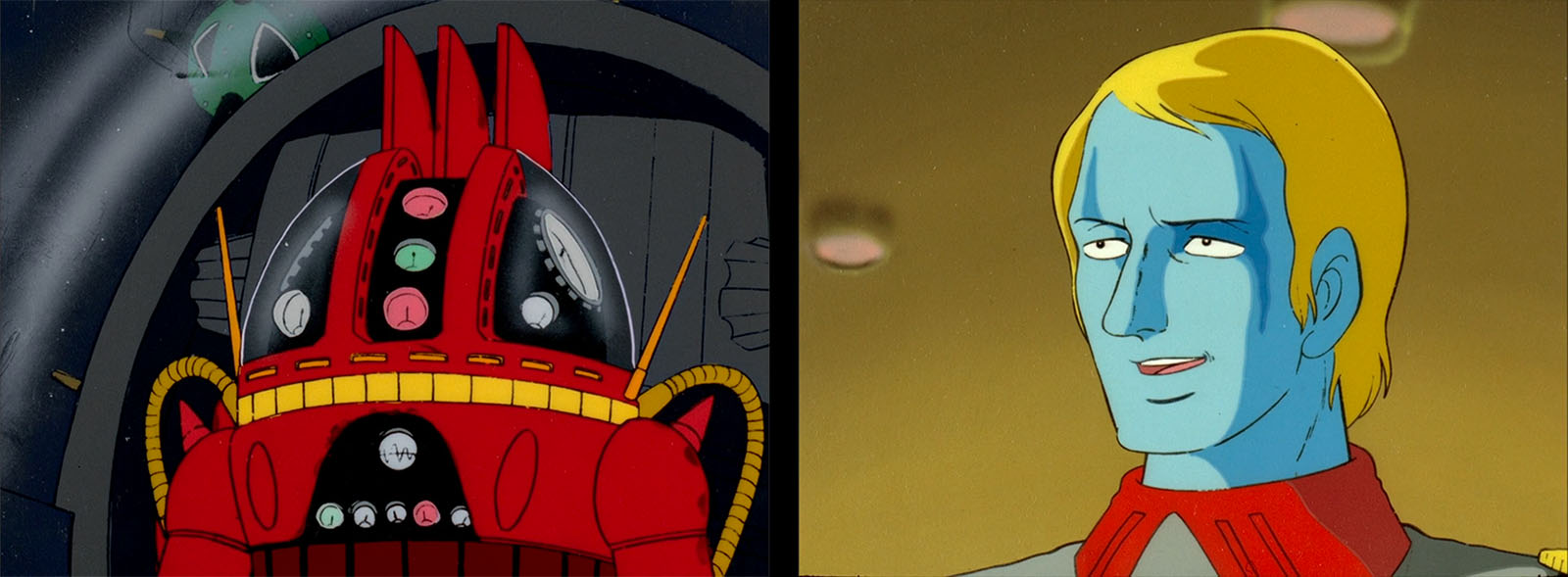
Performing precision work while tipsy, that is the true image of a craftsman who understands the value of “play.” The kind of “intuition” that goes beyond the manual can only be born from a sense of composure and humor.
I was particularly struck, and deeply impressed, by the figure of Analyzer. I’ve recently been studying generative AI for my blog, but you certainly can’t hand a drink to those guys. People today love to string together nothing but pretty words, talk of “efficiency” and “optimization.” Yet, there are undoubtedly situations in this world that simply cannot be resolved by work that amounts to nothing more than tracing the lines of a blueprint. In that robot, I felt I caught a glimpse of that “craftsman’s intuition,” a quality possessed only by those who truly know the atmosphere and the sounds of the actual workplace floor.
Dessler
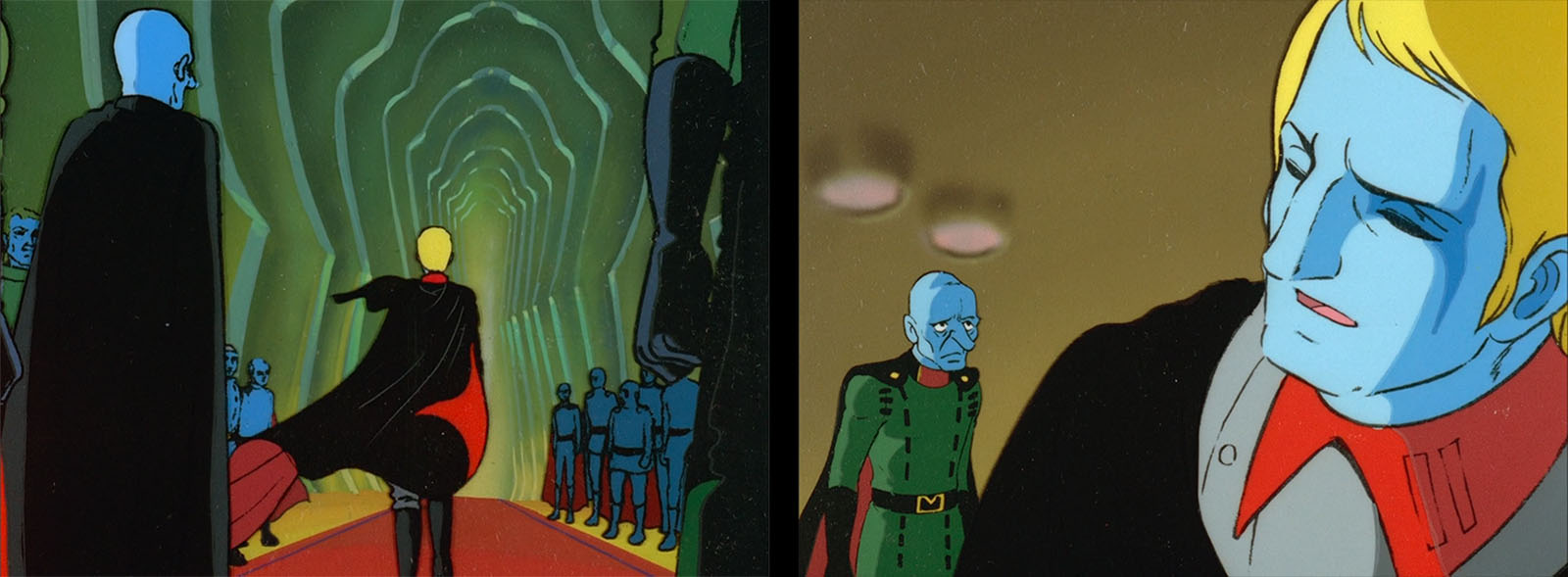
The composure to send a congratulatory telegram to an enemy represents a form of “respect” that is sorely lacking in the world today. He embodies an aesthetic that celebrates and honors the skill of one’s opponent.
The ultimate truth: Sometimes, the only way to clear an obstacle is with your own two hands
“The Truth of the Field,” a reality often lost in an efficiency-driven society:
(Subject)
Solution
Dialogue
“Intuition”
Stance toward Obstacles
Perspective on the Adversary
(AI-like Thinking)
Calculation of the shortest route,
Thorough elimination of risk
Emotionless,
Precise transmission of information
Statistical,
Presentation of predictive values
At the limits of the system,
Halting with “It’s impossible”
An efficient judgment,
Target for elimination
(Human Resilience)
Gritty, manual labor,
A head-on breakthrough
Driven by responsibility, exchanging insults and raw, honest feelings
Grasped through the five senses,
32 years of accumulated experience
The tenacity to declare,
“In the end, we’ll move it by hand”
Based on a specific aesthetic,
“Respect” and a “Toast”
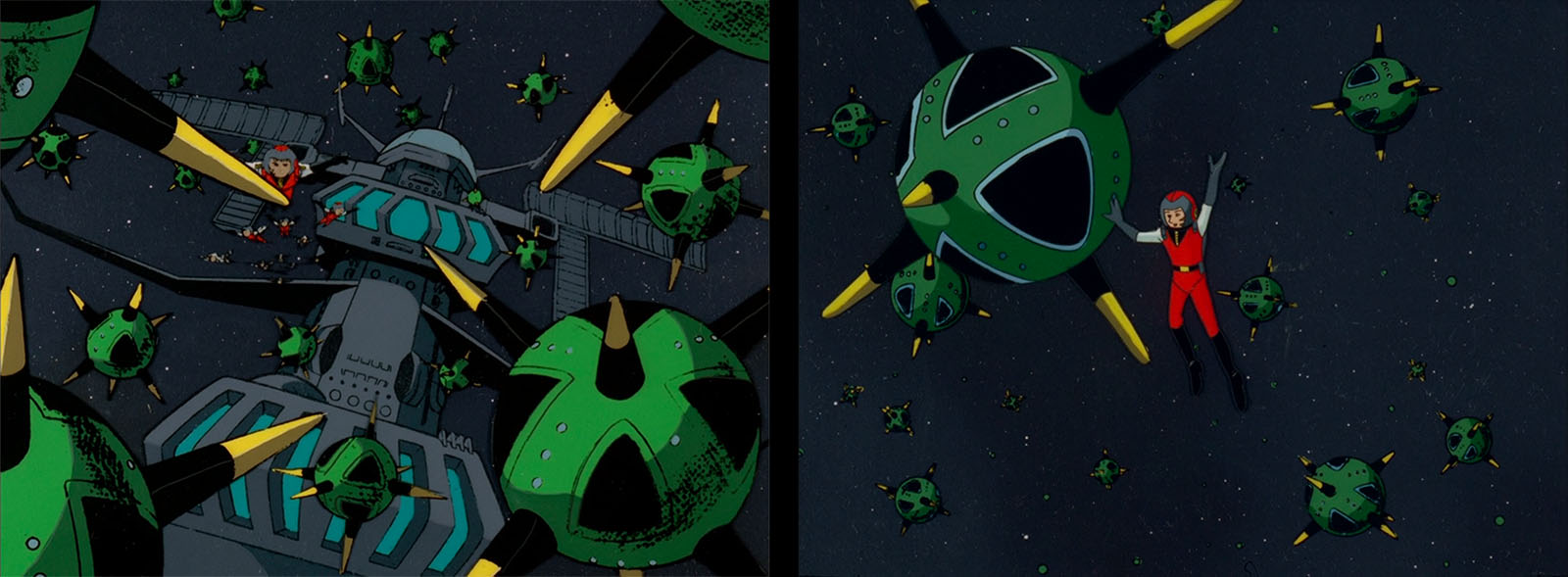
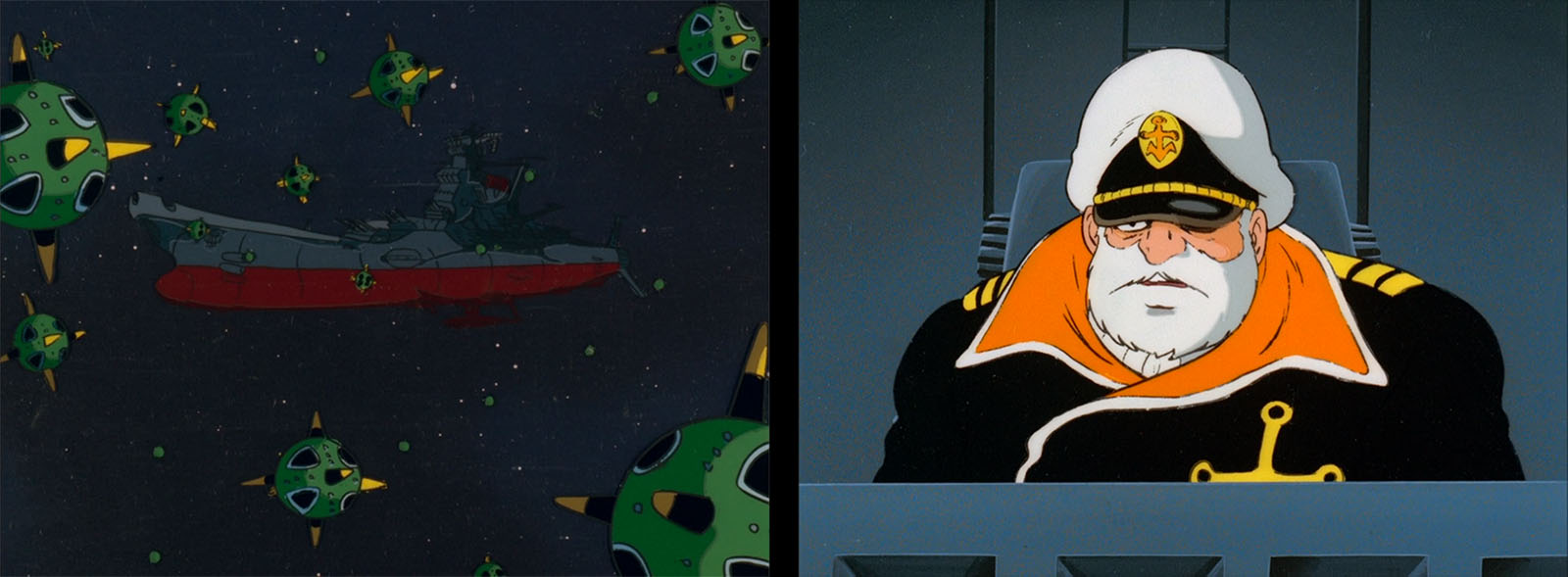
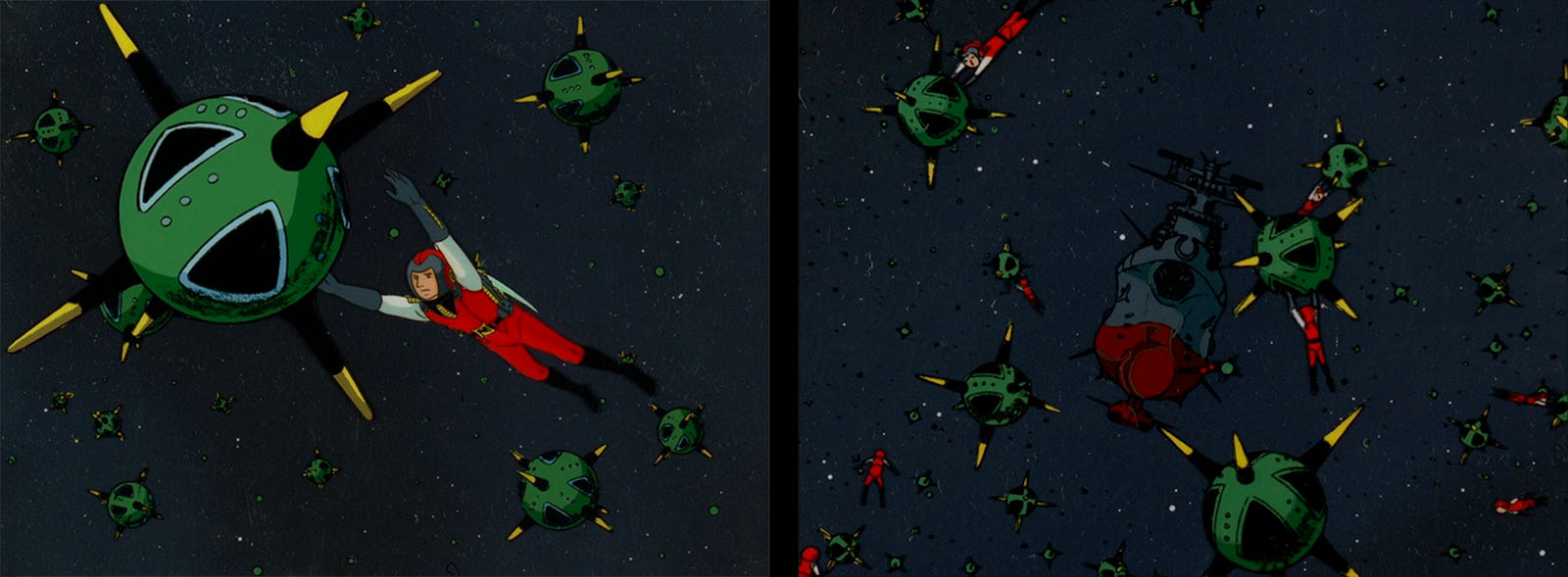
The highlight of this episode is undoubtedly Captain Okita’s decision to clear a minefield through sheer “manual labor.” Members of the Black Tiger Squadron sortie into space, where they proceed to “physically push aside” massive mines, one after another. To a younger generation accustomed to the sleek, sophisticated animation of today, this scene might seem so unscientific as to be laughable.
Yet, for me, this was the moment that resonated most deeply. It is because, no matter how much state-of-the-art detection equipment is introduced, it is ultimately the veteran’s “ears,” “nose,” and “fingertips” touching cold pipes that pinpoint a minute gas leak.
Statistics and data are undoubtedly important. However, a look at the 2023 labor force survey reveals that the proportion of older workers engaged in fieldwork, such as manufacturing, construction, and maintenance, remains remarkably high. Is this not because there is a demand for the accumulated experience of those who have overcome the “walls of life” with their own two hands? Who have faced challenges that simply cannot be resolved through purely digital solutions?
“Beer,” A Gesture of Respect for One’s Adversary
Late in the story, Leader Dessler sends a congratulatory telegram to Yamato. Upon seeing this, I was reminded of my late wife. She had absolutely no interest in anime, but one night, when I returned home dejected after making a major blunder at work, she placed a single bottle of the most expensive beer we had right in front of me, without saying a word.
It was a gesture of “respect for one’s adversary,” something that transcends the simple logic of “friend versus foe.” As the quiet kindness my wife showed back then overlapped in my mind with the aesthetic code of a man like Dessler, I found my chest growing unexpectedly warm with emotion.
Episode Commentary
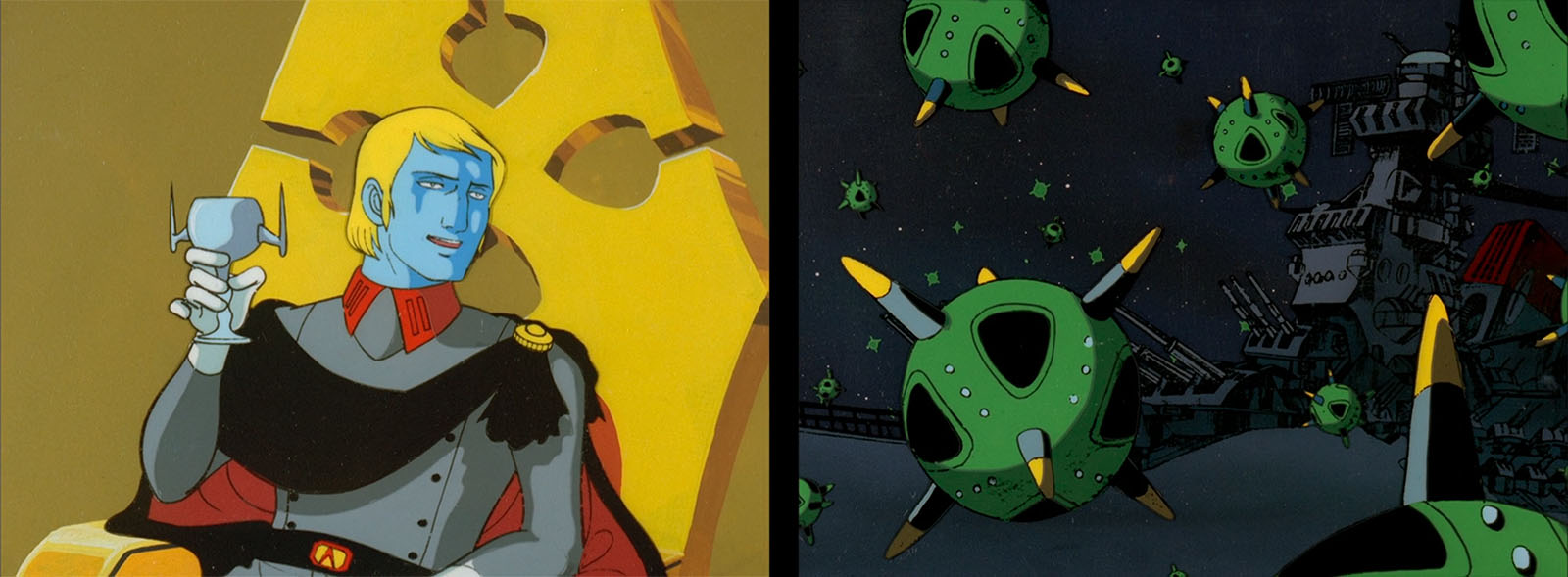
Year 2199 A.D. Only a scant amount of time remains before the extinction of the human race. Having departed the Solar System and ventured out into the vast reaches of the galaxy, Yamato suddenly finds its path blocked by an “invisible wall,” a trap laid by the cold, ruthless dictator, Leader Dessler.
Leader Dessler’s “Elegant Diversion”
Leader Dessler observes the operation to blockade Yamato, executed using the “Dessler Mines” that bear his very name, as if he were simply enjoying a theme park attraction. Backed by overwhelming scientific might, he displays an air of utter composure, toying with Yamato as if it were a mere plaything.
The Approaching “Invisible Wall”
The mines completely immobilize Yamato. If the ship tries to dodge, they will give chase. If it stops, they will tighten their encirclement. Closing the distance by two centimeters every second, they begin emitting powerful electromagnetic waves. For the massive Yamato, it is a desperate situation, akin to being trapped inside a cage with absolutely no means of escape.
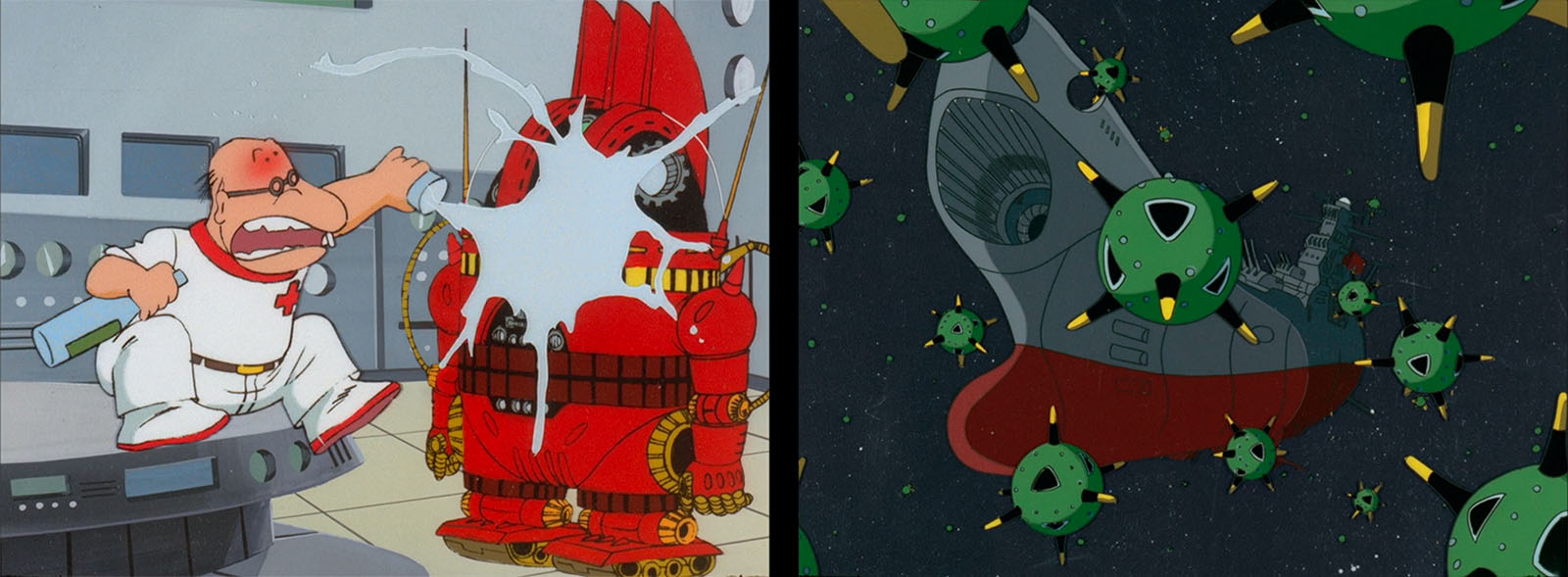
The Saviors: A “Drunken Robot” and a “Scientific Genius”
The ones who save the ship from this dire predicament are Chief Engineer Shiro Sanada and the robot Analyzer. Just moments earlier, Analyzer is plied with sake by Dr. Sado, leaving his circuits in a “staggering” state, but the moment the mission begins, he unleashes a computational power boasting 100,000 times his normal precision. Navigating through the storm of electromagnetic waves, he successfully manages to halt the mines’ movements.
“Manual Labor” That Surpasses Automated Systems
Although the mines have ceased moving, Yamato remained surrounded. Consequently, Captain Okita issues an order for the Black Tiger Squadron to carry out “manual removal of the mines.” The advanced scientific civilization of Gamilon failed to account for the “primitive” notion of human beings intervening directly with their own hands. Thanks to this ingenuity, Yamato succeeds in brilliantly breaching the blockade.

In Conclusion: An Old Man’s Musings
The days have grown noticeably longer outside, yet the wind in Sapporo remains piercingly cold. Keeping one eye on the kerosene gauge of my heater, I sat alone, transfixed by those old images from 1974.
To be honest, I was astonished. For the children of that era, Space Battleship Yamato represented the very “pinnacle of science,” the embodiment of hope for the future itself. The Warp, the Wave-Motion Gun; every one of these elements filled us kids with sheer excitement. Yet, what Episode 11 depicted was a gritty, down-and-dirty “reality on the ground” where none of those cutting-edge systems worked at all.
Surrounded by Gamilas mines and facing certain destruction, Yamato found itself in a desperate bind. The order Captain Okita issued in that moment was, of all things, to “clear the mines by hand.” I was absolutely floored. It is no wonder that Kodai, the young Chief of Combat Operations, instinctively doubted his own ears and asked, “By hand… sir?” He must surely have expected his seasoned commander to propose a strategy that was more scientific, safer, and (above all) efficient enough to be resolved with the mere push of a button.
But I can never forget Okita’s reaction in that moment. He simply offered a quiet, gentle smile, a smile filled with a profound sense of tenderness. To me, that expression serves as a powerful antithesis to modern humanity, a humanity that has been swallowed up by the relentless tide of efficiency and has become incapable of acting unless everything is strictly calculated and pre-planned.
Okita deliberately chose the most “primitive” option available. If a problem cannot be solved through the power of science, then, in the end, one has no choice but to dirty one’s own hands, break a sweat, and use the tactile sense of one’s fingertips to pry open a path toward the future. Within that act lay a spirit akin to the tenacity of a true craftsman, a quality that can never be found in any manual or data log. Only now, having passed the age of sixty, does it finally sink deep into my bones that, hidden behind this judgment (which might well be termed the “Okita Strategy”), lies a “profound lesson” intended for the younger generation.
No matter how the times may change, or how the world evolves into an era where AI provides all the answers, there is one essence we must never let go of: the act of touching things with our own hands, feeling their weight, and shouldering the responsibility for them. Was Okita not, perhaps, spending the last reserves of his own life force to teach Kodai and his peers about the “pride of being human”?
We must never forget a way of life that possesses such tangible texture, much like polishing a wrench that has grown rusty over the long winter months.
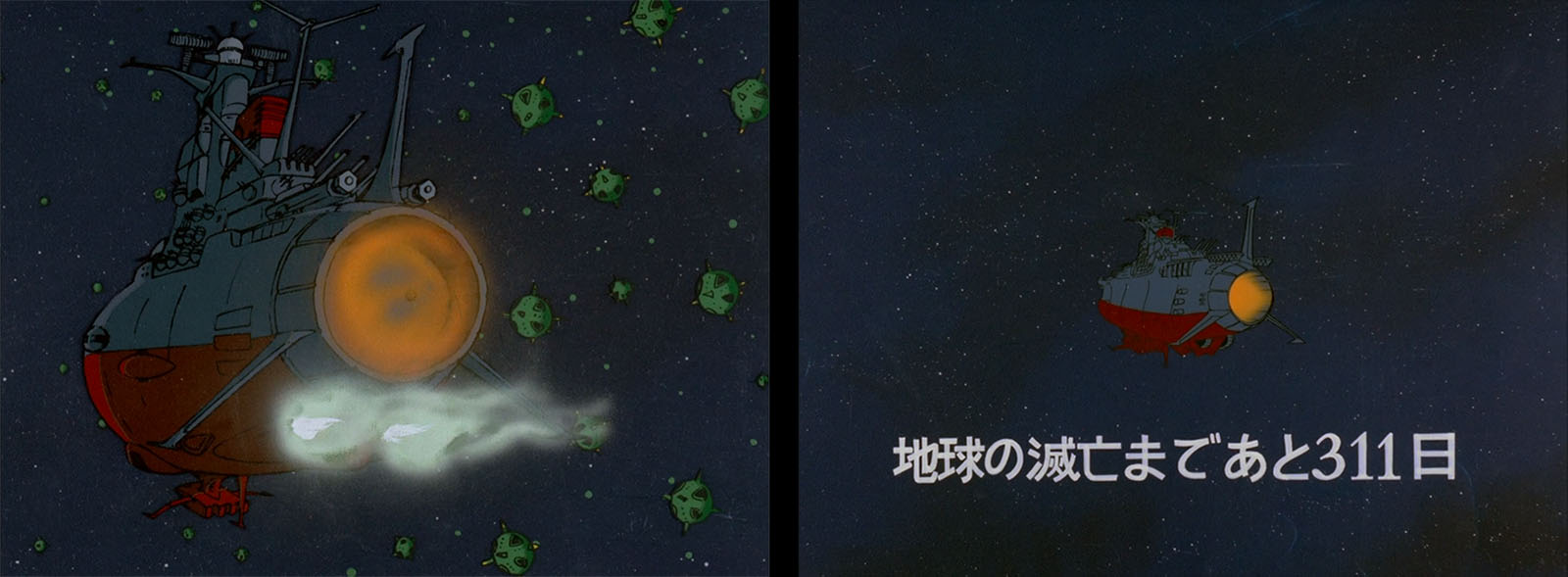
In Closing
The hands of the clock are just about to strike three. Only 311 days remain until the day of humanity’s extinction… is that right? To me, right now, that countdown feels like a heavy weight pressing down upon me, much like a blog deadline, or the vague anxieties I harbor about the future.
Yet, the sheer resilience demonstrated by the crew on the front lines in Episode 11 was brimming with the power to transform such despair into hope. My own tomorrow, too, will begin with shoveling snow early in the morning. My back aches, and I’ve had my fill of the cold. But perhaps these days I spend here on this cold northern land, writing my words while protecting my family, are, in their own way, a voyage of sorts.
Well then, I suppose it’s time I headed to bed. The fuel gauge on the kerosene heater looks like it’s about to dip into the red zone. You, too, take care not to catch a chill. The nights here in Hokkaido can freeze you to the very core if you let your guard down.
To you, who have taken the time to read this article: I hope that you, too, will find the strength to use your own hands to gradually, one step at a time, move past whatever “mine-like troubles” you may currently be grappling with.

Key Characters
Juzo Okita (Voice: Gorō Naya)
Captain of Yamato. A solitary commander who must make difficult decisions.
Susumu Kodai (Voice: Kei Tomiyama)
Chief of the Combat Division. A passionate young leader who grows and matures throughout the series.
Daisuke Shima (Voice: Hideo Nakamura)
Chief of the Navigation Division. In Episode 11, his heated argument with Kodai serves as a symbol of the “intense energy of the front lines.”
Analyzer (Voice: Kenichi Ogata)
A high-performance robot. In this episode, he shares a drink with Dr. Sado and ends up “staggering like a drunkard.”
Shiro Sanada (Voice: Takeshi Aono)
Chief of the Engineering Division (Chief Engineer). He saves Yamato from peril through his calm and rational judgment.
Leader Dessler (Voice: Masayuki Ibu)
Supreme Leader of the Gamilas Empire. His “congratulatory telegram” in Episode 11 is considered one of the series’ most iconic scenes.
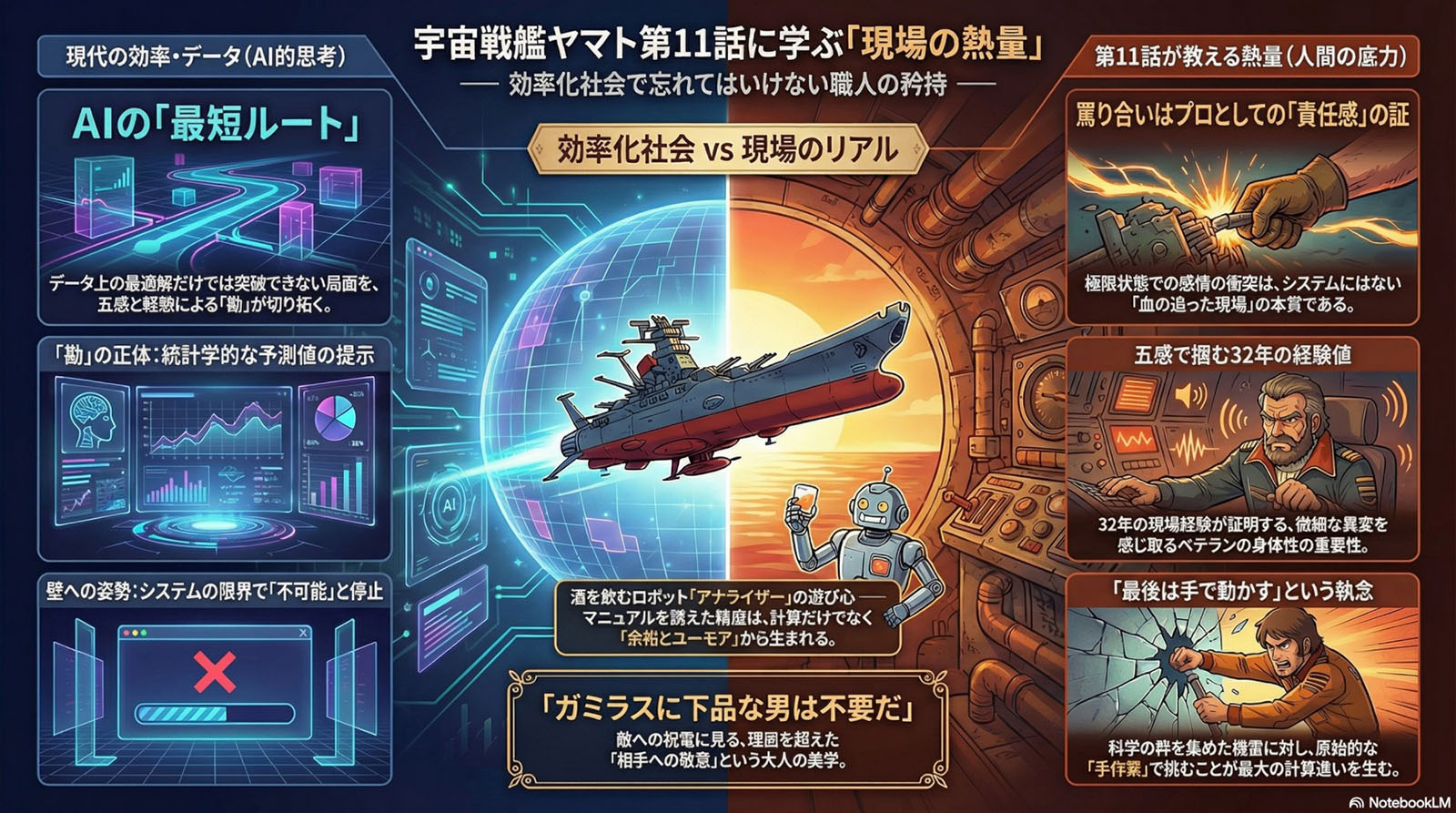
This infographic uses Episode 11 as a case study to illustrate the contrast between “efficiency-driven society vs. the reality of the workplace.” The left side shows the shortest route taken by AI-like thinking, while the right side explains the “inherent strength of humanity,” the sense of responsibility of craftsmen, the experience gained through the five senses, and the tenacity of manual labor.
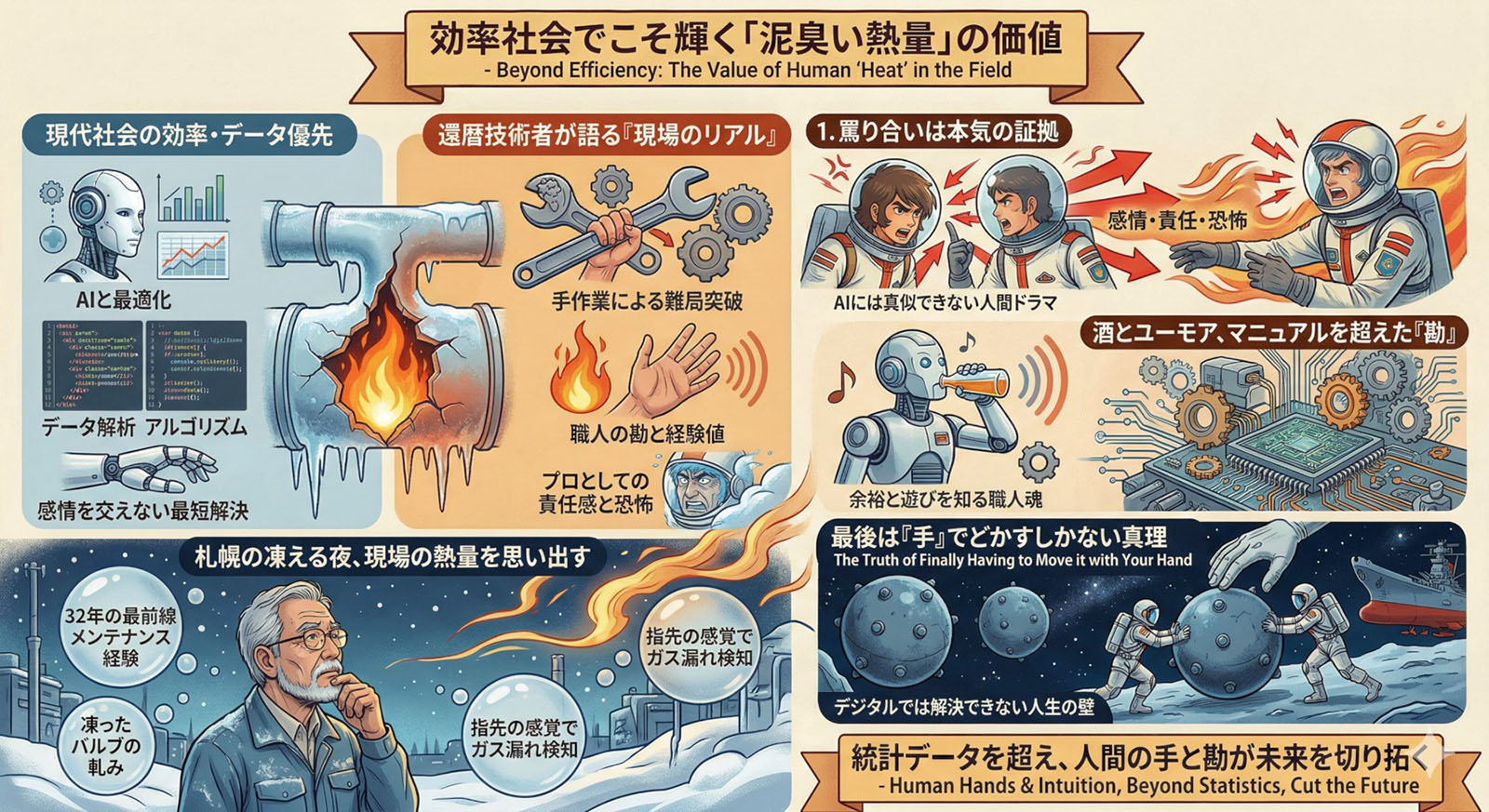
This infographic depicts the theme of Episode 11, an antithesis to the modern efficiency-driven society. Championing the truth that “ultimately, things must be moved by human hands,” the illustration visualizes the contrast between AI-driven optimization and the intuition and accumulated experience of a skilled craftsman.
In the lower left, a reporter is depicted reminiscing about 32 years of maintenance experience amidst a snowy landscape in Sapporo, expressing the moment when the passion of the front lines surpasses statistical data.
This infographic visualizes the contrast between AI-driven optimization, which champions a “cold, correct solution” that sacrifices emotion for efficiency, and the uniquely human qualities of emotion and the inherent messiness of human endeavor. Someone cries oiut, “Don’t let data kill your emotions,” thereby expressing the profound value of being human.
Thank you for reading to the end.