
From The Anime magazine, May 1983 issue
Rather than thinking too much about the future, I want to focus on the work I’m doing now, even if it’s just a slow process.
Haruhiko Mikimoto, who has been attracting attention as the animation director of Super Dimension Fortress Macross, is a young animator who is still only 23 years old. He is also a unique animator, having graduated from the faculty of engineering at Keio University. We asked him some questions, focusing on Macross, which he said he was “blessed with from the very beginning.“
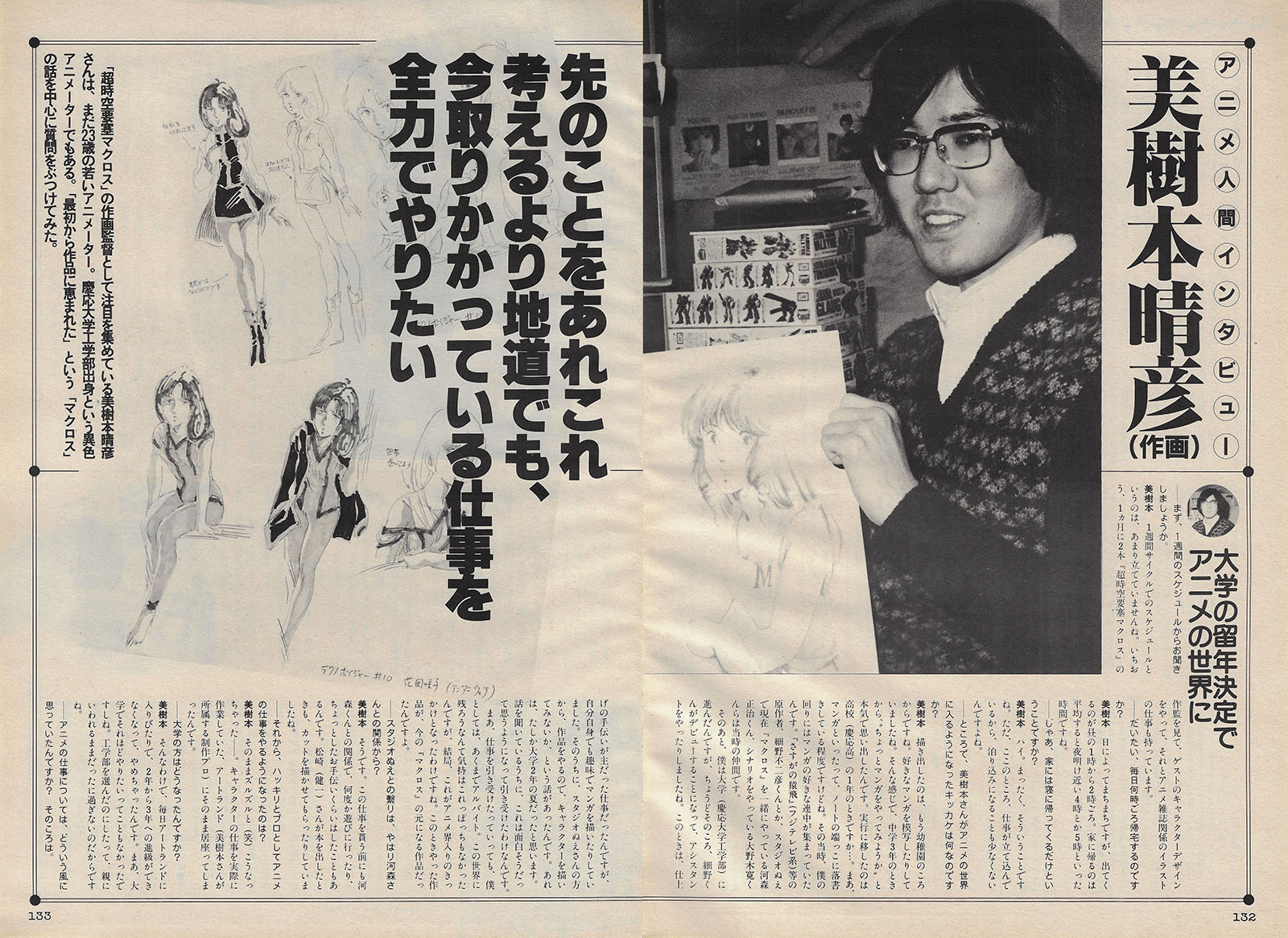
I decided to repeat a year at university and entered the world of anime
Interviewer: first, let me ask you about your weekly schedule.
Mikimoto: I don’t really have a weekly schedule. I supervise two episodes of Macross a month, design guest characters, and also do illustration work for anime magazines.
Interviewer: What time do you usually get home every day?
Mikimoto: It varies depending on the day, but I usually leave for work around one or two in the afternoon and get home around four or five in the morning, which is close to dawn.
Interviewer: so you only come home to sleep?
Mikimoto: Yes. That’s exactly it. However, I’ve been busy with work lately, so I often have to stay overnight.
Interviewer: What made you decide to enter the world of anime?
Mikimoto: I started drawing manga when I was still in kindergarten. I would copy my favorite manga. So in my third year of junior high school, I seriously thought, “maybe I should give manga a try.“ I think I put it into action in my first year of Keio high school.
Well, when I say manga, I mean just doodling on the edges of notebooks. At that time, I was surrounded by people who loved manga. My friends from back then included Fujihiko Hosono, the original author of Sasuga no Sarutobi (Fuji TV), Shoji Kawamori, who I’m currently working with on Macross at Studio Nue, and Hiroshi Onogi, who writes the scripts.
After that, I went on to university (Keio University, faculty of engineering) and around that time Hosono-kun was about to make his debut, so I worked as his assistant. At the time, my main job was helping with the finishing touches, but I also drew manga myself as a hobby. Then Studio Nue approached me and asked if I would like to try drawing characters for a project they were working on. I think it was the summer of my second year of university.
As I listened to the story, I thought it sounded interesting, so I accepted the job. Well, even though I took it, it was just a part-time job for me. I had no intention of staying in this world, but in the end, this was what led me to enter the anime world. The work I did at that time was the basis for Macross.
Interviewer: So your connection with Studio Nue comes from your relationship with Kawamori-san?
Mikimoto: That’s right. Even before I got this job, because of my relationship with Kawamori-kun, I went over to visit a few times and even helped out a little. When Kenichi Matsuzaki released his book, I was also allowed to draw some scenes.
Interviewer: After that, when did you start working professionally in anime?
Mikimoto: Things just kept dragging on until this happened. (Laughs) I ended up staying at Artland (the production company Mikimoto is affiliated with) where the actual work on the characters was being done.
Interviewer: What happened to university?
Mikimoto: I was so engrossed at Artland every day, I couldn’t advance from the 2nd to 3rd year, so I dropped out. I didn’t really have anything I wanted to do at university, either. Even though I chose to study engineering, I was just doing what my parents told me to do.
Interviewer: What did you think about working in anime at that time?

Mikimoto: To be clear, I had no desire to become an animator at all. Character design work was something I just thought sounded interesting, to a certain extent. But once I actually started doing it, I began to think that this kind of work could be worthwhile. Still, as I said earlier, the direct reason was that I had decided to repeat a year at university. (Laughs) So So I just went along with it and made the decision.
Interviewer: What was the first project you worked on after entering the world of animation?
Mikimoto: it was the new Astro boy (1980). I started out doing inbetween animation, and then I started doing key animation halfway through. After that, I was supposed to start working on Macross right away, but even though the company was ready, it wasn’t clear when it would actually be broadcast on TV. I helped with key animation for other anime, and did rough character designs for Technovoyager. It was just one episode, though.
Interviewer: When did you start working on Macross?
Mikimoto: Around the summer of last year. Actually, when this work was first being planned, it was a comedy. I’m not particularly good at comedy, so I wasn’t keen on it at first, but as the project developed, it took on its current form, and I started to get interested in it. However, I wasn’t involved in the planning meetings, so I don’t know much about how Macross changed from its original comedy nature.
Interviewer: What do you find interesting about working on anime?
Mikimoto: simply put, it’s the fact that the drawings I’ve made appear exactly as is on the TV screen. That’s what’s fun, or rather that’s what makes me happy. On the other hand, I do feel a certain amount of responsibility because my drawings are actually being shown on the screen. The job of animation director is to revise the original drawings made by other people, so it’s not a very satisfying feeling. It’s not something I enjoy doing.
Interviewer: When you look at your own work on the TV screen, do you often feel satisfied with it, or do you feel like it needs a little more?
Mikimoto: There are a lot of things that I think could’ve been a little better. It would be fine if it was just a few, but there are many that I think are complete failures. (Laughs)
Interviewer: Is lack of time the reason you’re often dissatisfied with the results?
Mikimoto: In most cases, it’s more accurate to say that it was a lack of ability.
Interviewer: When do you feel completely satisfied?
Mikimoto: When I can clearly express my goal. There are times when I feel like things are going as I expected, or that the effect I aimed for is being achieved. But I’m not sure about the feeling of satisfaction. I think it’s a little different. Although, in most cases, I scratch my head and say, “next time I’ll make something better.” (Laughs)
Interviewer: What about the reaction from fans?
Mikimoto: I receive about four letters a week.
Interviewer: What kind of things do you hear most often?
Mikimoto: I get a lot of messages from people who have seen Macross and say, “I like your art, so please draw something and send it to me.” And words of encouragement. Most of the messages I get are relatively tame. However, it seems like a lot of them that are addressed to Director Ishiguro are just discussing the film one way or another
Interviewer: Are there any characters that are easy or difficult to draw?
Mikimoto: It’s relatively easy to draw characters who are close to my age. On the other hand, if they’re much older than me, it just doesn’t work out. For example, in Macross it’s hard for me to draw the town council president. Characters I can draw easily or Hikaru and Minmay.
Interviewer: Other than those, who is your favorite? Which characters are easy or difficult to draw?
Mikimoto: Misa is the easiest to give expressions to. Minmay and Hikaru are more of the traditional hero type, aren’t they? With big, round eyes, that sort of thing. With them, it feels more like giving them a shape rather than giving them an expression. That makes it look like manga, and it’s hard to add depth to their expressions. In that respect, Misa has smaller eyes, and is closer to a real human. It’s easier to give her a richer expression.
Max is also difficult to express. He’s not a very dynamic character, so he can be a bit difficult to get into. It’s hard to empathize with him. However, with anime, what I design doesn’t come out exactly as is. There are several stages along the way. It’s possible that something I’m confident in unexpectedly turns out not good, or vice versa.
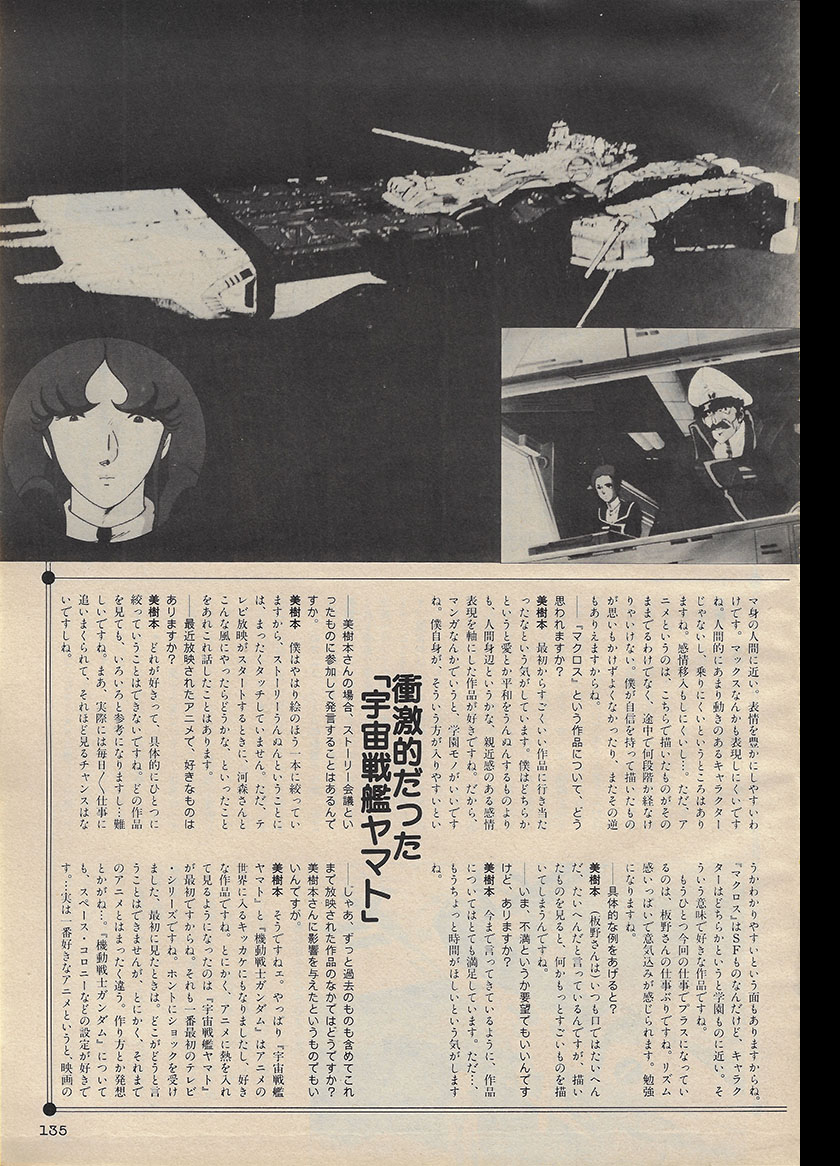
Interviewer: what do you think about Macross?
Mikimoto: Right from the start, I felt like I’d come across a really good work. I prefer works that are more human, that are centered around expressing familiar emotions, rather than works about love or peace. So, when it comes to manga, I like school stories. I personally think that it’s easier for people to get involved in something like that. It’s easy to understand. Macross is a science-fiction story, but the characters are more like something from a school setting. I like that about it.
Another positive aspect of this job is Ichiro Itano’s work ethic. He has a great sense of rhythm and you can really feel his enthusiasm. It’s a learning experience.
Interviewer: Can you give a specific example?
Mikimoto: He always talks aboiut how difficult it is, but when you see what he draws, it’s always something amazing.
Interviewer: Do you have any complaints or requests right now?
Mikimoto: As I said, I’m very satisfied with the work. However, I feel like I need a little more time.
The shocking Space Battleship Yamato
Interviewer: Do you ever participate in story meetings and have a say?
Mikimoto: I’ve narrowed it down to just the art, so I haven’t had any involvement with the story or anything like that. However, when the TV broadcast started, I did talk with Kawamori-san about various ideas, like it would be good if we did it this way.
Interviewer: Is there any anime that has aired recently that you like?
Mikimoto: I can’t really narrow it down to one specific work that I like. Everything I watch is helpful in many ways. It’s difficult. Well, actually, I’m so swamped with work every day that I don’t have much chance to watch them.
Interviewer: What about the works that have aired before, including those from long ago? Which ones influenced you?
Mikimoto: Space Battleship Yamato and Mobile Suit Gundam were the ones who that got me into the world of anime, and they’re two of my favorite works. It was Yamato that got me into watching anime with such enthusiasm. It was the very first TV series. I was really shocked when I first saw it. I can’t really say what it was about it, but it was completely different from any anime that had come before. The way it was made, the ideas, etc.
I also like the space colony setting of Gundam. Actually, my favorite anime is the movie Gundam III. The interactions between Mirai and Bright, for example, are so well thought out, down to the smallest of details. There was something about it that really conveyed the characters’ emotions.
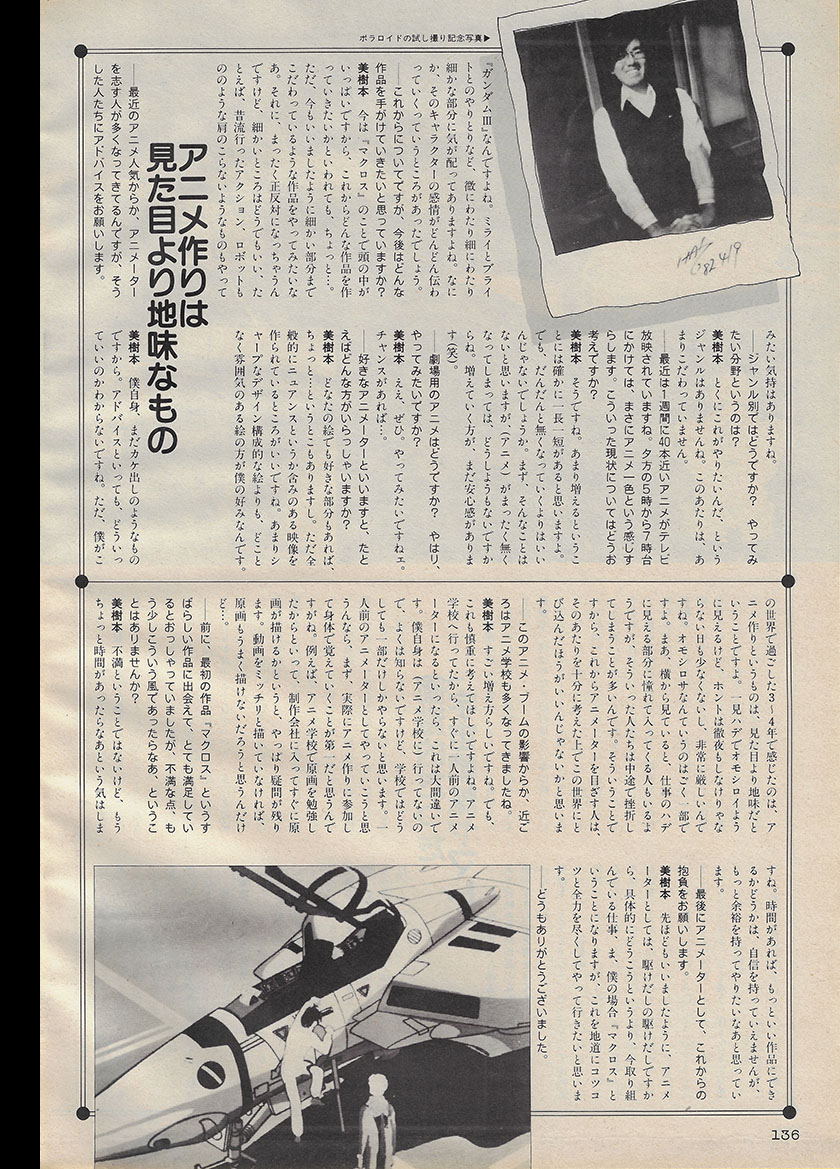
Interviewer: Looking ahead, what kind of projects would you like to work on in the future?
Mikimoto: Right now, my mind is full of thoughts about Macross. So if you ask me what kind of work I want to create in the future, I’m not sure. However, as I said, I’d like to try working on a project that pays attention to even the smallest details. Also, although this is the complete opposite, I’d like to try something that doesn’t require much attention to detail, like the action and robot movies that were popular in the past, that were more relaxed.
Interviewer: What about genres? What field would you like to try?
Mikimoto: there’s no particular genre that I want to work on. I’m not picky about that.
Interviewer: Lately, there are nearly ten anime shows being broadcast on TV per week. It almost feels like the hours between 5pm and 7pm are dominated by anime. What do you think about this current situation?
Mikimoto: I think there are certainly pros and cons to increasing the number. But it’s better than gradually disappearing. First of all, I don’t think that’s going to happen, but if anime were to disappear completely, there would be nothing we could do. I feel more at ease if it continues to increase. (Laughs)
Interviewer: What about a theatrical anime? Would you like to try that?
Mikimoto: Yes, definitely. I’d like to try it if I have the chance.
Interviewer: Who are your favorite animators?
Mikimoto: There are parts of every artist’s work that I like, but there are also parts I’m not keen on. But overall, I like images with nuance and hidden meaning. I prefer pictures that have a certain atmosphere rather than pictures with a very sharply-designed composition.
Making anime is more mundane than it looks
Interviewer: perhaps due to the recent popularity of anime, more and more people are aspiring to become an animators. Do you have any advice for them?
Mikimoto: I’m still just starting out myself. I’m not sure what kind of advice I can offer. However, what I’ve learned from the three or four years I’ve spent in this world is that making anime is more mundane than it looks. It may seem flashy and fun at first glance, but in reality, there are many days when you have to stay up all night, and it’s extremely tough. Only a small part of it is interesting.
Looking in from the outside, it seems like some people join the industry because they’re attracted to the flashy aspects of the job, but those people often give up halfway through. That’s why I think someone who wants to become an animator should think about these things carefully before jumping into this world.
Interviewer: Perhaps due to the influence of this anime boom, there has been an increasing number of anime schools opening recently.
Mikimoto: It seems like a huge increase. But I think they need to think carefully about it, too. It’s a big mistake to think that just because you went to an animation school you’ll immediately become a full-fledged an animator. I didn’t go to an animation school myself, so I don’t know much about it, but I think schools only teach a small part of it.
If you want to make it as a full-fledged animator, I think the first thing you need to do is actually get involved in making anime and learn it with your body. For example, just because you studied key animation at a school, does that mean you’ll be able to draw a key animation as soon as you join a production company? I have doubts. I think if you haven’t done a lot of animation, you won’t be able to draw key animation well.
Interviewer: You said before that you were very happy to have come across the wonderful Macross, but is there anything you’re dissatisfied with, or wish had been a little better?
Mikimoto: It’s not that I’m dissatisfied, but I do wish there was a little more time. I can’t say with confidence that if there was more time, I could’ve made a better work, but I want to do it with more time to spare.
Interviewer: Finally, as an animator, what are your plans for the future? Please tell me your aspirations.
Mikimoto: as I said earlier, I’m still a beginner, so rather than thinking about specific things, I’d like to focus on the work I’m currently doing, which in my case is Macross. And to do my best, steadily and diligently.
Interviewer: Thank you very much.