
Predictably, Final Yamato created a big wake after its release, which was filled by one last blitz of book and music publishing along with the game-changing arrival of home video. Amidst all this came the announcement that “Final” Yamato wasn’t actually “Final” after all…
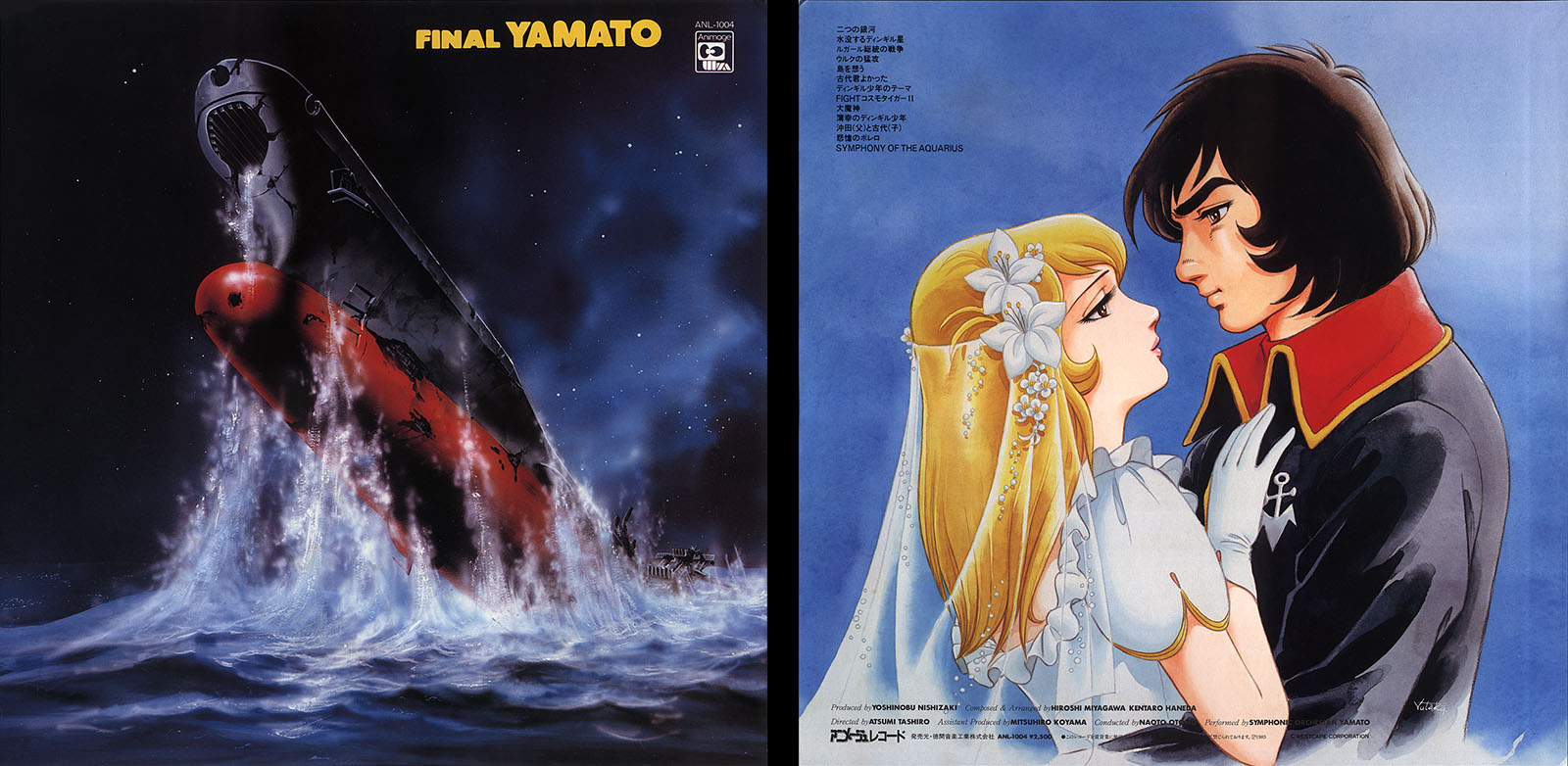
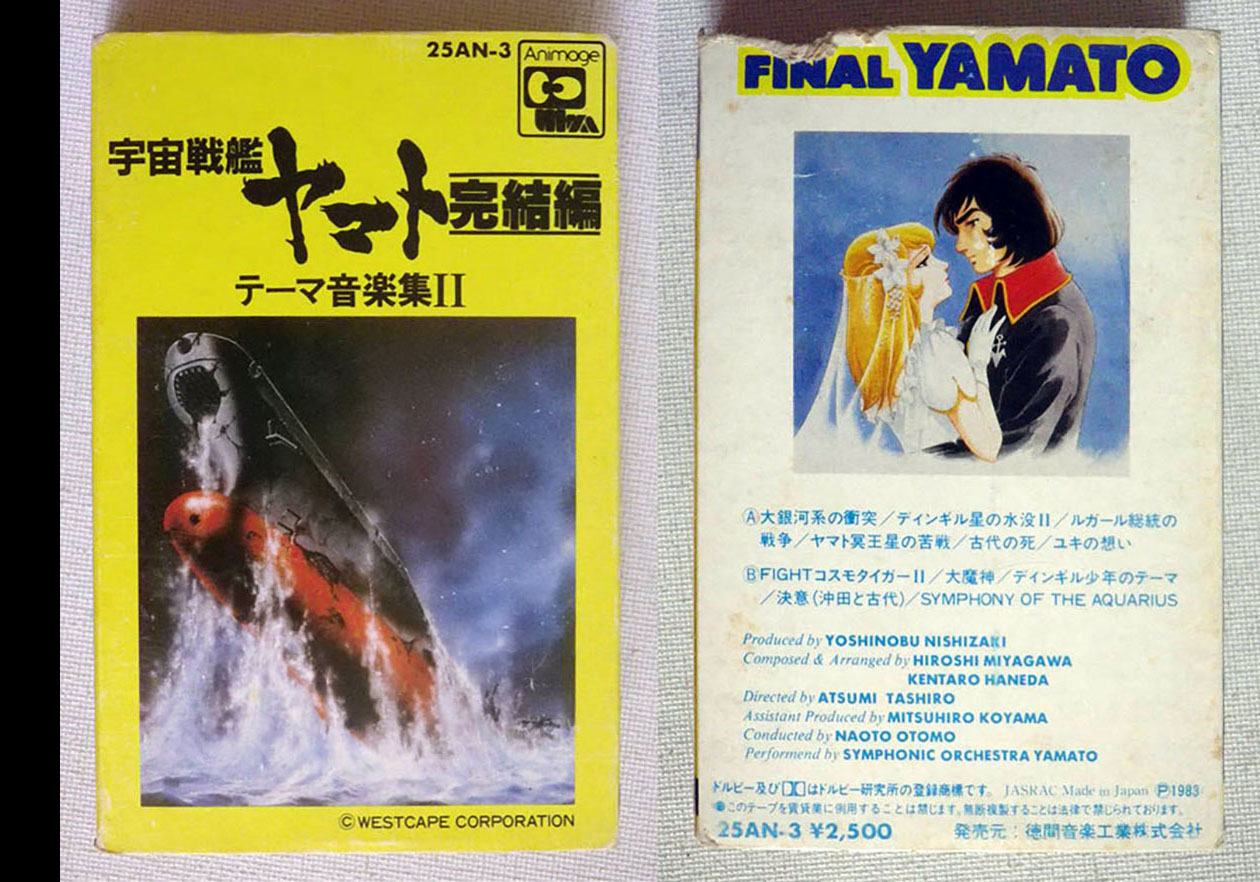
April 1: Final Yamato Theme Music Collection II
This was the second of two albums released by Tokuma Shoten that contained music from the film and variations. Like the AM Juju novels (from the same company) it included a contribution by superstar animator Yoshinori Kanada.
See the full Final Yamato discography here
See a complete Final Yamato music index here
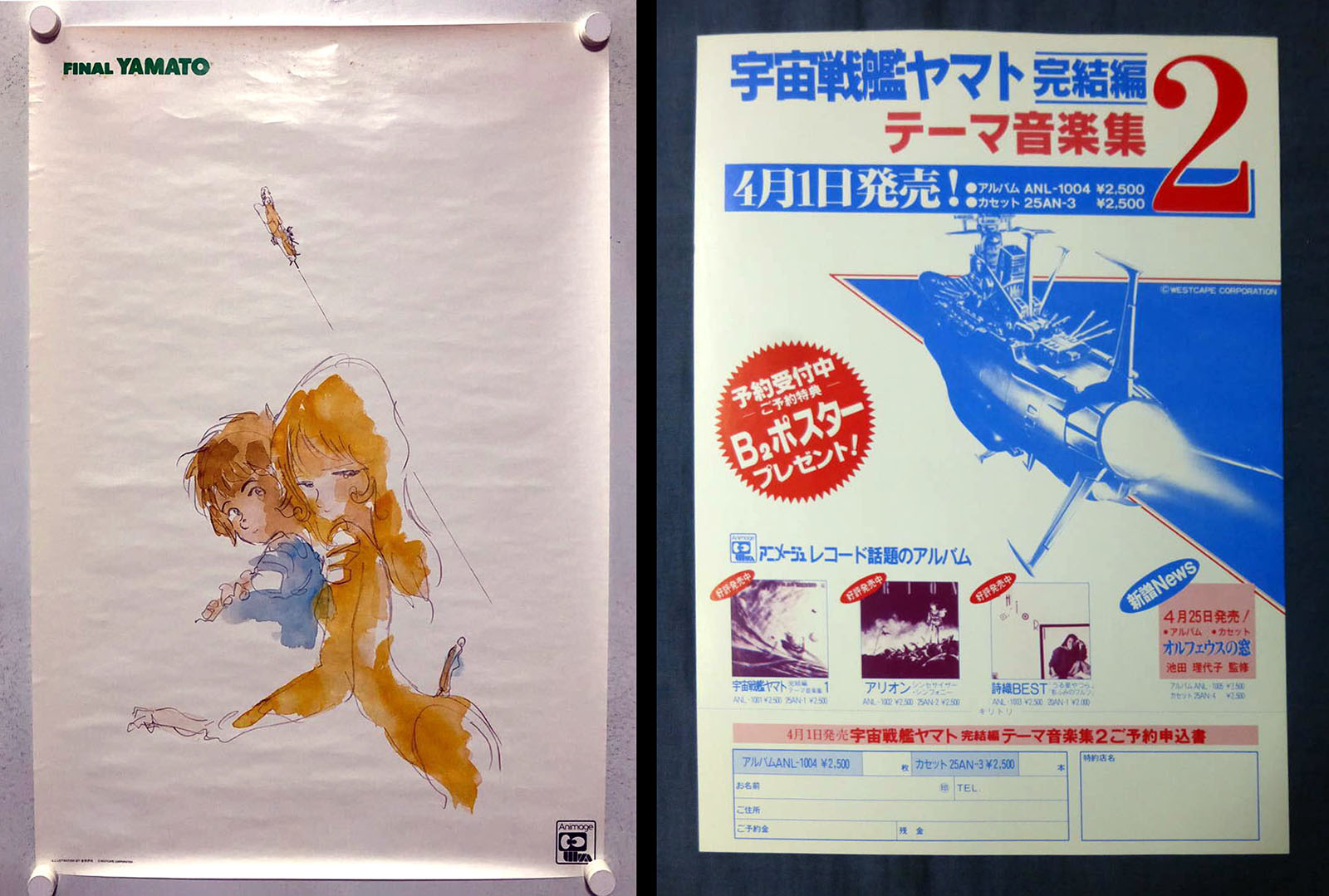
Left: poster given away in stores with purchase. Right: promotional flyer for the album.
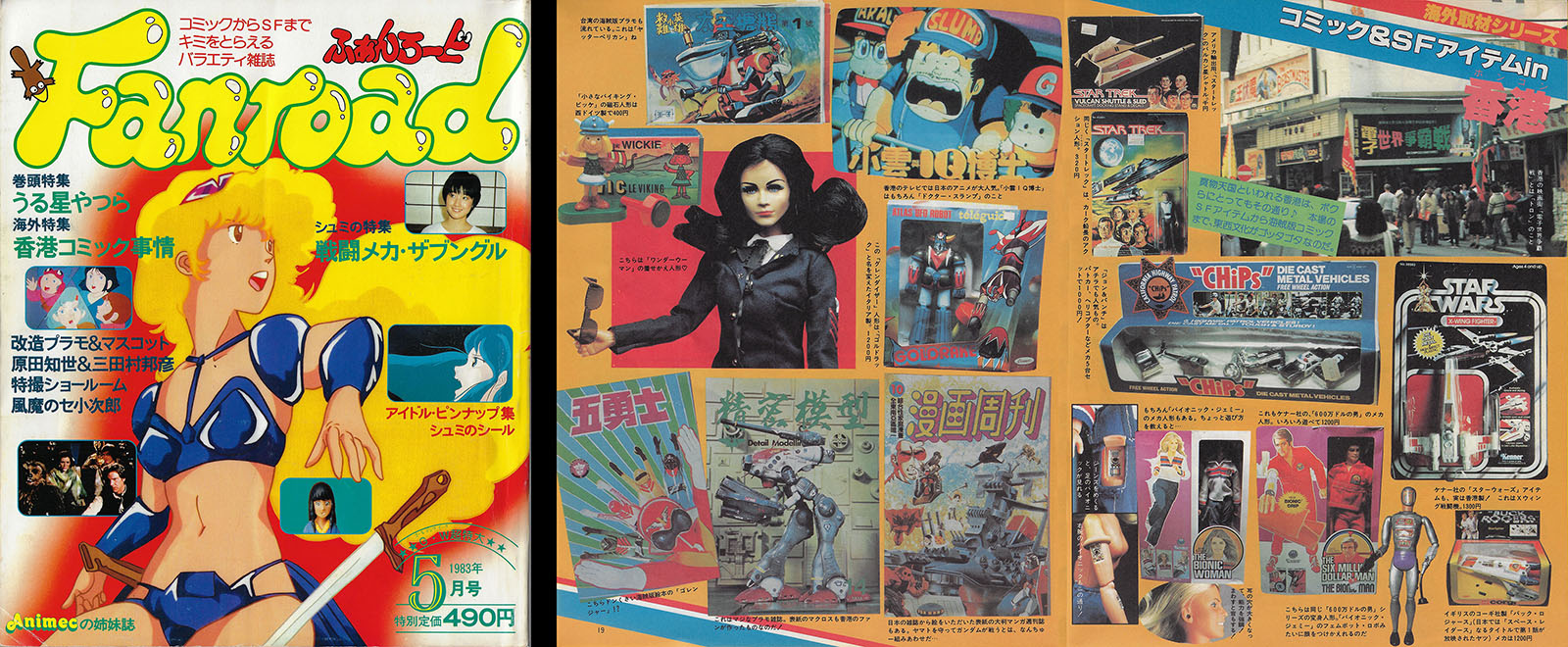
April 1: Fanroad, May issue
The staff of Fanroad magazine, beings fans themselves, would take occasional trips to Hong Kong with the mission of documenting pop culture as refracted through a lens unregulated by international copyright laws. The two pages above right show the discoveries made on this particular trip.
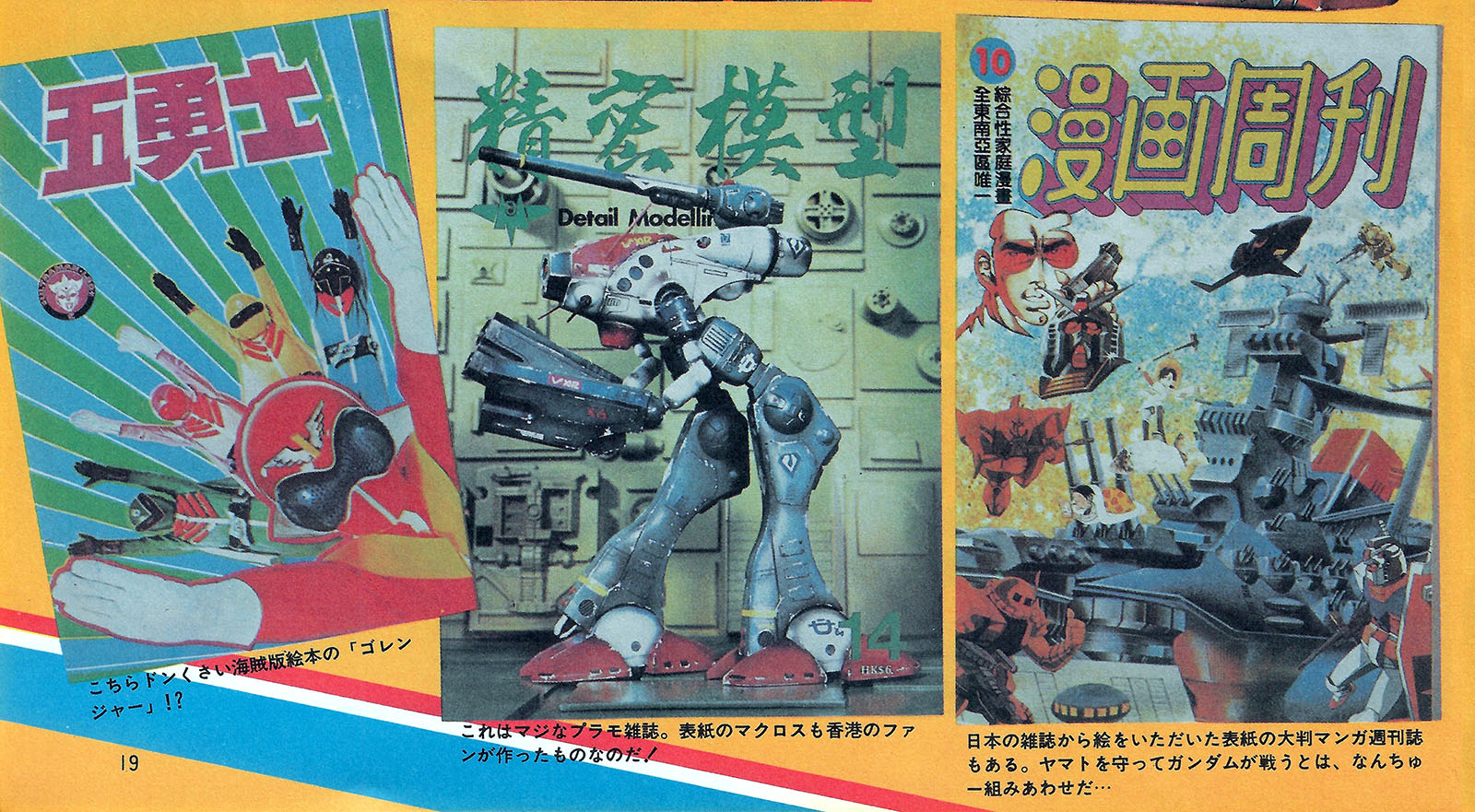
Of particular interest to Yamato fans was the magazine cover at right. Titled simply Manga Magazine, it pirated various unconnected strips from Japan. The caption reads, “There is a large format weekly manga magazine with a cover featuring illustrations taken from Japanese magazines. Gundam fighting to protect Yamato — what a combination…”
April 2: Final Cruise 3
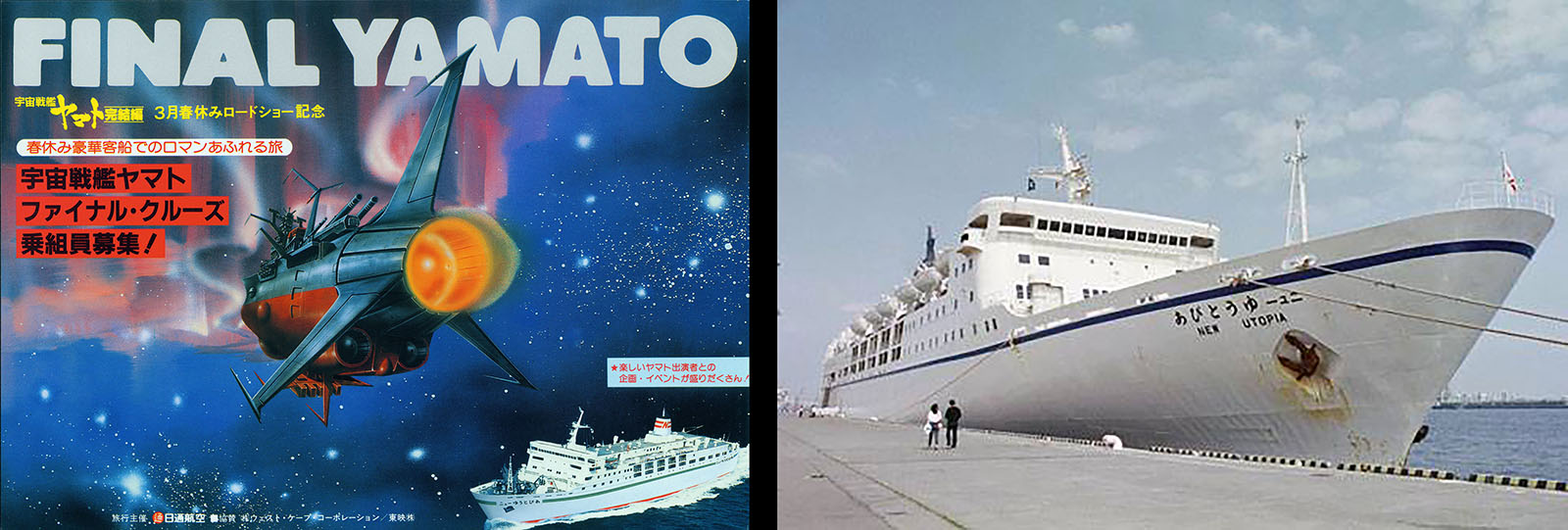
The third and last of the cruise trips took place from April 2-4, during which staff and cast members interacted with fans in various onboard events. Read all the details in Report 44 here.
April 3: Scramble Photo magazine No. 3
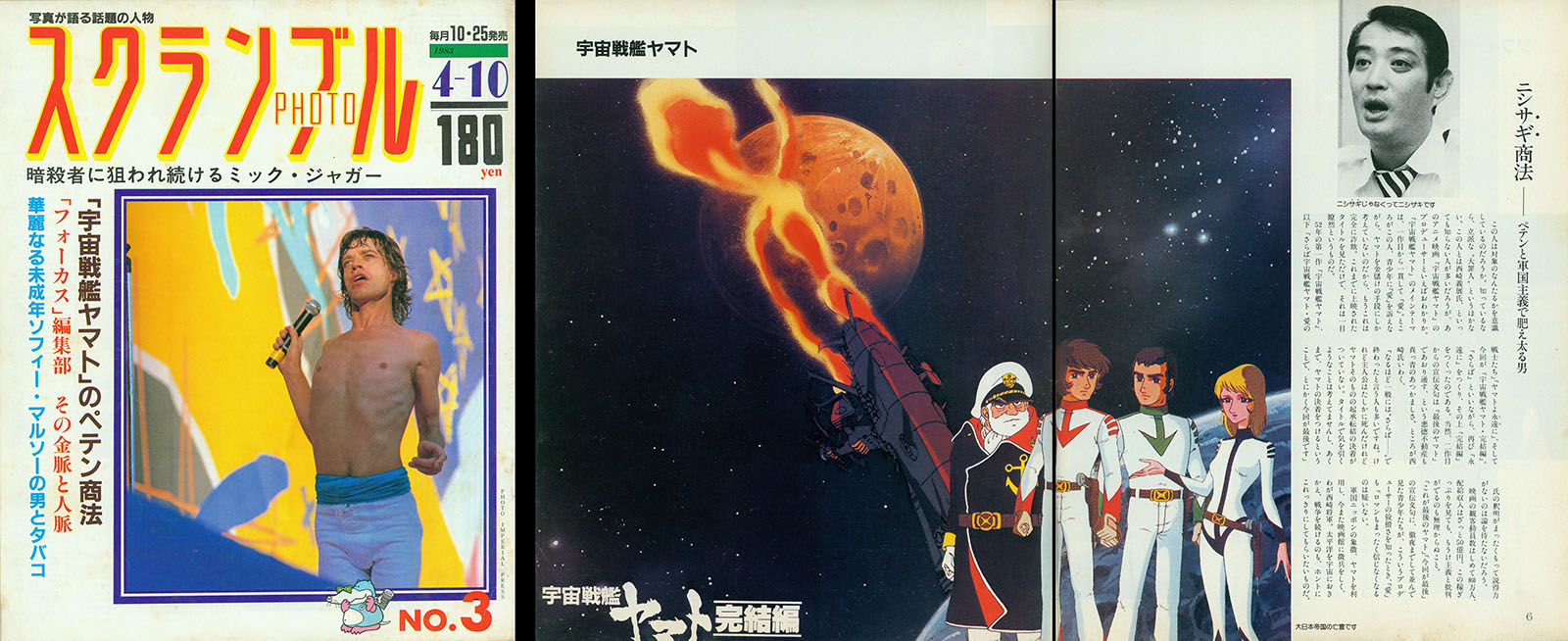
April was the first month magazines could print reactions to Final Yamato, and this oddball got things off to a rocky start. It was a gossip magazine devoted to international showbiz, politics, and social commentary. In a short, poorly-informed screed, Yoshinobu Nishizaki was savaged by one of the editors (the text is unsigned) who clearly had an axe to grind.
Read their grievances here
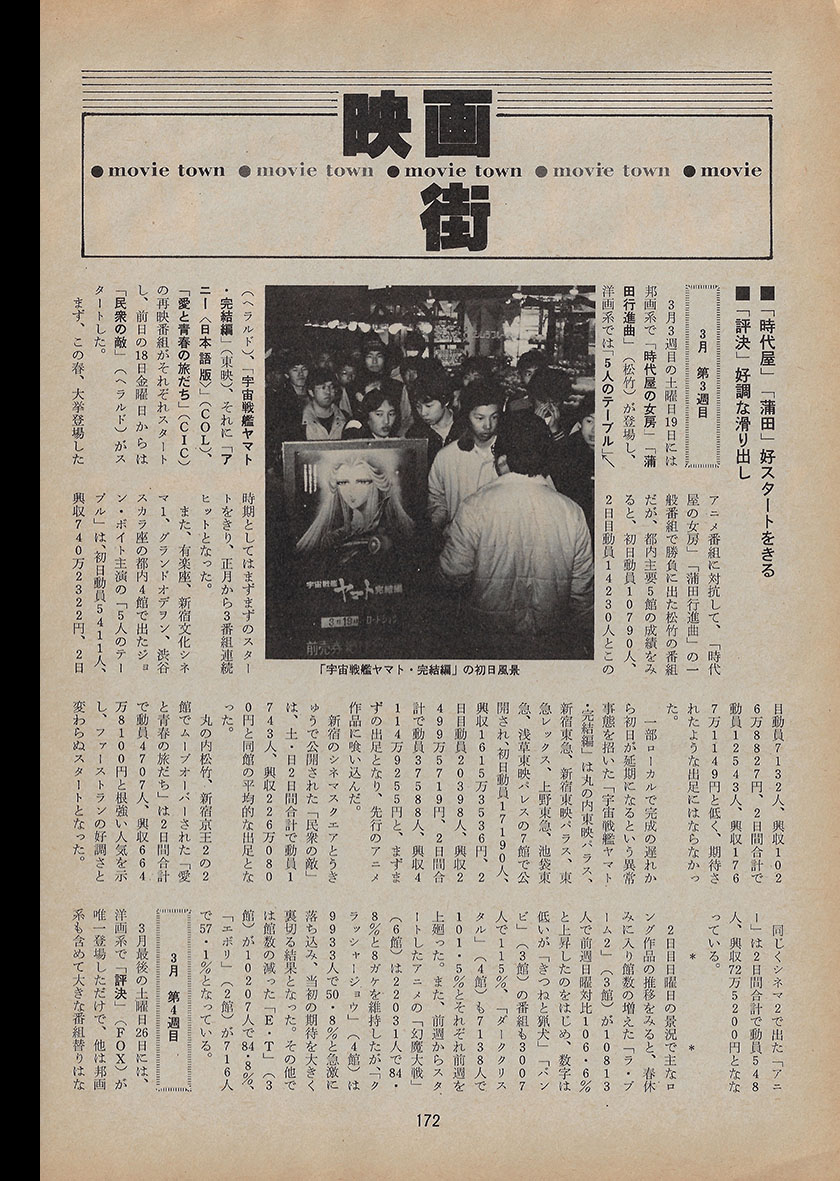
April 5: Kinejun No. 859
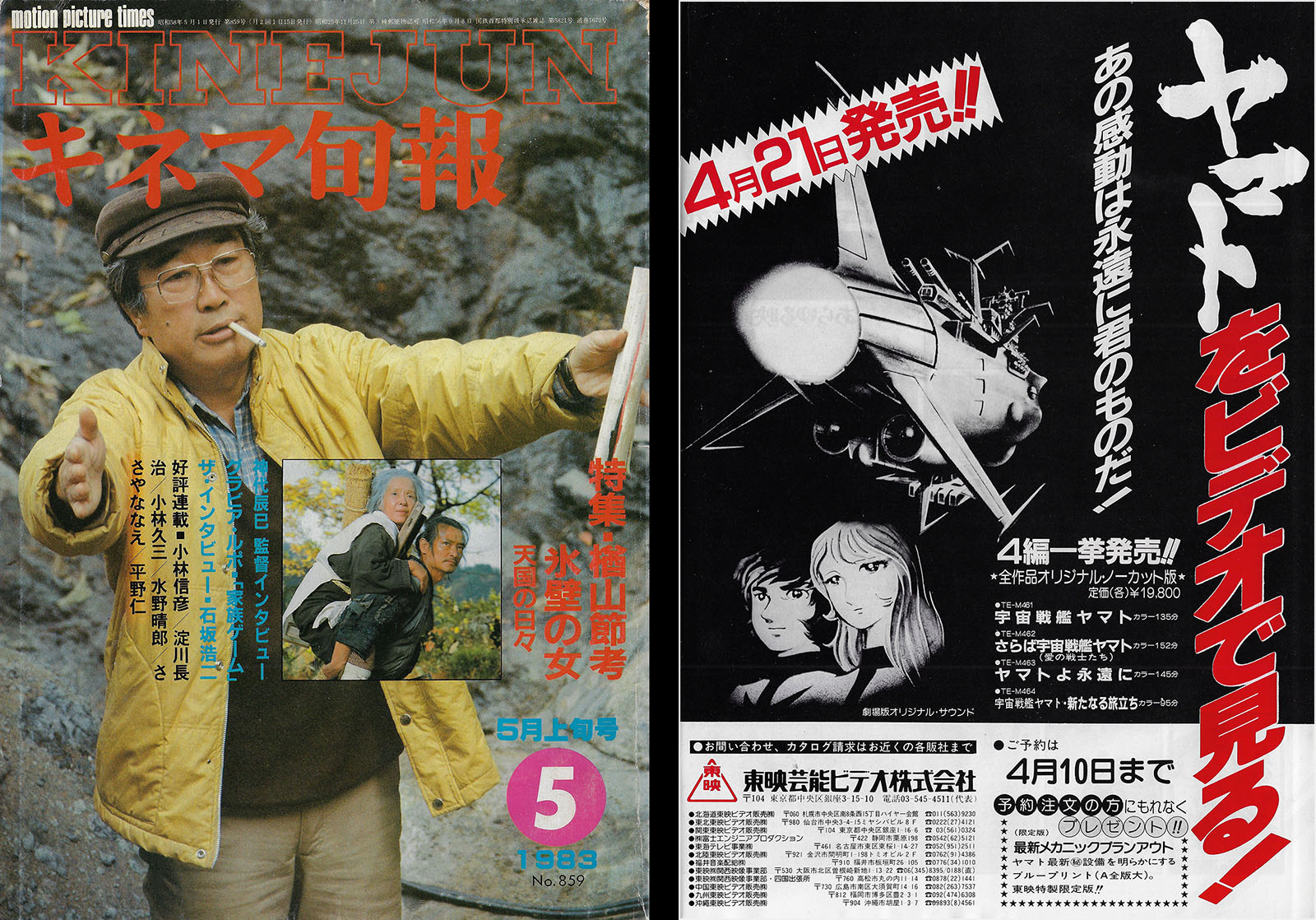
As soon as you opened this issue, an ad announcing the approach of Yamato video tapes (placed by Toei) smacked you right in the eyes. “Watch Yamato on Video!” and “The feeling will be yours forever!” were the headlines. The release date was to be April 21, and everyone was given a deadline of April 10 to preorder their copies to receive a free gift described as a “Mechanic Plan.”
Inside the magazine, a report on early March’s box office performance could be found in the Movie Town column. The paragraph on Final Yamato read as follows:
Despite the unusual situation of the opening day being postponed in some locations due to delays in completion, Space Battleship Yamato, The Final Chapter was released in seven Tokyo theaters: Marunouchi Toei Palace, Shinjuku Tokyu, Shinjuku Toei Palace, Tokyu Rex, Ueno Tokyu, Ikebukuro Tokyu, and Asakusa Toei Palace. On the first day, it attracted 17,190 people and earned ¥16,153,536. On the second day, it attracted 20,398 people, and earned ¥24,995,719, for a total of 37,588 people, and ¥41,149,255 in box office revenue, making a decent start and inroads for other anime works.
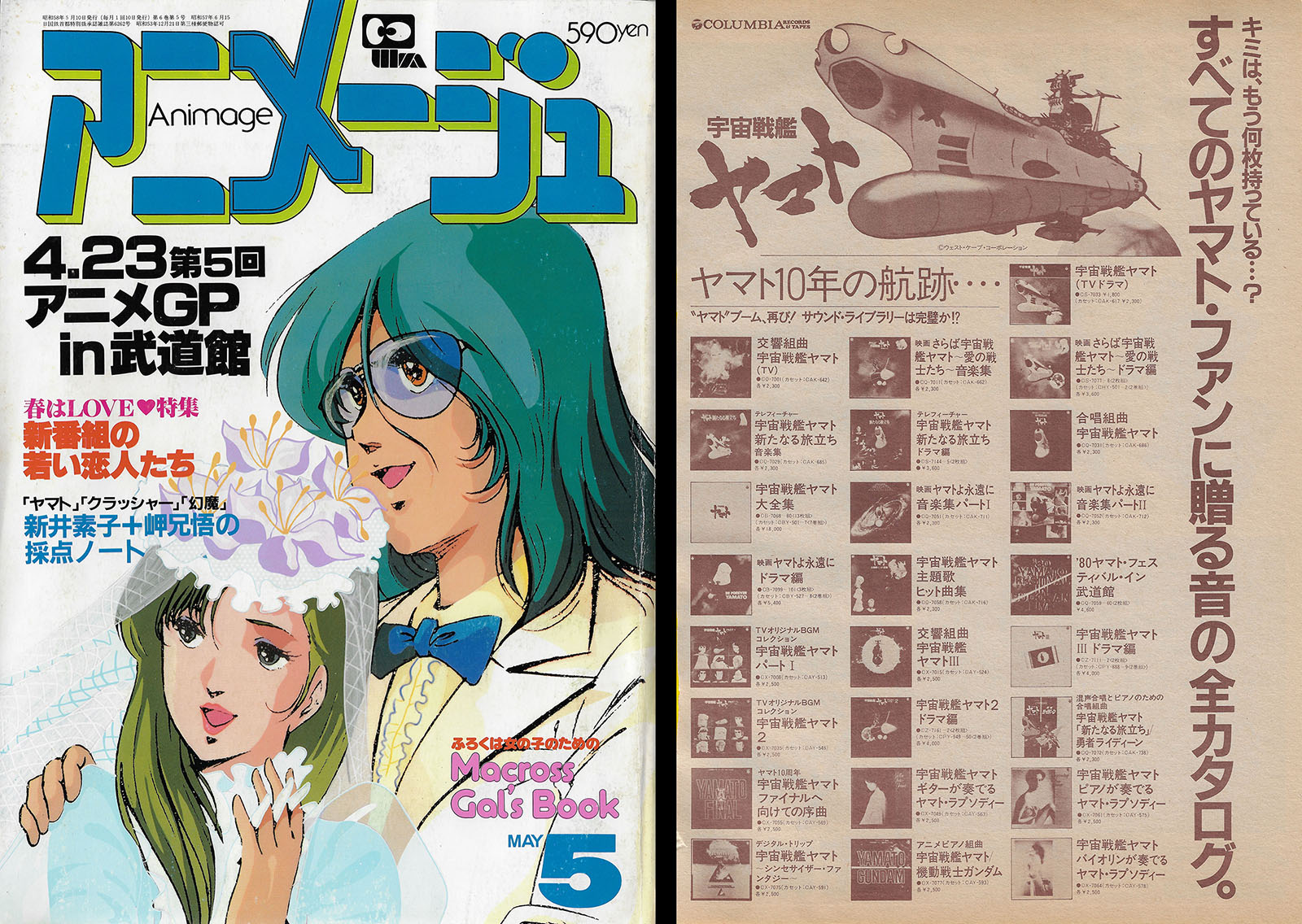
April 10: Animage Vol. 59
There was no dedicated article on Final Yamato in this issue, but it still had a presence in two forms. First, an impressive ad from Columbia Music (above right) that showed off the whole sweep of Yamato albums in the catalog. The headline read, “How many do you already have? A complete catalog of sound for Yamato fans.” The last one to be pictured was a Final Yamato Digital Trip LP, seen here for the first time.
Next, since the film was part of the March “anime battle” that pitted it against Crusher Joe and Harmagedon, it was part of an 8-page bound-in booklet by two writers who saw all three films and gave their reviews. There was also a short article about how the films performed on opening day,
Read the articles here

It was easy to miss, but the magazine carried another brief message about the upcoming home video releases. It encouraged readers to write in with proposals for future video releases, and four lucky winners would be rewarded with a Yamato video tape from Toei.
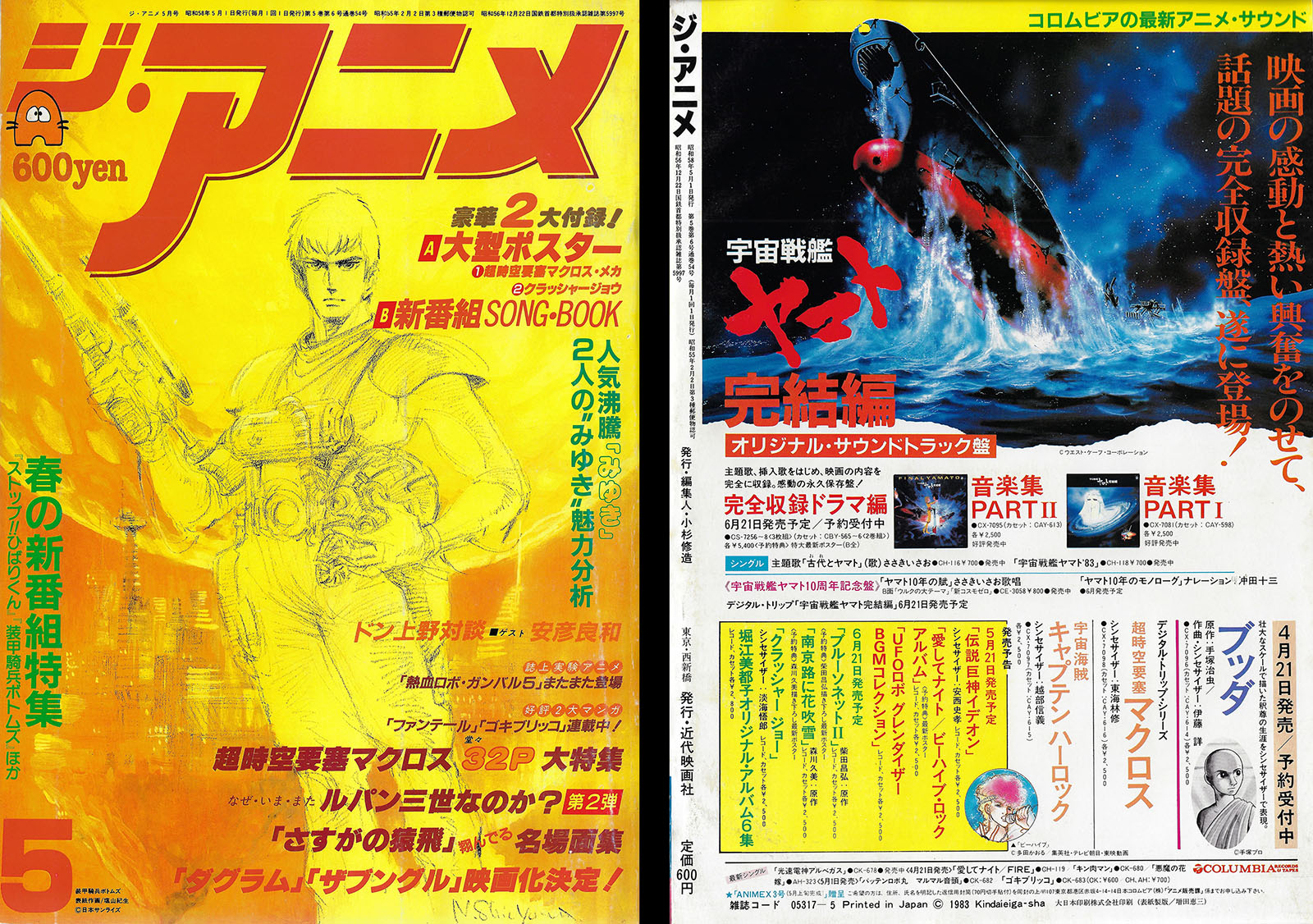
April 10: The Anime Vol. 42
The back cover of this month’s The Anime magazine sported an ad from Columbia that would get plenty of exposure in April. It promoted the first Final Yamato Music Collection (already available) and the second volume to come on June 21st.
The headline reads: With the excitement and passion of the movie, the highly anticipated complete recording is finally here!
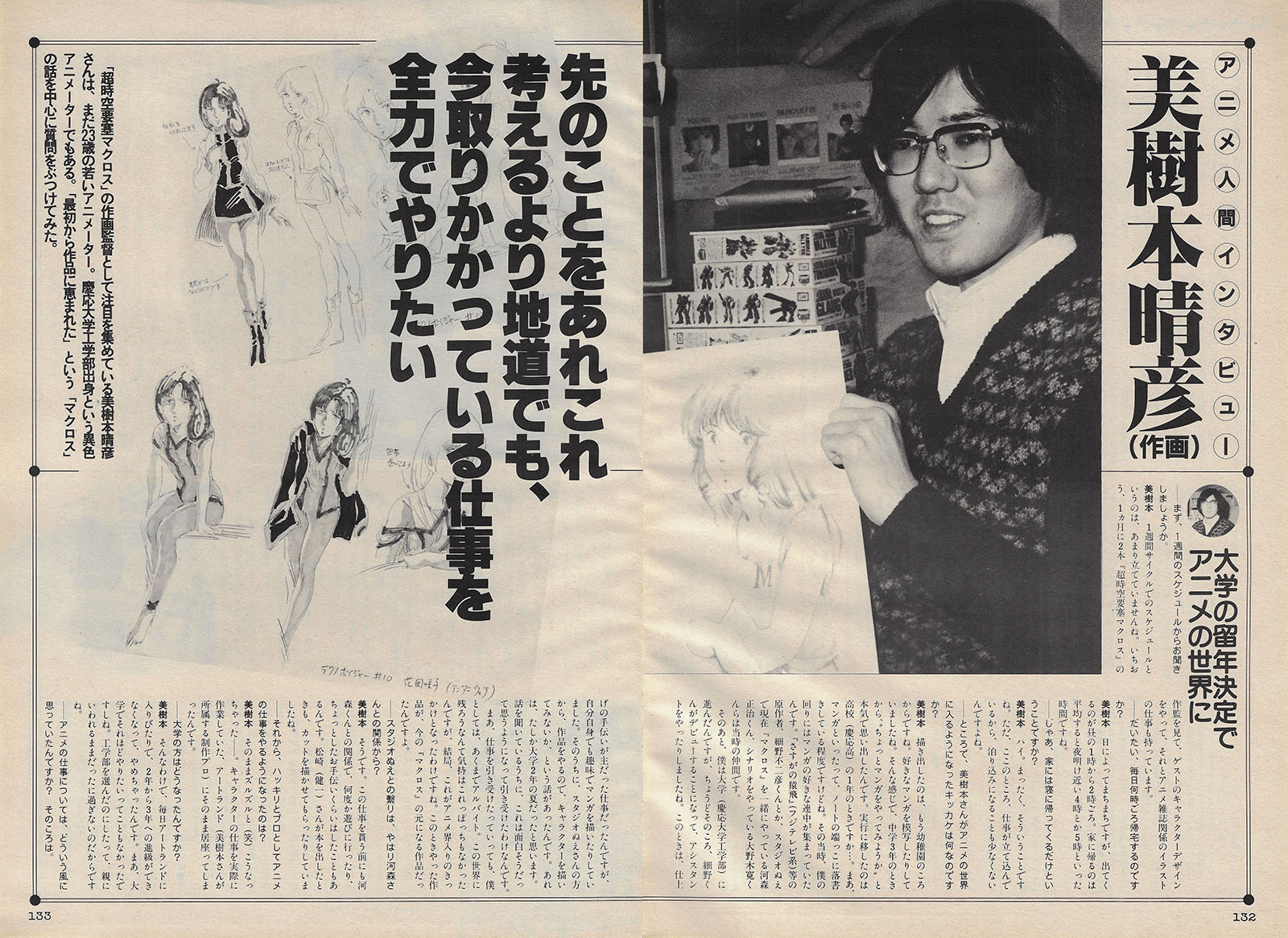
There was no Yamato article inside, but there was a notable mention tucked into their interview with Haruhiko “Hal” Mikimoto, the rising star character designer/animator on the Macross TV series. Read that interview here.
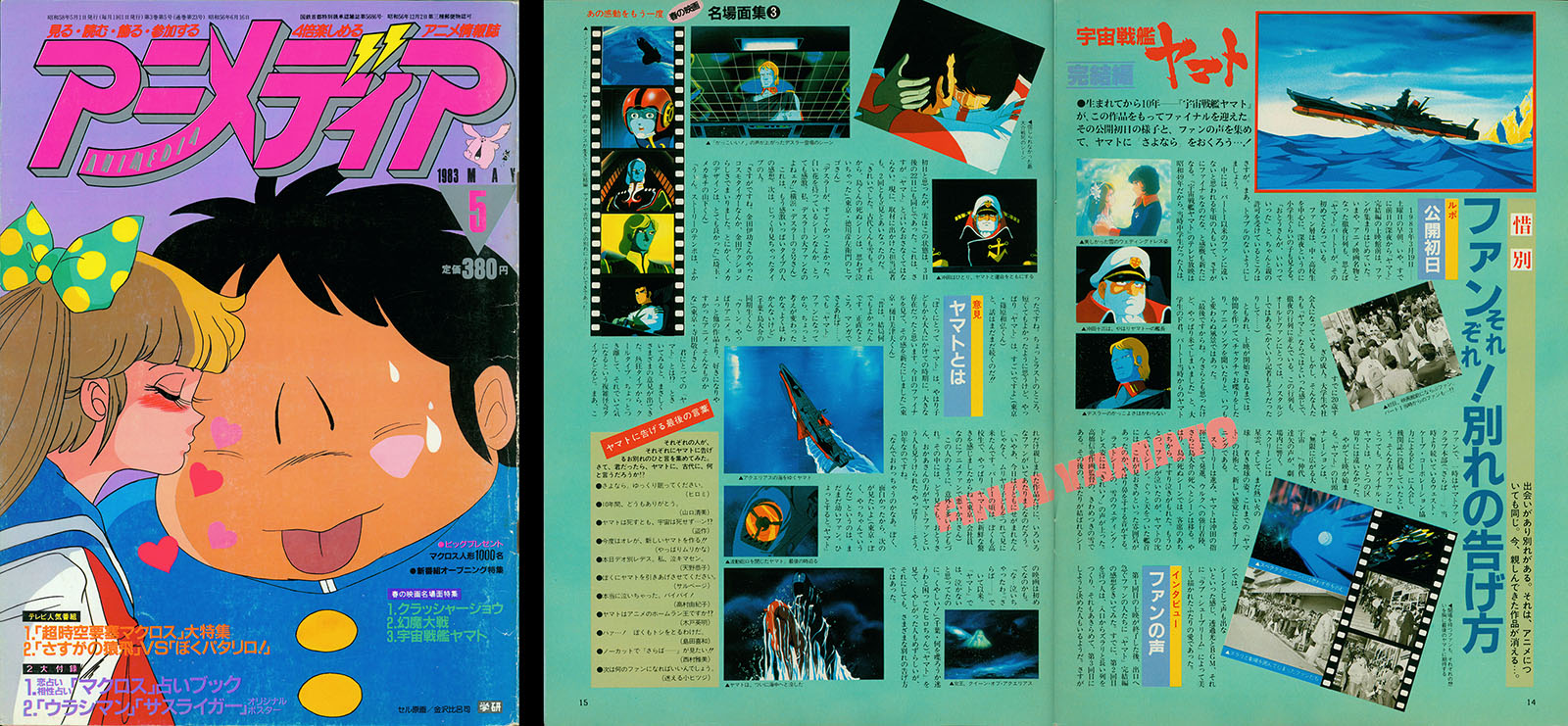
April 10: Animedia, May issue
Four pages were devoted to Final Yamato in which fans were asked to comment on the film during opening weekend and vote for their favorite scene.
Read their reactions here
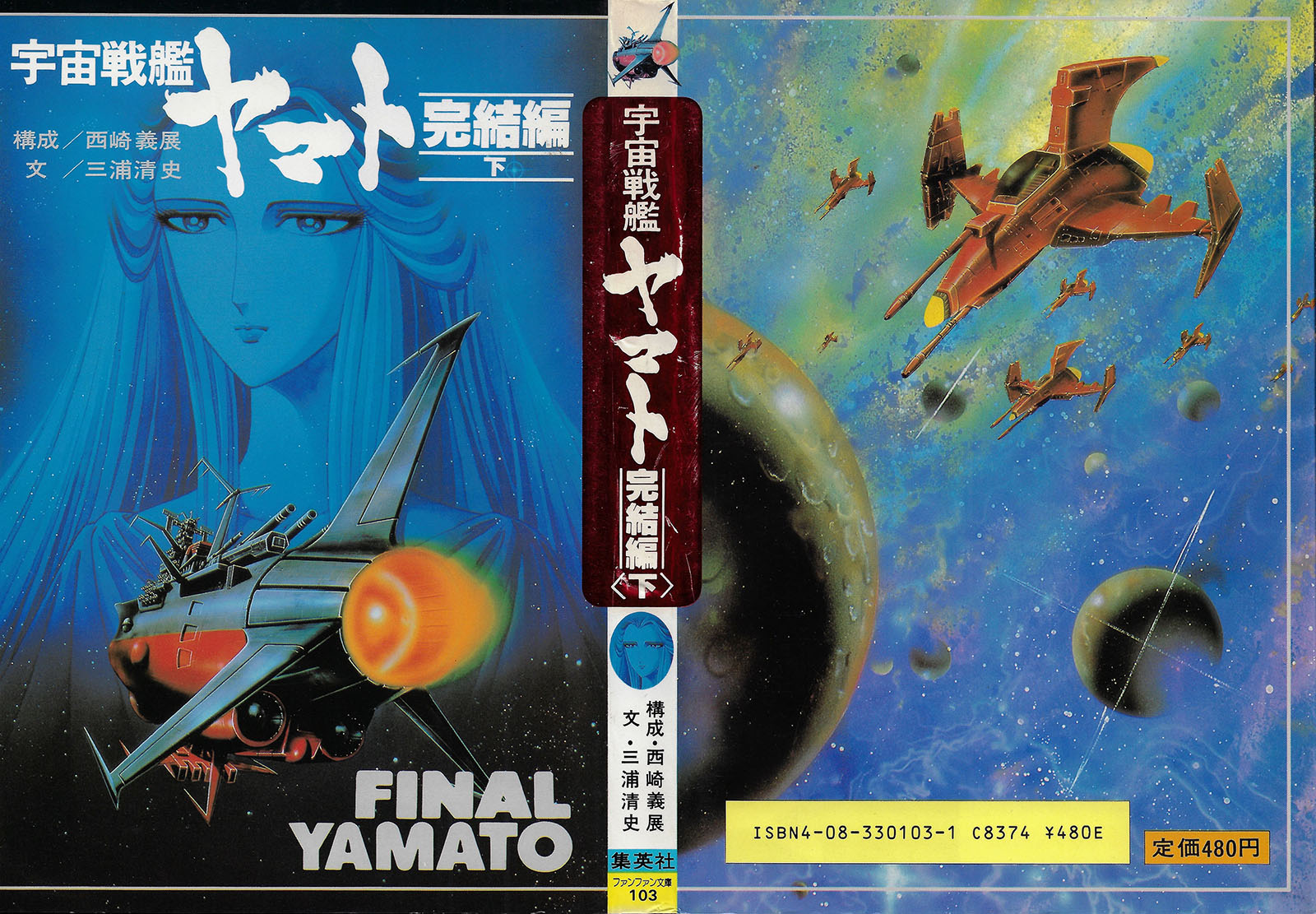
April 10: Final Yamato novel part 2, Fanfan Library
Of the four different Final Yamato novelizations, two had concluded in March and the other two followed in April. The first of those two was from Shueisha’s “Fanfan Library” imprint for younger readers. Written by Kiyoshi Miura, it opened with 32 pages of color stills and featured black and white illustrations and animator’s drawings throughout.
Read this novel’s finale here
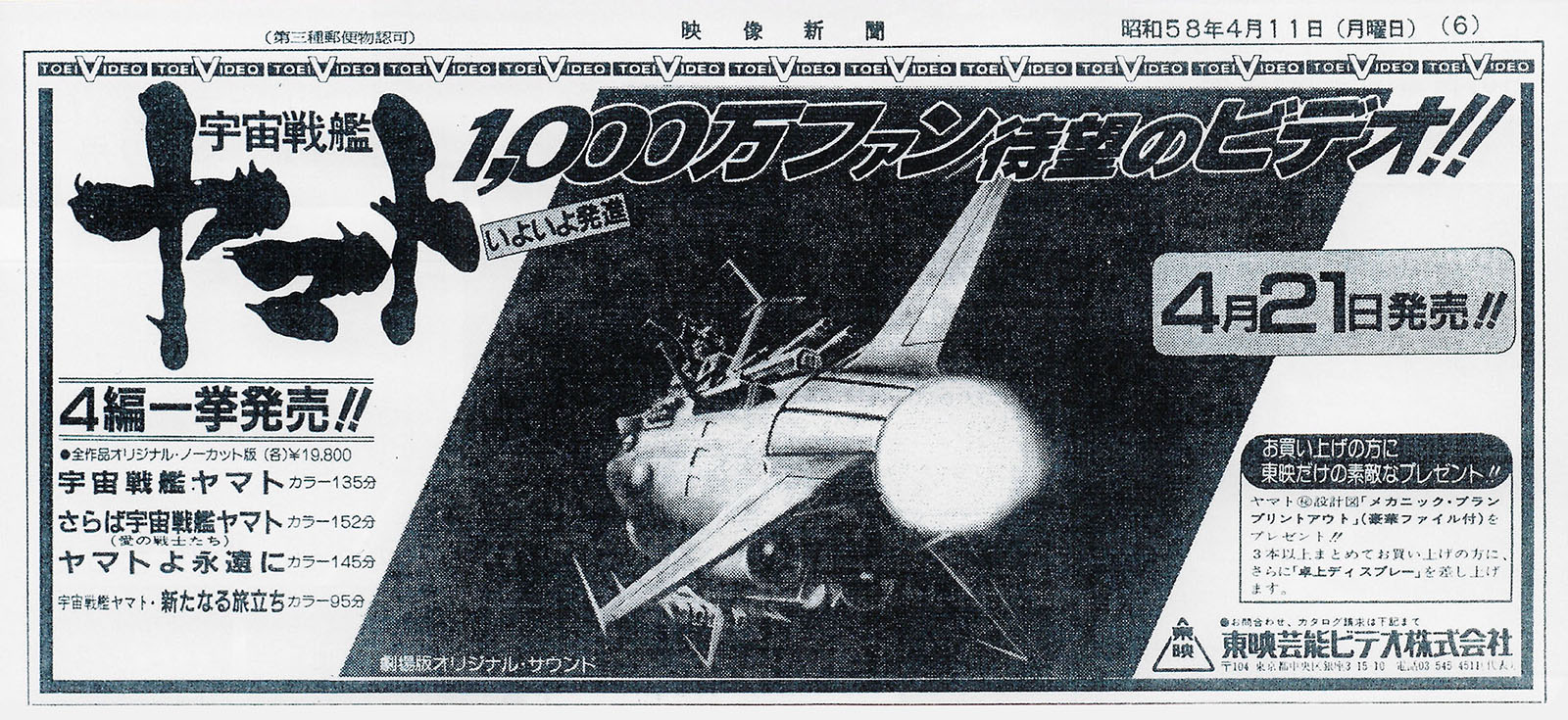
April 11: Eizo Shimbun [Newspaper] ad
The home video revolution was now just ten days away. This ad from Toei Entertainment Video Co. promoted the first four movies with the headline, “The video 10 million fans have been waiting for!!” Each film would be uncut (as opposed to the occasional trimmings seen on TV), and a special “blueprint file” gift would be given away with purchase.
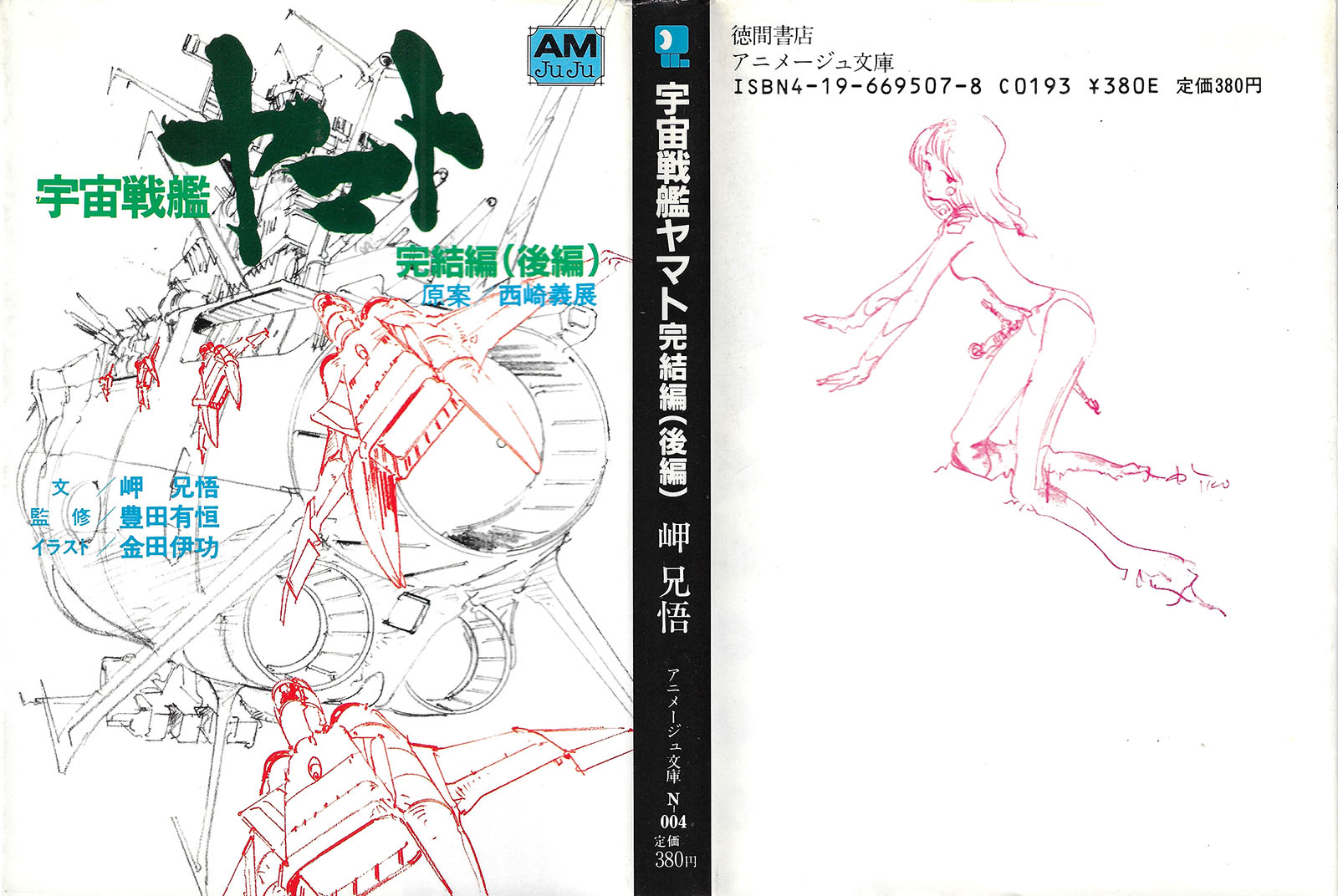
April 15: Final Yamato AM Juju novel part 2
The second novelization to start (on December 31) was the last to finish, highlighted by both color and black & white illustrations by animator Yoshinori Kanada.
Read the entire AM Juju novelization in English here
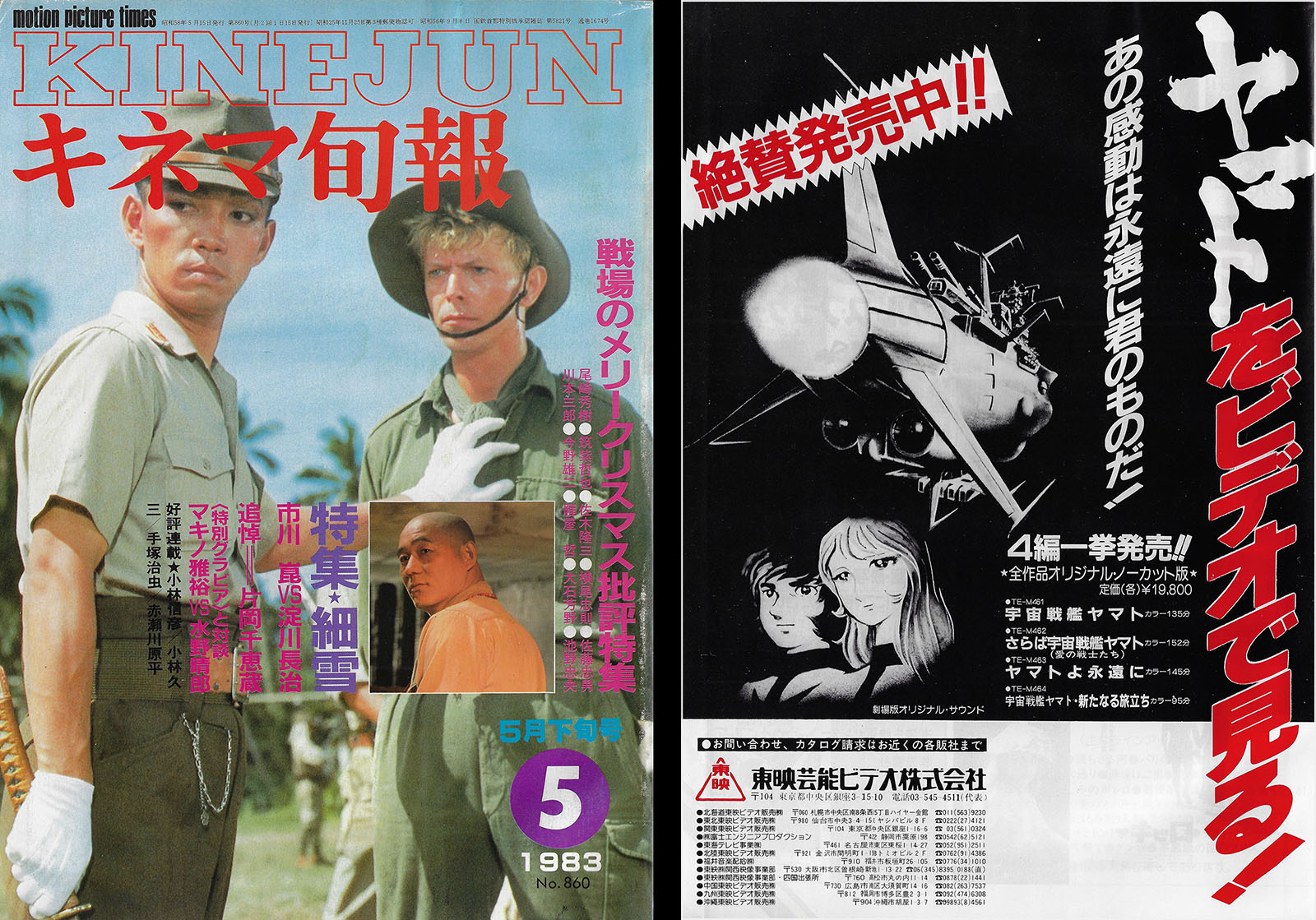
April 20: Kinejun No. 860
Kinejun was published twice a month, and Toei’s ad for Yamato videos occupied the same page as the previous issue. This time, however, the “Coming April 21” banner was changed to read “Now on sale!!”
Within the magazine, two Yamato features could be found: a rather tepid review of Final Yamato and a correspondingly glowing review of the new videos.
Read both features here
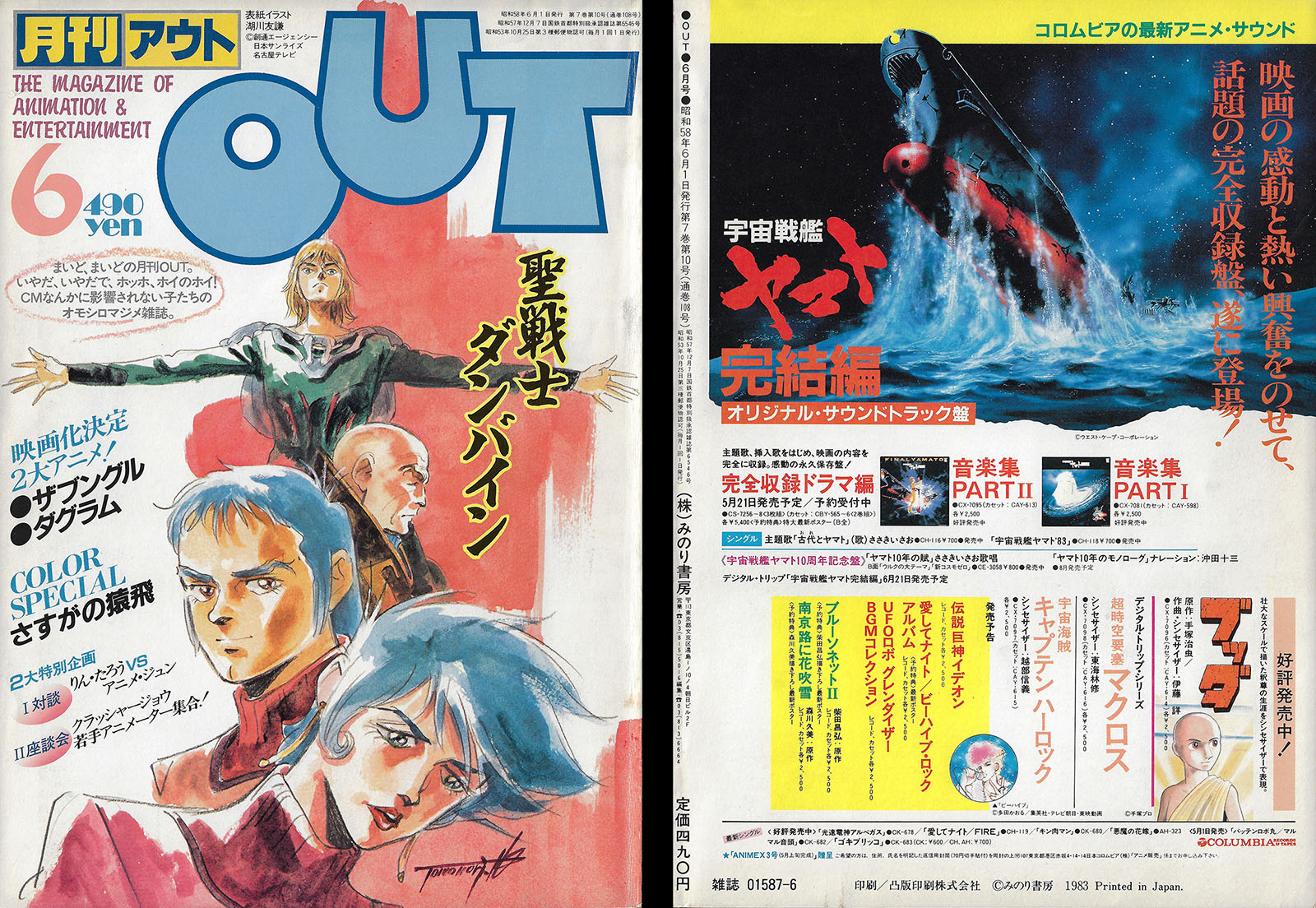
April 21: OUT, June issue
The Columbia music ad that first appeared on the back cover of The Anime earlier in the month made a slightly-revised comeback here. Inside the magazine, there were three Yamato features to be found: a four-page article that examined highlights of Final Yamato, a short manga story by a fan, and a single review of the film in the “Readers’ Voices” section.
Read all these features here
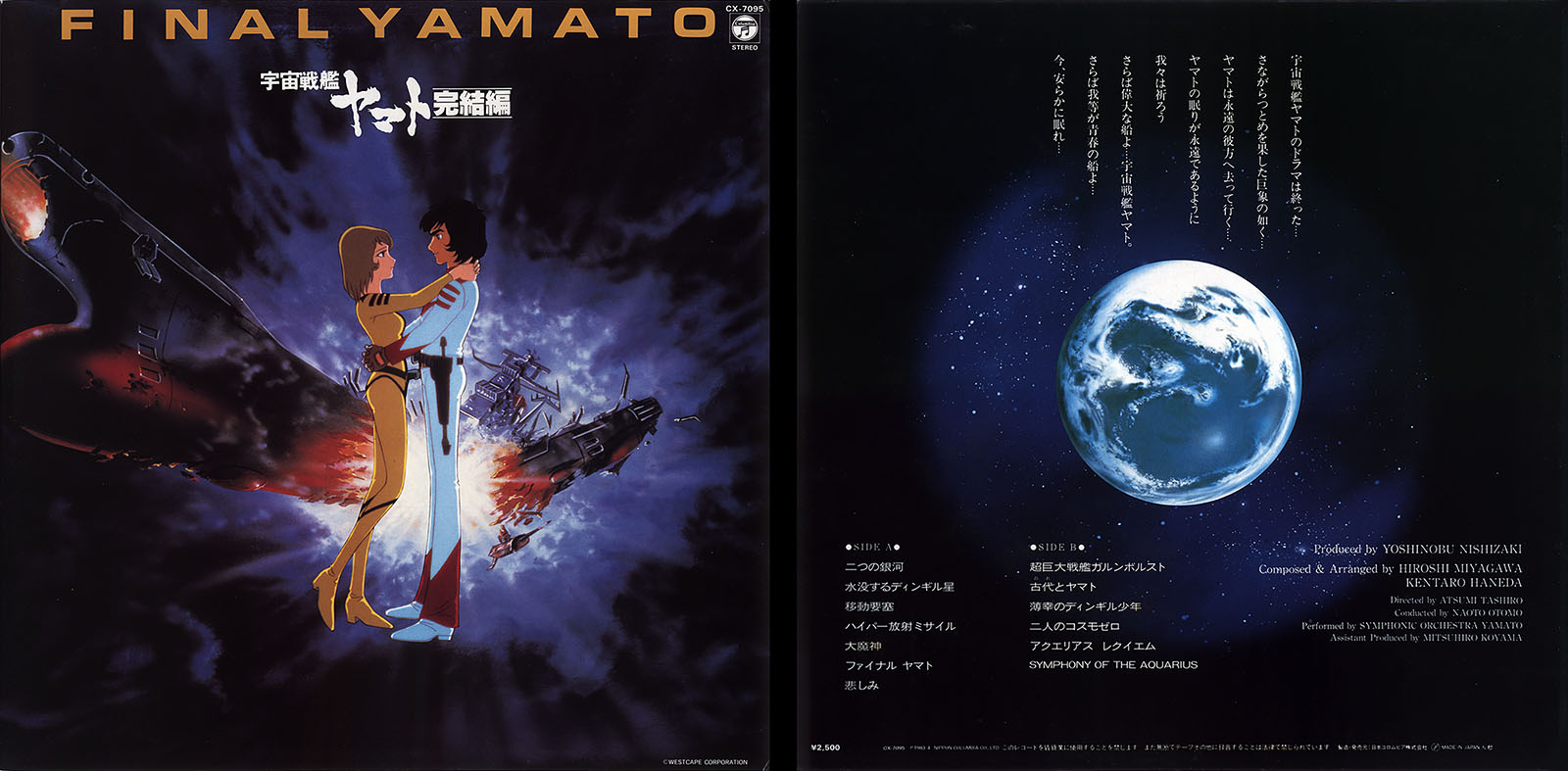
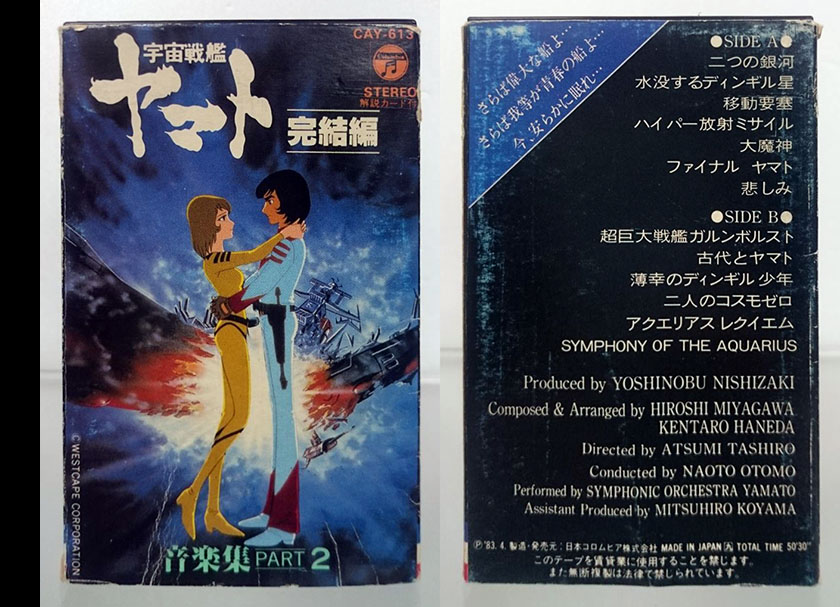
April 21: Final Yamato
Music Collection Part 2
The second of Columbia’s symphonic albums was ordered to follow the flow of the story and concluded with Kentaro Haneda’s personal masterpiece, the Symphony of the Aquarius: a huge, sprawling concerto written for the movie’s climax. Haneda himself was the pianist on this 10-minute track, turning in a virtuoso performance that became a masterpiece in the history of anime music.
Haneda: I was able to compose music for Final Yamato as a co-production with Miyagawa because I thoroughly understood the atmosphere of Yamato after many earlier recordings. We lived in the same apartment building for a while, and I begged him to let me join up. I first saw Yamato on TV back in my school days and thought the music was really cool. It had great scale and set “anime sound” on a healthy path. We recorded this piece with the scene projected on a monitor next to the conductor. Including the mike check, it took about an hour and half.

Posters given away in stores with purchase of the Columbia albums. Left: Music Collection 1. Right: Music Collection 2.
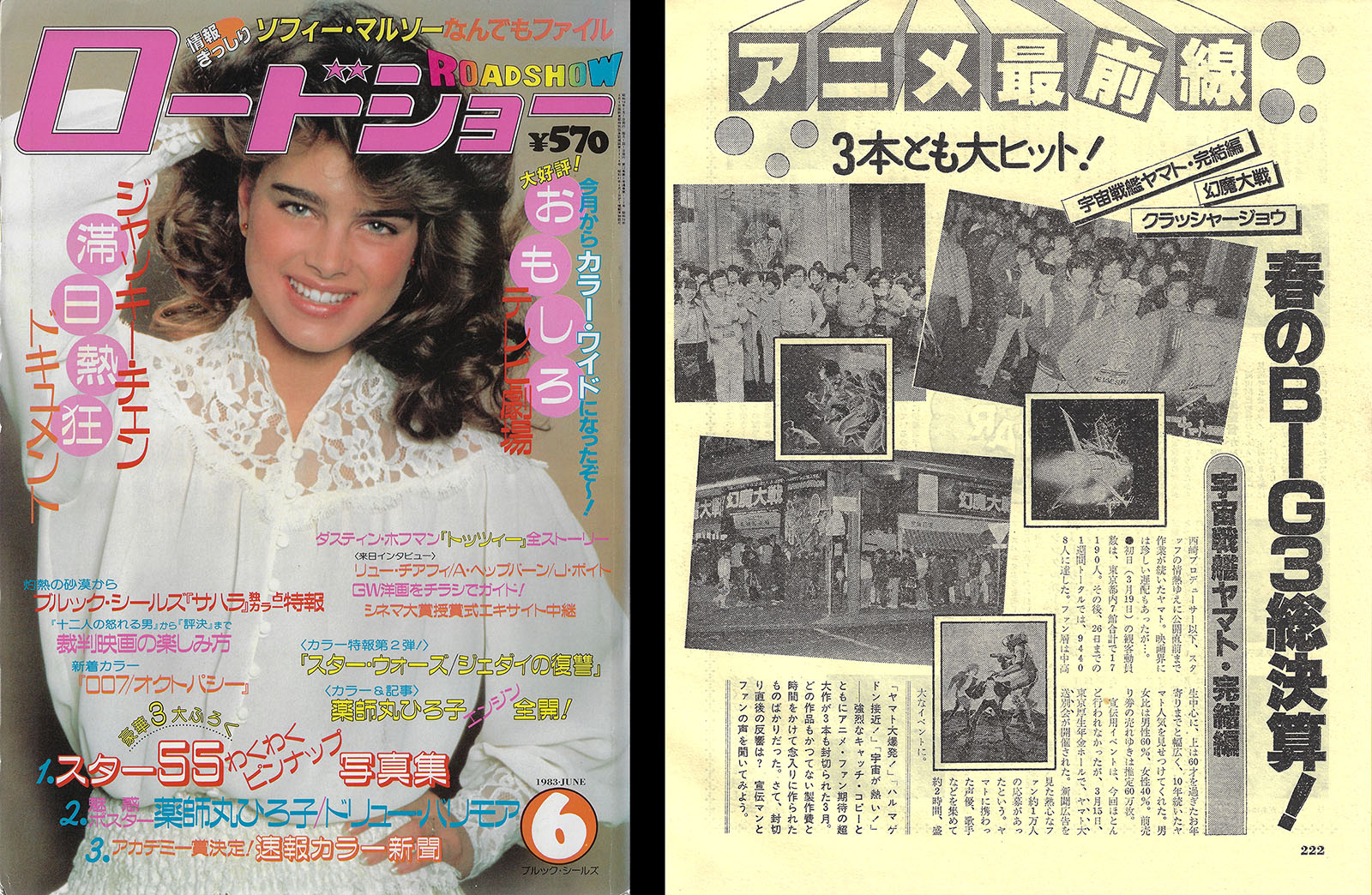
April 21: Roadshow, June issue
Roadshow‘s “Anime Frontline” section devoted two pages to the “Spring Movie Big 3 Roundup,” asking PR reps and fans what they thought of Final Yamato, Crusher Joe, and Harmagedon. The answers did not disappoint.
Read them here
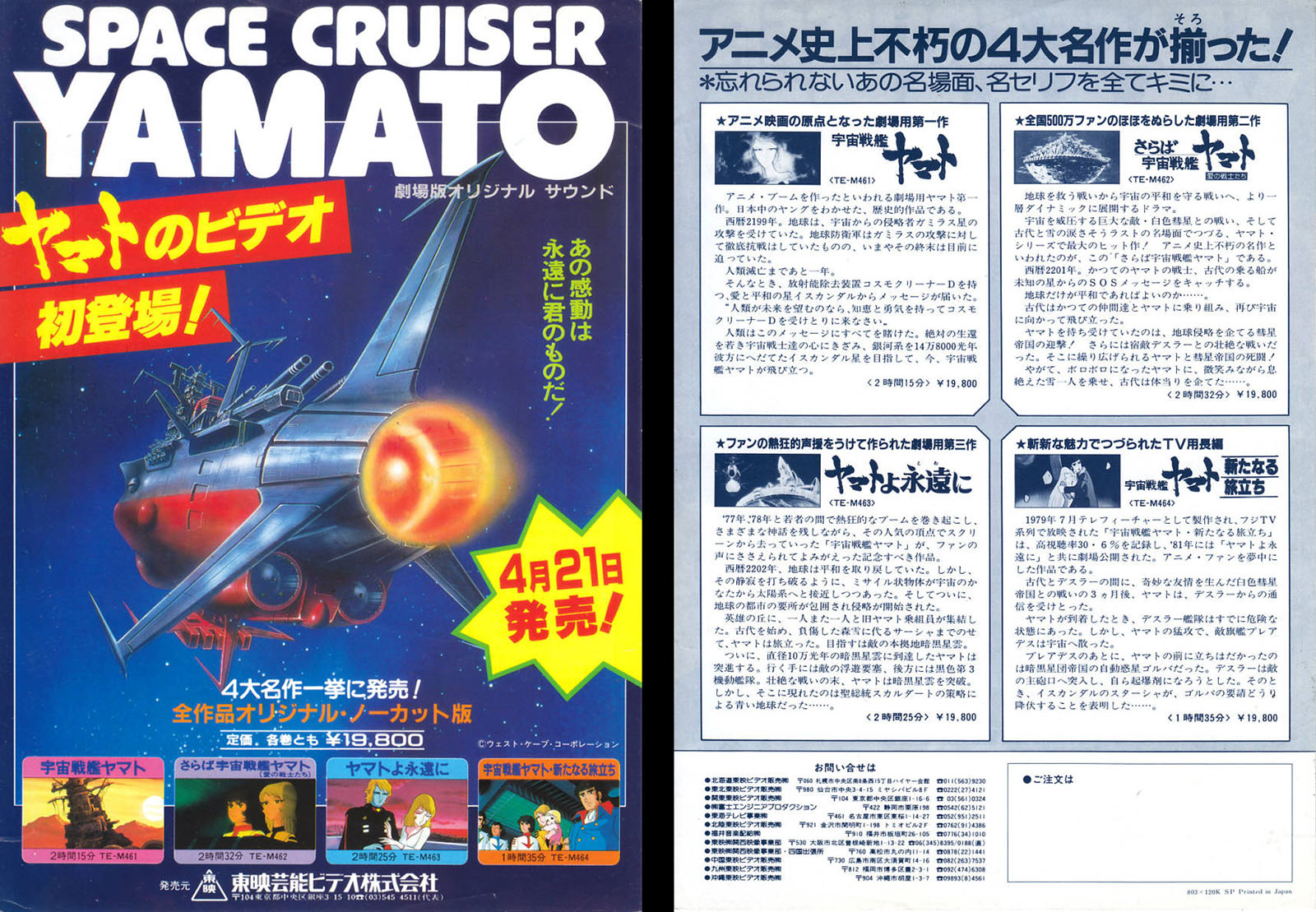
2-sided flyer, Toei Video Entertainment
April 21: Home video releases from Toei, Victor, and VAP
Of all the turning points in 1983, none had a more far-reaching impact than the transition to home video. For the first time, fans could watch Yamato movies on demand by renting or buying (if they had deep enough pockets) rather than waiting for a TV or theatrical revival. It opened up an entirely new revenue stream that would guarantee a future for the saga.
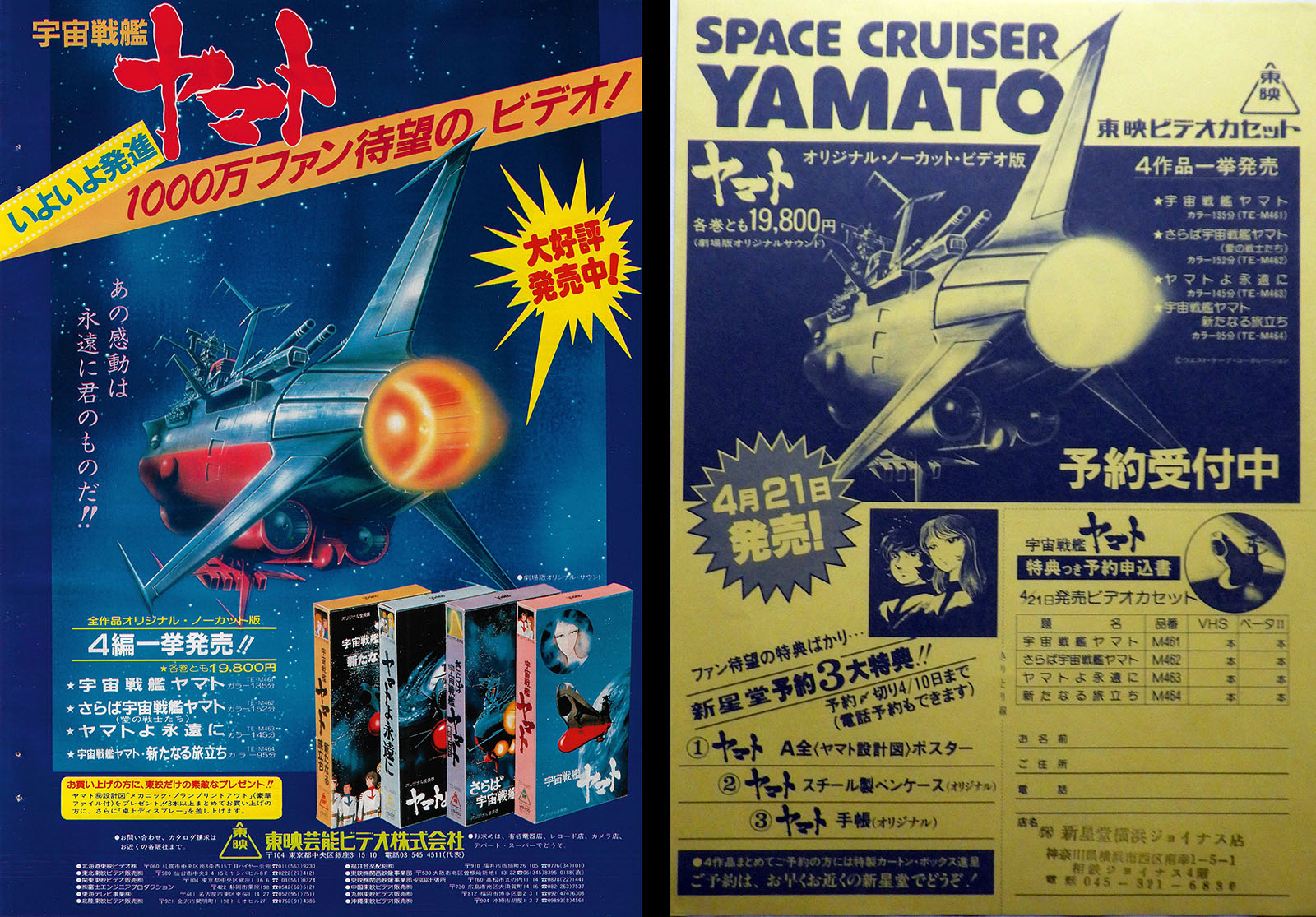
Left: magazine ad. Right: flyer from Shinseido Department Store
As if anyone needed it, there were bonus items available. Toei offered a “Mechanical Plan Printout” and Shinseido offered three gifts if you got your preorders in by April 10: a blueprint poster, a steel pen case, and an original notebook.
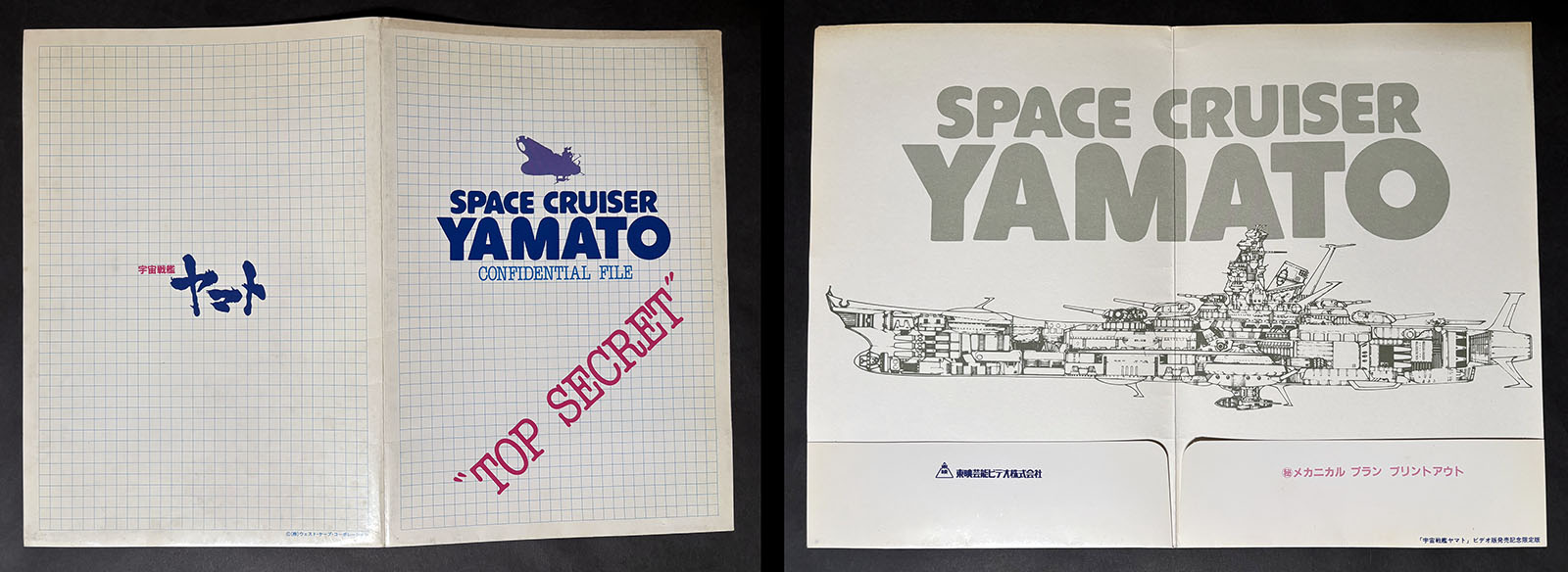
Toei’s “Mechanical Plan Blueprint” came in a “Top Secret” folder. You would open it to see the familiar cutaway profile of the ship…
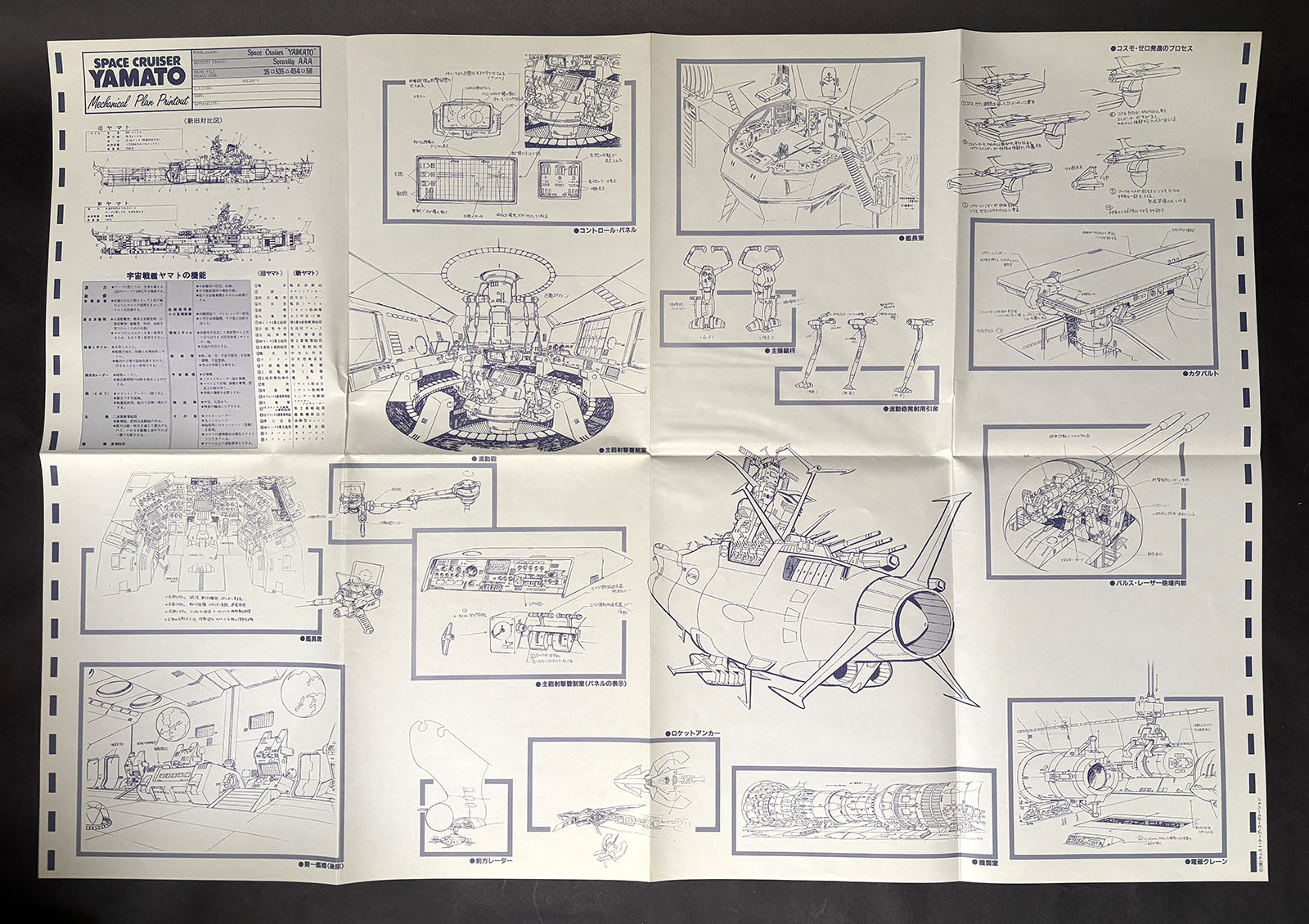
…and then unfold this huge 22″ x 32″ poster with internal mecha design drawings, many of which were done for Final Yamato.
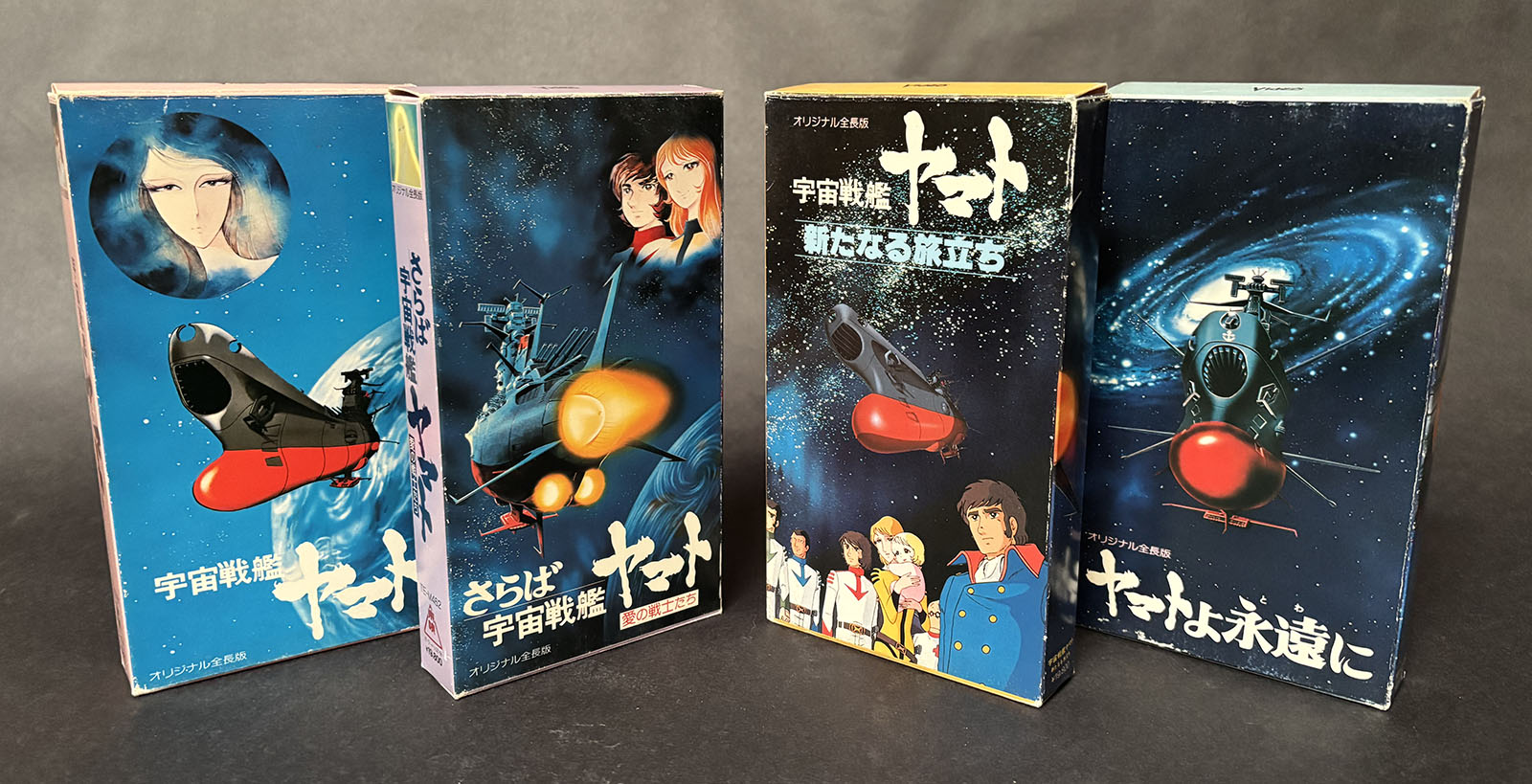
As with Yamato publishing, multiple companies were involved in releasing these new products. Toei Video Entertainment was in the lead with four simultaneous releases on both VHS and Beta.
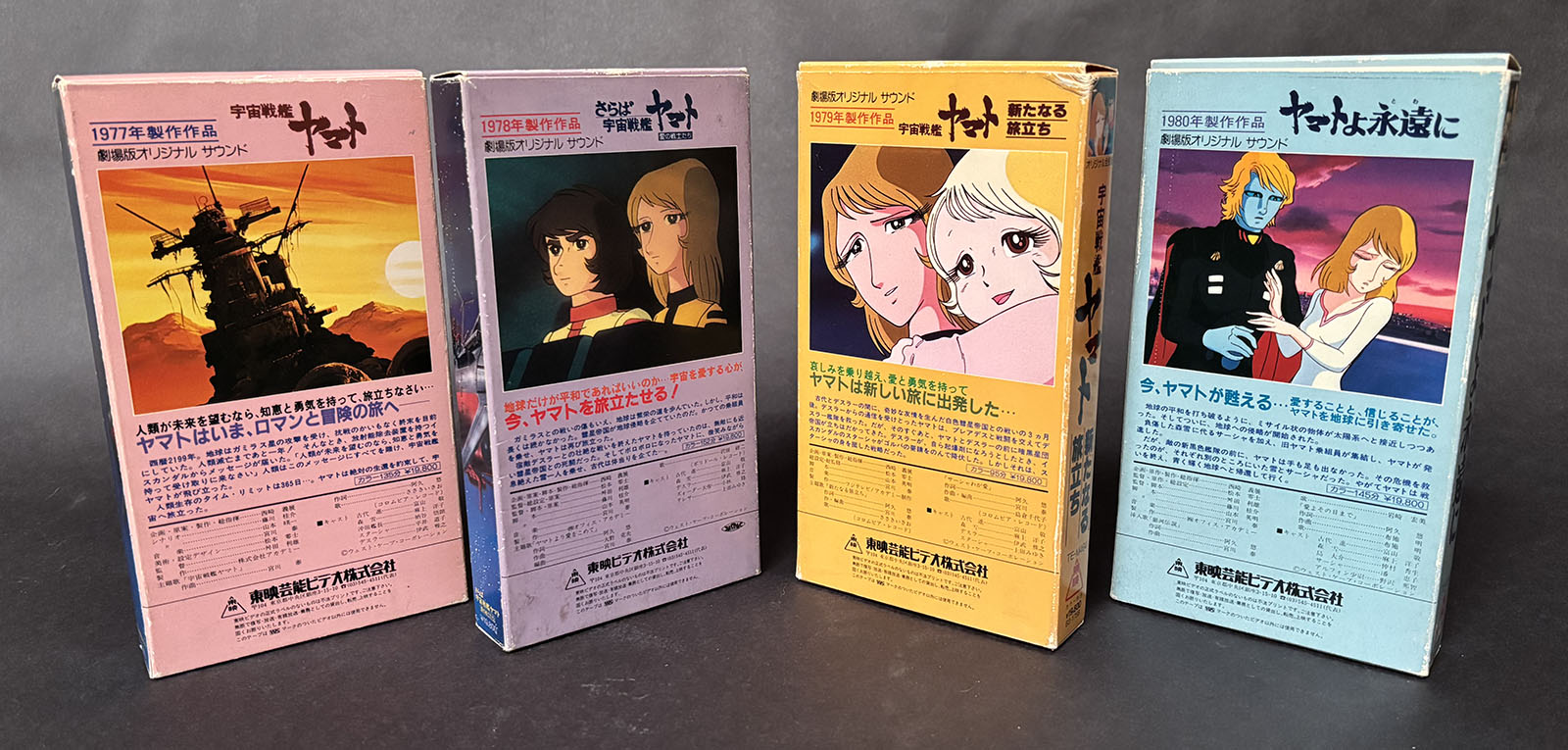
They were promoted as “uncut,” differentiating them from TV broadcasts that deleted content to fit broadcast time. The most recent broadcast of Be Forever, for example, had cut the attack on the Dark Nebula supply base.
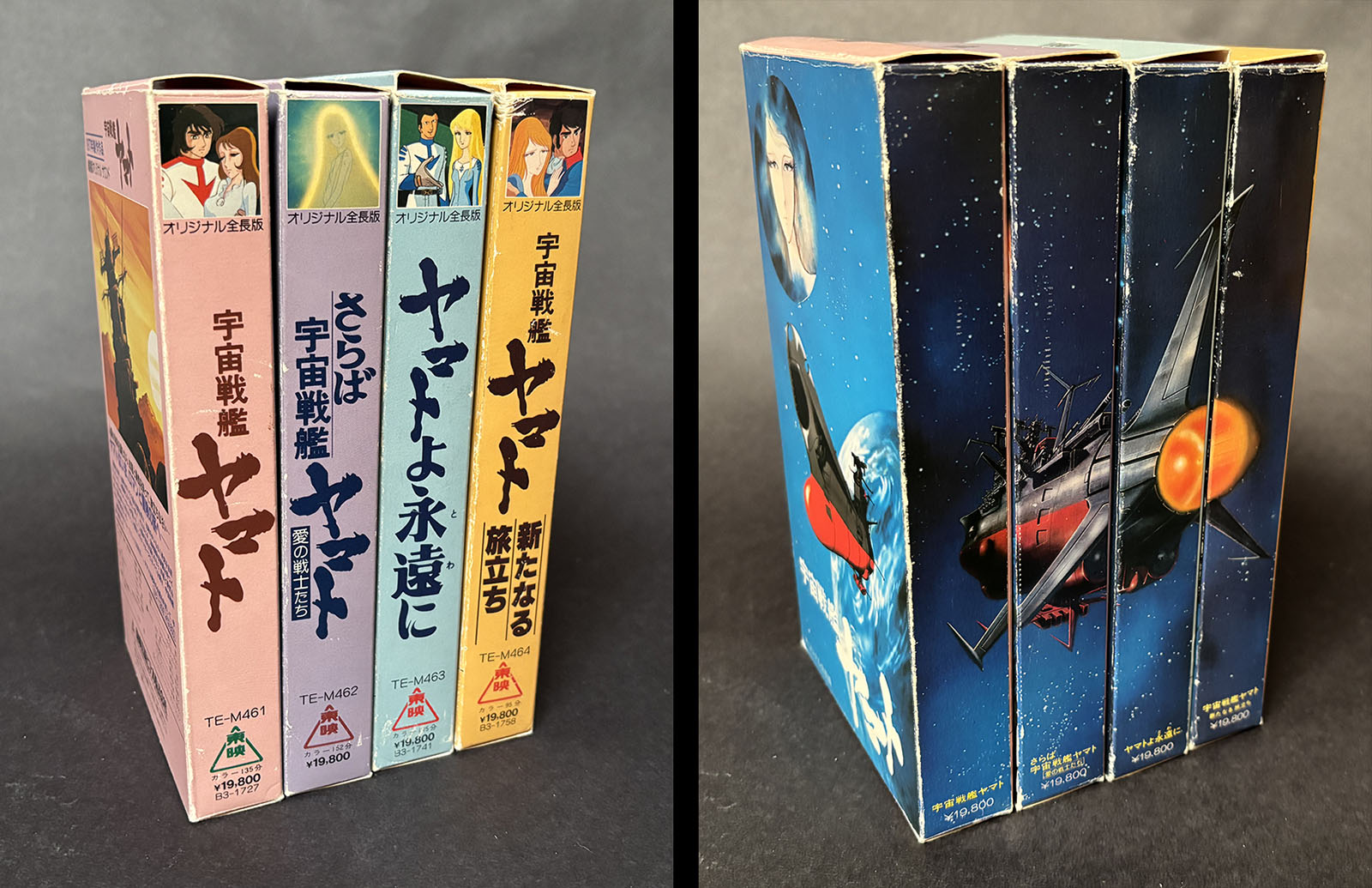
Unexpected bonuses were songs added to the first movie and to Be Forever that played without visuals, and a FOMO-driven spine image that would appear when all four tapes were lined up on a shelf.
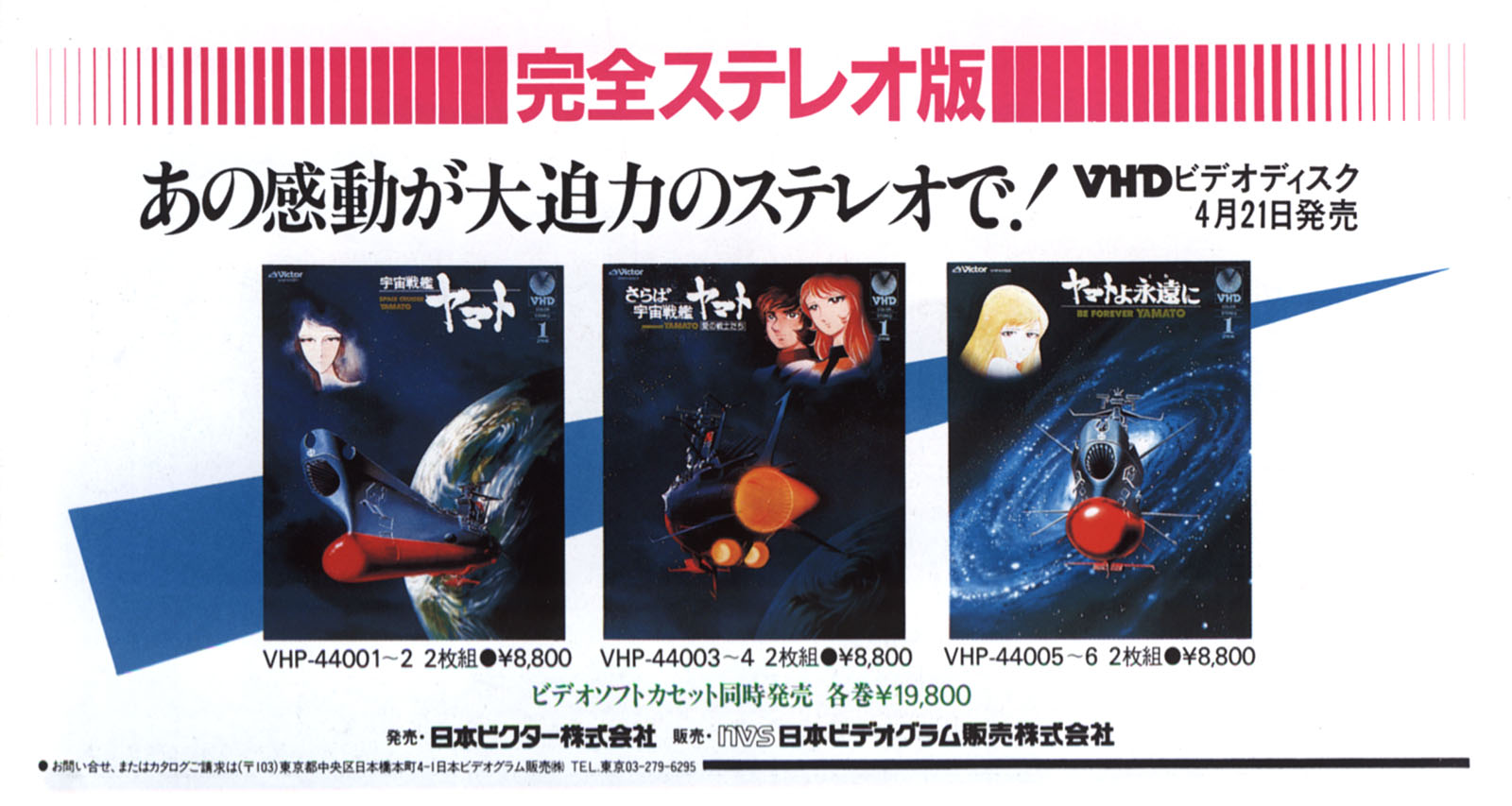
Next up was Japan Victor, who landed the rights for the movies on VHD (Video High Density) format. This was an analog video disc that could store up to 60 minutes per side, marketed by JVC in Japan. Unlike laserdiscs, VHDs were read with a physical stylus like a record player. April 21 was literally the first day this format was available to consumers, which placed the Yamato movies on the cutting edge of what was hoped to be a new wave of home electronics.
One specific advantage they had over VHS was stereo capacity, which was a major selling point in the ad shown above (from the Final Yamato program book). Up to this point, the only stereo sound that had been heard in theaters was the latter portion of Be Forever and all of Final Yamato. Nevertheless, Victor advertised stereo sound for all three of these releases. In fact, pseudo-stereo processing was applied to the original monaural recordings and minor changes were made. Differences in mixing and timing can be found, but the basic music configuration was the same.
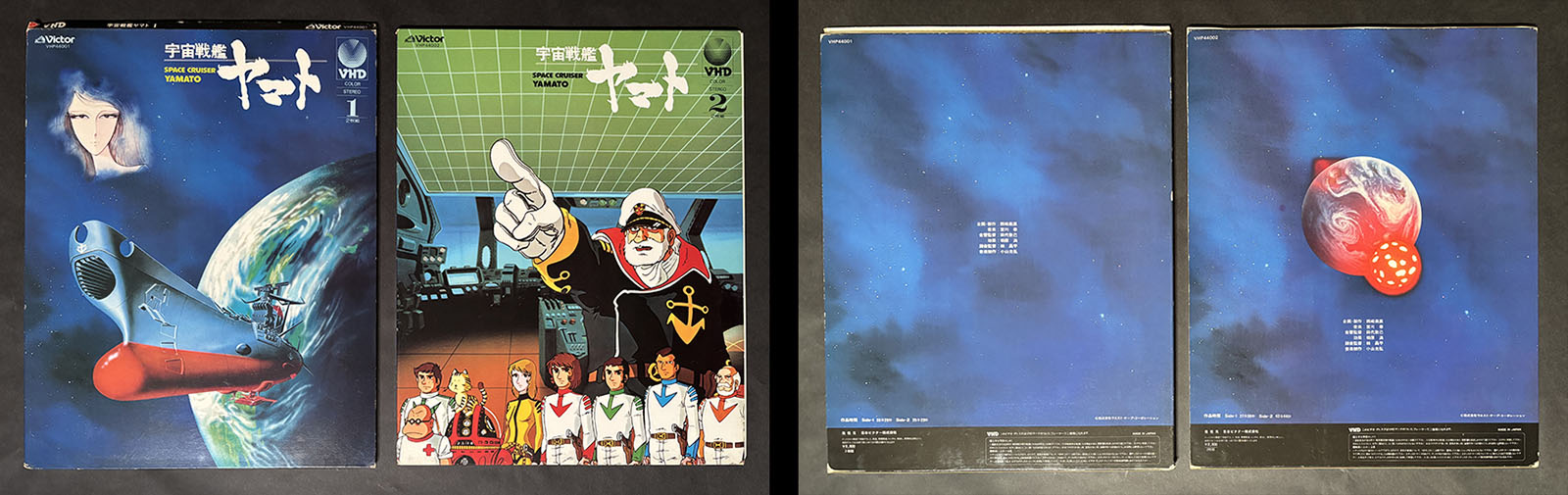
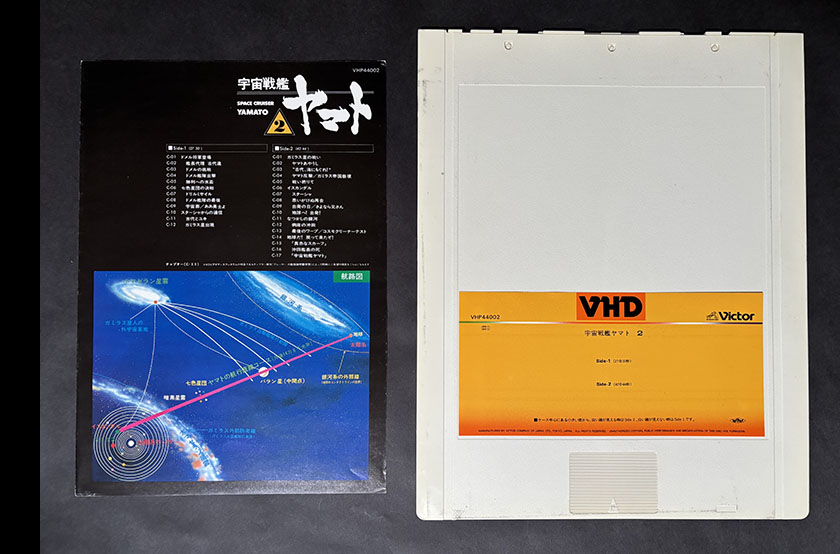
Each movie required two discs with two sides of content that came in a large caddy measuring about 10″ X 13″. The disc would be protected by the caddy, which would slide into a player. You’d insert the caddy and pull it out, leaving the disc inside. You’d play side A, then insert the caddy again to grab the disc and flip it over for side B.
The presence of a physical stylus touching the disc subjected VHDs to the same conditions as an LP record, leading to skips and dropouts as the product aged, and freeze frames were not possible. VHDs had the capability to be more interactive than other video formats, especially in the realm of video games, but the cost challenges ultimately doomed VHD to the consumer graveyard.
Read more about VHDs at Wikipedia here
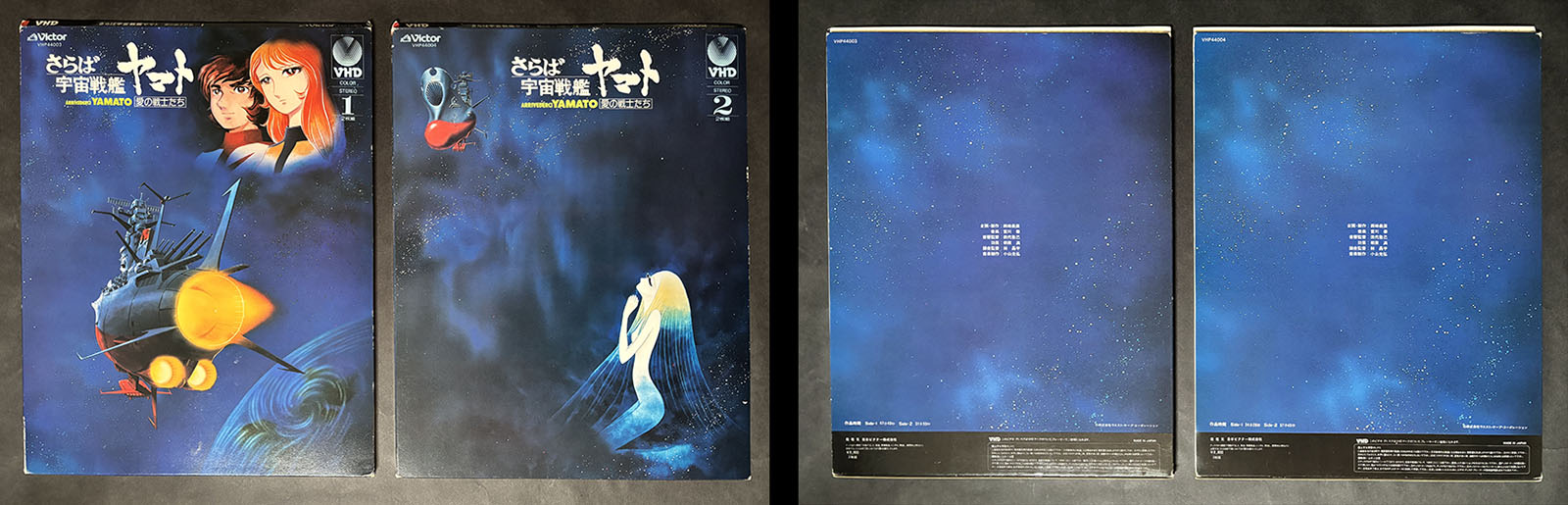
Japan Victor only had three of the Yamato movies in 1983: the first one, Farewell, and Be Forever. The New Voyage and Final Yamato would follow two years later.
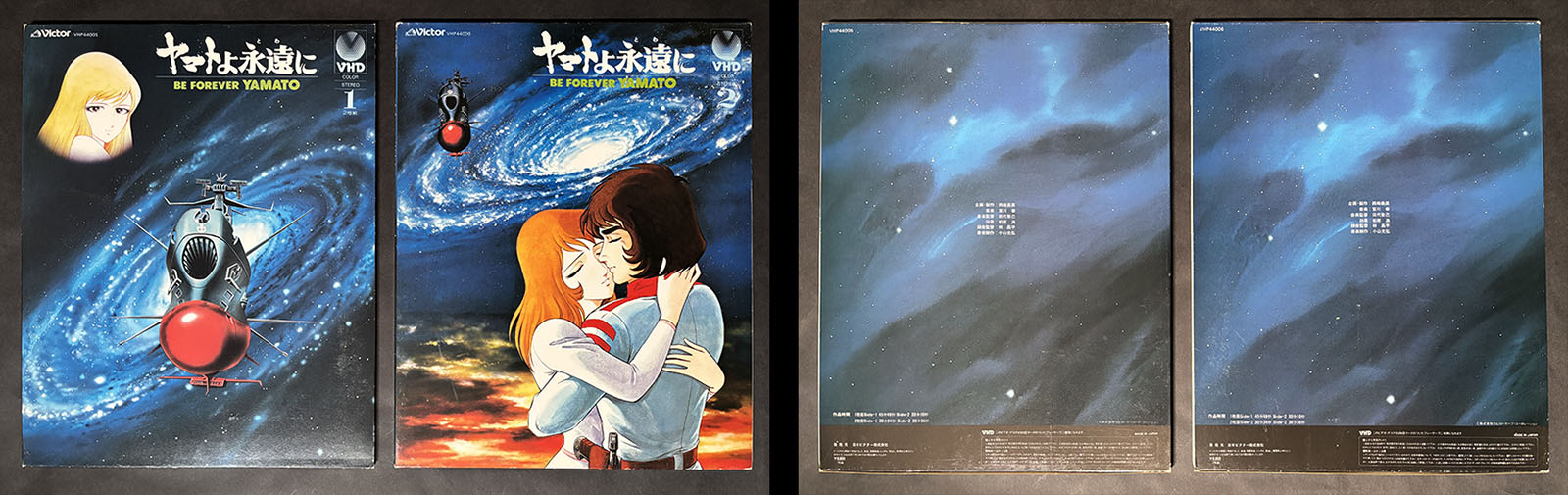
The art that adorned the second volume of Be Forever seemed unique, but was actually derived from the 1981 Be Forever wall calendar. Similarly, cover art the second volume of Space Battleship Yamato came from the 1982 calendar.
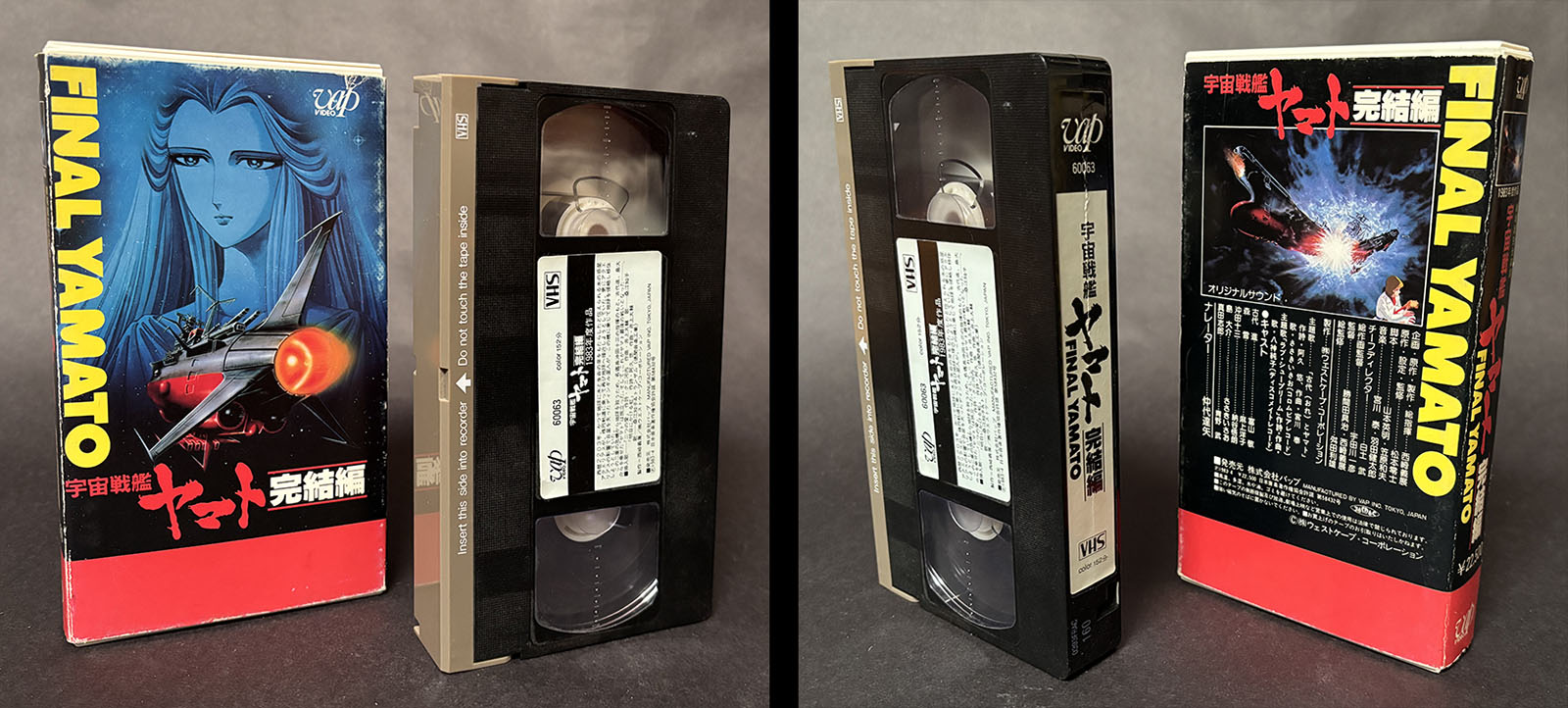
The last release was quite a surprise; the first VHS/Beta release of Final Yamato at a time when it was still playing in theaters, though this version did not preserve the stereo sound. The licensor was VAP (full name Kabushi Gaisha Video Audio Project), which had been founded in 1981. A subsidiary of Nippon Television, the company would find great success with anime on home video over the next several decades and is still around today.
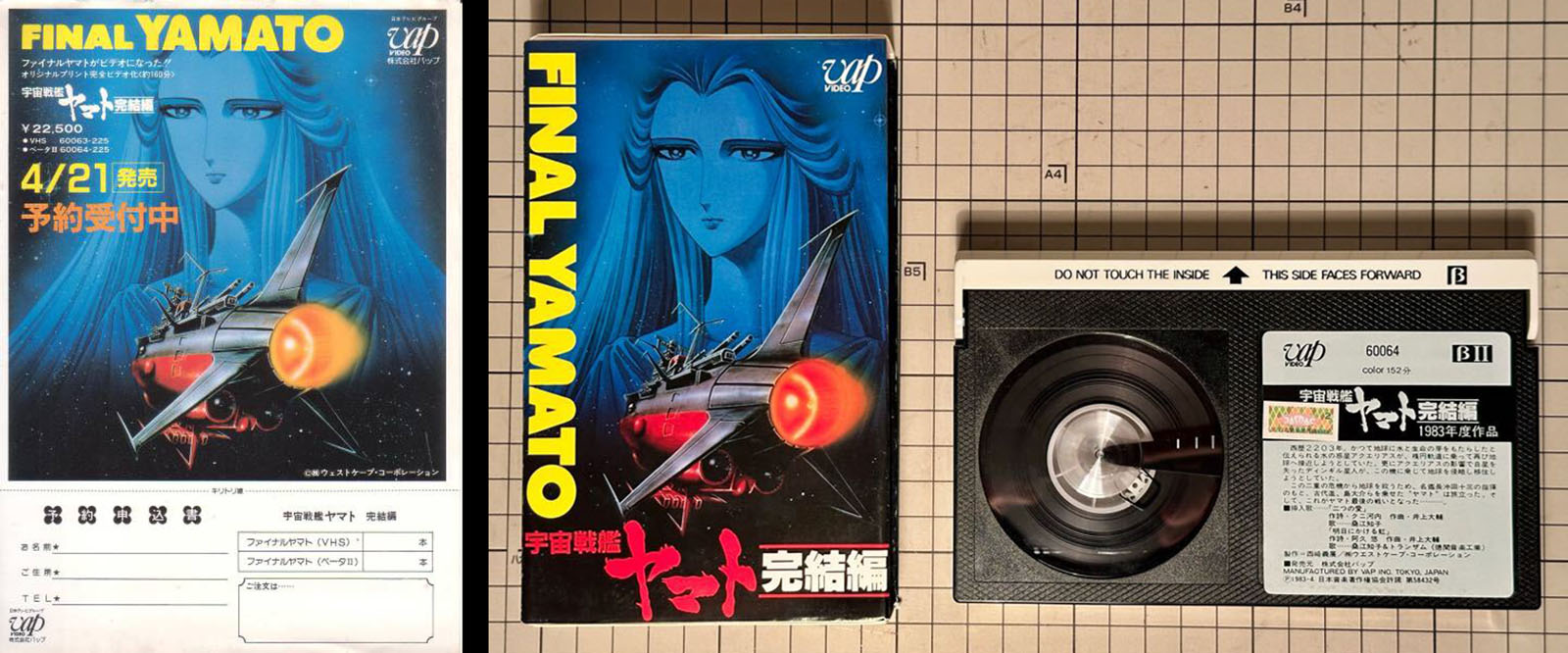
What makes the VAP release special, especially today, is that it was the only tape to preserve what is now called the “35mm version” of Final Yamato. This was the film seen in theaters at the time, up to and including the infamous “epilogue” scene that Yoshinobu Nishizaki had ordered struck after opening day. It is also the only home video version that preserves the original 3X4 picture, which was destined to be altered. (Keep reading)
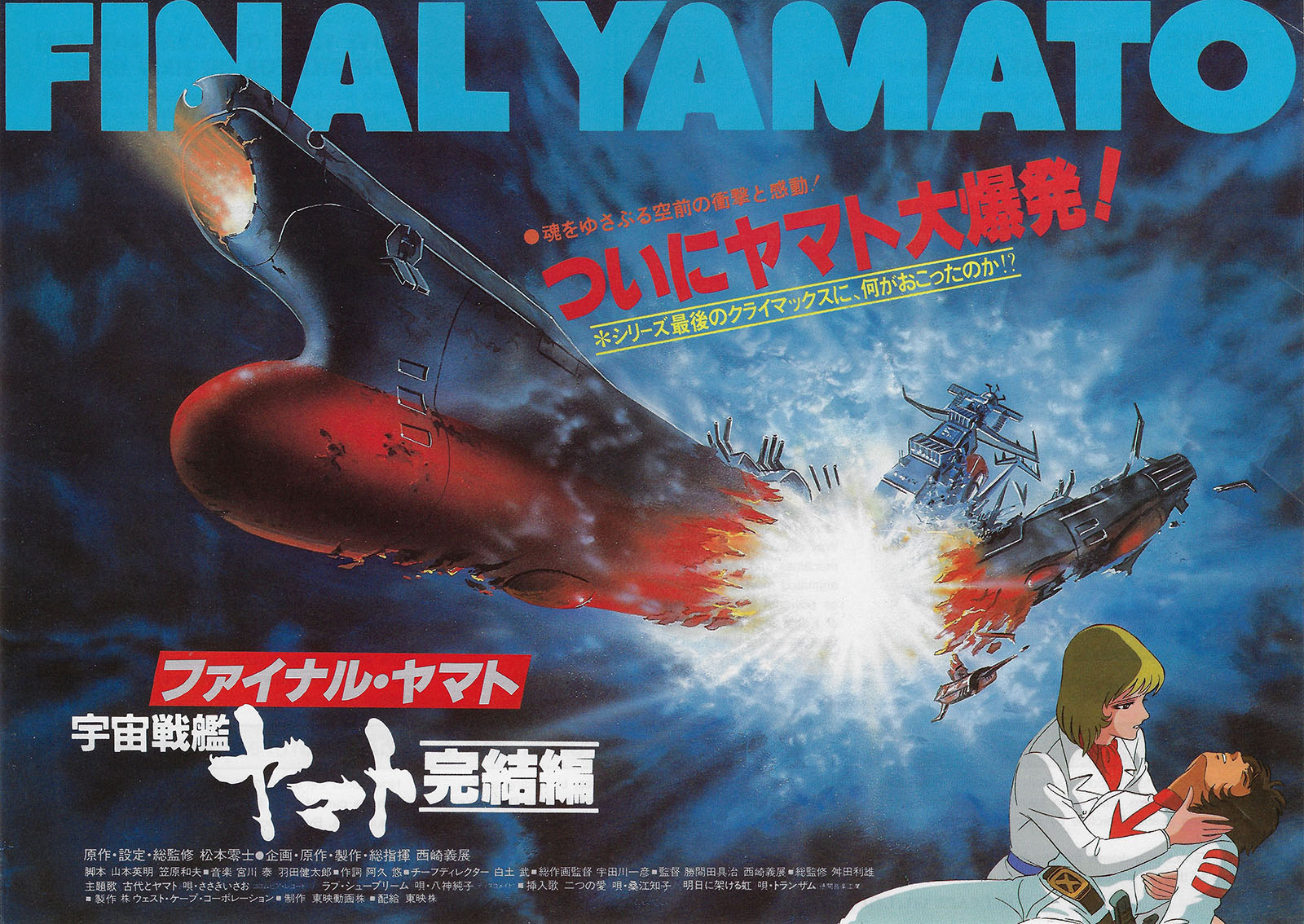
April 22: Final Yamato “Complete Edition” press conference
Just one day after the home video blitz, a surprise came from Yoshinobu Nishizaki. He’d never avoided a media opportunity for previous movie premieres, but had been uncharacteristically silent since the rollout of Final Yamato. Today everyone learned one reason for that.
Members of the entertainment press were invited to a conference in which Nishizaki apologized for the “unfinished” version of the film that had been released in March and proclaimed that he was putting it back into production. Scenes would be corrected, restored, and upgraded to 70mm and a new sound mix would be engineered to the multi-channel stereo experience he’d hoped for.
The new version of the film would be released in the fall, called the “Complete Edition.” This, of course, would give everyone something to report over the coming month…
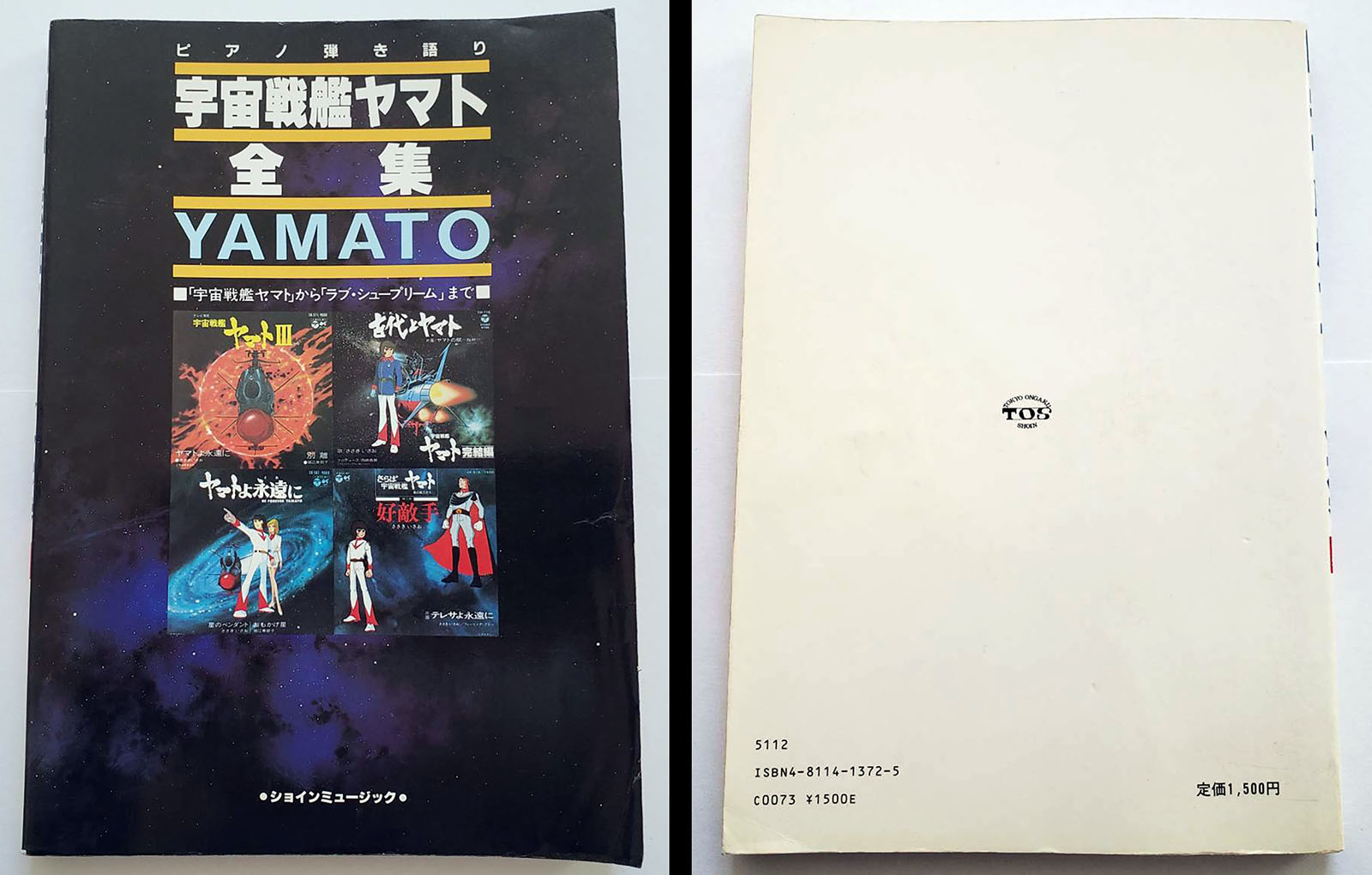
April 25: Piano and Vocal Performance, Space Battleship Yamato Complete Collection
Tokyo Ongaku Shoin [Music Study] published the most comprehensive sheet music book to date, a 250-page whopper that contained piano compositions for 17 songs and 28 BGM tracks with several from Final Yamato appearing for the first time. This and many other music books can still be found from second-hand sources today, but always command high prices.
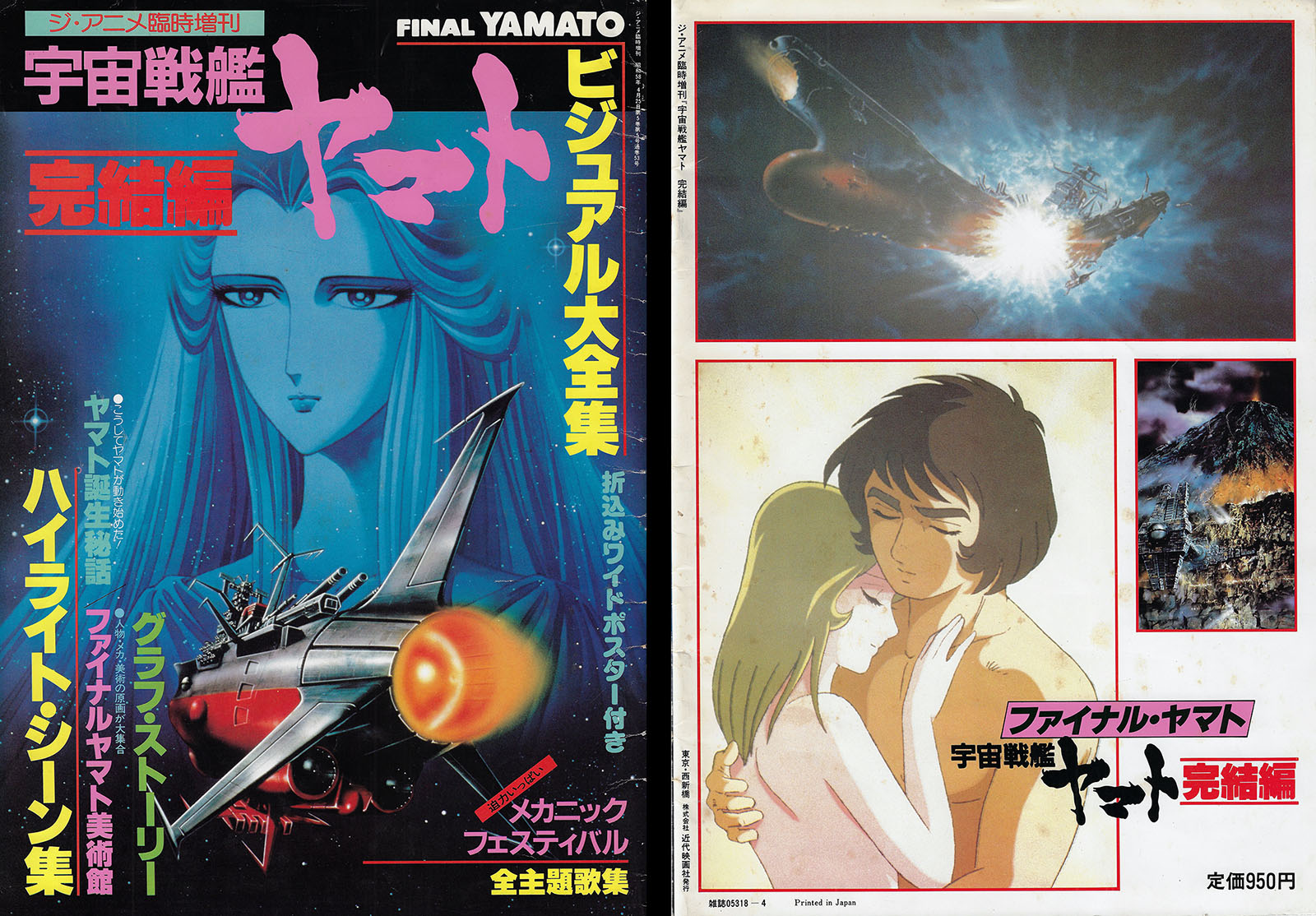
April 25: Final Yamato Visual Big Compendium
This tabloid-format spinoff special of The Anime magazine opened with large-scale highlight scenes and moved through a photostory of the film. Also included were model sheets in color and monochrome, a look at the original concepts for Yamato, and sheet music for the songs from Final Yamato. At 10″ x 14.5″ it was the largest Final Yamato publication to date.
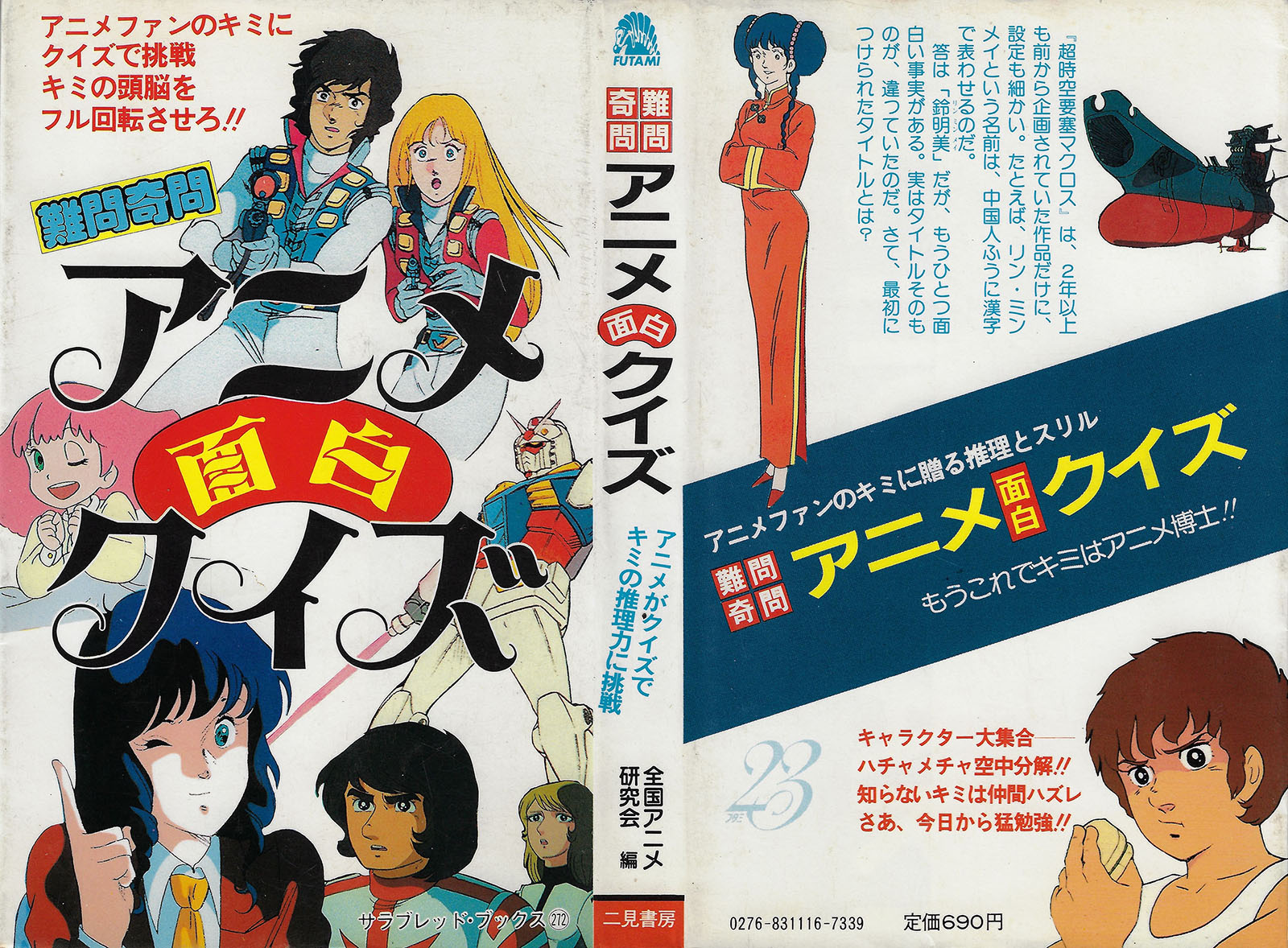
April 25: Anime Fun Quiz book
At just over 250 pages, this paperback from Futami Books was denser and more wide-ranging than a previous one published the year before by Sonorama. Questions were grouped by categories from heroes, heroines, robots, and mecha to anime staff members, production techniques, and history. This even stretched to the ancient origins of art depicting movement and the etymology of “animation” itself.
Yamato came up in many of the categories, and one particularly interesting question asked readers to identify its name in the USA. They also observed the fact that Star Blazers had attracted its own adult fan club.
Chock full of illustrations, diagrams, puzzles, and more, this book was more than just a trivia test, making an effort to educate the reader about the subjects in a very engaging format. Definitely worth the paper it was printed on.
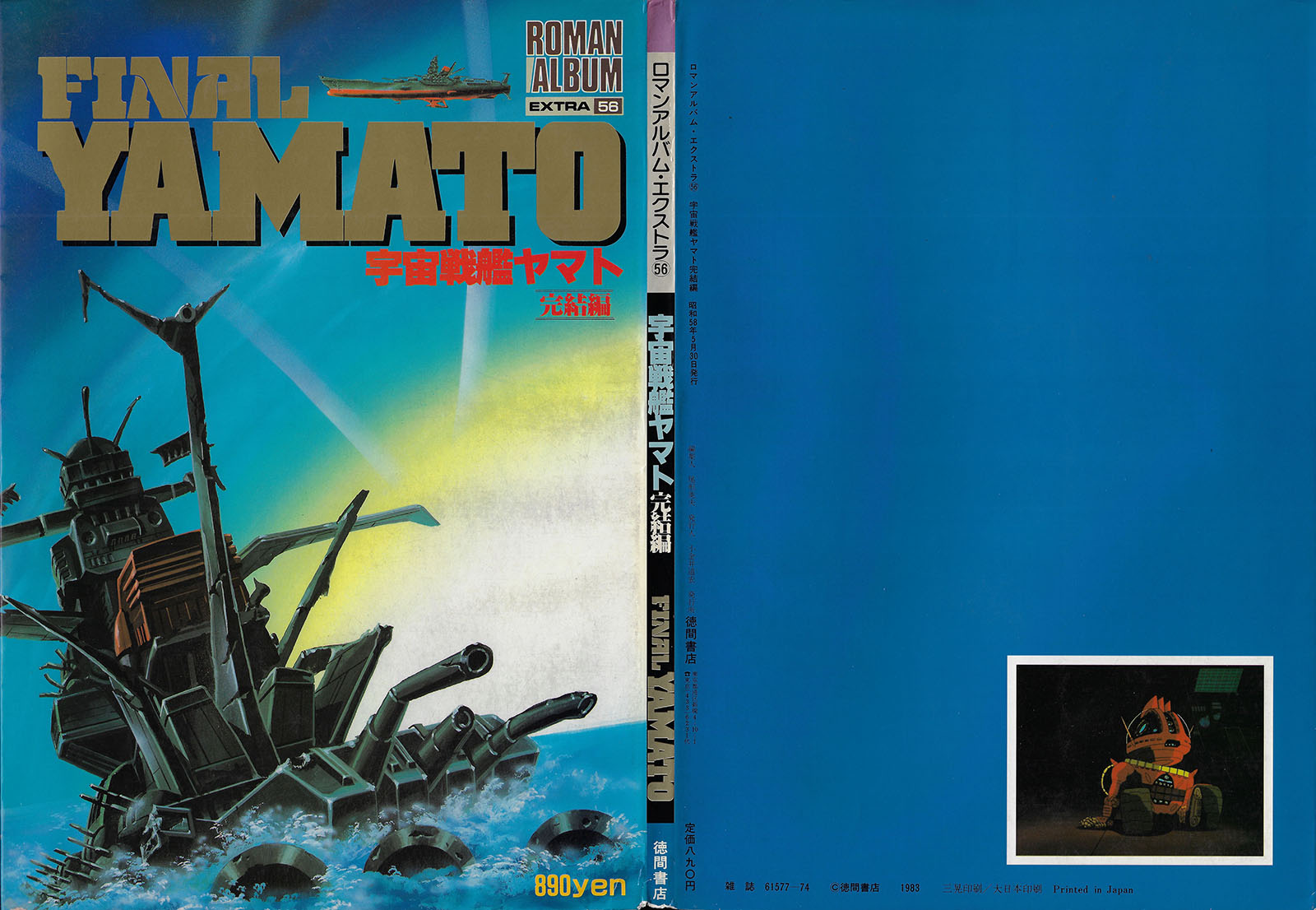
April 28: Final Yamato Roman Album
The last Yamato Roman Album carried Tokuma Shoten’s standard as high as it had always been, second only to the work of Office Academy/West Cape Corporation. The formula was well-worn by now; photostory, highlight scenes, art galleries, model sheets, and production notes. But the quality and completeness, not to mention the stunning cover image and a huge collection of Yoshinori Kanada’s concept sketches, made certain that the only Final Yamato book to surpass this one would be the Super Deluxe hardcover published by West Cape six months later.
Read translated content from the Roman Album here:
Producer’s message
Staff comments
Assistant Producer’s production notes
Voice actor comments
April 29: Final Yamato closes in theaters
The last week of Final Yamato‘s theatrical run was symbolic of what was to come. During that week, if you had the financial resources, you could buy it on VHS or Beta and watch it at home. And if you had access to the latest Yamato news, you knew that another version of the film was coming. It was a signal that, when everything came to fruition, access to Yamato would essentially become unlimited. We all just had to wait a little longer.
April context
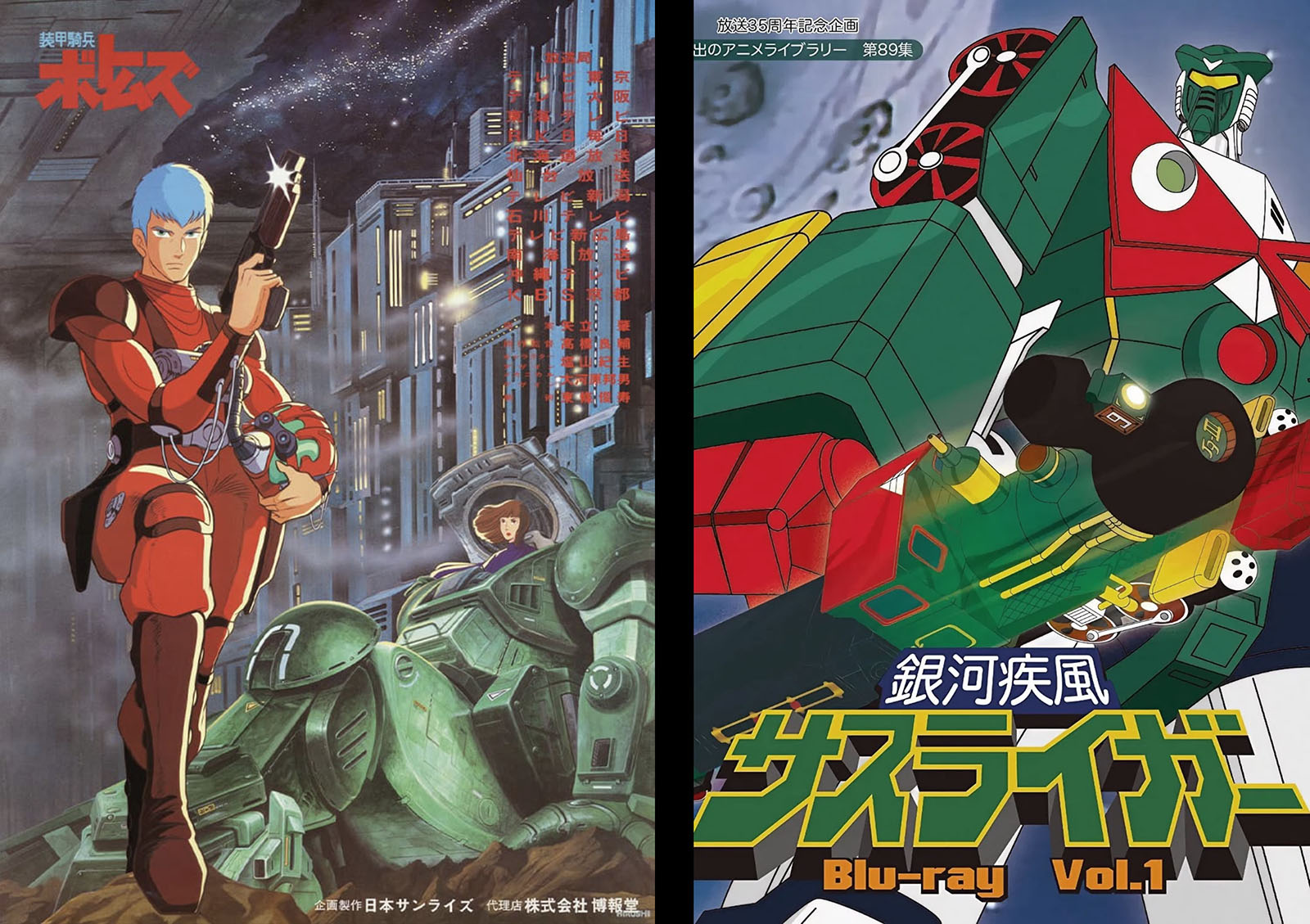
Two new SF anime series made their debut on Japanese TV. On April 1, Fang of the Sun Dougram gave way to an groundbreaking new mecha series by the same director (Ryusuke Takahashi) called Armored Trooper Votoms. It would go on to generate several multimedia spinoffs, and as these words are being written, a new anime series has just been announced for 2026. Read more about Votoms here.
On April 5, the third and last installment of the J9 series, following Braiger and Baxinger, rolled out with the name Galactic Whirlwind Sasuraiger. Its gimmick was a super robot that could transform into a space train. Read more about it here.
Anime magazines published in April


Macross and Dunbine both get another cover. New TV series Armored Trooper Votoms and Future Police Urashiman each get their first.
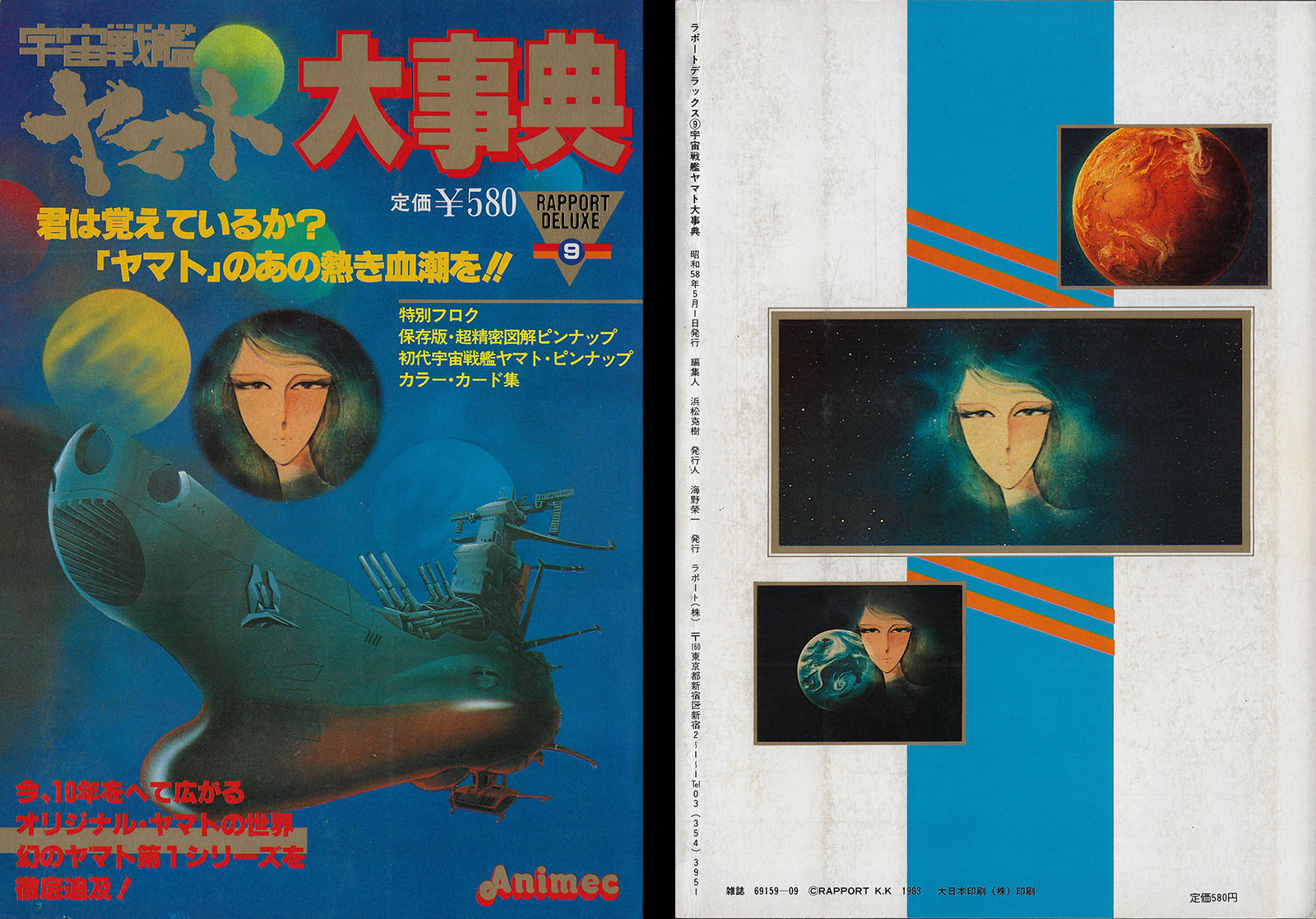
May 1: Space Battleship Yamato Big Encyclopedia
Rapport Deluxe special No. 9, Rapport
This was one of the standout books of the production years, a fantastic grab-bag of data on the Yamato saga in general and Series 1 in particular. Rapport KK was also the publisher of Animec, a hardcore otaku magazine if there ever was one, the editor of which was a former member of Yamato Association, one of the founding fan clubs.
The passion of the staff for their subject matter was obvious in the breadth and depth of their coverage. Highlights included sample storyboards from each TV episode, a timeline of events and trivia from the production years, and a round-table discussion with members of the fan clubs who were chiefly responsible for rescuing Yamato for all time.
Read their discussion here
By appearing at the end of the production years, the Rapport Deluxe special was the perfect bookend to 1977’s OUT magazine issue 2, where anime journalism was created by the very fans who participated in the discussion.
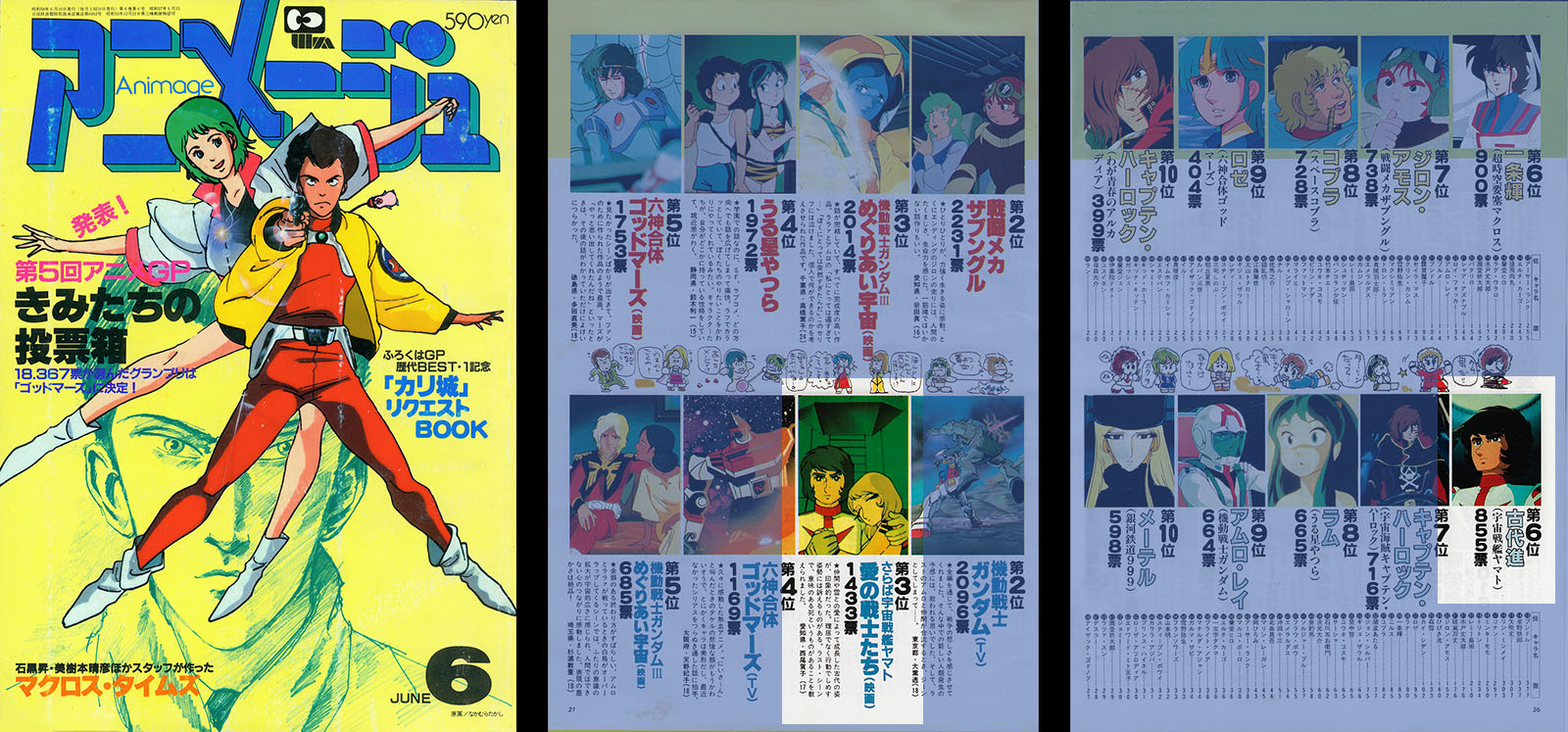
May 10: Animage Vol. 60
This issue’s top feature was the fifth Anime Grand Prix, an annual survey of readers’ favorites. In the “best anime” category, Farewell to Yamato came in third after Cagliostro Castle and Mobile Suit Gundam. Susumu Kodai ranked as the number six favorite anime character (Gundam‘s Char Aznable was number one, natch) and Isao Sasaki took the number one spot for favorite male vocalist.
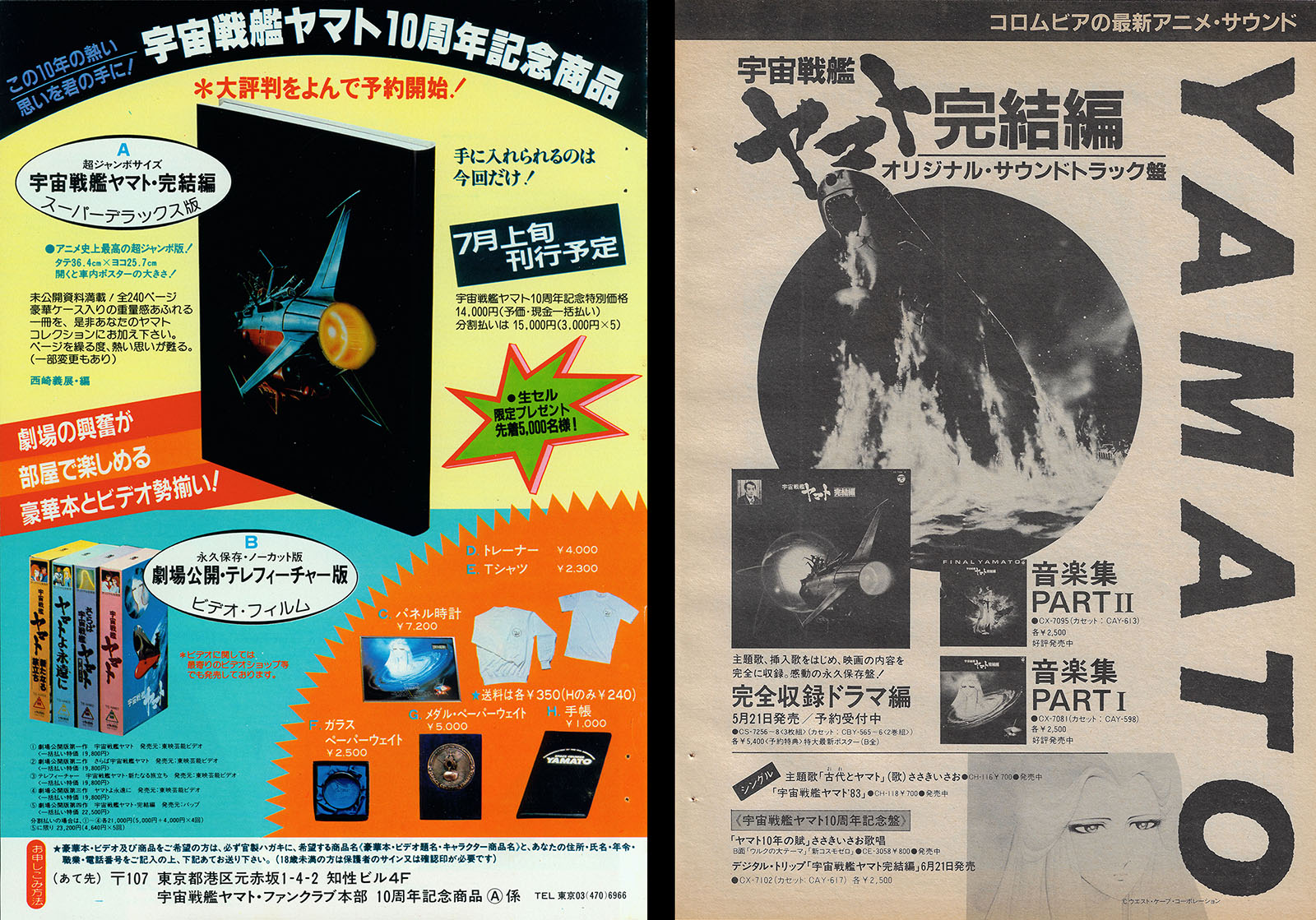
Left: Yamato fan club ad spotlighting the forthcoming Final Yamato deluxe hardcover
Right: Columbia Music ad with the first image of the Final Yamato Drama Album
There was no full-color article on Final Yamato, but there were several pages of ads for high-profile products, the first announcement of a surprising new Nishizaki project, and a collection of movie reviews (both pro and con) that gave fans the last word.
Animage had begun its coverage of Final Yamato in issue #49, published in June 1982. This one made it twelve consecutive issues totaling just over 70 pages of material, more than any other magazine. Fittingly, it was the last of them all.
Read the articles here
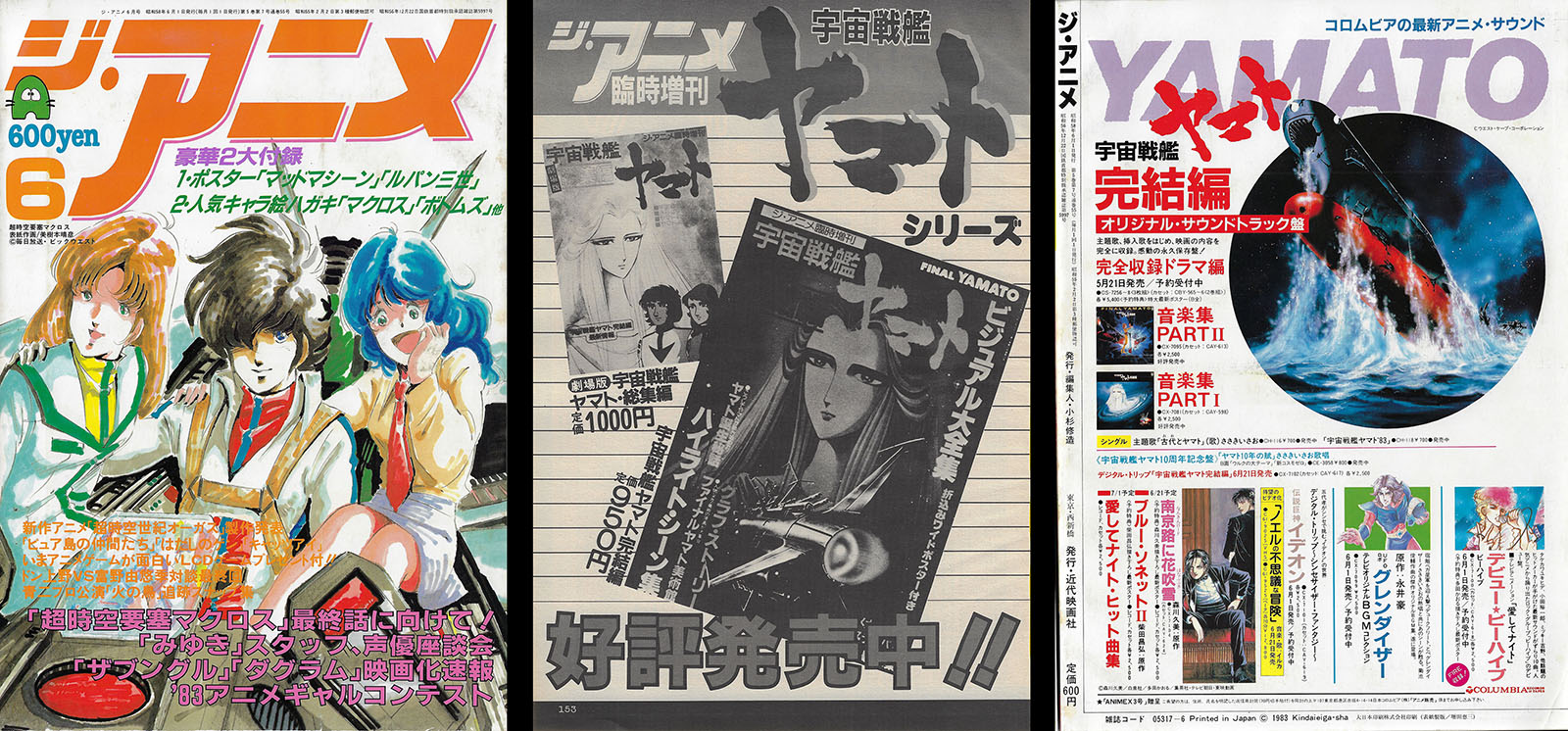
May 10: The Anime Vol. 43
There were no Yamato articles inside, but there were two prominent ads. In the center is a full-pager for both of the Final Yamato books published as The Anime spinoff specials. At right is another ad from Columbia that mentions (but does not picture) the upcoming drama album.
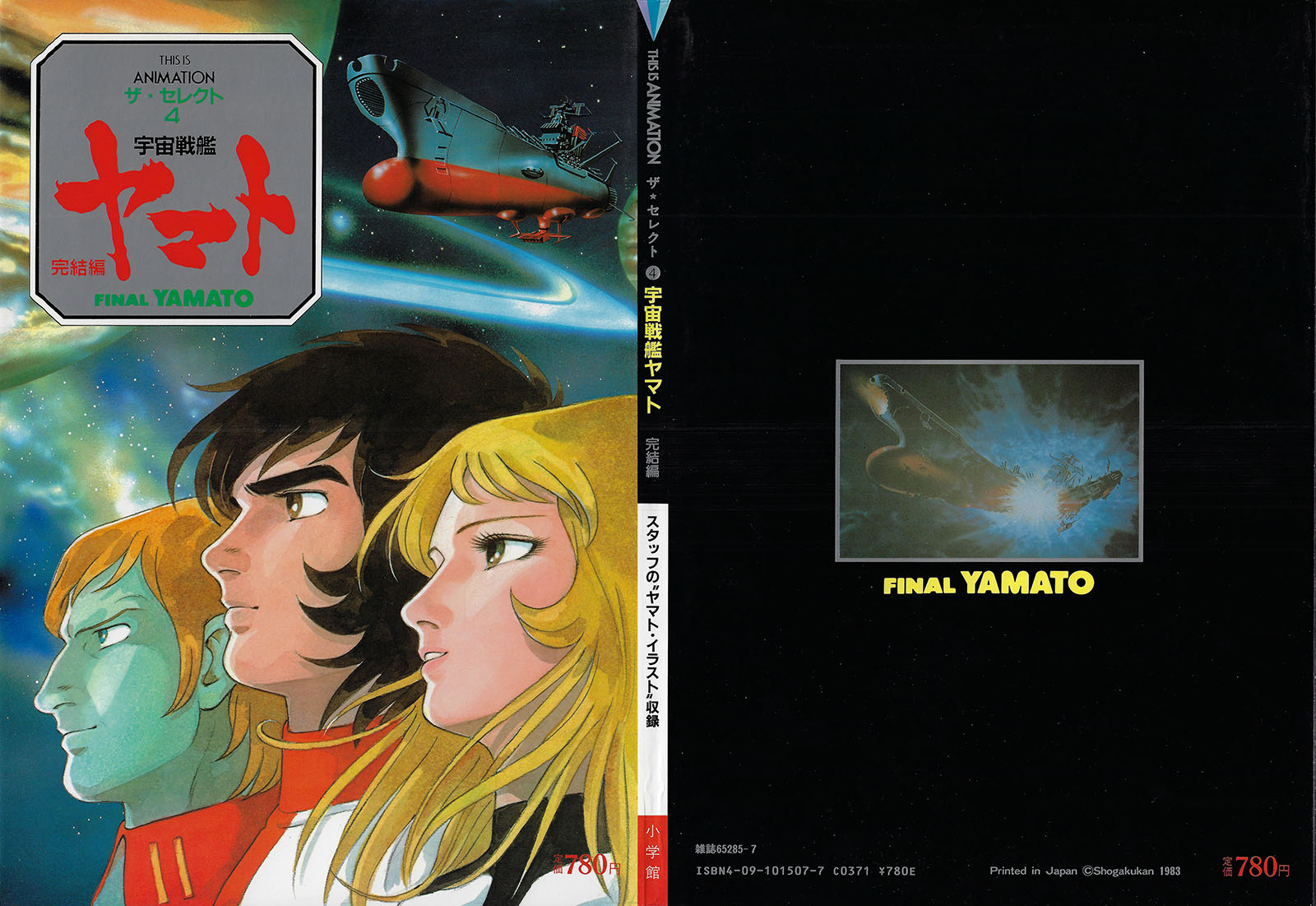
May 13: This is Animation, Final Yamato
“The Select” Vol. 4 was Shogakukan’s second This is Animation special devoted to Yamato; the first arrived in January ’83 and covered the entire saga up to that point. This volume was entirely focused on Final Yamato with original illustrations, a photostory, art gallery, and character & mecha model sheets.
“Dessler’s Story” continued its investigation with a text feature that incorporated Final Yamato and a look at Gamilas history & culture (read it here). This was followed by an interview with Yoshikazu Yasuhiko (read it here), a “cosmic history” overview (read it here), and some production notes.
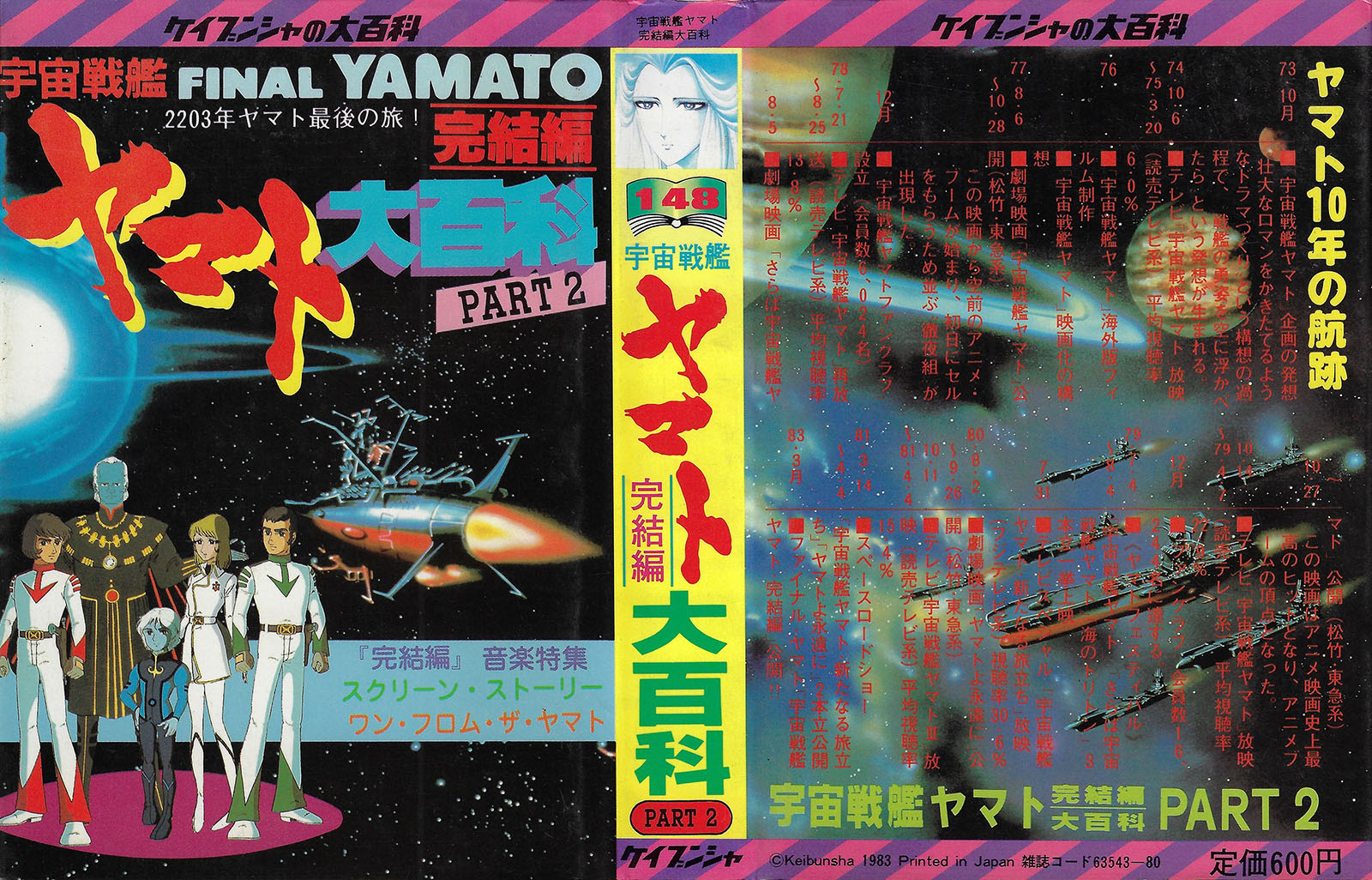
May 15: Final Yamato Big Encyclopedia Part 2
Part 1 of this digest-size volume in the Keibunsha series (Vol. 138, published by Kodansha) came out in February and was mainly a retrospective of the saga with comparatively little on Final Yamato (though it did leak the first half of the story). Part 2 (Vol. 148) made up for this with substantial coverage; the rest of the story was retold along with a section of fan messages, encyclopedic pages of characters and mecha, staff comments, and music notes.
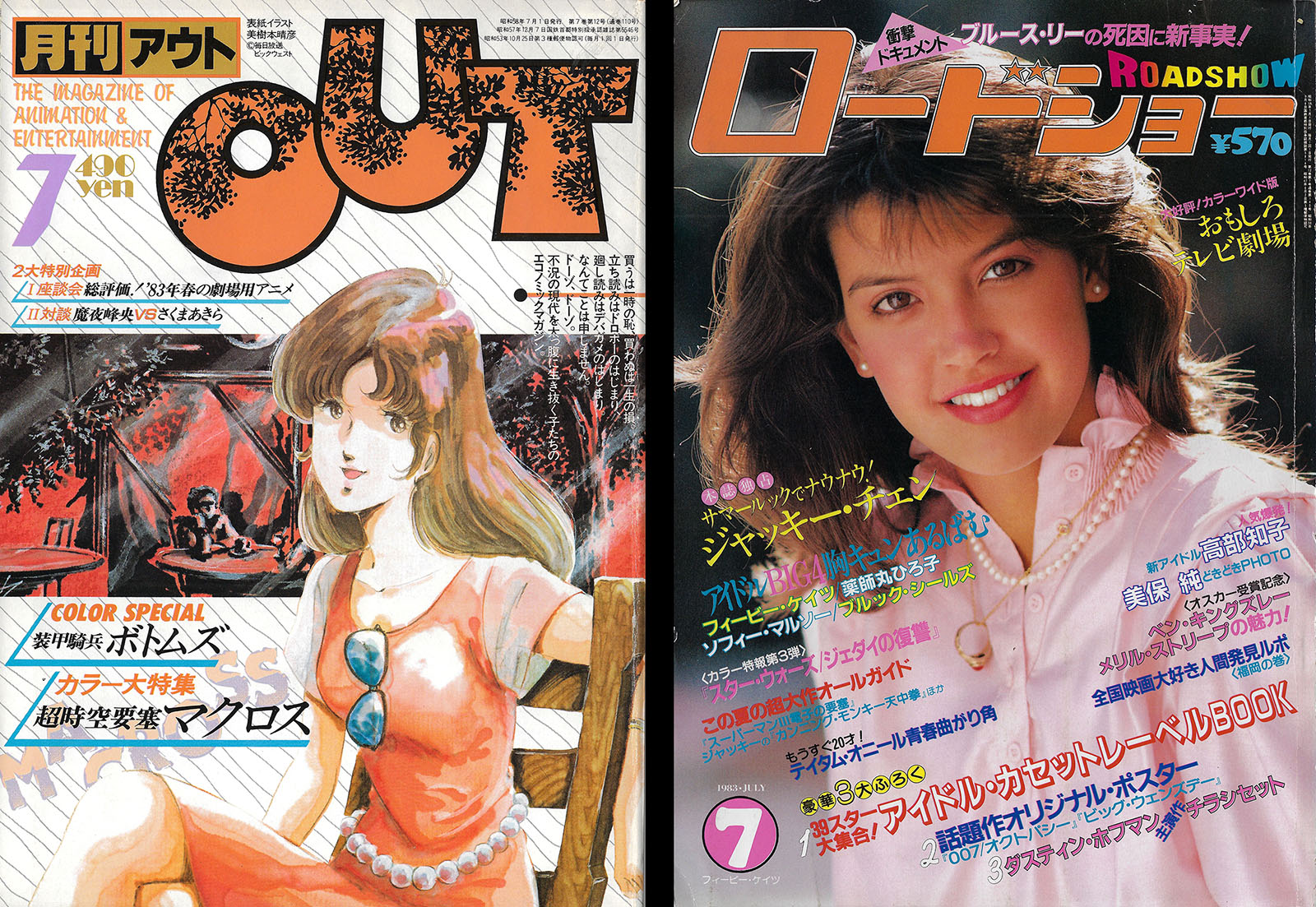
May 21: OUT and Roadshow, July issues
In any other month, the only thing these two magazines had in common were their publication dates. But this time, both reported on what they learned at the April 22 press conference for the “Complete Version” of Final Yamato.
Read their reports here
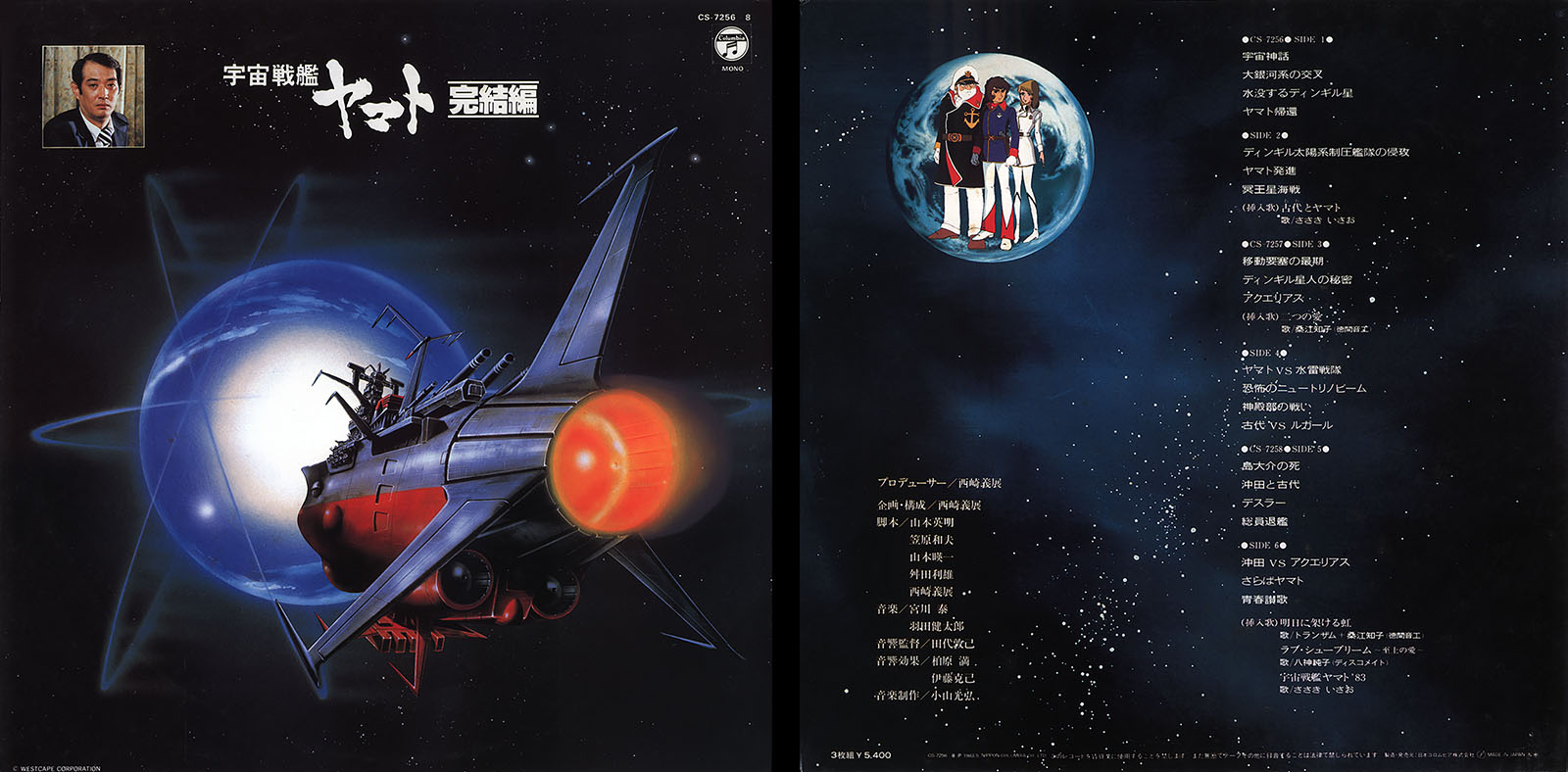
May 21: Final Yamato Drama Album
Like Be Forever, the drama album for Final Yamato was a three-record extravaganza that included soundtrack scores not heard on the symphonic LPs. It came with a 14-page color storybook and the photo of Yoshinobu Nishizaki on the front cover was yet another reminder that the Executive Producer of Yamato was nearly as famous as his creation.
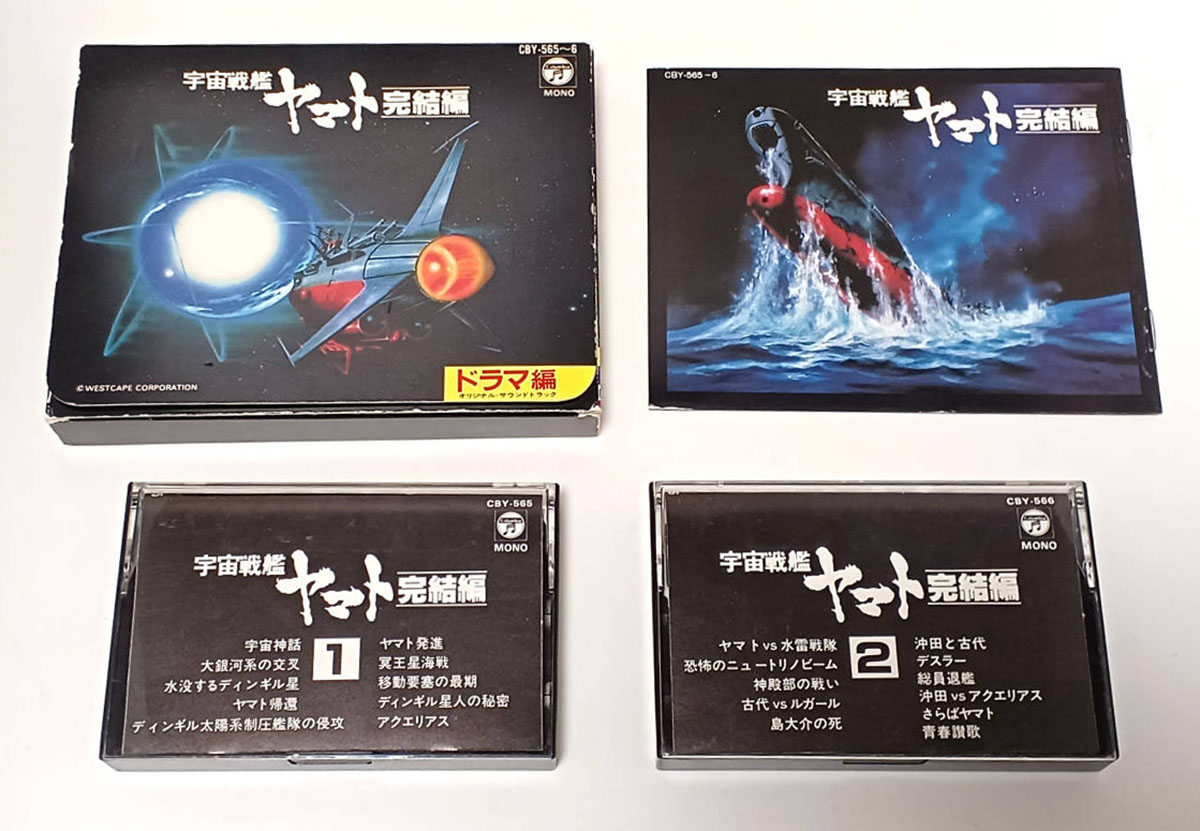
The cassette version was sold in a slipcase containing a booklet and two extended-length tapes with the same content as the LP.
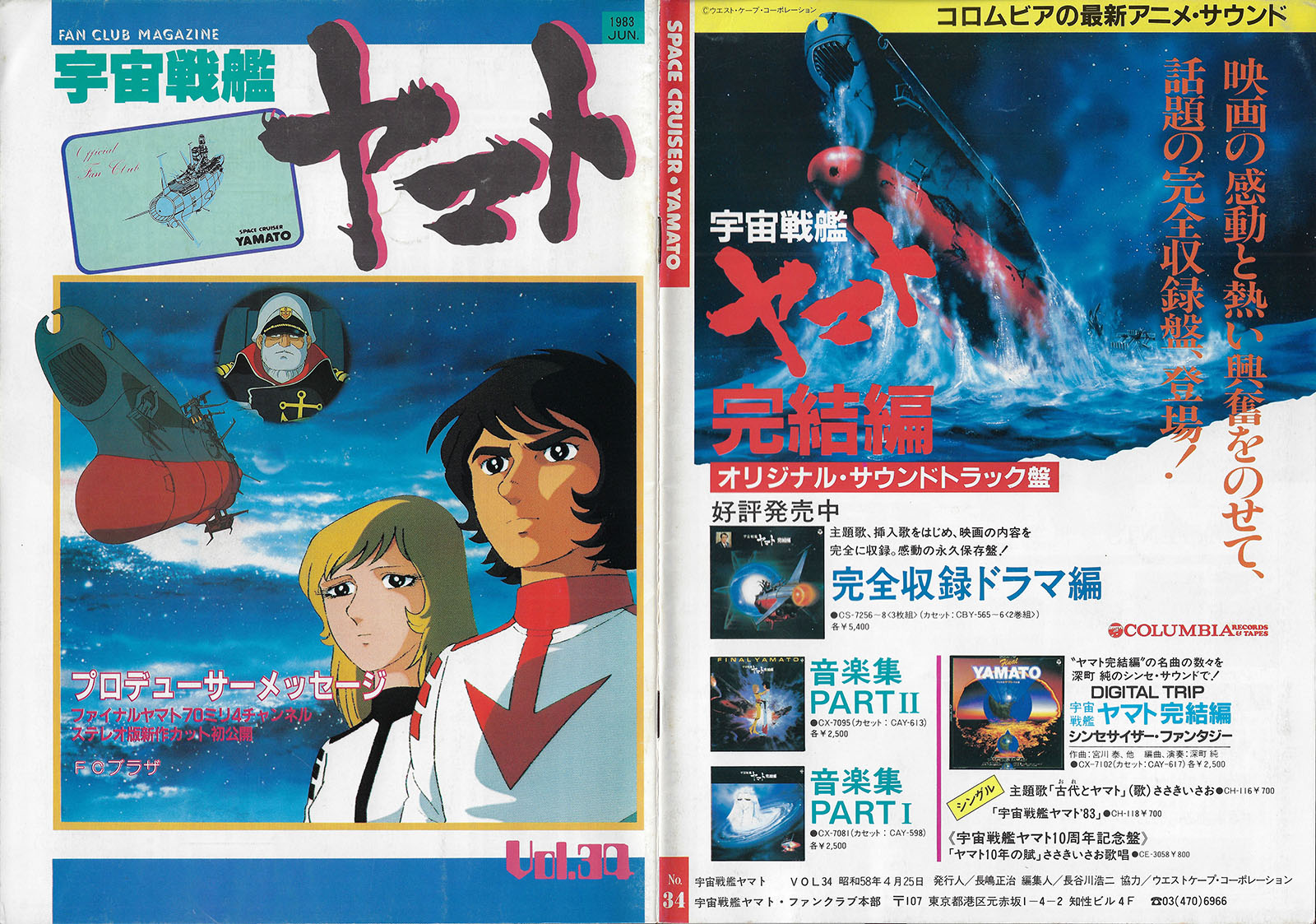
May 25: Fan club magazine Vol. 34
The latest issue opened with a 4-page message from Nishizaki about the making of the movie and featured his personal announcement about the 70mm “Complete Version.” He also shared his initial thoughts about what he wanted to do after Yamato was laid to rest.
This was followed by six pages of animation and storyboard art with short articles about fan reactions and more news of the 70mm upgrade. The rest of the issue (about half) was filled with fan art and chatter. The back cover (above right) gave us another ad from Columbia, including the forthcoming Final Yamato Digital Trip.
Read the articles here
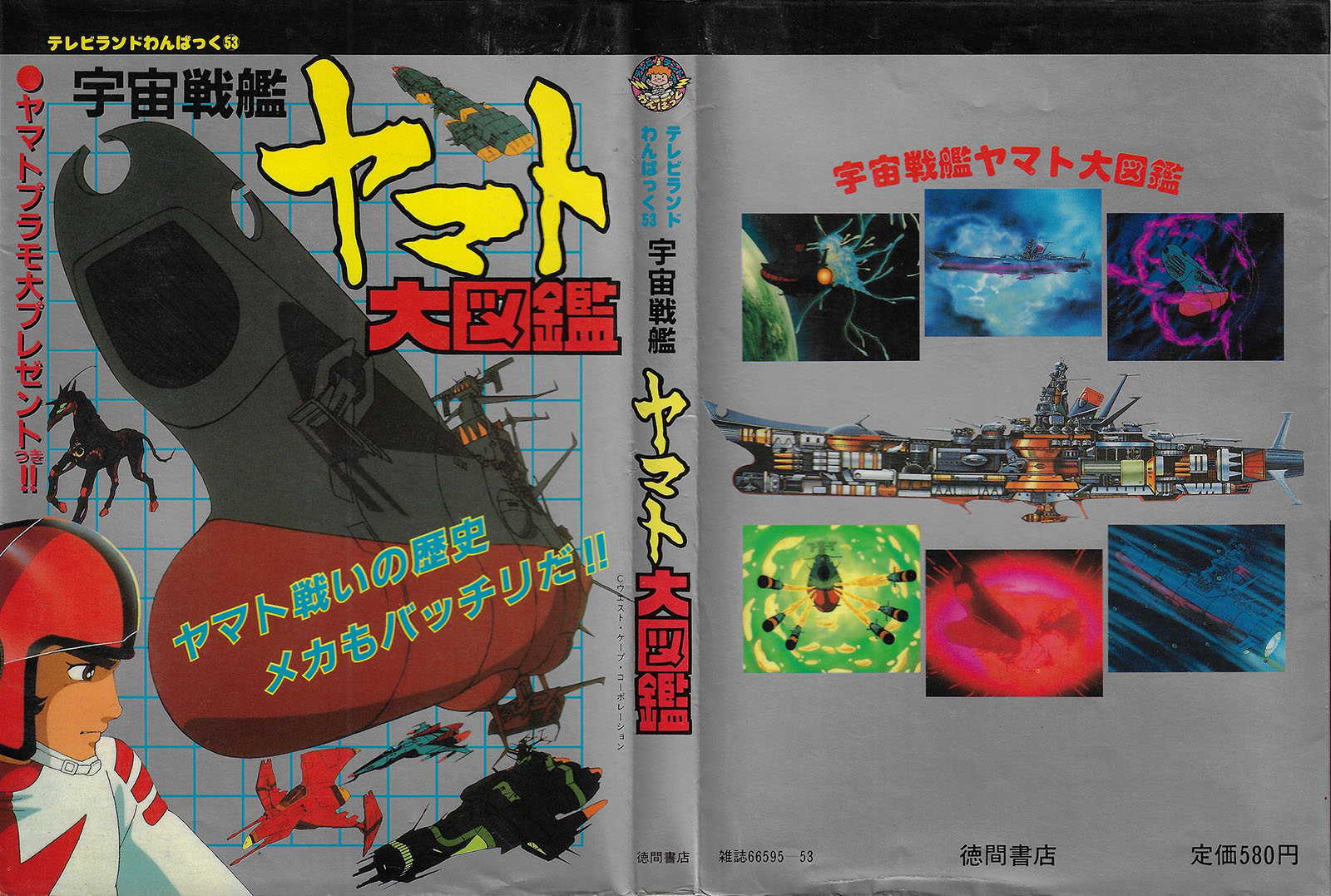
May 30: Terebiland specials
Terebiland magazine, published by Tokuma Shoten, had nurtured a relationship with Yamato all the way back in the days of Series 1, and the two had grown together in mutually beneficial ways. Their swansong took the form of two Final Yamato specials published on the same day.
Space Battleship Yamato Big Collection (above) was a guidebook to the principal characters and mecha of the entire saga and included some coverage of the Bandai model kits. The section devoted to Final Yamato was in full color; all others were in limited color or monochrome.
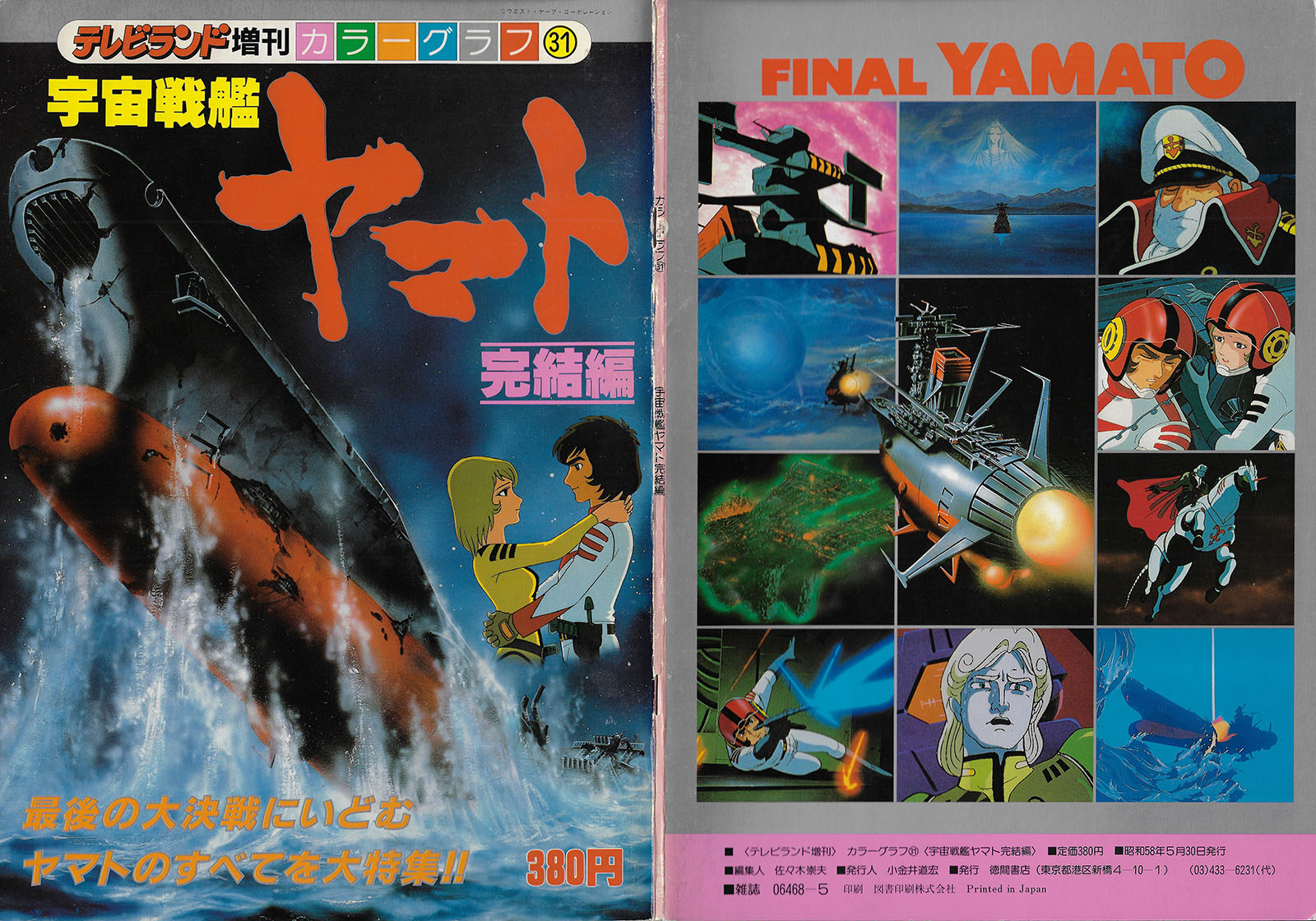
Terebiland “Color Graph” No. 31 was light on page count, but vibrant and colorful, and could have served as an excellent theatrical program book for younger readers. Its montage style of stills and paintings presented the highlights of Final Yamato with brief text.
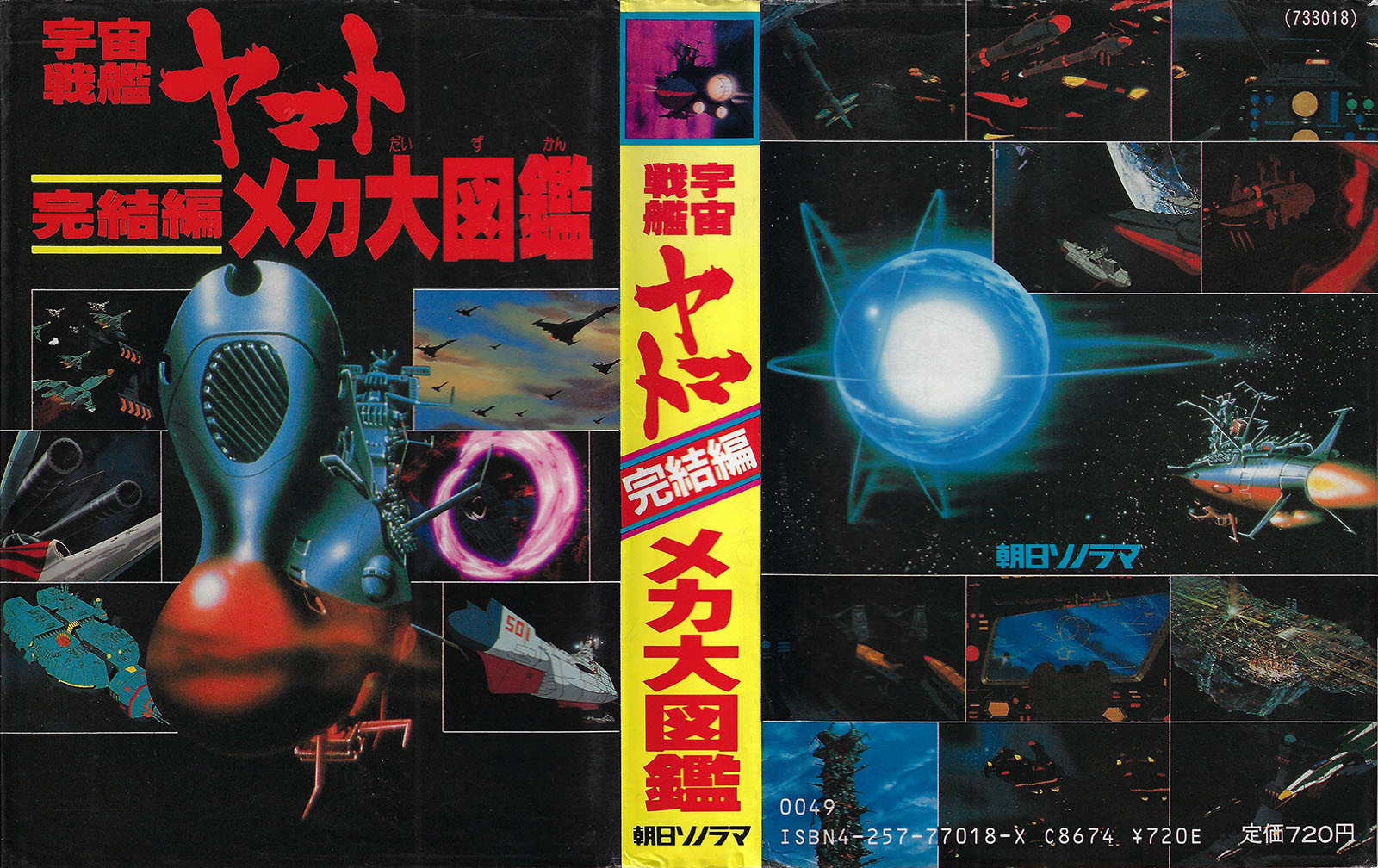
May 30: Final Yamato Mecha Big Collection
Published by Asahi Sonorama in the same format as Kodansha’s Keibunsha encyclopedias, this volume covered the mecha of the entire Yamato saga. A previous volume from 1980 did the same, but this time it was presented in black and white stills rather than a mix of stills and artwork. It included a 32-page color photo story for Final Yamato.
Anime magazines published in May


Macross scores an impressive four covers in May. Votoms and Urashiman get the other two.
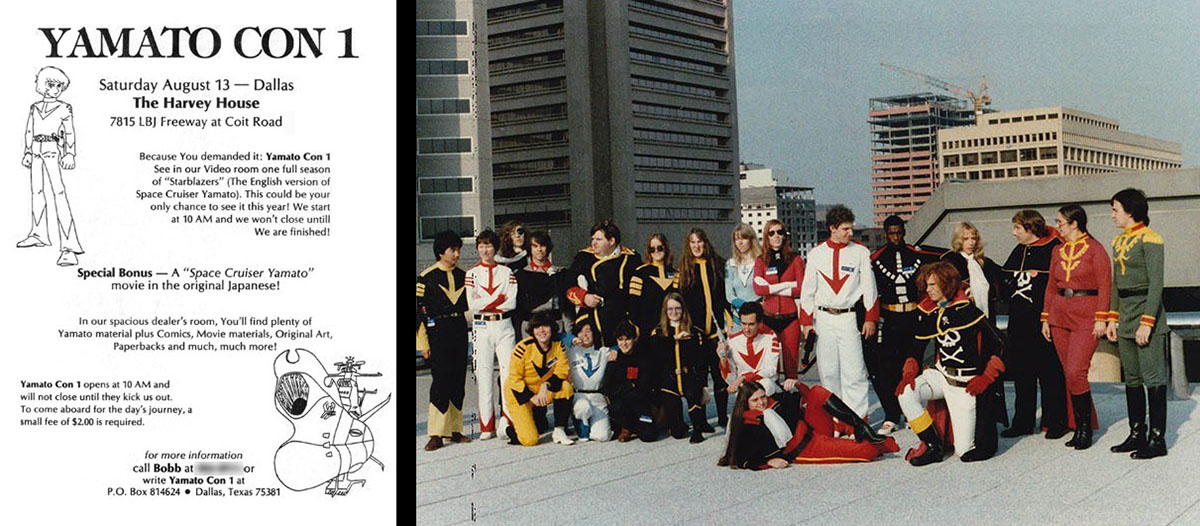
What’s next
Summer 1983 sees a slowdown in Japanese activity, but a ramp-up in the US with a record number of conventions making room for fans to plant the anime flag. See the beginning of a whole new wave in Vintage Report 46!
boy is this nostalgia lane seeing some of those magazine/book covers that started to seep into local comic book shops around that time
You’ll see more of that as the reporting continues beyond 1983.