
Neo Negal issue 1
Space Battleship Yamato Fan Club II, June 1, 1977

The 15th Japan SF convention, Tokon 6
August 14 and 15, 1976
Nikkei Hall, Otemachi
Sponsored by SF Central Art
Reporter: Yuki Aihara
For those unfamiliar with science fiction conventions…
This refers to a fan convention held annually by the SF fan world. It’s usually held around August, and the Seiyun award, voted on by the convention participants, is announced at that time. Yamato is from two years ago. It’s well known that it won first place in the anime category, while Gatchaman came in third.
What is Yamato Hour…?
Yamato hour was one of the programs held on the first day of the 15th Japan SF convention. The production process leading up to the start of Yamato’s broadcast was explained on stage in a panel discussion by Aritsune Toyota, Noboru Ishiguro, Leiji Matsumoto, Kenichi Matsuzaki, and others, with slides used as a guide. It was moderated by Koji Tokugawa.
The story of Asteroid 6 in the initial draft stage was interesting, and there was a story about the animators asking for the third bridge to be removed because there were so many attachments, which elicited laughter from the audience each time.
It ended after just one hour. It felt like the time went by incredibly quickly. The chairman of Yamato Fan Club II said they’d like to hold a Yamato festival sometime next year, so maybe that dream will come true again. I don’t know if it will revive or not. Since the fan club has just started, I really can’t say anything about it here.
That’s all for Yamato Hour. So I will end here. This has been Yuki Aihara.

Yamato hour anecdotes
Asteroid 6 was the prototype for the ship. The shape was said to be a mix of the Mikasa and a nuclear submarine, and its craters were named Fujimidai Plateau, and Nerima Village! The idea to make Yamato fly in the sky was conceived by a producer who liked war stories. Initially, the plan was to only use models for the scenes of Yamato, but this was scrapped due to time and budget constraints.
Even just flying scenes of Yamato required 300 cells, so one episode required 6,000 cells, and a typical episode would require 4,000 or 5,000. The Gamilas battleship was initially camouflaged, and when Leji Matsumoto was diligently painting it at home, Mr. Matsuzaki and others weren’t there.
Ishiguro: Whose idea was that?
Matsuzaki: It was Matsumoto’s…
Tokugawa: Didn’t anyone try to stop him?
And the audience erupted in laughter!
Matsumoto said he would be sad if the number of meters decreased, so that’s why the meters animators stubbornly omitted from backgrounds ended up increasing every four or five episodes.
(Yu Seito)
Zero No. 1
Space Cruiser Yamato Hamidashi [Split Off] Fan Club, January 12, 1978

Do you know Tokon?
Tokon is an abbreviation for the 6th Tokyo Convention (of the 15th Japan SF Convention), which is like a big annual festival for SF fans.
Yamato Hour was held as one of the programs on the first day of Tokon 6, on August 14 of last year [1976]. The content was by the creators of Yamato.
They invited Leiji Matsumoto, who was in charge of art and design, Noboru Ishiguro, who was in charge of directing, Yoshihiro Nozaki, who was the production manager from the planning stages to the broadcast, and slides of materials were shown. Kenichi Matsuzaki of Studio Nue and the others were invited to talk about the behind-the-scenes story in a round table discussion. The MC was Koji Tokugawa, the chairman of Tokon 6.
In this article, I intended to introduce the entire scope of Yamato Hour. Unfortunately, the slides didn’t turn out well in the photographs, and the audio from the recording is difficult to hear. so I apologize for the incompleteness of this document, since I’m unable to provide a detailed introduction of the materials.
From Asteroid 6 to Space Battleship Yamato
Tokugawa: Regarding Yamato Hour, how will we do it? Actually, the schedule for Yamato was incredibly hectic, or as Studio Nue puts it, hellish. Normally, when you’re in charge of mecha for animation, you draw many frames per episode, but with Yamato, there was an insane amount. There was a lot of work, but it was acceptable as long as it got done, and everything was spilling over. To talk about how Yamato came to be, Mr. Nozaki first came to Studio Nue with the assignment, based on a story by author Aritsune Toyota. This changed a lot in the hands of the artists, so we’ll use slides to show you how it changed and what Yamato was like at first. We’ll be discussing various topics.
Now, let’s take a look at the first slide. Mr. Matsuzaki, please explain this one.

Matsuzaki: The general shape was like this from the beginning. The intention was to make something like this. But as the name Asteroid suggests, the idea was to hollow it out and turn it into a spaceship. You blow away the rocks, it reveals the shape of the ship. That was the prototype for the Asteroid Ship.
Tokugawa: What did the “6” in Asteroid 6 mean?
Nozaki: Regarding the title, initially there was a project where we imagined flying a ship in the sky, so we gathered various science-fiction writers, including Mr. Toyota. At that time, Toshio Masuda happened to come up with the idea of not just floating through space, but also attaching a rock formation to it. So we asked the artists for a rough draft of what it would look like, and the title came from that, with the idea of putting team members on it.
Tokugawa: This was the first form of the Asteroid Ship?
Matsuzaki: This was the second version. We don’t have any materials for the first one. You can think of it as a hybrid, roughly the same. Simplification was the custom in anime at the time, in order to make it move. So they made the design as simple as possible. That’s how it ended up looking like a hybrid of a nuclear submarine and Mikasa. At least that’s what it looks like to me. But then we got this strange order to make it even more chaotic…(Laughs)
Matsuzaki: So next, we followed this plan…
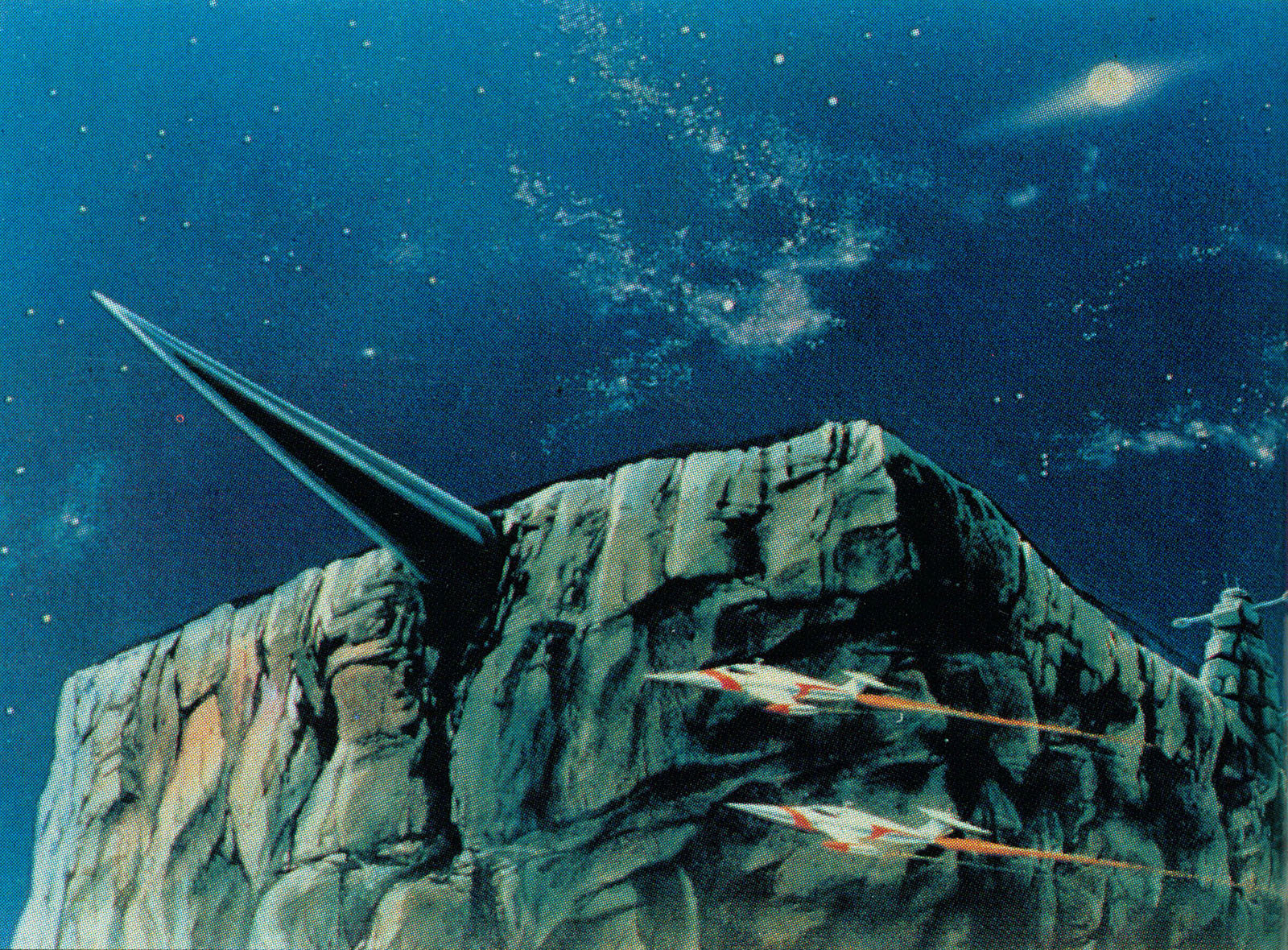
Tokugawa: Wait a second. This one has a big shape in the front. Does that have any meaning?
Matsuzaki: This was the initial form, but we didn’t know what it would become if it had a powerful destructive weapon attached to its front, so we just decided to put a spike on it for the time being. That was essentially the prototype for the Wave-Motion Gun.

Tokugawa: In this slide, it became quite slender. It’s different from the one before.
Matsuzaki: This is, for the most part, the final form of the Asteroid Ship. I think it was around this time that the name Yamato came up. It just somehow felt like Yamato. It had twin-barrel guns at the time, so they more long-range.

1. Yamato Alps / 2. Mt. Takachiho / 3. Takeru River (also known as Yamato Takeru River) / 4. Hyuga Plateau
5. Azuma Falls / 6. Iwanaga Lake / 7. Sakuya Lake / 8. Fujimi Plateau / 9. Toyotama Lake / 10. Akitsu Plain
Tokugawa: The slide that was shown at the beginning has appeared again. What’s going on. Why is it appearing again?
Matsuzaki: The shape of the asteroid itself hasn’t changed from the first one. But the shape of the ship inside it changed. Therefore, this is the first stage of the asteroid defense counter-measure.
Tokugawa: The first one that was shown was a ship made by hollowing out an asteroid, and this one is the opposite, made by attaching asteroids to the outside of a ship.
Matsuzaki: And everyone’s name is included on the surface. Like Fujimi Plateau.
(Audience laughs)
Tokugawa: Let’s move to the next slide.

Tokugawa: This is after the rocks have been blown off?
Matsuzaki: It still has rocks attached to the bottom, but it’s a first stage defensive structure. In other words, you can see a command tower, but that’s just an observation dome.
Tokugawa: Next, please.

Matsuzaki: This is the process of ring formation. Basically, it’s all coming together to form a ring from the dispersed rocks.
Tokugawa: Next?

Matsuzaki: This form shows the consolidated defensive system.
Tokugawa: So this is a ring formed from solidified material.
Matsuzaki: it’s not about offensive positioning, but about defensive control.
Tokugawa: It’s a barrier. This is what we mean by asteroid barrier?
Matsuzaki: We weren’t calling it a barrier back then.
Tokugawa: It seems this version doesn’t have a turret.
Matsuzaki: Later, the command tower and turrets for offense extended out from this. There were all sorts of things jumbled together.
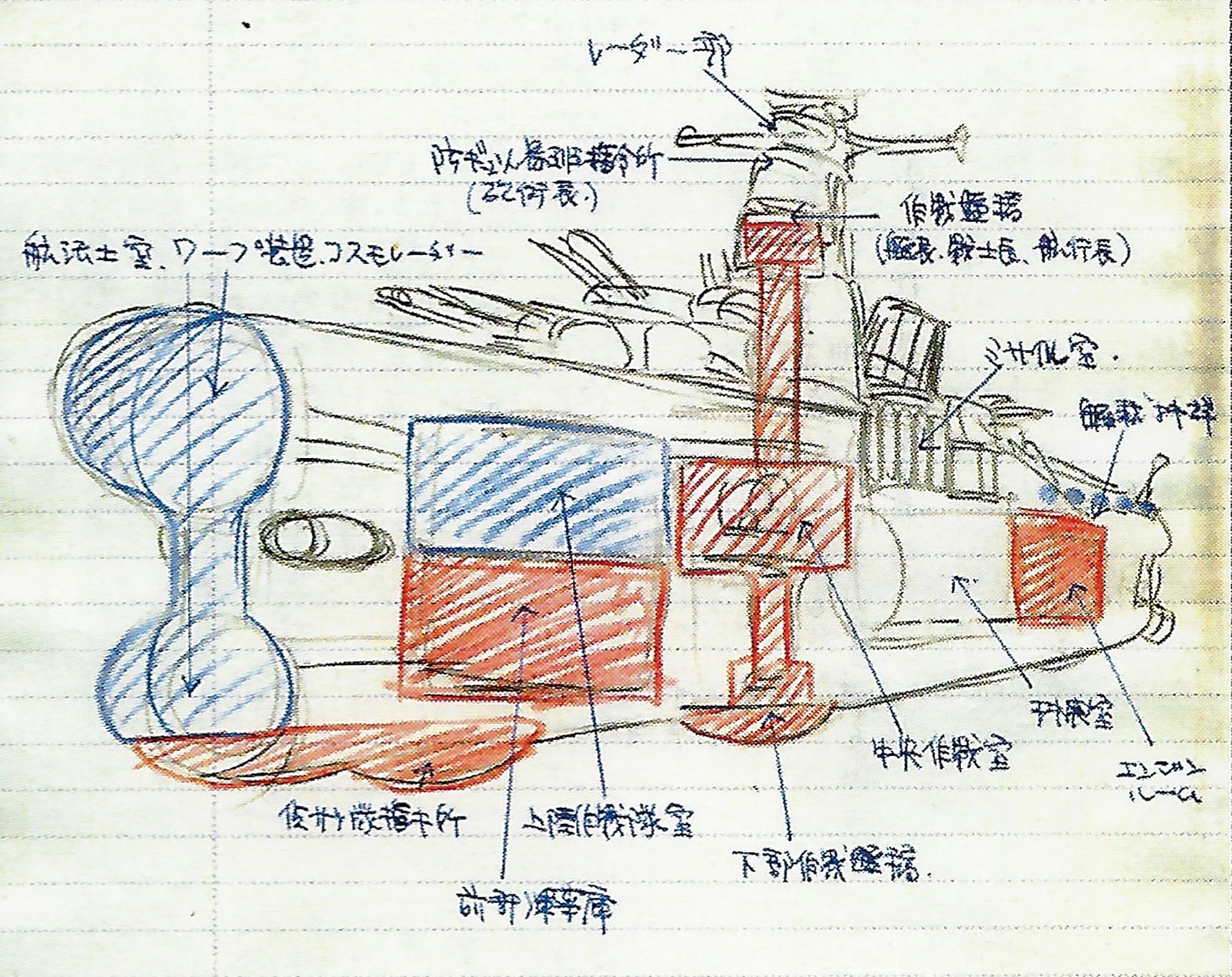
Nozaki: This is the original drawing that Mr. Matsumoto first drew, but he joined the company with the understanding that he would be in charge from the start.
Tokugawa: Mr. Nozaki, what was the background behind Mr. Matsumoto joining the company?
Nozaki: I was involved with Yamato from the planning stage for two and a half years. It was put on hold for six months, and I didn’t put much effort into it then, but it was a very difficult job. When Mr. Matsumoto joined, the producer’s idea was to make Yamato fly in the sky. They were various opinions on this, so we kept it under wraps for a while, but then the producer said, why not just make it Space Battleship Yamato, and make Yamato fly? So from that stage, the mecha aspects were always important, along with the other mecha that would actually be in space.
We wanted to enlist Mr. Matsumoto’s help with the mecha aspects from that point, along with the tones that are always present in space, and other mechanical elements. So I was the first to visit him and we had a casual chat. When I arrived, there was a meter-long model of the Battleship Yamato in his reception room, so I thought, “this is perfect for Mr. Matsumoto,” and immediately arranged for the producer to meet with him the very next day.
At the very beginning, we asked Mr. Matsumoto to do the mecha designs, and also the space backgrounds. He said he wanted to be fully involved, and that’s when Mr. Matsumoto‘s version of Yamato started to permeate the work.
[End of article]