
At the dawn of its “legacy years”, the Yamato saga was in an uncertain place. The biggest project on the calendar at the start of 1984 was the Grand Symphony. Video releases went into overdrive and an unusual publishing project was underway (in English), but Yoshinobu Nishizaki had made it clear in ’83 that the Yamato story was over.
Would he stick to that promise? Nope. He would not.
Here is a comprehensive look at the first of Yamato‘s legacy years…
Special thanks to Steve Harrison for research assistance.
OFFICIAL ACTIVITY
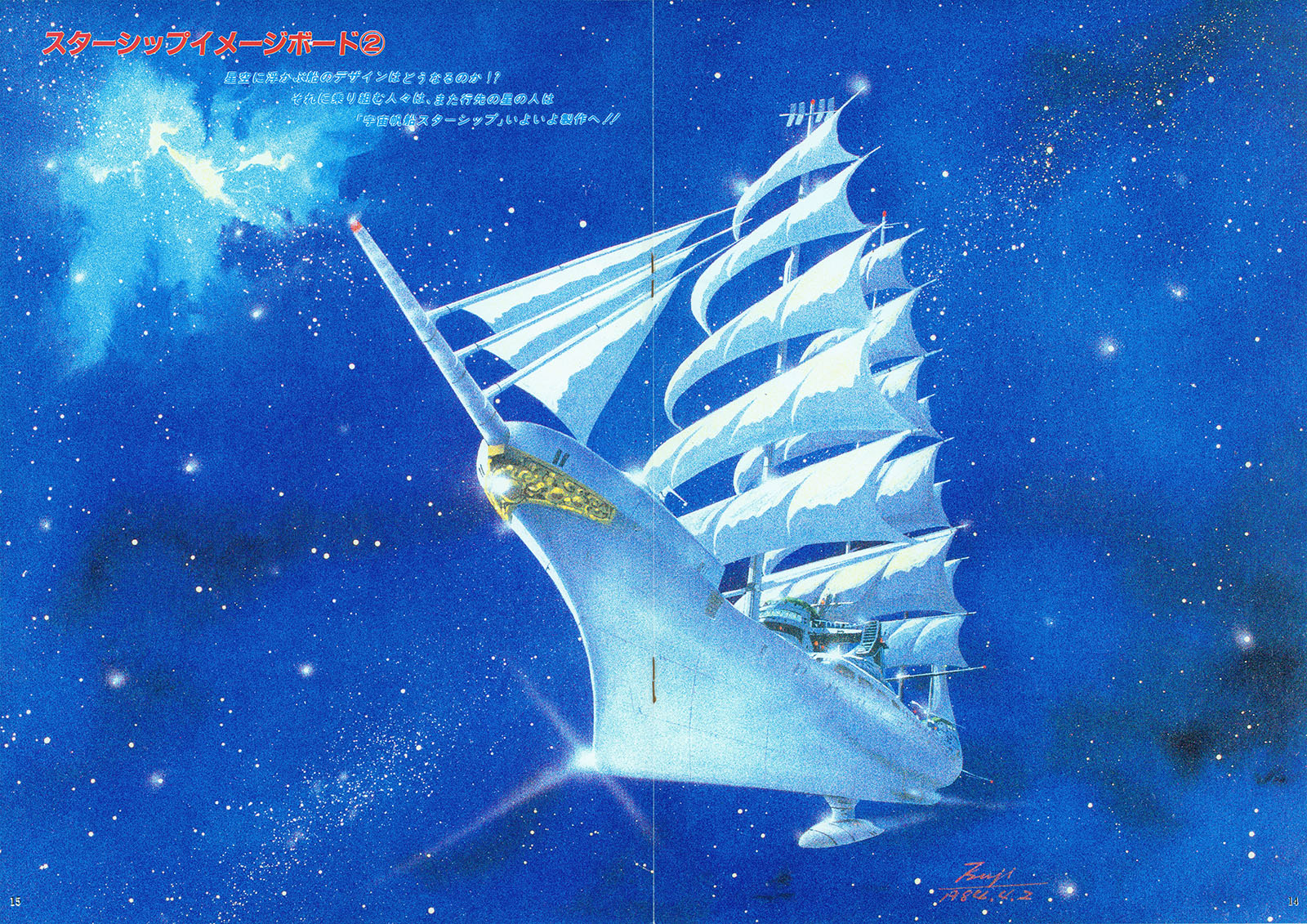
Behind the scenes, things were moving at a steady clip in the first quarter. Despite being saddled with health issues, Nishizaki had embraced a new slate of films, the first of which had the working title of Starship. Development commenced in April (first concept art by Tsuji Tadanao shown above), and the historic Grand Symphony concert took place on May 4 (more info below). Right after that, the next stop was…France?
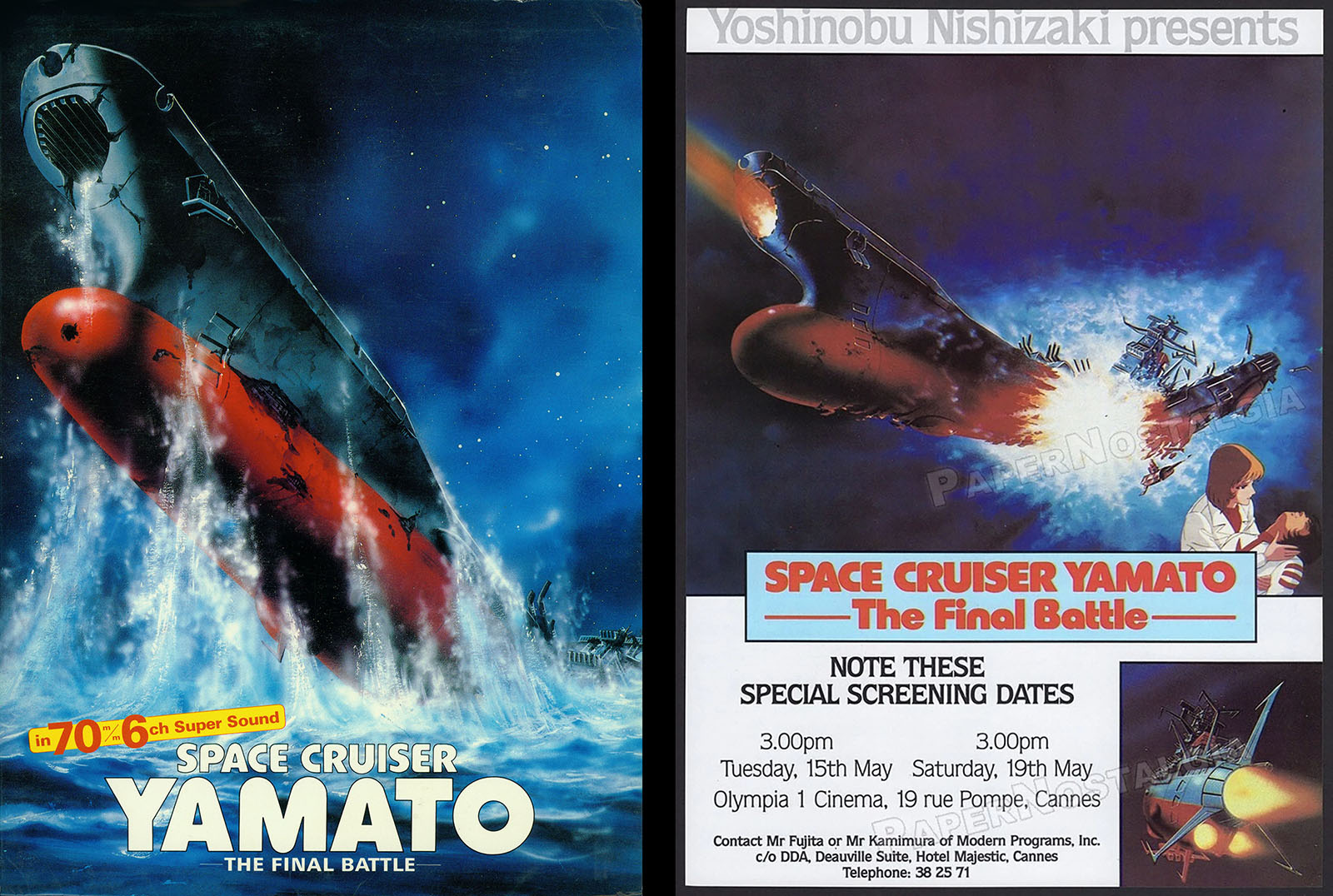
May 15 & 19: Final Yamato at the Cannes Film Festival
Yamato had been to Cannes once before, when Nishizaki took the English-dubbed Space Cruiser Yamato there in 1976 (subsequently selling it to Europe and America), but this was a new day; he now had Japan’s first domestically-produced 70mm anime feature film to offer. The agency representing the movie, Modern Programs Inc, arranged for it to be screened at least twice, but it is unclear whether or not it came with subtitles. It probably didn’t, since plenty of time has passed for it to emerge from the vault.
After deciding on Space Cruiser Yamato, The Final Battle as an international title, Team Yamato went into battle with a custom press kit containing English-language flyers, the Japanese program book with a translation guide, and several still photos of production art.
See it all here
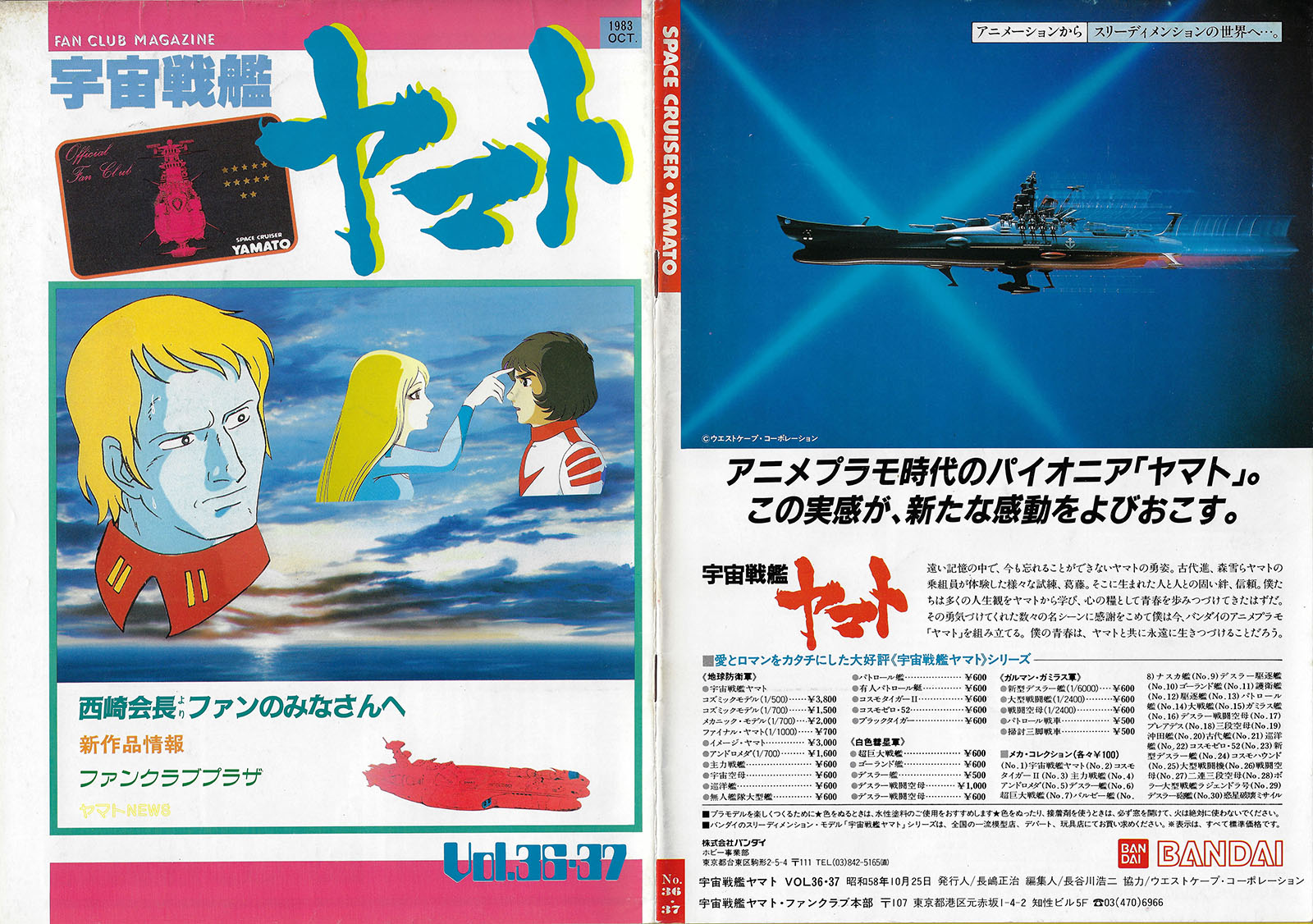
May: Fan club magazine 36/37 (double issue)
The publication date on this magazine reads October 1983, but like several previous issues it was conflicted by the content. According to interior info, issue 36 ran so late that it was combined with 37, and the information inside went all the way to May 1984. Despite its lateness, it was one of the most interesting and important of the entire run, definitively marking the turning point into the legacy years.
Fully half of the issue was filled up with an extensive essay from Nishizaki explaining what he’d been up to since the 70mm Final Yamato was released in November ’83. In that time frame, he contracted a major illness and used his downtime to start conceiving new projects. They were all outlined here, beginning with Starship. He also had new Yamato stories in mind along with his first live-action project (an adaptation of the SF novel Yoseiden), and he expressed his desire for the fan club to evolve and support what was coming next.
Read his essay from this issue here
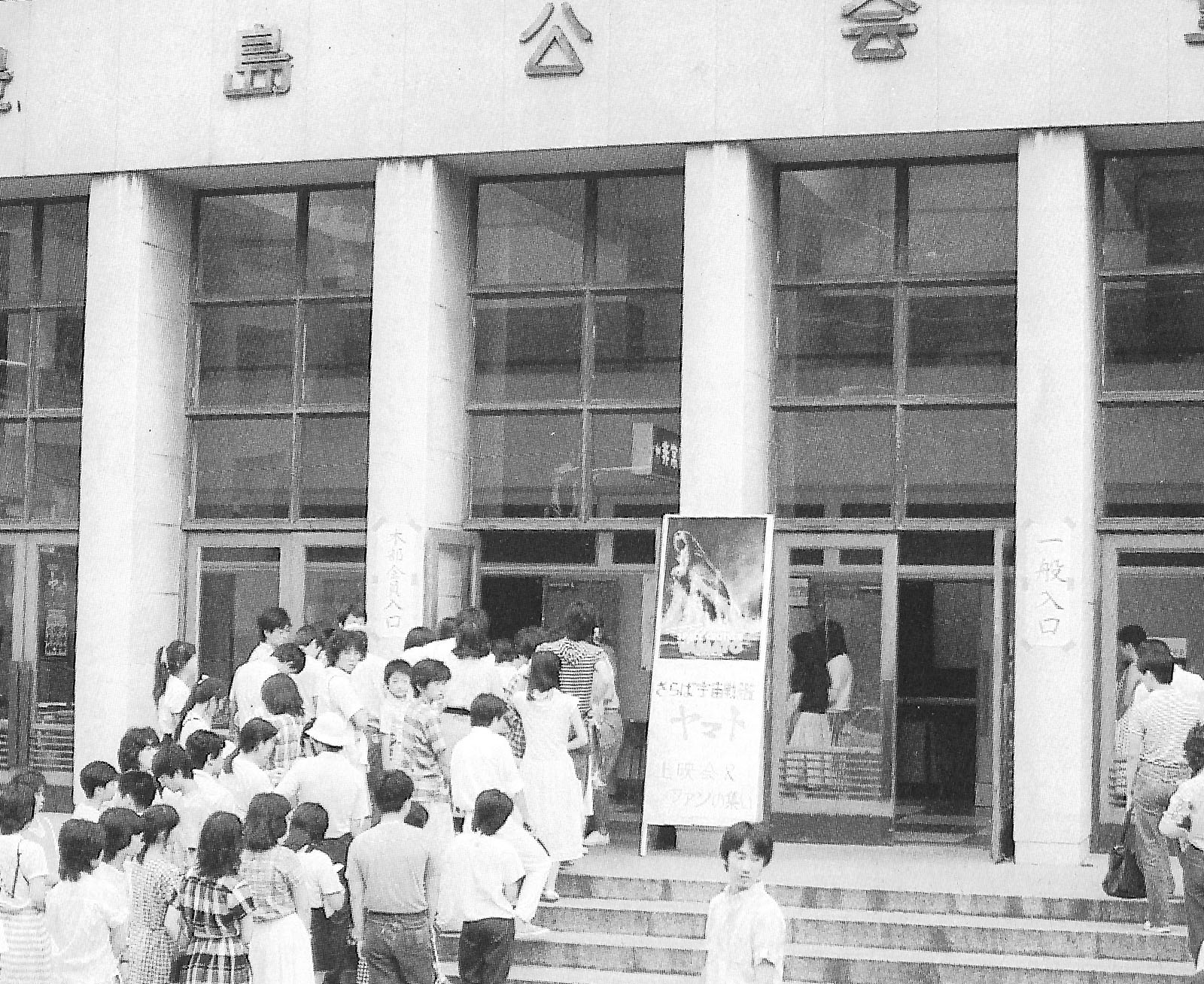
August 27: Official fan club meeting
The Yamato fan club was still going strong as the legacy years began, and twice-yearly meetings gave everyone a chance to continue their association with the home office. Film screenings, karaoke, cosplay and special presentations were a staple of these meetings, with Nishizaki conducting a lecture and Q&A session. The meetings continued throughout the 80s and were reported on regularly in the pages of the fan club magazine.
Read a full report of this meeting here
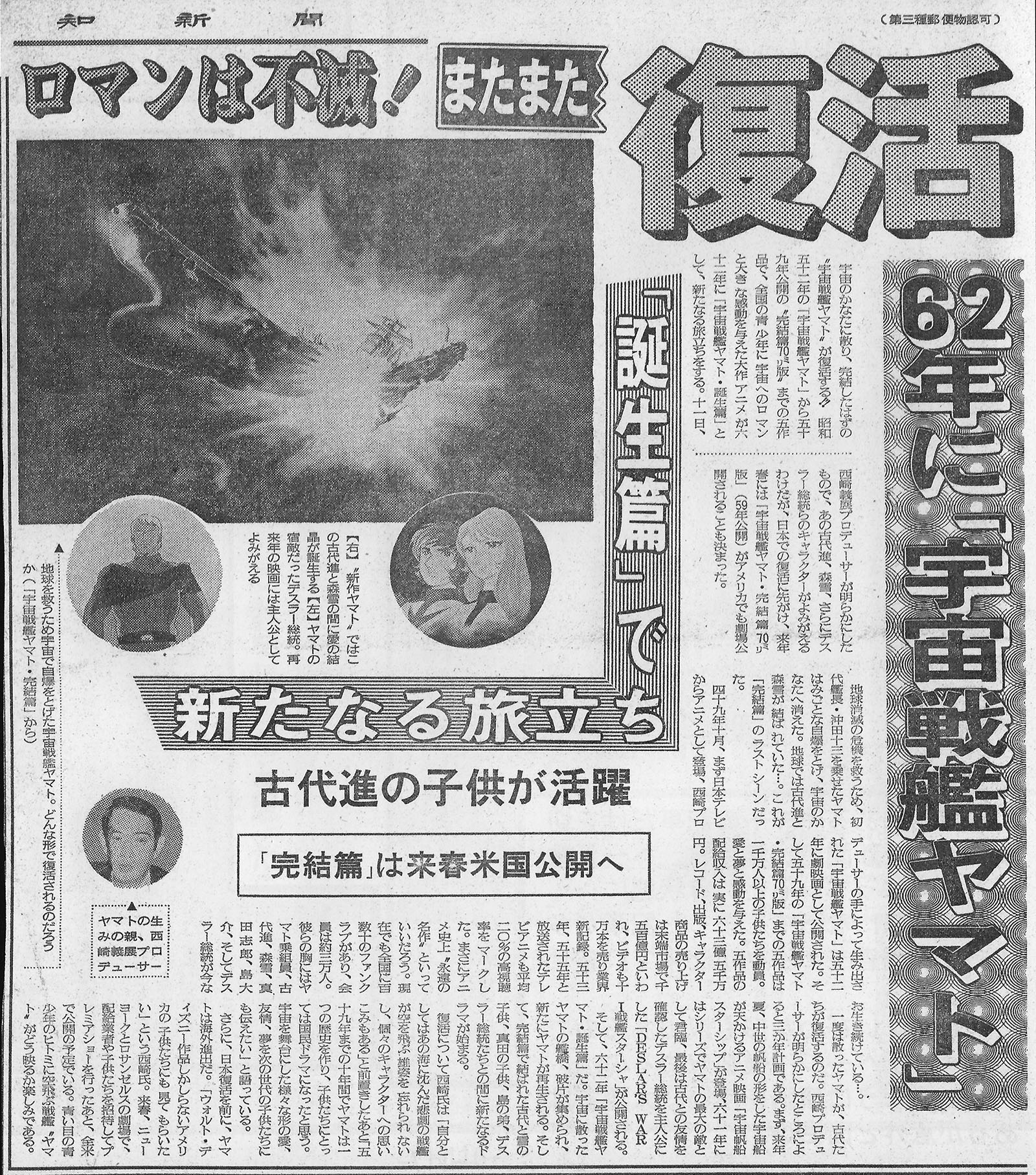
October 12: The 3-year plan goes public
The article shown above was published in the October 12 edition of the Hochi Shimbun [newspaper], revealing to the rest of the world what fan club members had known about since May.
Read the article here
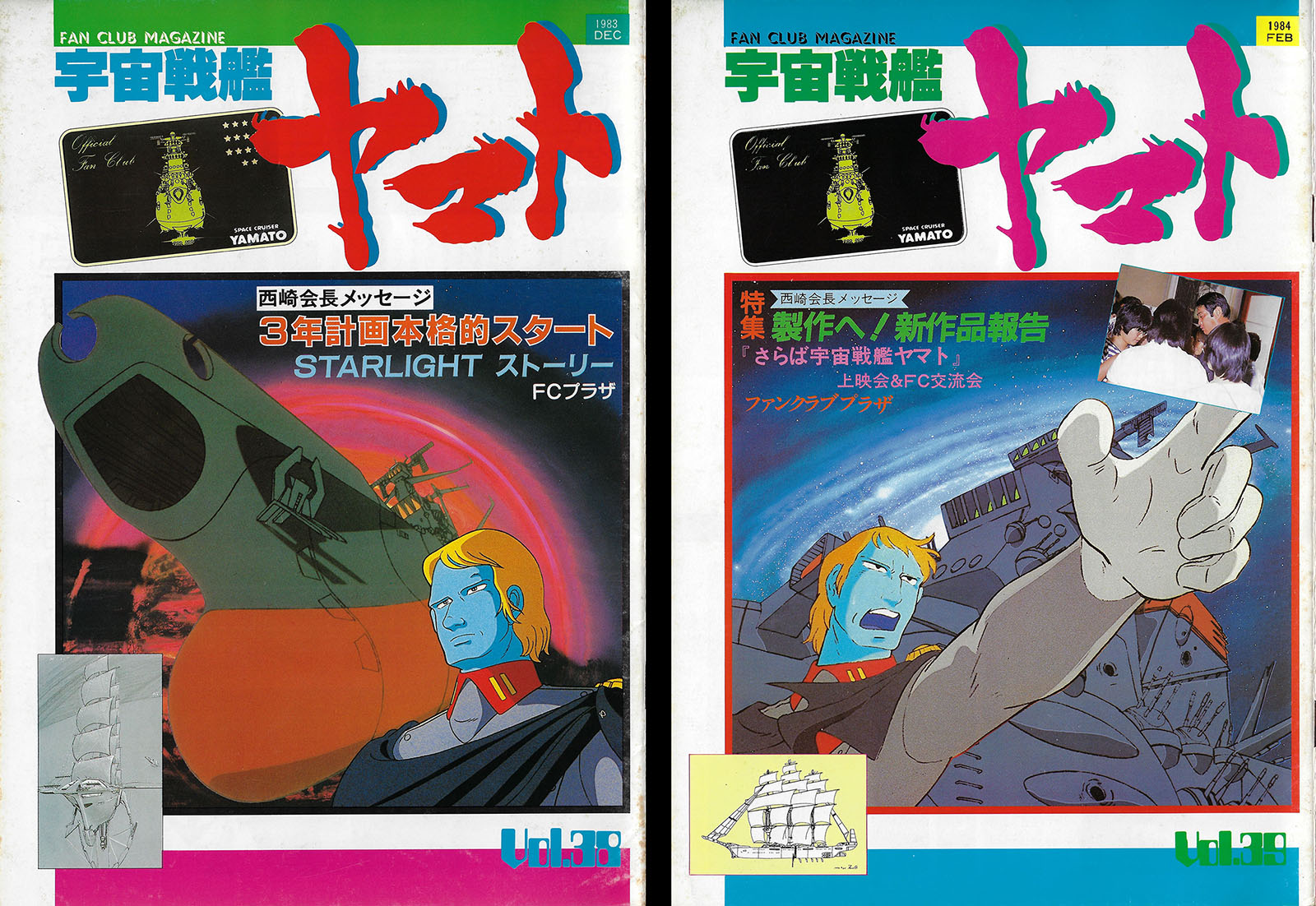
Fan club magazines 38 & 39
West Cape Corporation, Summer and fall 1984
These issues were dated December ’83 and February ’84, but by now this was merely wishful thinking. They were full of summer news with a lot of time spent on the Starship brainstorming sessions, in which the working title was expanded to Space Sailor Starlight.
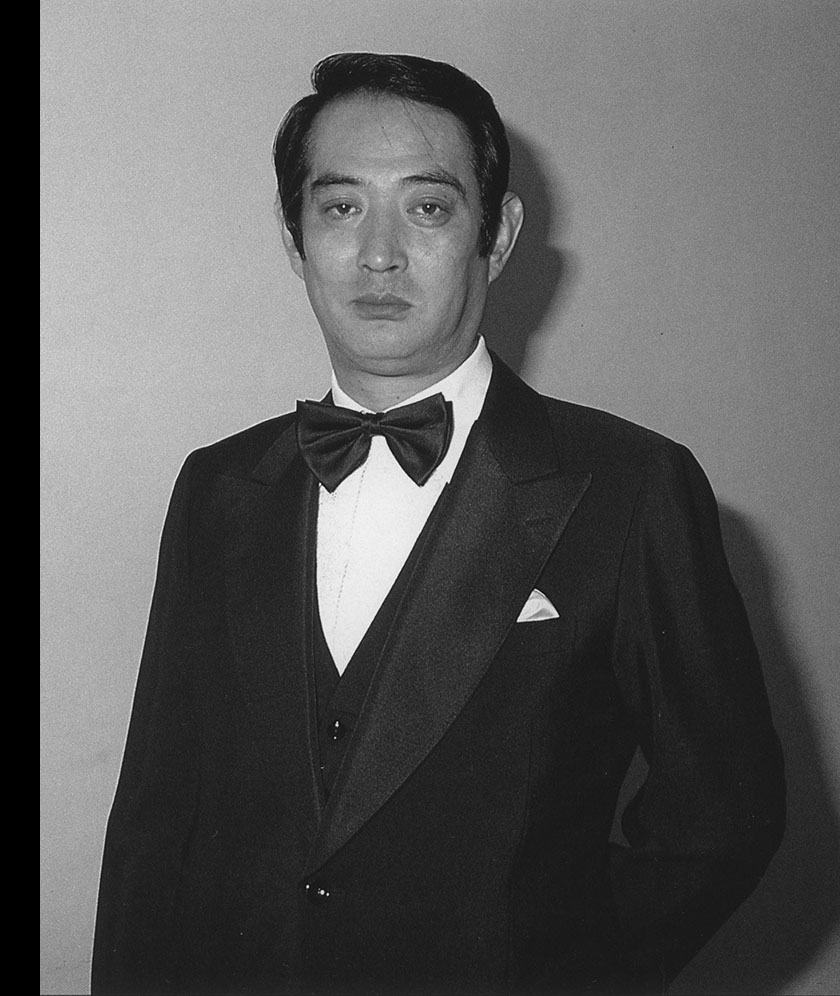
December: JAVN founded
After the announcement in May that Nishizaki was pursuing his first live-action project, there was no further mention of Yoseiden. However, his appetite for an expanded slate of projects across multiple platforms had moved him to form an entire new company. It was described as follows in the 2015 biography The Man Who Made Space Battleship Yamato:
In December 1984, the establishment of Japan Audio Visual Network (commonly known as JAVN) was announced. It was a new company funded by leading Japanese entertainment companies. The capital was ¥205 million. The investment ratio was 33% each for West Cape and Nippon Colombia, 15% each for Bandai and Shochiku, and 4% for Yasuyoshi Tokuma, president of Tokuma Shoten, as an individual. Nishizaki, who spearheaded the establishment of JAVN and brought together the investing companies, became the representative director. At this point, he representated both West Cape and JAVN. He could no longer say, “I have Yamato,“ but his charisma as a hit maker was still very much recognized among industry insiders. In its early stages, JAVN was of Nishizaki, by Nishizaki, and for Nishizaki.
JAVN established its office in Roppongi, Tokyo. The investing companies, each with their own agendas in their respective fields – toys (Bandai), records, (Columbia), films (Shochiku), and publishing (Tokuma) – were undoubtedly interested in what Nishizaki himself envisioned for JAVN. Looking at his later writings, he said “West Cape’s work had become solely supporting its employees. To break through that limitation, I needed a platform to create and invest in works that reflected my own unique sensibilities and worldview.”
Simply put, now that the limitations of Yamato had become apparent, the aim was to raise funds from familiar major companies and start a new business without being burdened by employee salaries.
“First, JAVN will acquire software, including works purchased from overseas, and each investing company will sell them through its own distribution channels. In the meantime, JAVN will develop new works through marketing, and each company will cooperate to create a nationwide distribution network. After laying this foundation, producers led by Nishizaki will acquire, produce, and invest in works that can be accepted on a global scale.”
The above was the agreement of the investing companies. If you read this straightforwardly, it is an ambitious plan in which the investing companies would ultimately unite in a single joint venture.
TV & VIDEO
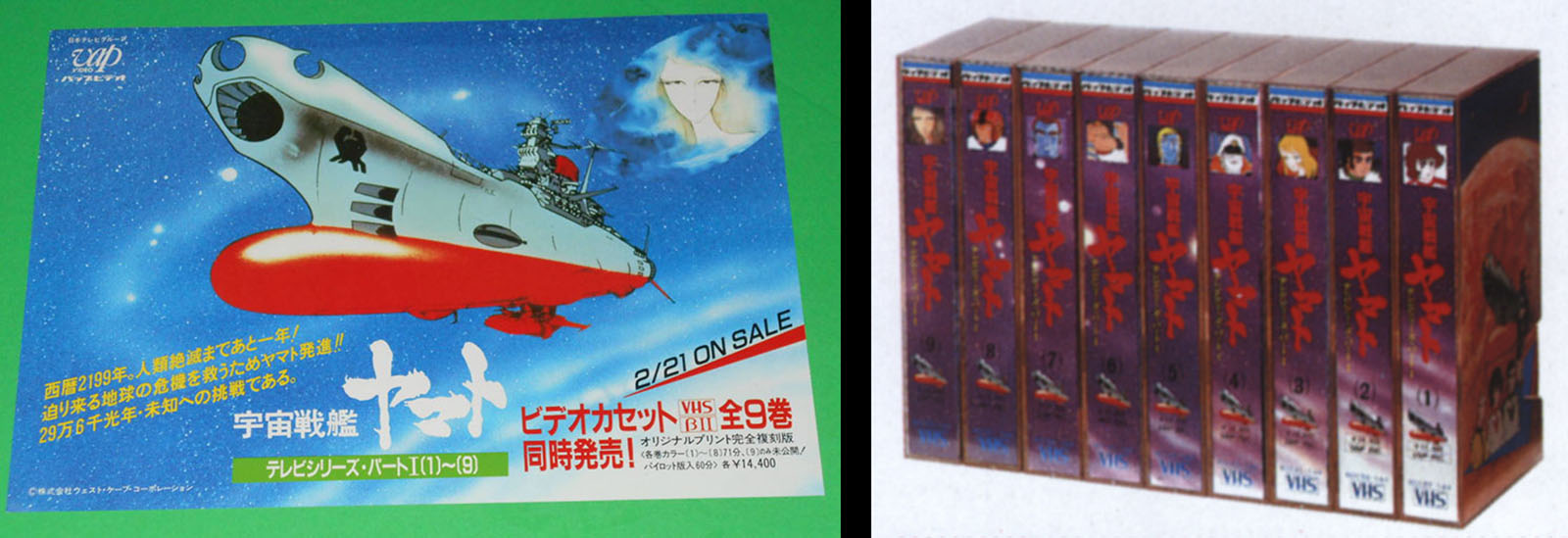
February 21: Series 1 set (VHS and Beta, VAP)
The first Yamato videos had arrived in 1983, all of which were movies. It took about another year for this complete rollout of Series 1 to happen. It was not the first time TV episodes could be purchased on tape (Urusei Yatsura, Macross, and Future Boy Conan were among those already available), but this may have been the first time a complete TV series was made available all at one time. The asking price was 130,000 yen, more than all the movies put together.

Each tape in this set contained three episodes bracketed by only one opening and closing title. The episodes were divided by title cards that were not part of the TV broadcasts. The final volume contained two episodes and one bonus feature: Nishizaki introducing the 1974 pilot film in footage that had been created for the 1983/84 revival screenings of Farewell to Yamato (prior to the premiere of Final Yamato). This was the first time it was released on home video, and the 1974 temp music was replaced by Miyagawa score because of music rights issues.
See all nine VHS sleeves here
Read all about the pilot film here
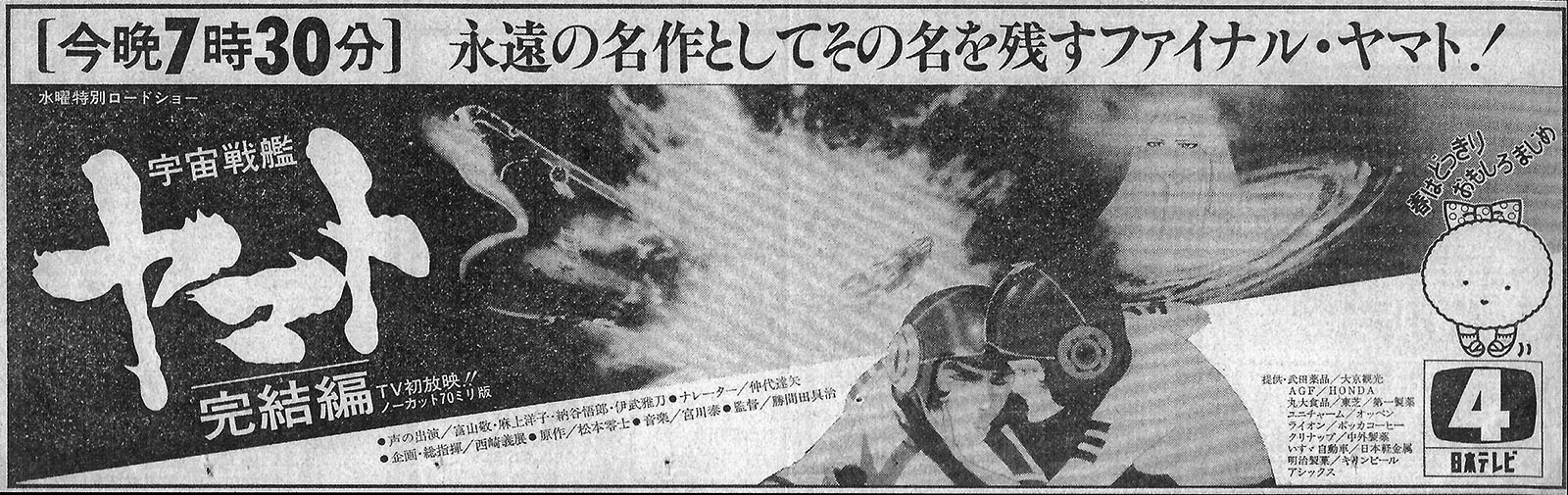
April 4: Final Yamato on TV
Just over a year after its 35mm premiere and five months after its 70mm reissue, Final Yamato arrived on Nippon Television’s Wednesday Special Roadshow. This was a letterboxed version broadcast in stereo, but both widescreen TVs and stereo TVs were practically nonexistent at the time. However, VHS and Beta VCRs were a new factor in 1984 and played a role in promoting the broadcast. (Side note: they were called VTRs in Japan, standing for Video Tape Recorder.)
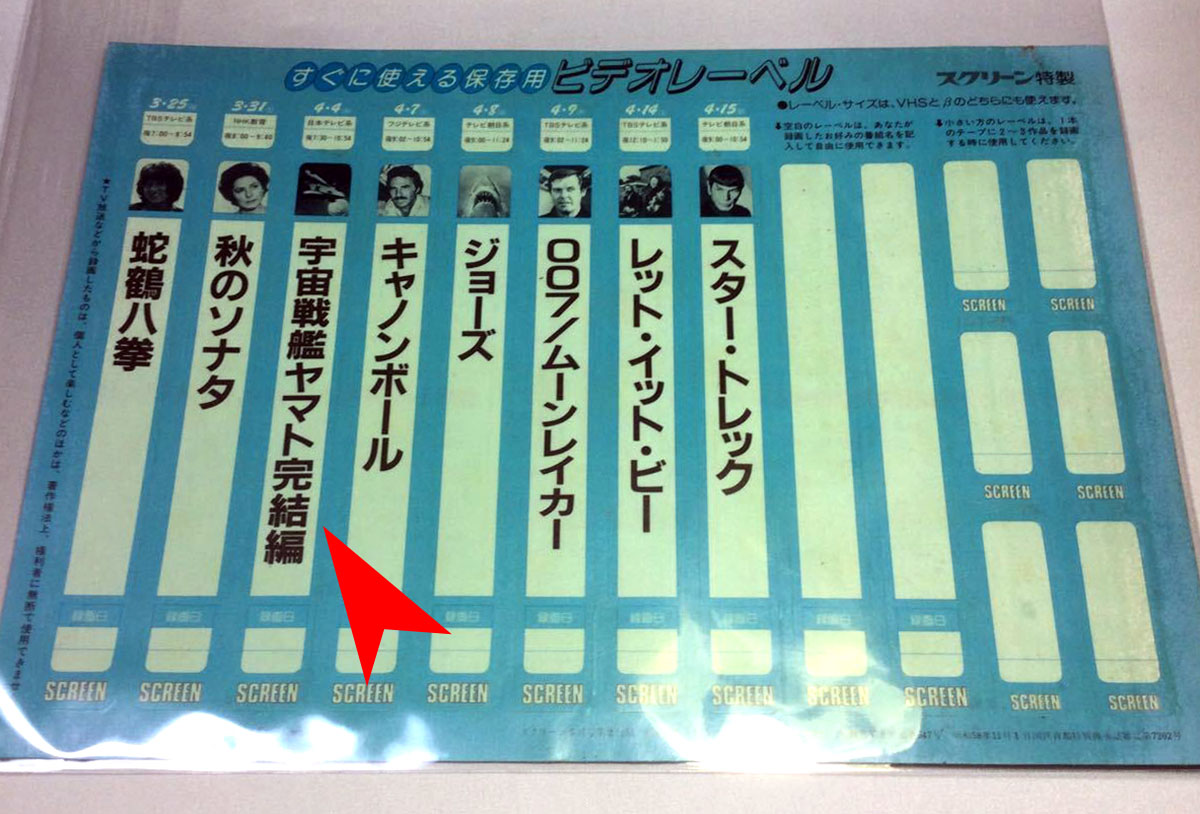
Though it was not entirely legal to record a broadcast signal (nervous entertainment lawyers were constantly sounding the alarm about bootleggers), getting the film on tape wasn’t exactly discouraged. In fact, Screen magazine offered an interesting bonus feature in the issue released in March: premade tape labels. Not just for Final Yamato, but for every major film due to air in April including Cannonball Run, Jaws, Moonraker, Let it Be, and Star Trek the Motion Picture.
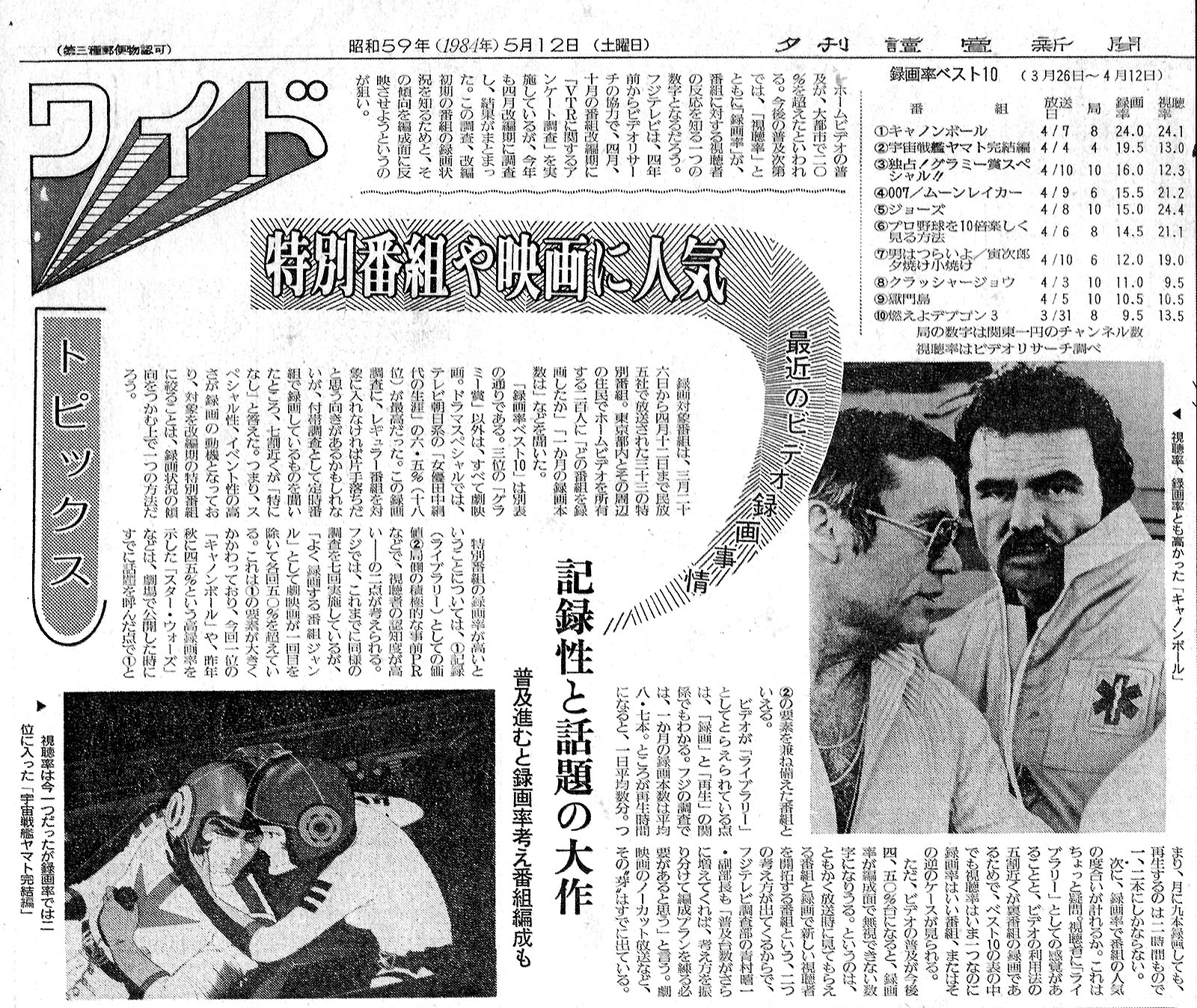
The Yomiuri Shimbun [newspaper] did some followup in a May 12 article in which they polled VCR owners and learned that Final Yamato was the second most-recorded film, right after Cannonball Run. There were a lot of question marks surrounding home recording at the time, since broadcasters were always looking at whatever metric they could get. “Most recorded” didn’t necessarily mean “most popular,” since many viewers claimed they were watching one show while recording another in the same time slot. Then as now, the struggle to stay ahead of a constantly evolving media landscape was eternal.
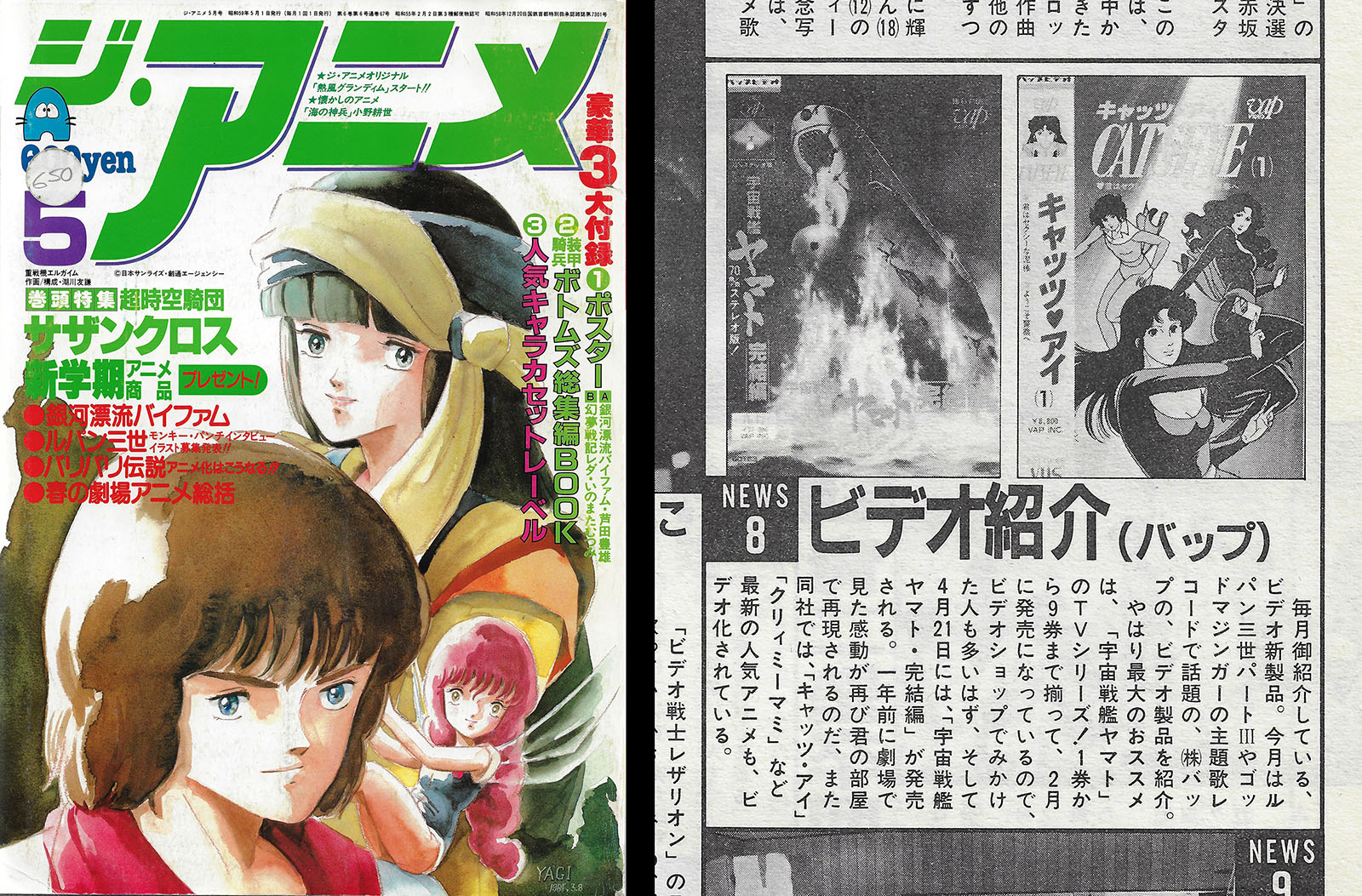
April 10: The Anime, May issue
The world of home video was explodin’ in early 1984, and the 70mm version of Final Yamato was part of the assault.
Video introduction (VAP)
We introduce new video products every month, and this month we are featuring video products from VAP Inc., the company that’s been making headlines with its Lupin III discs and God Mazinger theme song records.
Our top recommendation is definitely the Space battleship Yamato TV series! All nine volumes are available and were released in February, so many of you have probably seen them at video stores. And on April 21, Space battleship Yamato, The Final Chapter will be released. The excitement you felt when you saw it in the theater a year ago can be recreated in your own room. The same company has also released the latest popular anime such as Cat’s Eye and Creamy Mami on video.
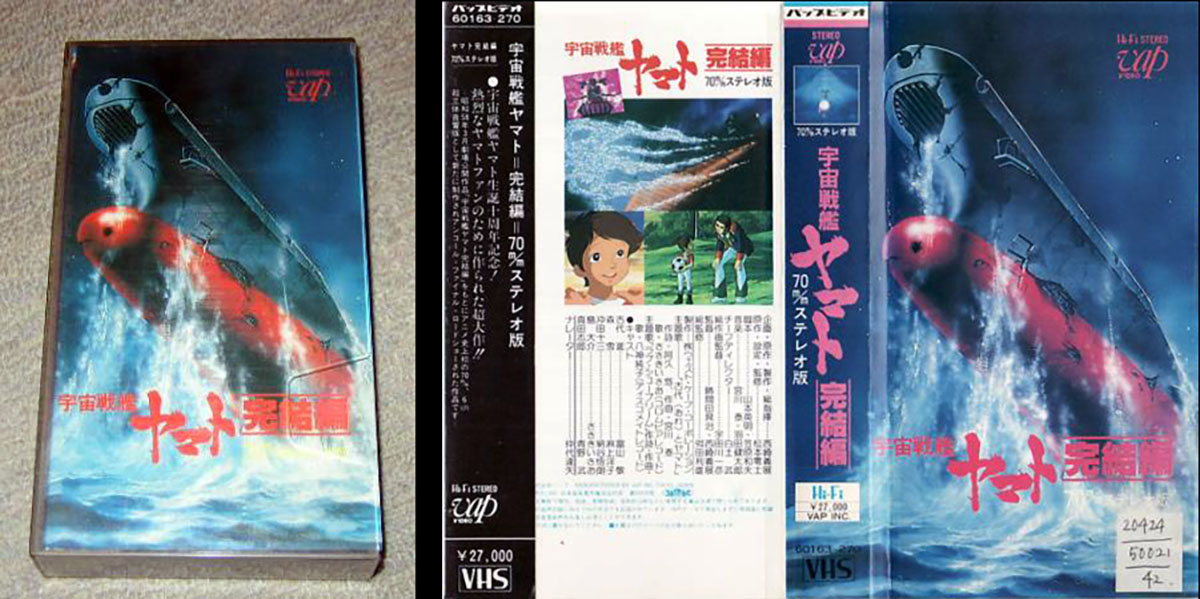
April 21: Final Yamato 70mm edition on VHS and Beta (VAP)
One year to the day since VAP released the 35mm version of Final Yamato, they rolled out its upgraded successor. It came with a new sleeve, letterboxing, stereo sound, and the cleaned up/revised footage. This would become the standard for all releases from then on, with the 35mm version being left in the dustbin of history.
What exactly are the differences between the two versions of the film? Look at them scene by scene here.
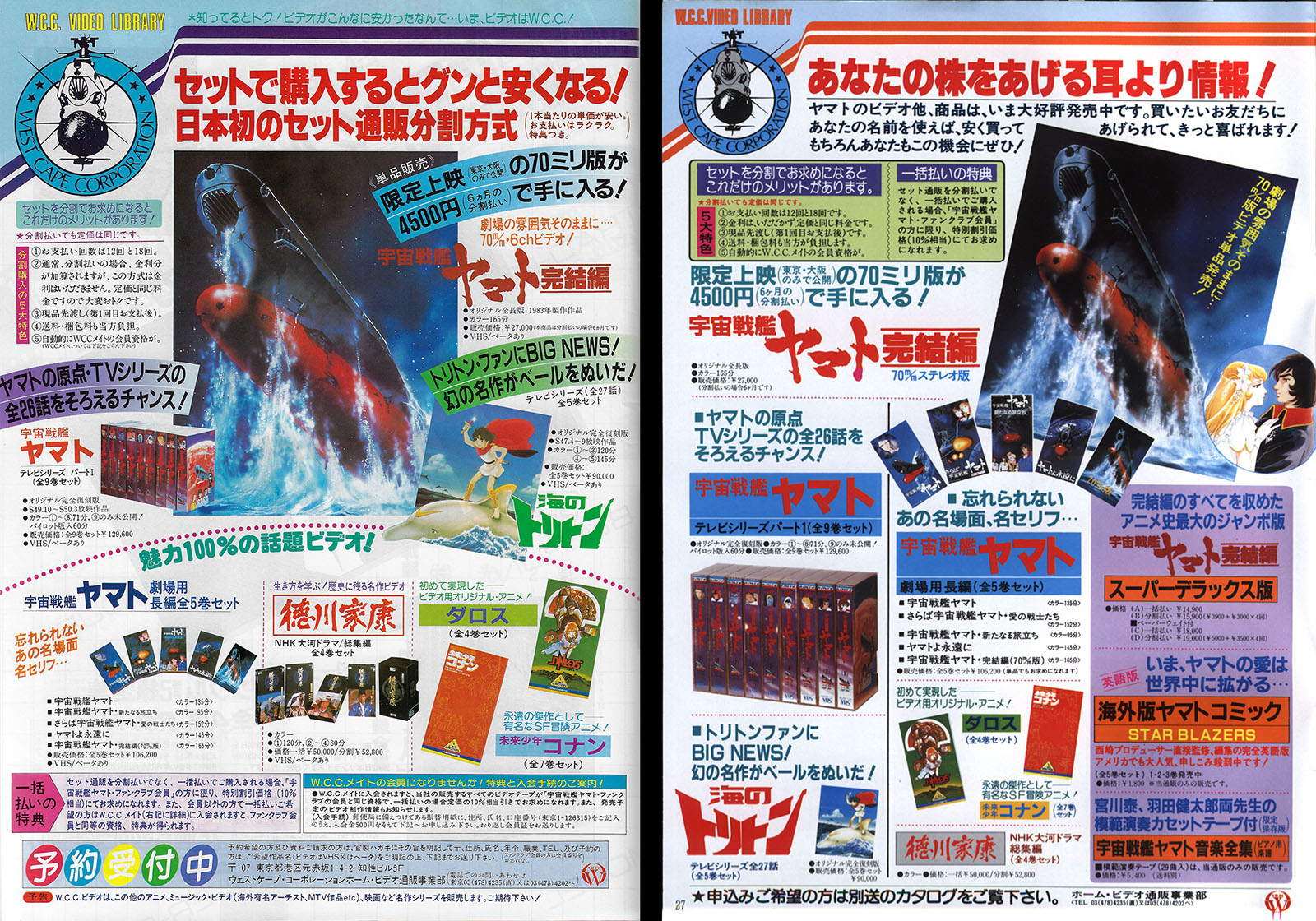
Contemporary magazine ads placed by West Cape Corporation, promoting Series 1, Final Yamato, and more.
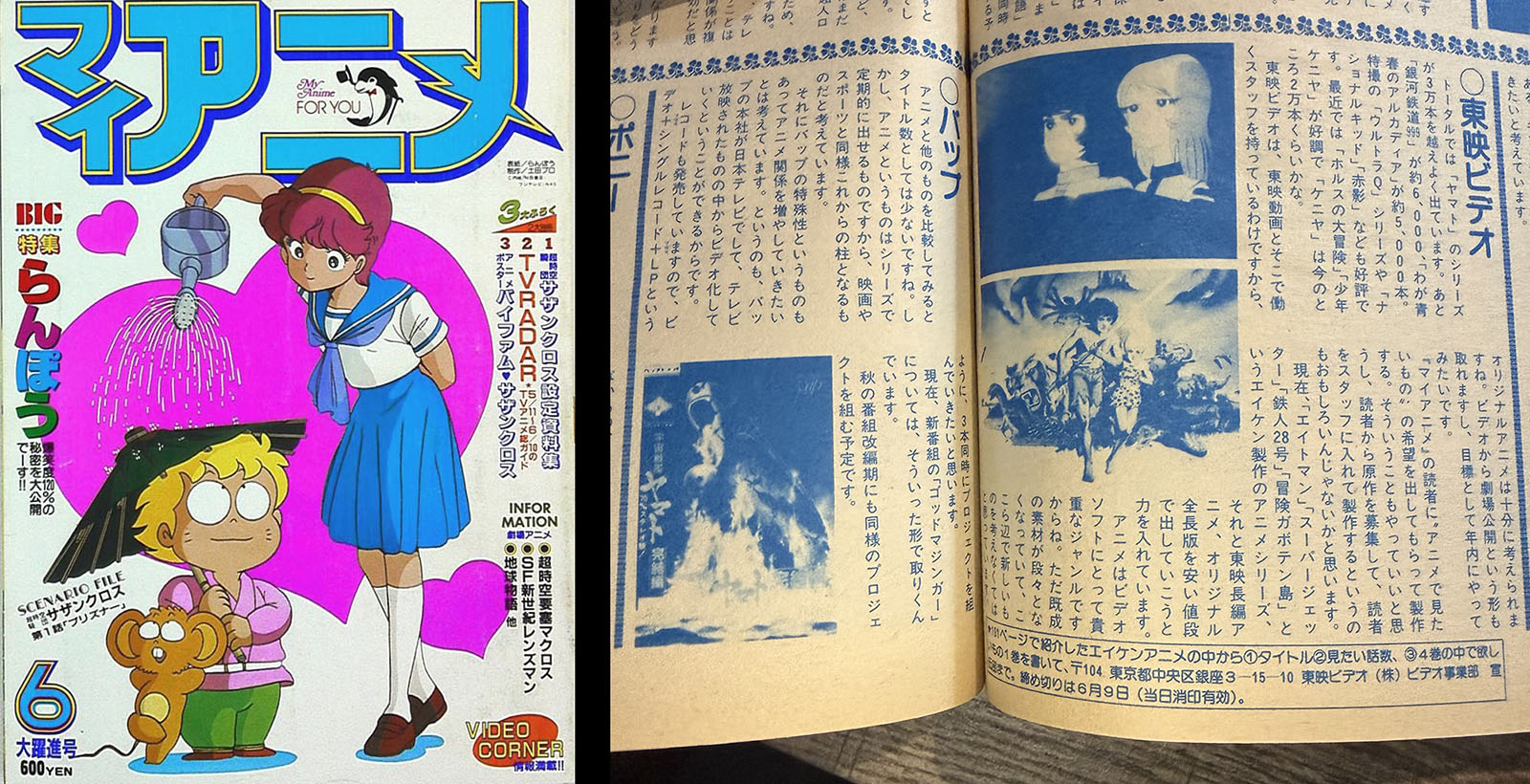
May 10: My Anime, June issue
There was more followup on video releases to be found in this blurb:
Toei Video
In total, the Yamato series has sold over 30,000 copies which is a great success. Also, Galaxy Express 999 has sold about 6,000 copies, and My Youth in Arcadia has sold about 5,000 copies. The tokusatsu series Ultra Q is also popular, as well as National Kid and Akakage. More recently, Hol’s Great Adventure and Boy Kenya have been doing well, with Kenya having sold around 20,000 copies so far. Toei Video has Toei Animation and the staff who work there so an original anime is definitely a possibility. They could release it on video first and then in theaters, and they would like to start doing that by the end of the year.
Video introduction, VAP
Compared to other forms of entertainment, VAP’s number of anime titles is relatively small. However, since anime can be released regularly as a series, we believe it will become a pillar of the industry in the future, just like movies and sports. Furthermore, given VAP’s unique characteristics, they would like to increase their anime-related offerings. This is because VAP is headquartered at Nippon Television, which allows them to release broadcast programs. They also release records, so they would like to tackle video, singles, and LPs simultaneously. They are currently working on the new program God Mazinger in that manner.
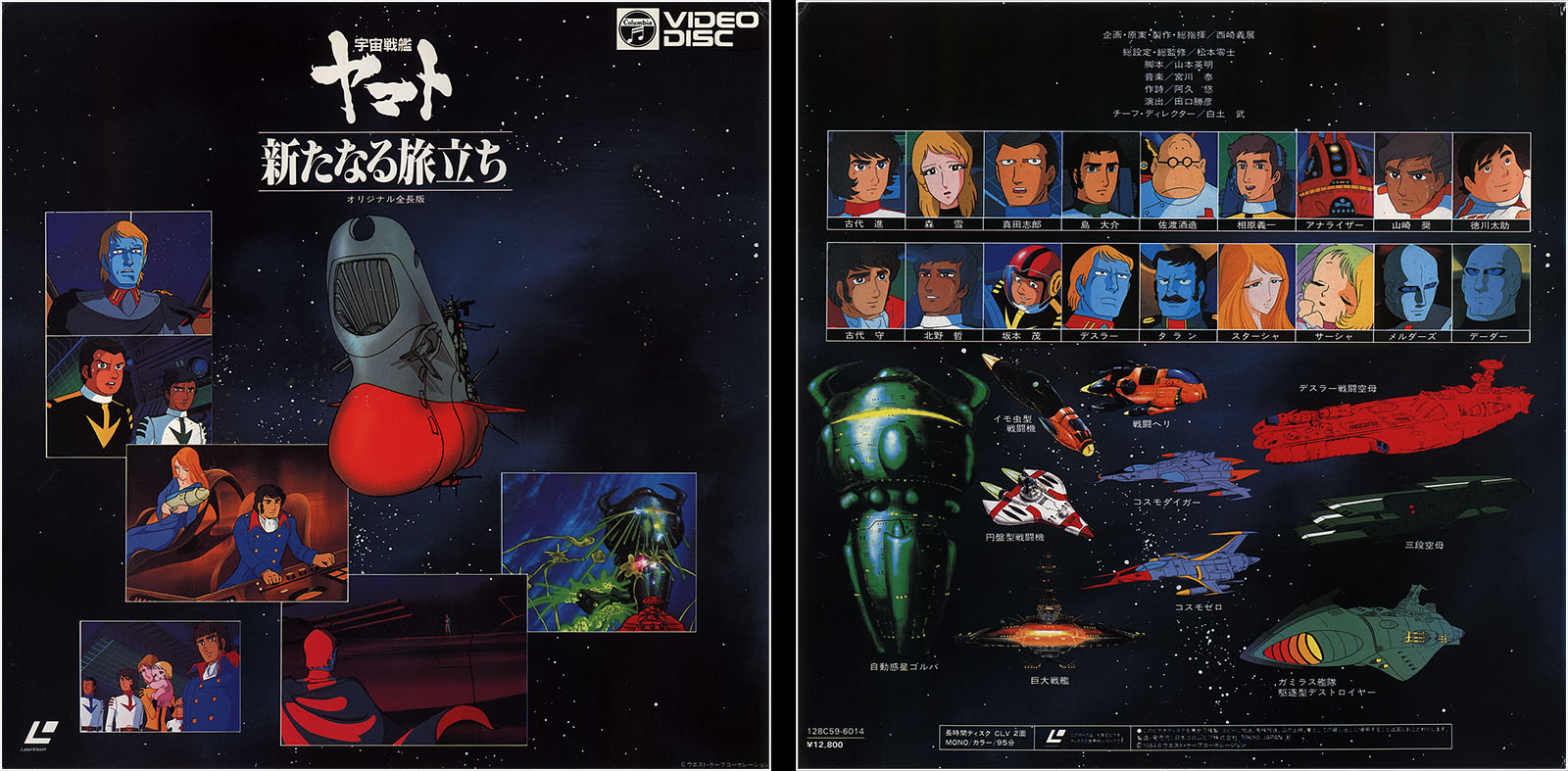
June: The New Voyage laserdisc (Columbia)
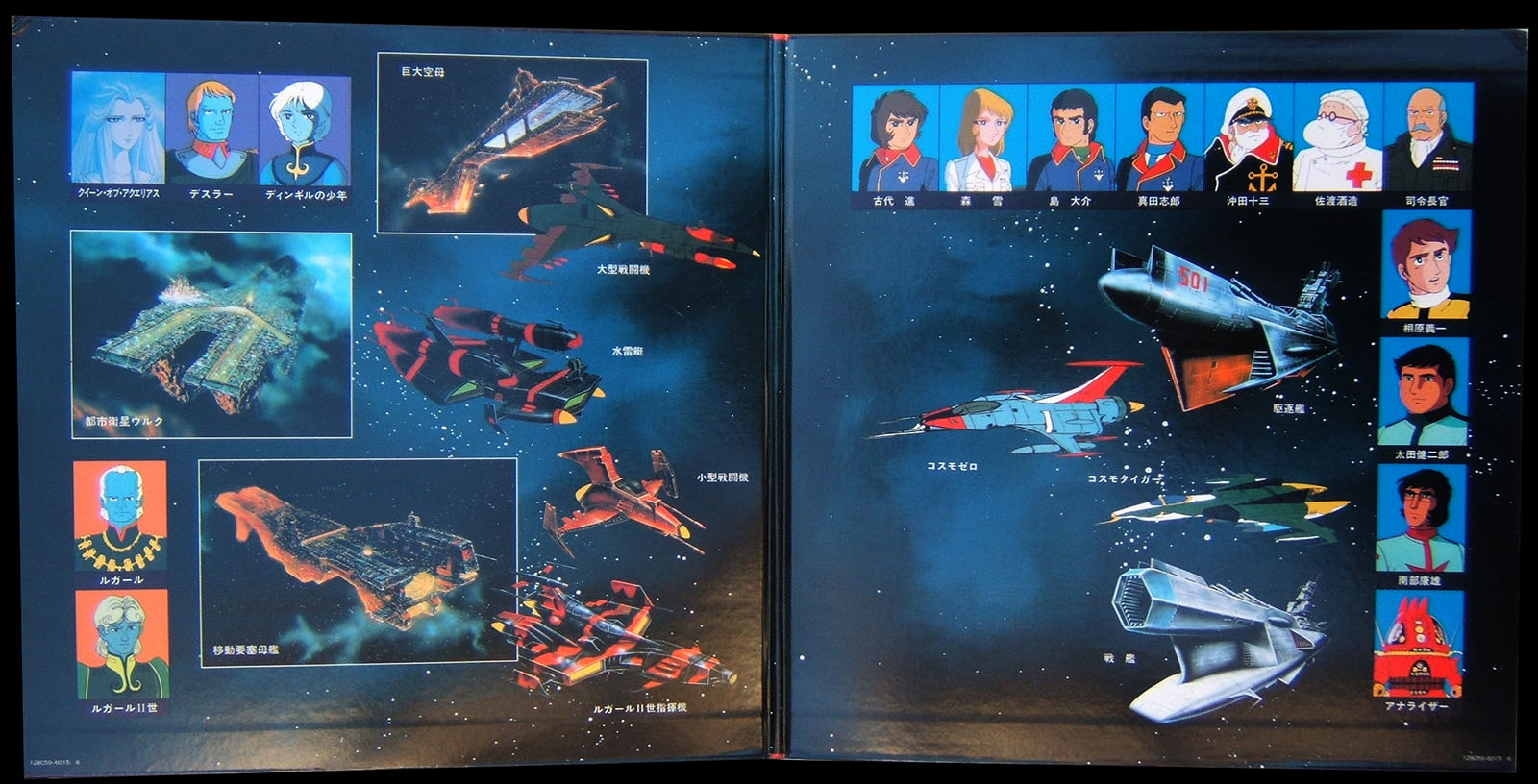
About a year after the initial movie releases from Toei and Victor, Nippon Columbia followed up with their own handsome edition of The New Voyage for the first time on the shiny new LD format. Unlike the other films released in this format, the sleeve did not fold out.
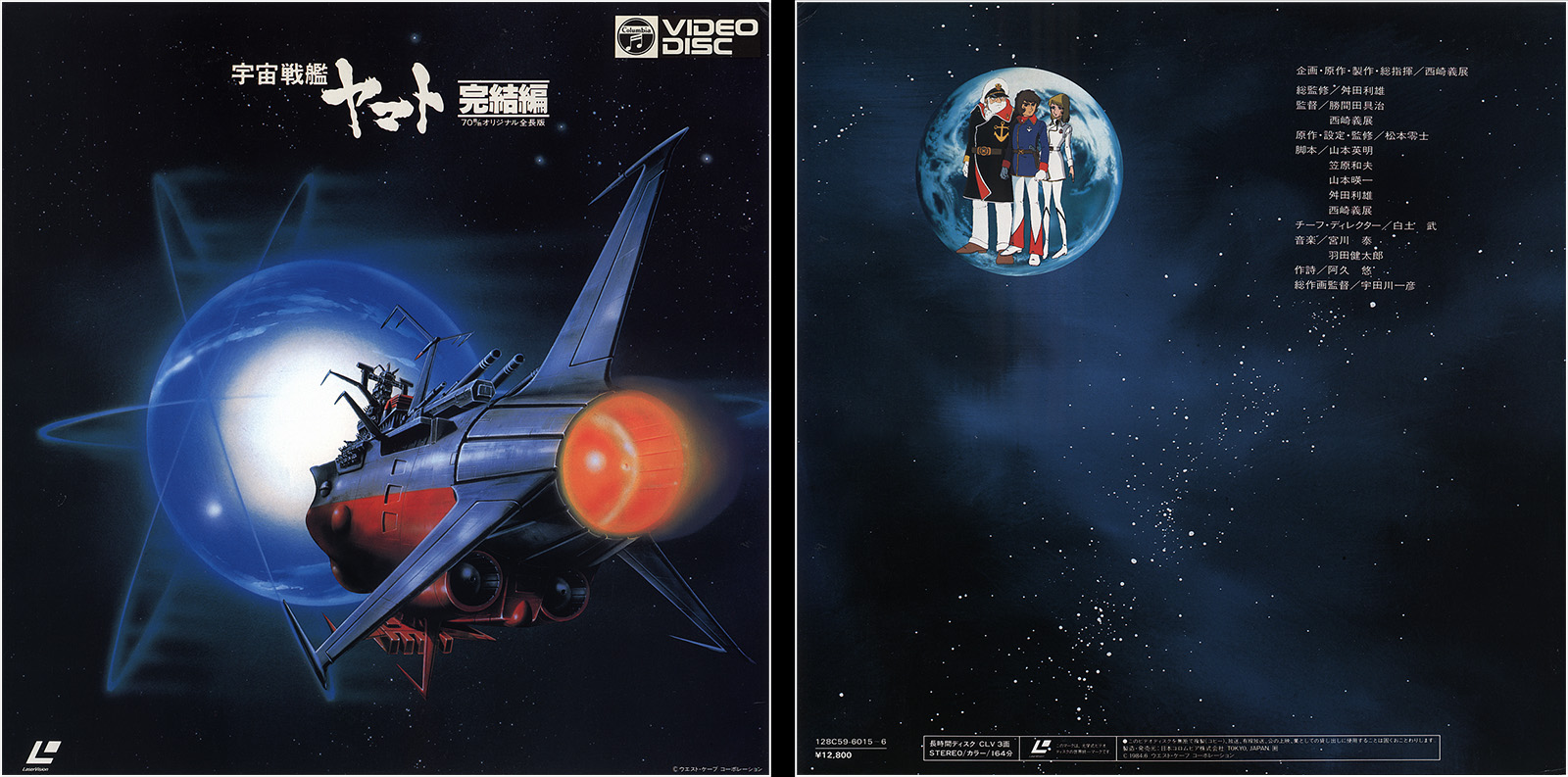
June: Final Yamato laserdisc (Columbia)
Final Yamato (70mm version, of course) was in stores on the same day as The New Voyage, which was a curious choice since the other three movies (Yamato, Farewell, and Be Forever) had not been released on LD yet; all three would follow in 1985.
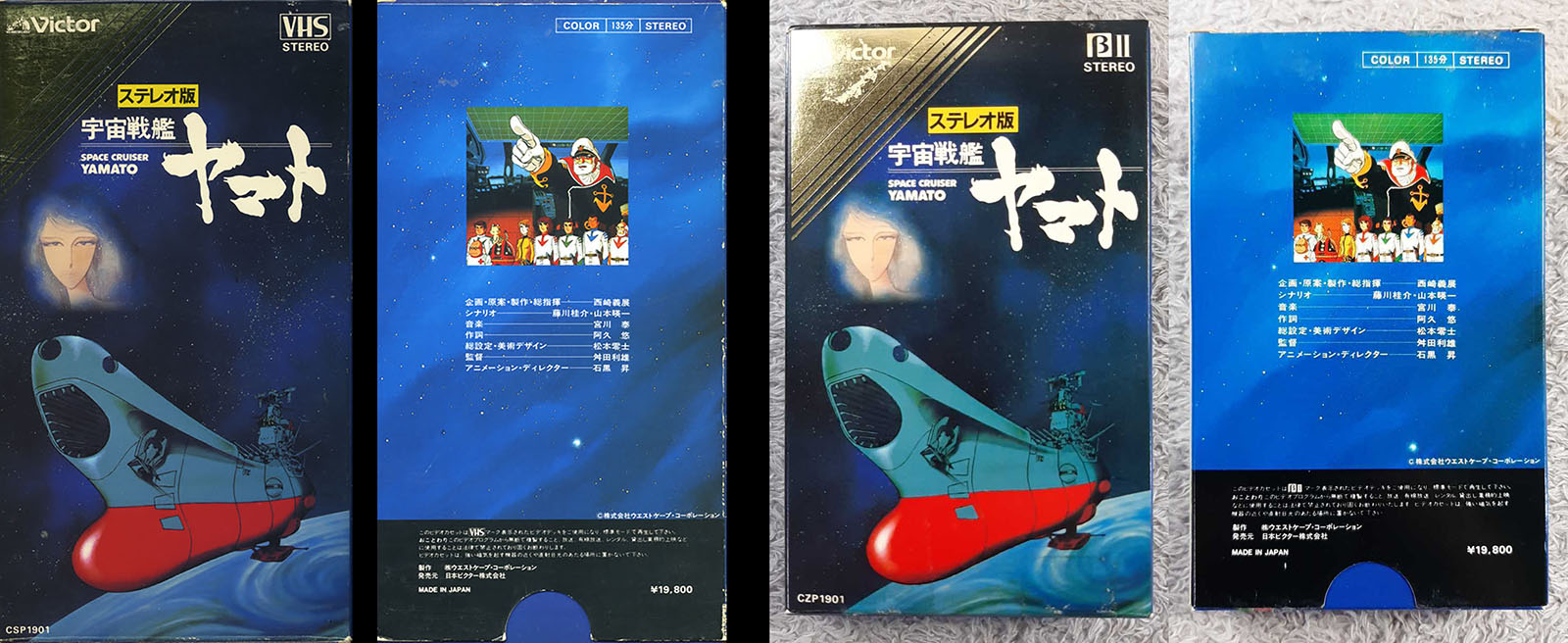
Space Battleship Yamato, VHS and Beta
December: More movies (Japan Victor)
Victor had gotten into the Yamato video game at the same time as Toei and VAP in April 1983, but exclusively released their Yamato movies on the proprietary VHD format. They were still in the pool after Columbia jumped in.
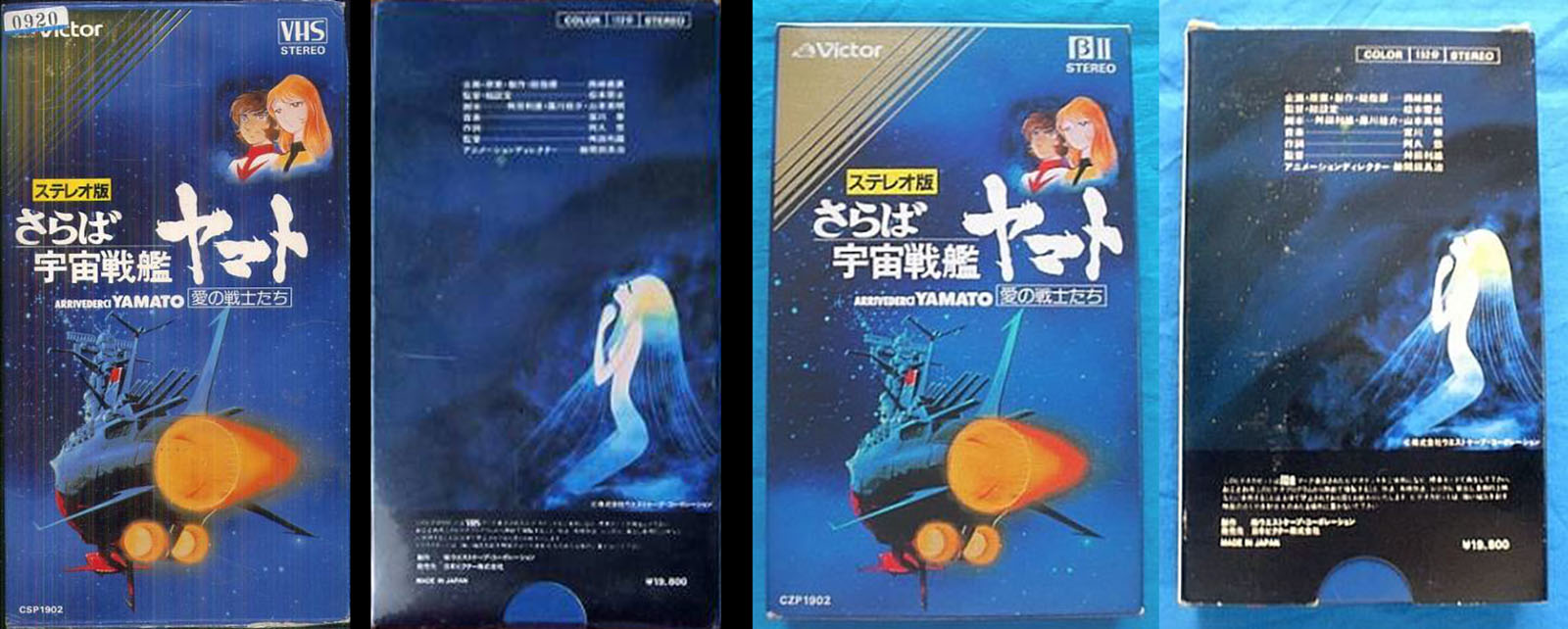
Farewell to Yamato, VHS and Beta
In 1983, Toei had been the first to release the movies on VHS and Beta, and their licensing term must have expired since Victor was now doing the same. As 1984 drew to a close, they released new editions of Space battleship Yamato, Farewell, and Be Forever.
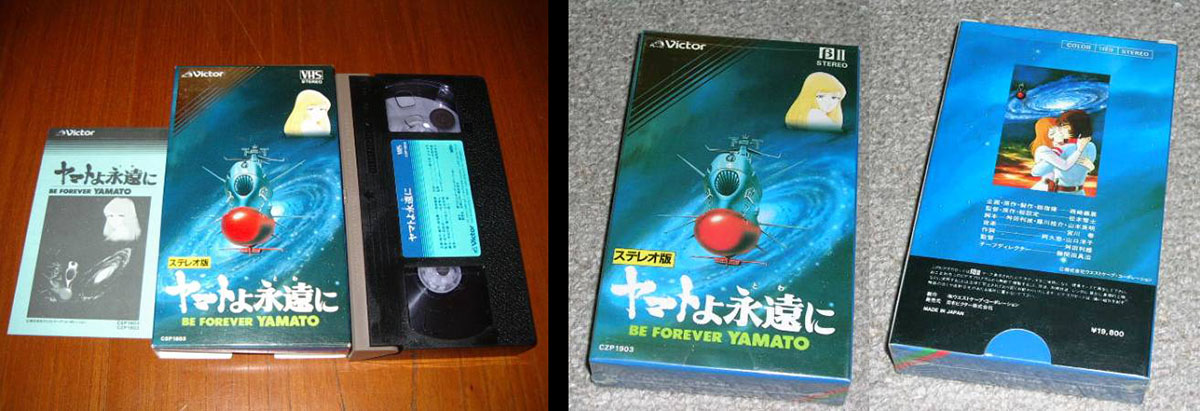
Be Forever Yamato, VHS and Beta
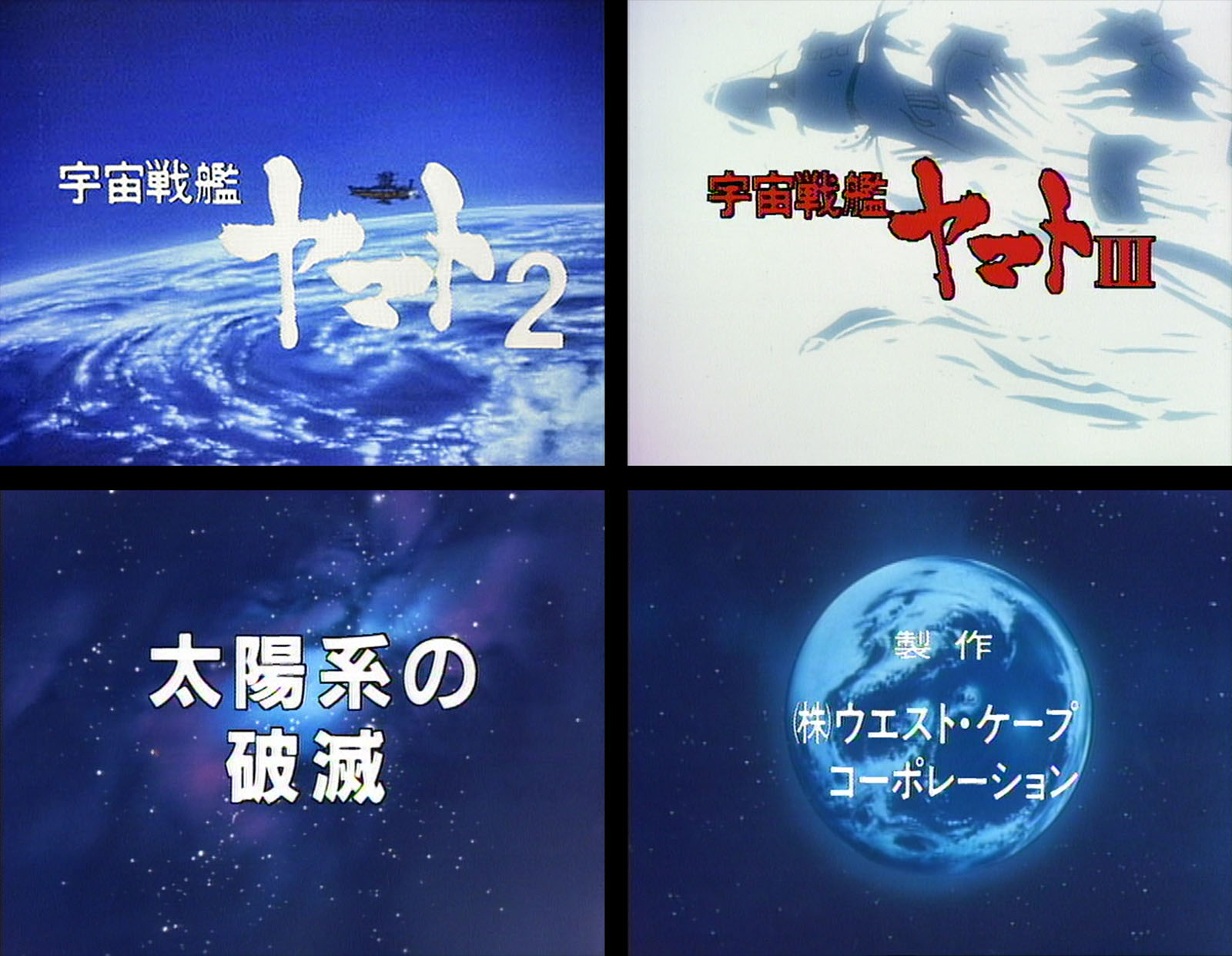
December 25 & 26: Compilation movies on TV
Fuji Television dipped into lesser-known material when they dusted off the 96-minute Yamato 2 compilation movie for broadcast on Christmas day. This set the stage for a world premiere when the 93-minute Yamato III compilation movie was seen for the first time anywhere on December 26. It had been completed all the way back in 1981, at which point the audio portion was split off for the Yamato III Drama Collection LP. The movie itself had been stuck in a vault ever since, but now those dark days were over.
MUSIC
May 4: The Yamato Grand Symphony concert
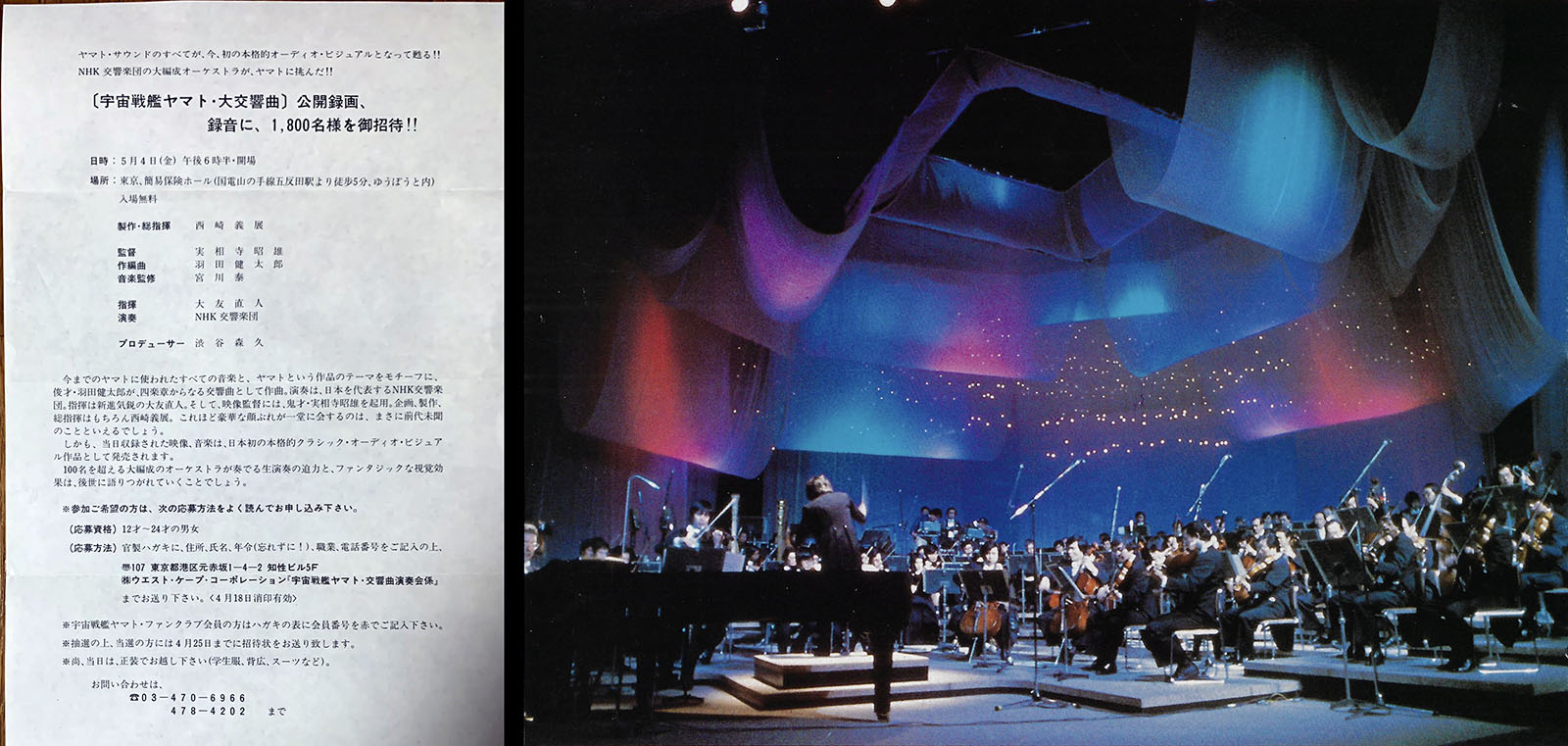
For some very lucky lottery winners, biggest Yamato music event of the year, and perhaps for the entire history of the saga, began with the letter shown above left, informing them that they were one of 1,800 audience members invited to the inaugural performance.
All of Yamato‘s sound is now revived in its first ever full-fledged audiovisual experience! The NHK Symphony Orchestra’s massive ensemble takes on the challenge of Yamato!
We are inviting 1800 people to the public audio recording of Space battleship Yamato Grand Symphony!
Drawing inspiration from all the music used in previous Yamato works and the themes of the Yamato franchise, the brilliant Kentaro Handa has composed a four-movement symphony. The performance will be by Japan’s leading NHK Symphony Orchestra, conducted by the up-and-coming Naoto Otomo. The video director is the genius Akio Jisoji. The planning, production, and overall direction are, of course, by Yoshinobu Nishizaki. It is truly unprecedented to see such a star-studded lineup come together in one place.
Furthermore, the video and music recorded on that day will be released as Japan’s first full-fledged classical audiovisual work. The sheer power of the live performance by a large Orchestra of over 100 musicians, combined with the fantastical visual effects, will undoubtedly be remembered and talked about for generations to come.
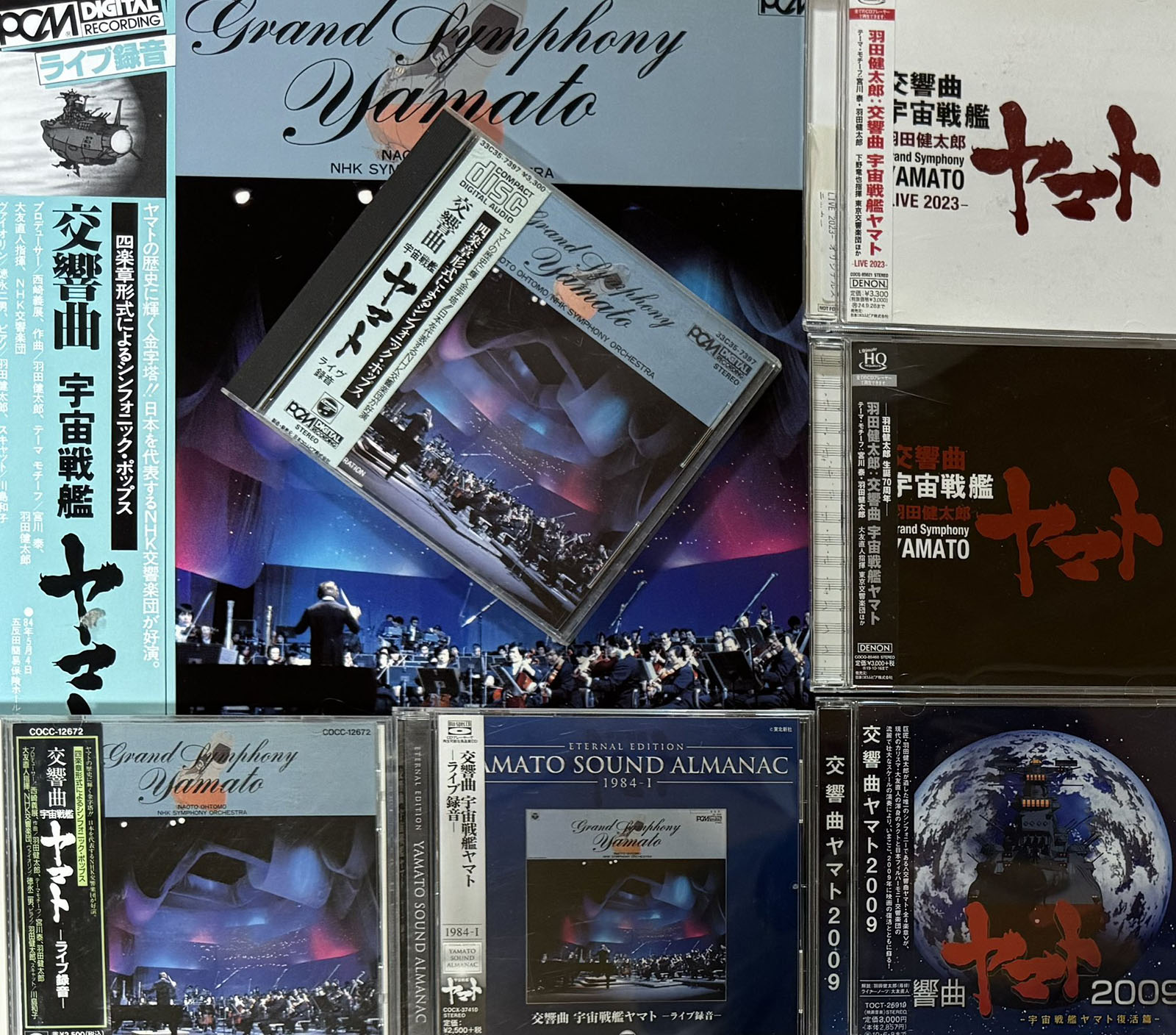
Photo posted on Twitter by MiyaT
Personal memoir by veteran fan Toshinori Watanabe:
A special free concert by the NHK Symphony Orchestra was held by invitation at Kanpo Hall in Tokyo. Participation required formal attire for everyone: students in their uniforms, and men in suits and ties. Children under 11 were not allowed in because they would be disruptive during the recording. I was so moved by Kazuko Kawashima’s scat singing, which I heard live at the time, that it shook my soul, and I was in tears.
The Grand Symphony did indeed live up to its promise; it was recorded both for album and video release and reached the realm of masterpiece status with many subsequent reissues. As these words were written (in 2026) it has been reissued on CD many times (along with sheet music) and become a frequent subject for live performances.
Read much more about it here
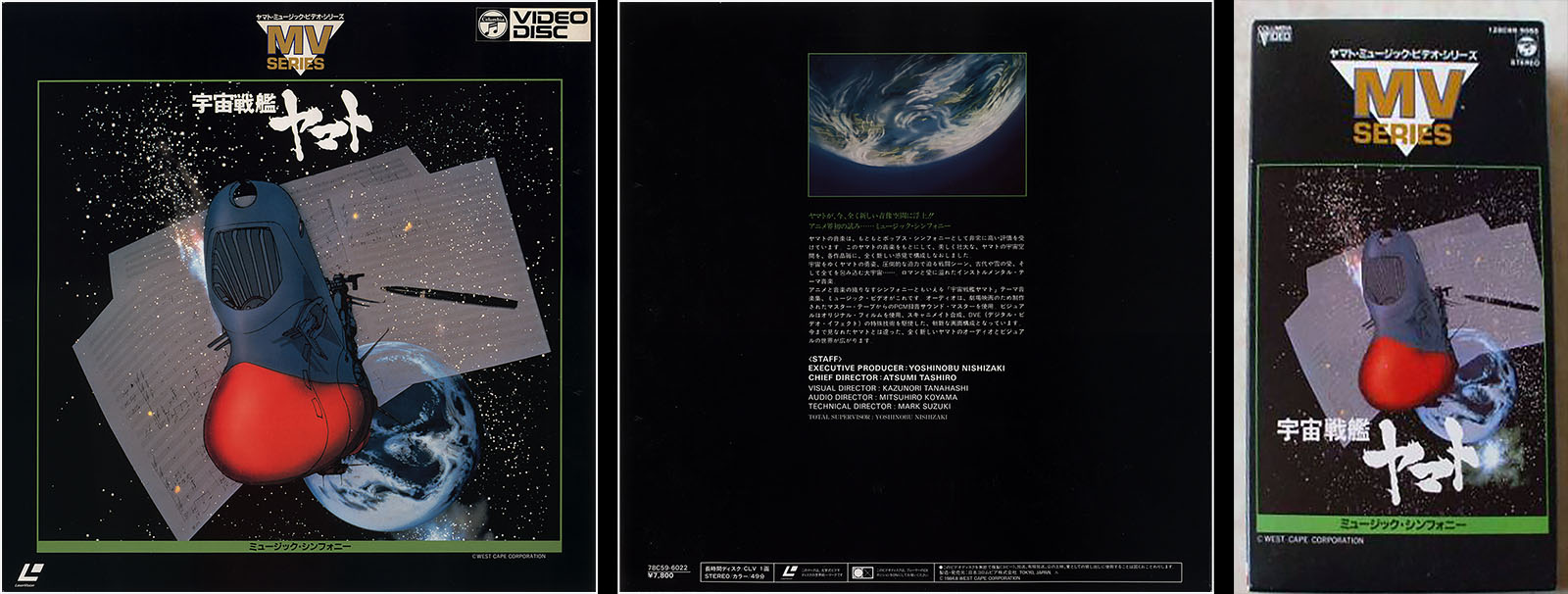
Space Battleship Yamato MV, laserdisc and VHS (July 1)
July 1: MV (Music video) series begins
The staying power of Yamato music provided yet another way to expand the video library. One by one, Nishizaki supervised the conversion of each Yamato movie into a Music Video, removing dialogue and sound effects from key scenes and creating extended montages that could be paired with an appropriate score. The result was a symphonic music video that could be played like an album.
They were initially released by Columbia on Laserdisc, VHS, and Beta, ultimately getting revivals on Blu-ray in 2013/14.
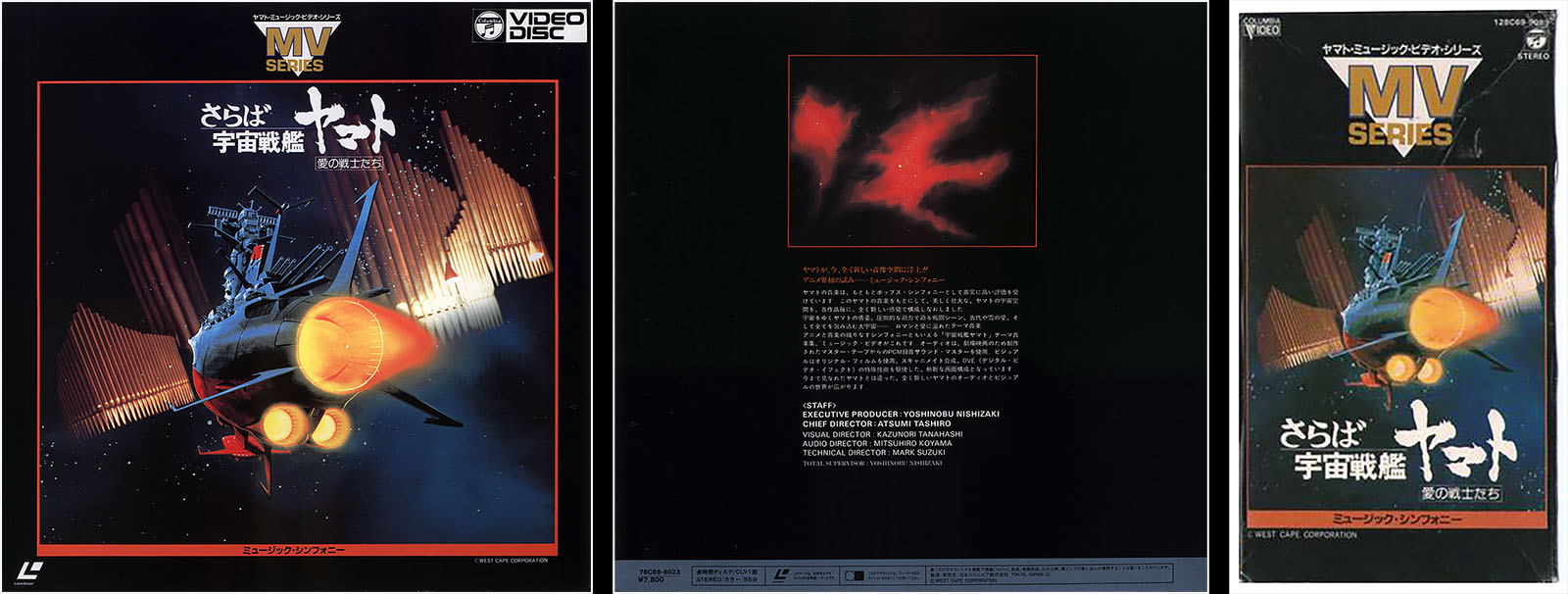
Farewell to Yamato MV, laserdisc and VHS (August 1)
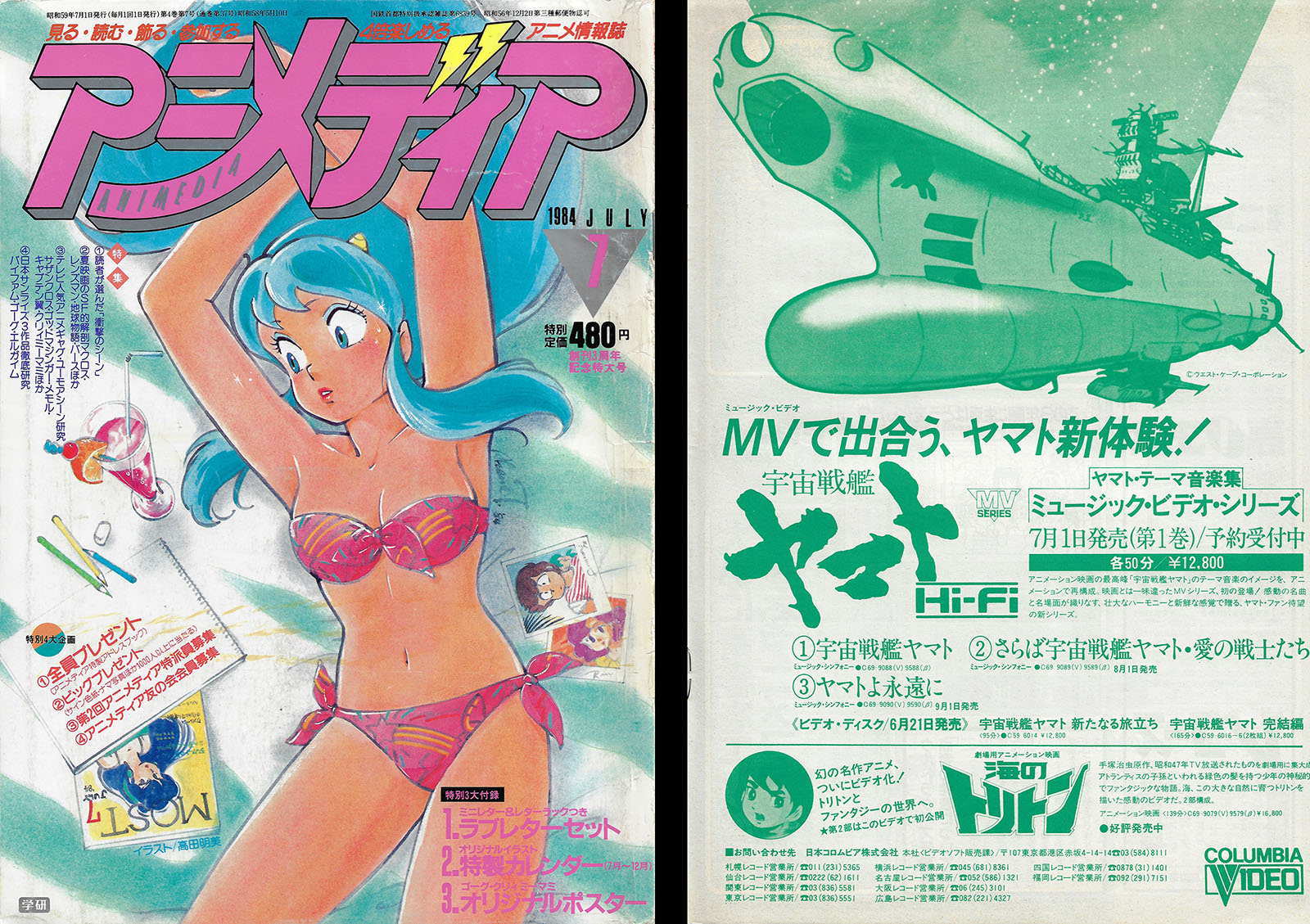
the July issue of Animedia ran the first ad for the MV series, which read:
Discover a new Yamato experience through the music video!
The theme music from the legendary animated film Space battleship Yamato has been reimagined in anime. A new music video series, distinct from the films, is here for the first time! A new series long awaited by Yamato fans, weaving together the moving masterpiece and memorable scenes with a grand harmony and a fresh feel.
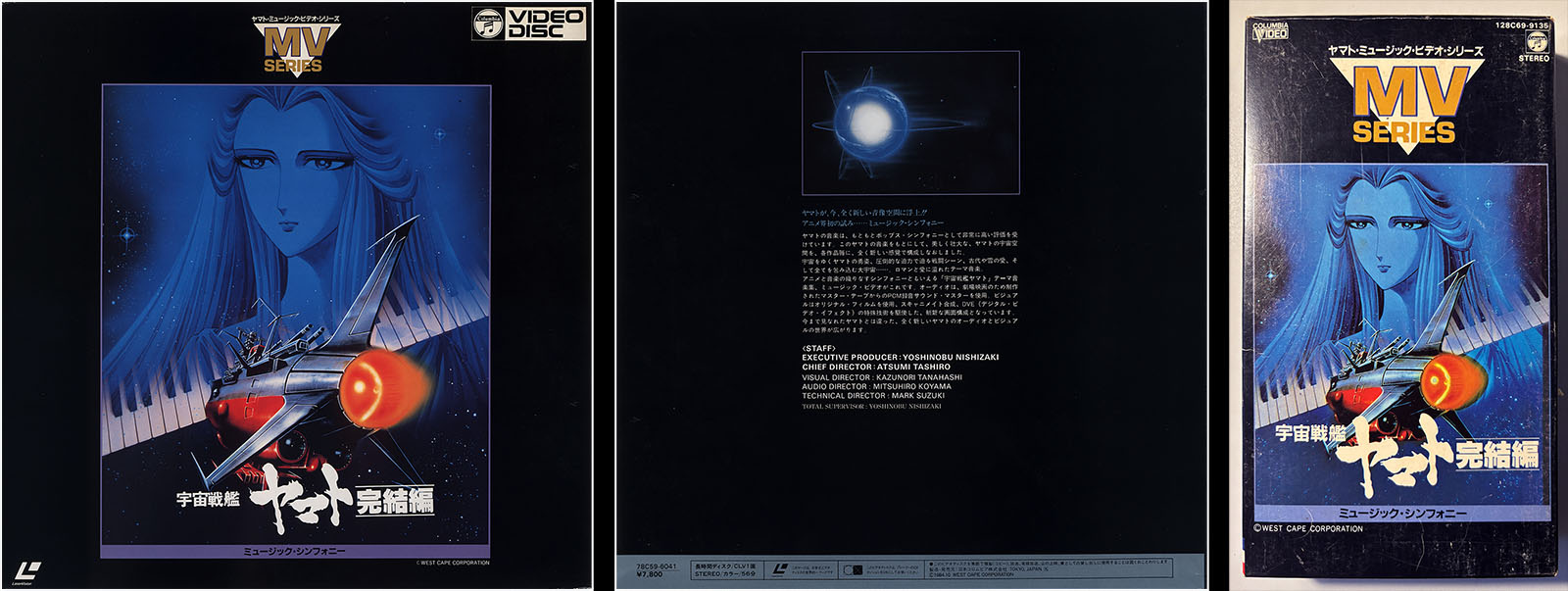
Final Yamato MV, laserdisc and VHS (September 21)
The MV scores were a mix of actual soundtrack music as heard in the anime and symphonic arrangements as heard on LP records. Sometimes entire animated sequences played end-to-end, other times they were edited and combined differently. The opportunity was also taken to enhance older footage with new effects, such as the misty “Scanimation” developed for Be Forever and used extensively in Final Yamato.
Read more about the MV series here
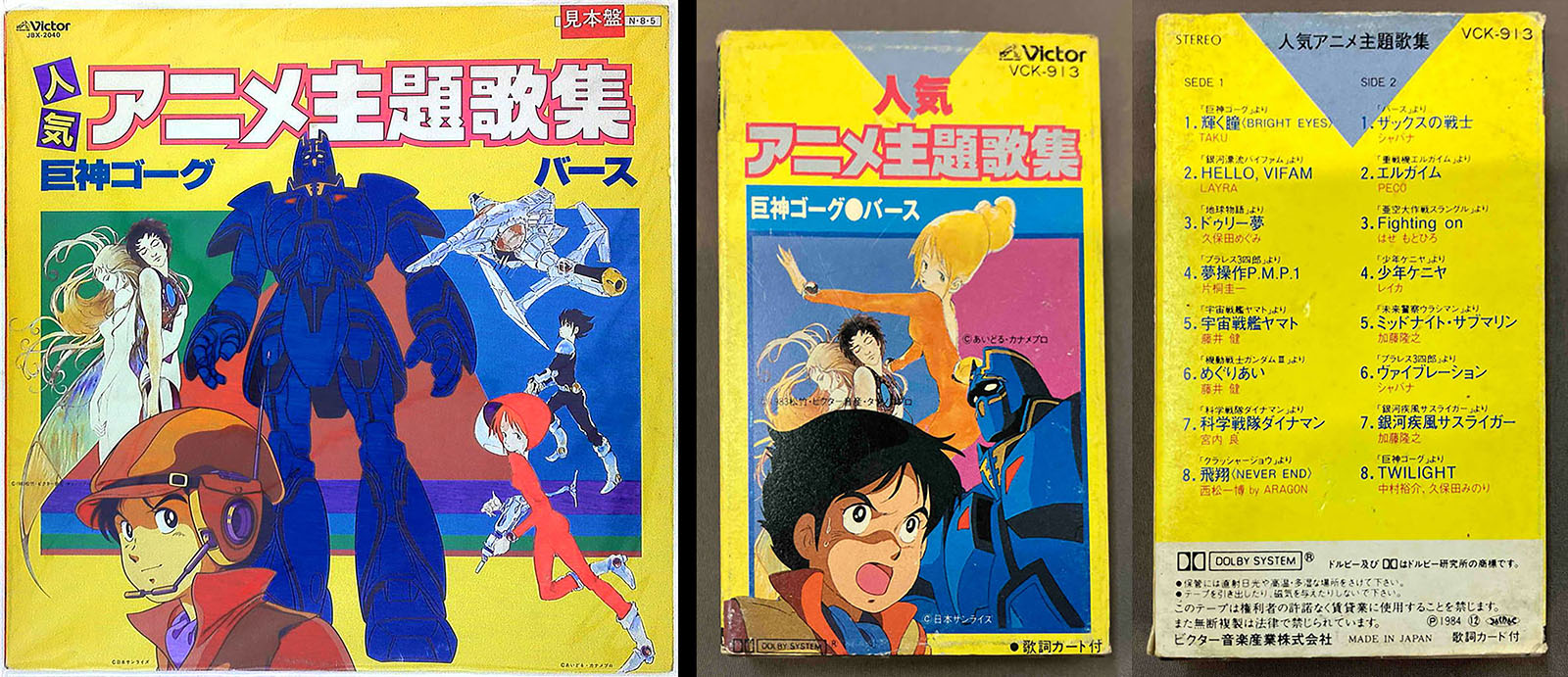
August 5: Popular Anime Theme Song Collection, Giant Gorg • Birth
The Yamato theme and subsequent songs graced many a compilation album during the production years, and the trend continued in 1984. This LP and cassette from Victor Music included it in a 16-song collection of theme songs (all cover versions) that included recent contemporaries: Giant Gorg, Vifam, Gundam, Crusher Joe, L-Gaim, Urashiman, and others.
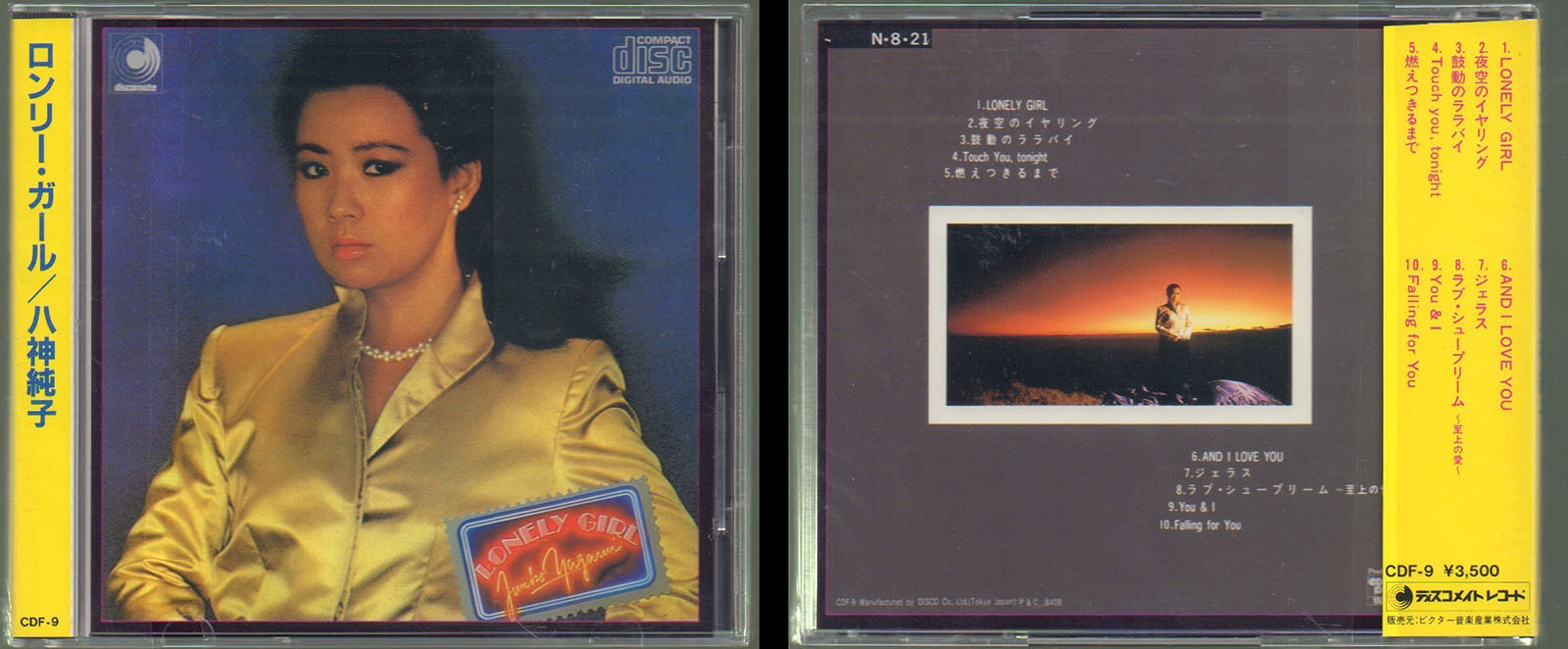
August 21: Lonely Girl CD
Discomate, CDF-9
What was the first Yamato music ever sold on CD? Surprisingly, it wasn’t a Yamato album at all. It was in fact Love Supreme, the closing song of Final Yamato, sung by superstar singer/songwriter Junko Yagami. It had first appeared on the LP version of her Lonely Girl album (before being released as a single in 1983), and she won the race again when it landed on her followup CD.
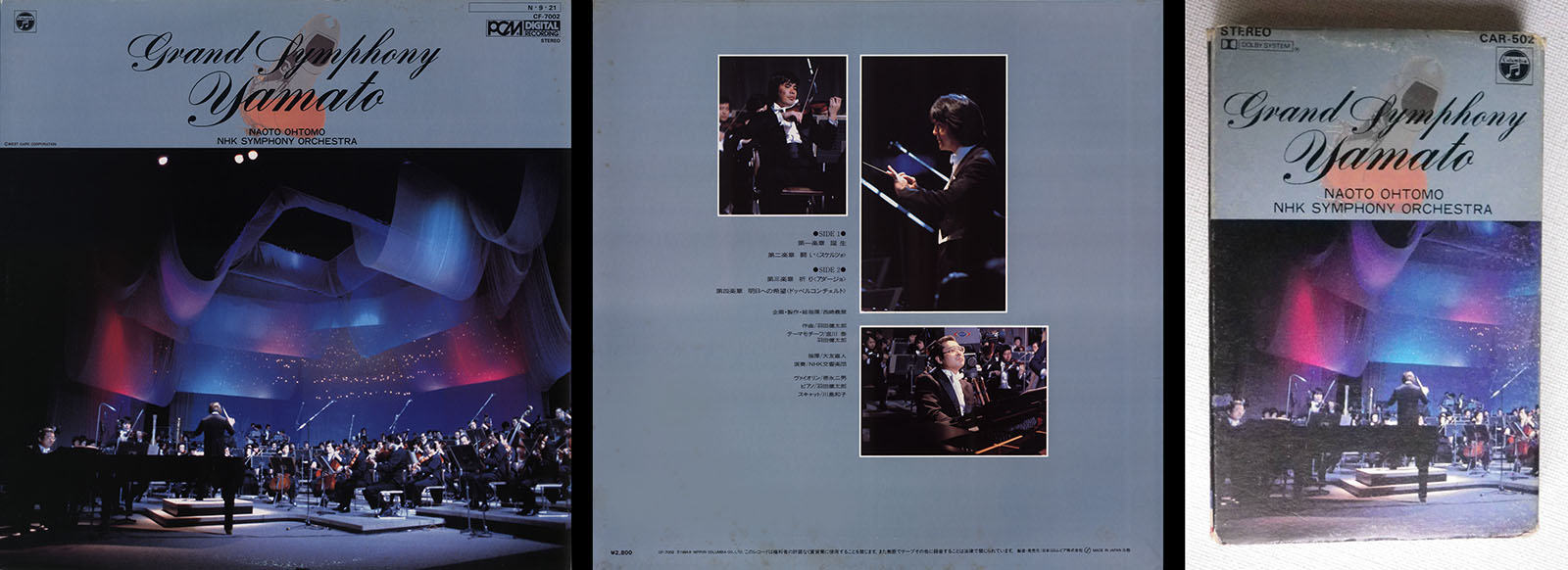
September 21: Grand Symphony Yamato
Nippon Columbia, LP: CF-7002 Cassette: CAR-502
Following the live performance in May, the album version became the first Yamato release of the legacy years, issued on LD and cassette. The CD and video versions would follow in 1985.
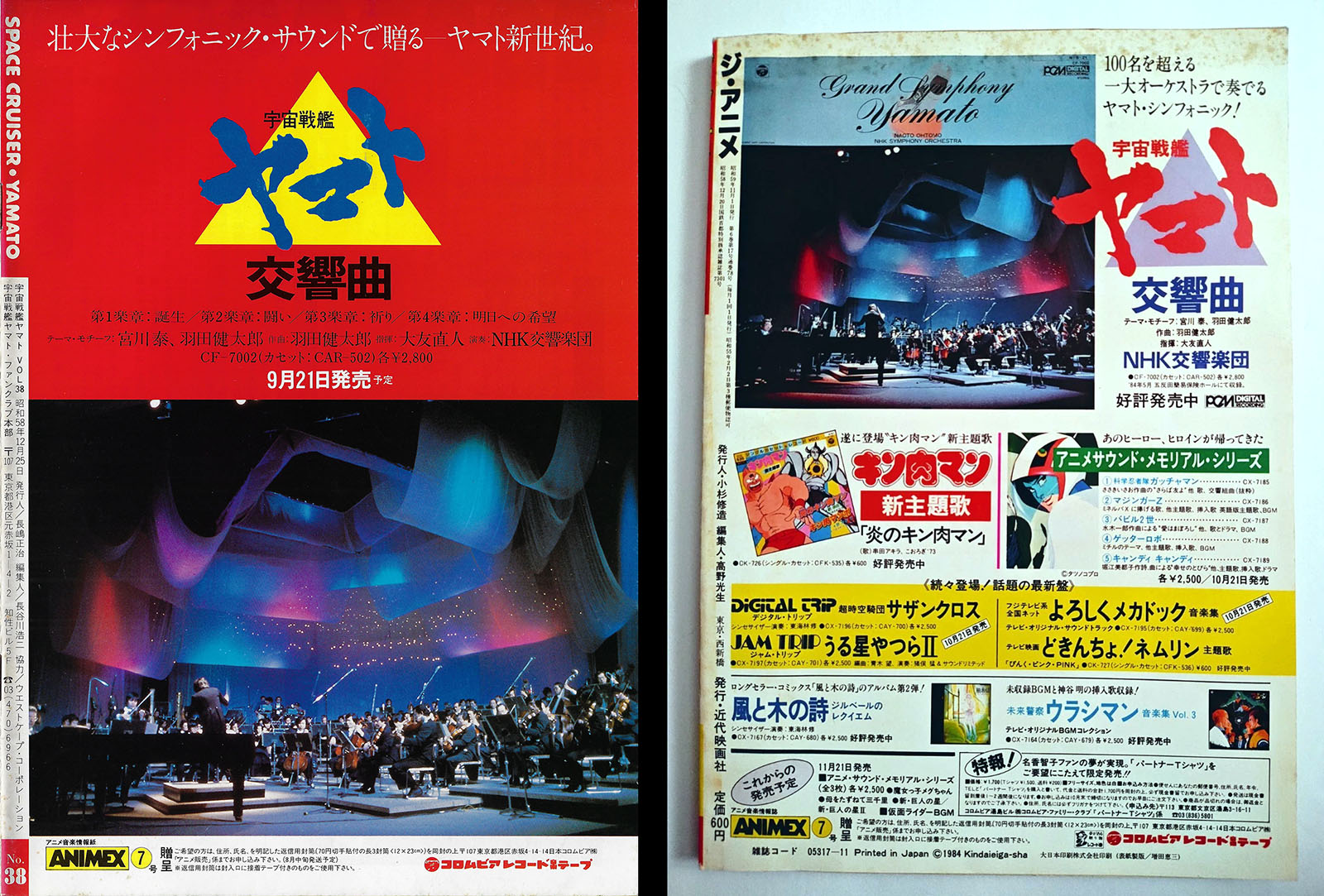
Ads appeared on the back covers of the fan club magazine and The Anime. The headlines read:
A new era of Yamato, presented with magnificent symphonic sound
Over 100 people ~ a large orchestra plays Symphonic Yamato!
Other music released in 1984
(Dates unknown)
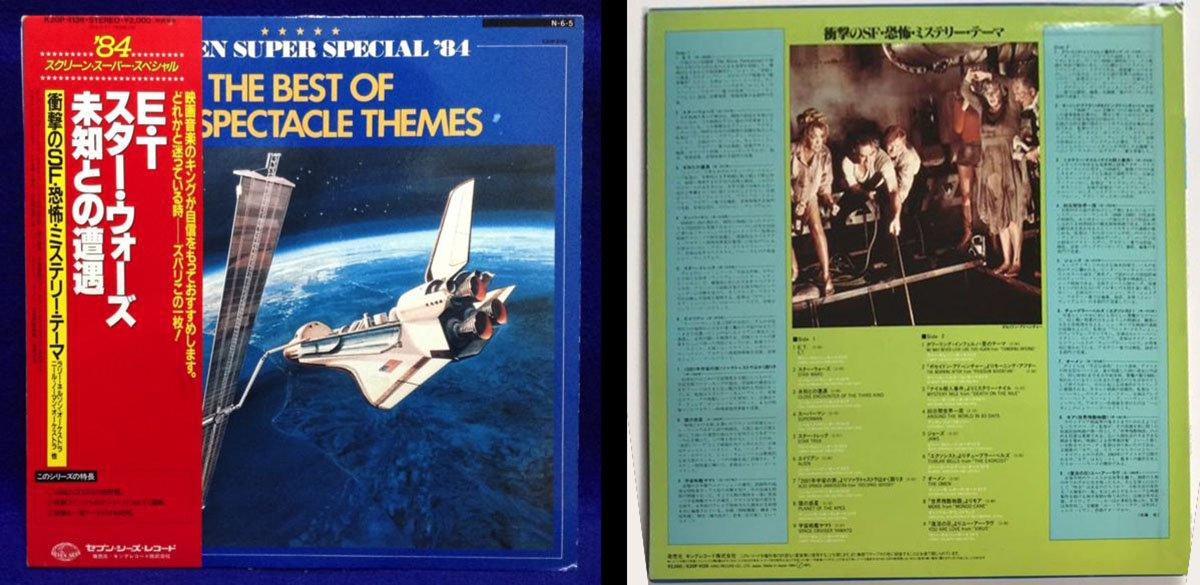
Screen Super Special ’84, The Best of Spectacle Themes
Seven Seas Records, K20P4136
A cover of the Yamato theme performed by the Larry Nelson Orchestra took its place among movie music from the west including many John Williams compositions, Star Trek, Alien, Planet of the Apes, and others.
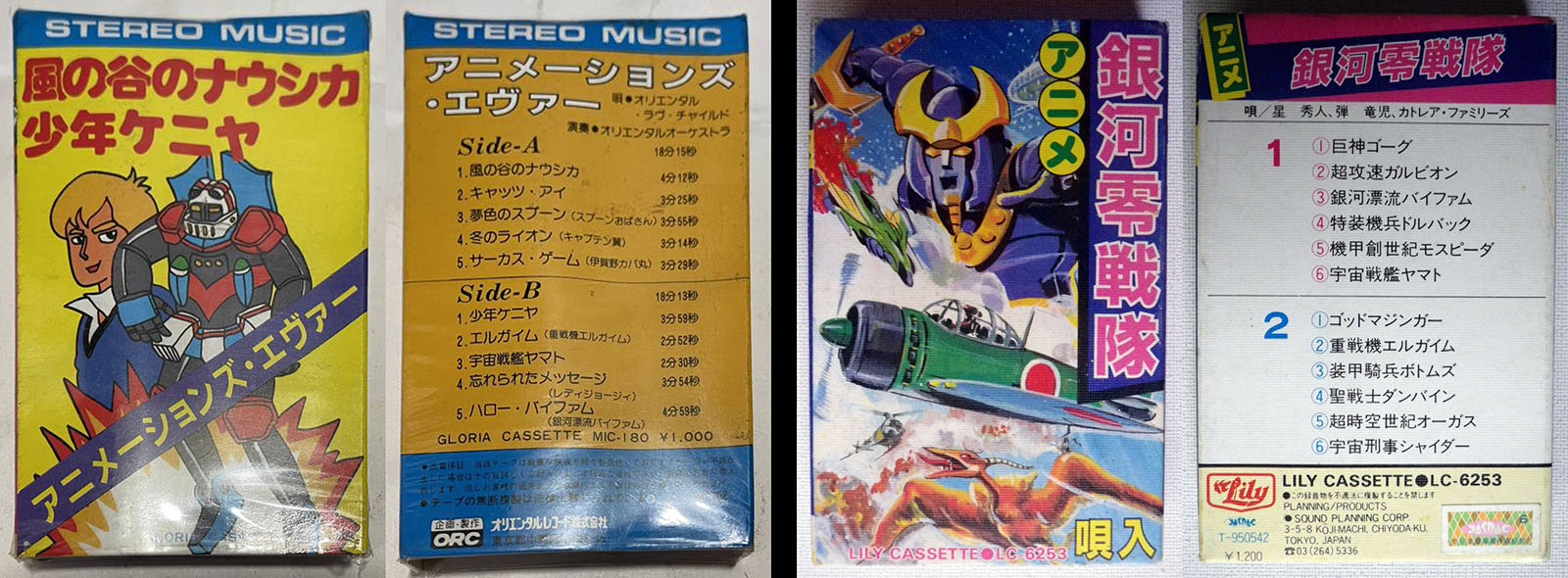
Animations Ever
Oriental Record Company
Galaxy Zero Fighter Squadron
Lily
These may have been the last of the infamous pachimono “knockoff” cassettes with budget cover versions of several anime themes. Animations Ever contained the Yamato theme, Nausicaa, Cat’s Eye, L-Gaim, Vifam, and five others. Galaxy Zero teamed up Yamato with Giant Gorg, Mospeada, Votoms, Dunbine, and seven others.
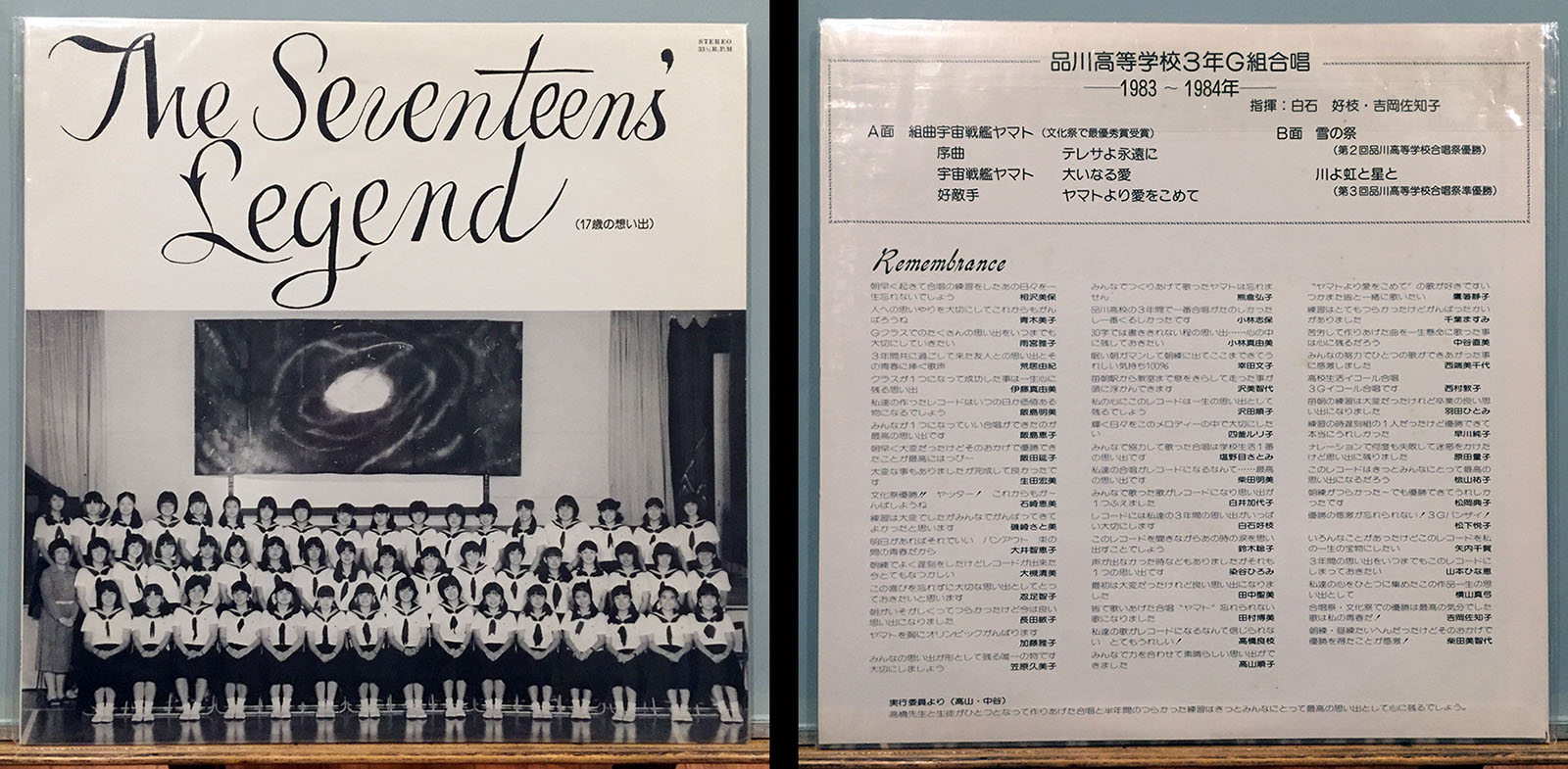
The Seventeen’s Legend
Choral album, Athene Record
Another format reaching the end of its days was the limited-edition pressing of live school recitals, and this was a good one to go out on. The English title is augmented by a Japanese one, 17-Year-Old’s Memory, named no doubt for its teenage performers. It is a choral suite recorded by Class G of Shinagawa Senior High School (1983-84 school year), conducted by Yoshie Shiraishi and Sachiko Yoshioka. The Space battleship Yamato suite that fills Side A of the record won the highest award given at a local school festival.
The suite consists of six tracks: Overture, main theme, The Rival, Teresa Forever, Great Love, and From Yamato With Love. They all came from the Farewell to Yamato oeuvre, and Great Love (the love theme from the film) is an especially unique recording since this version has lyrics, whereas every other commercial recording is instrumental only. It was performed with lyrics at least once before, in a 1980 TV special to promote Be Forever, so the arrangement may have been published as sheet music. Nevertheless, this is the only known source for a recorded version of it. Side B of the LP contains non-Yamato material.